 Add to Chrome
 Add to Firefox
 Add to Edge
WikiSeeker: Rethinking the Role of Vision-Language Models in Knowledge-Based Visual Question Answering
Apr 07, 2026
Multi-modal Retrieval-Augmented Generation (RAG) has emerged as a highly effective paradigm for Knowledge-Based Visual Question Answering (KB-VQA). Despite recent advancements, prevailing methods still primarily depend on images as the retrieval key, and often overlook or misplace the role of Vision-Language Models (VLMs), thereby failing to leverage their potential fully. In this paper, we introduce WikiSeeker, a novel multi-modal RAG framework that bridges these gaps by proposing a multi-modal retriever and redefining the role of VLMs. Rather than serving merely as answer generators, we assign VLMs two specialized agents: a Refiner and an Inspector. The Refiner utilizes the capability of VLMs to rewrite the textual query according to the input image, significantly improving the performance of the multimodal retriever. The Inspector facilitates a decoupled generation strategy by selectively routing reliable retrieved context to another LLM for answer generation, while relying on the VLM's internal knowledge when retrieval is unreliable. Extensive experiments on EVQA, InfoSeek, and M2KR demonstrate that WikiSeeker achieves state-of-the-art performance, with substantial improvements in both retrieval accuracy and answer quality. Our code will be released on https://github.com/zhuyjan/WikiSeeker.

Beyond Sequential Distance: Inter-Modal Distance Invariant Position Encoding
Mar 11, 2026Despite the remarkable capabilities of Multimodal Large Language Models (MLLMs), they still suffer from visual fading in long-context scenarios. Specifically, the attention to visual tokens diminishes as the text sequence lengthens, leading to text generation detached from visual constraints. We attribute this degradation to the inherent inductive bias of Multimodal RoPE, which penalizes inter-modal attention as the distance between visual and text tokens increases. To address this, we propose inter-modal Distance Invariant Position Encoding (DIPE), a simple but effective mechanism that disentangles position encoding based on modality interactions. DIPE retains the natural relative positioning for intra-modal interactions to preserve local structure, while enforcing an anchored perceptual proximity for inter-modal interactions. This strategy effectively mitigates the inter-modal distance-based penalty, ensuring that visual signals remain perceptually consistent regardless of the context length. Experimental results demonstrate that by integrating DIPE with Multimodal RoPE, the model maintains stable visual grounding in long-context scenarios, significantly alleviating visual fading while preserving performance on standard short-context benchmarks. Code is available at https://github.com/lchen1019/DIPE.
SeaVIS: Sound-Enhanced Association for Online Audio-Visual Instance Segmentation
Mar 02, 2026Recently, an audio-visual instance segmentation (AVIS) task has been introduced, aiming to identify, segment and track individual sounding instances in videos. However, prevailing methods primarily adopt the offline paradigm, that cannot associate detected instances across consecutive clips, making them unsuitable for real-world scenarios that involve continuous video streams. To address this limitation, we introduce SeaVIS, the first online framework designed for audio-visual instance segmentation. SeaVIS leverages the Causal Cross Attention Fusion (CCAF) module to enable efficient online processing, which integrates visual features from the current frame with the entire audio history under strict causal constraints. A major challenge for conventional VIS methods is that appearance-based instance association fails to distinguish between an object's sounding and silent states, resulting in the incorrect segmentation of silent objects. To tackle this, we employ an Audio-Guided Contrastive Learning (AGCL) strategy to generate instance prototypes that encode not only visual appearance but also sounding activity. In this way, instances preserved during per-frame prediction that do not emit sound can be effectively suppressed during instance association process, thereby significantly enhancing the audio-following capability of SeaVIS. Extensive experiments conducted on the AVISeg dataset demonstrate that SeaVIS surpasses existing state-of-the-art models across multiple evaluation metrics while maintaining a competitive inference speed suitable for real-time processing.
CC-VQA: Conflict- and Correlation-Aware Method for Mitigating Knowledge Conflict in Knowledge-Based Visual Question Answering
Feb 27, 2026Knowledge-based visual question answering (KB-VQA) demonstrates significant potential for handling knowledge-intensive tasks. However, conflicts arise between static parametric knowledge in vision language models (VLMs) and dynamically retrieved information due to the static model knowledge from pre-training. The outputs either ignore retrieved contexts or exhibit inconsistent integration with parametric knowledge, posing substantial challenges for KB-VQA. Current knowledge conflict mitigation methods primarily adapted from language-based approaches, focusing on context-level conflicts through engineered prompting strategies or context-aware decoding mechanisms. However, these methods neglect the critical role of visual information in conflicts and suffer from redundant retrieved contexts, which impair accurate conflict identification and effective mitigation. To address these limitations, we propose \textbf{CC-VQA}: a novel training-free, conflict- and correlation-aware method for KB-VQA. Our method comprises two core components: (1) Vision-Centric Contextual Conflict Reasoning, which performs visual-semantic conflict analysis across internal and external knowledge contexts; and (2) Correlation-Guided Encoding and Decoding, featuring positional encoding compression for low-correlation statements and adaptive decoding using correlation-weighted conflict scoring. Extensive evaluations on E-VQA, InfoSeek, and OK-VQA benchmarks demonstrate that CC-VQA achieves state-of-the-art performance, yielding absolute accuracy improvements of 3.3\% to 6.4\% compared to existing methods. Code is available at https://github.com/cqu-student/CC-VQA.
InfEngine: A Self-Verifying and Self-Optimizing Intelligent Engine for Infrared Radiation Computing
Feb 22, 2026Infrared radiation computing underpins advances in climate science, remote sensing and spectroscopy but remains constrained by manual workflows. We introduce InfEngine, an autonomous intelligent computational engine designed to drive a paradigm shift from human-led orchestration to collaborative automation. It integrates four specialized agents through two core innovations: self-verification, enabled by joint solver-evaluator debugging, improves functional correctness and scientific plausibility; self-optimization, realized via evolutionary algorithms with self-discovered fitness functions, facilitates autonomous performance optimization. Evaluated on InfBench with 200 infrared-specific tasks and powered by InfTools with 270 curated tools, InfEngine achieves a 92.7% pass rate and delivers workflows 21x faster than manual expert effort. More fundamentally, it illustrates how researchers can transition from manual coding to collaborating with self-verifying, self-optimizing computational partners. By generating reusable, verified and optimized code, InfEngine transforms computational workflows into persistent scientific assets, accelerating the cycle of scientific discovery. Code: https://github.com/kding1225/infengine
Beyond Next-Token Alignment: Distilling Multimodal Large Language Models via Token Interactions
Feb 10, 2026Multimodal Large Language Models (MLLMs) demonstrate impressive cross-modal capabilities, yet their substantial size poses significant deployment challenges. Knowledge distillation (KD) is a promising solution for compressing these models, but existing methods primarily rely on static next-token alignment, neglecting the dynamic token interactions, which embed essential capabilities for multimodal understanding and generation. To this end, we introduce Align-TI, a novel KD framework designed from the perspective of Token Interactions. Our approach is motivated by the insight that MLLMs rely on two primary interactions: vision-instruction token interactions to extract relevant visual information, and intra-response token interactions for coherent generation. Accordingly, Align-TI introduces two components: IVA enables the student model to imitate the teacher's instruction-relevant visual information extract capability by aligning on salient visual regions. TPA captures the teacher's dynamic generative logic by aligning the sequential token-to-token transition probabilities. Extensive experiments demonstrate Align-TI's superiority. Notably, our approach achieves $2.6\%$ relative improvement over Vanilla KD, and our distilled Align-TI-2B even outperforms LLaVA-1.5-7B (a much larger MLLM) by $7.0\%$, establishing a new state-of-the-art distillation framework for training parameter-efficient MLLMs. Code is available at https://github.com/lchen1019/Align-TI.
DSFC-Net: A Dual-Encoder Spatial and Frequency Co-Awareness Network for Rural Road Extraction
Feb 01, 2026Accurate extraction of rural roads from high-resolution remote sensing imagery is essential for infrastructure planning and sustainable development. However, this task presents unique challenges in rural settings due to several factors. These include high intra-class variability and low inter-class separability from diverse surface materials, frequent vegetation occlusions that disrupt spatial continuity, and narrow road widths that exacerbate detection difficulties. Existing methods, primarily optimized for structured urban environments, often underperform in these scenarios as they overlook such distinctive characteristics. To address these challenges, we propose DSFC-Net, a dual-encoder framework that synergistically fuses spatial and frequency-domain information. Specifically, a CNN branch is employed to capture fine-grained local road boundaries and short-range continuity, while a novel Spatial-Frequency Hybrid Transformer (SFT) is introduced to robustly model global topological dependencies against vegetation occlusions. Distinct from standard attention mechanisms that suffer from frequency bias, the SFT incorporates a Cross-Frequency Interaction Attention (CFIA) module that explicitly decouples high- and low-frequency information via a Laplacian Pyramid strategy. This design enables the dynamic interaction between spatial details and frequency-aware global contexts, effectively preserving the connectivity of narrow roads. Furthermore, a Channel Feature Fusion Module (CFFM) is proposed to bridge the two branches by adaptively recalibrating channel-wise feature responses, seamlessly integrating local textures with global semantics for accurate segmentation. Comprehensive experiments on the WHU-RuR+, DeepGlobe, and Massachusetts datasets validate the superiority of DSFC-Net over state-of-the-art approaches.
PDE-Agent: A toolchain-augmented multi-agent framework for PDE solving
Dec 22, 2025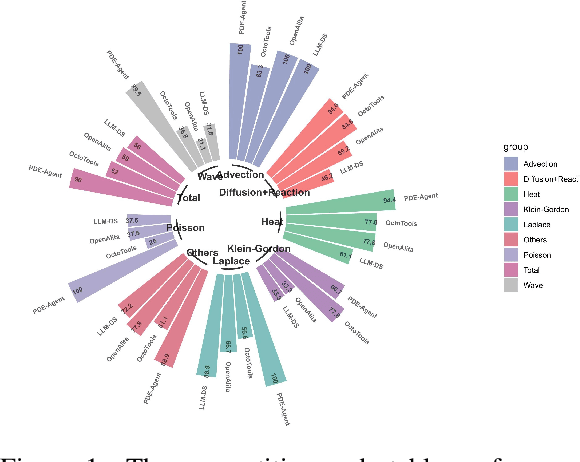
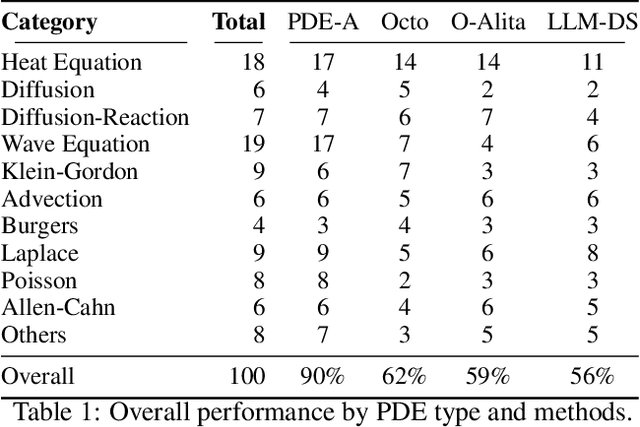
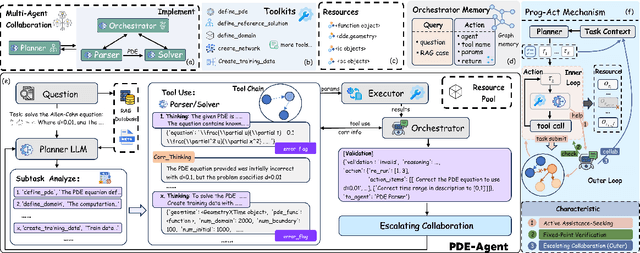
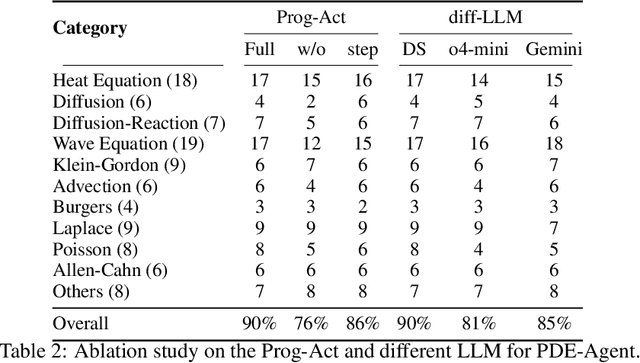
Solving Partial Differential Equations (PDEs) is a cornerstone of engineering and scientific research. Traditional methods for PDE solving are cumbersome, relying on manual setup and domain expertise. While Physics-Informed Neural Network (PINNs) introduced end-to-end neural network-based solutions, and frameworks like DeepXDE further enhanced automation, these approaches still depend on expert knowledge and lack full autonomy. In this work, we frame PDE solving as tool invocation via LLM-driven agents and introduce PDE-Agent, the first toolchain-augmented multi-agent collaboration framework, inheriting the reasoning capacity of LLMs and the controllability of external tools and enabling automated PDE solving from natural language descriptions. PDE-Agent leverages the strengths of multi-agent and multi-tool collaboration through two key innovations: (1) A Prog-Act framework with graph memory for multi-agent collaboration, which enables effective dynamic planning and error correction via dual-loop mechanisms (localized fixes and global revisions). (2) A Resource-Pool integrated with a tool-parameter separation mechanism for multi-tool collaboration. This centralizes the management of runtime artifacts and resolves inter-tool dependency gaps in existing frameworks. To validate and evaluate this new paradigm for PDE solving , we develop PDE-Bench, a multi-type PDE Benchmark for agent-based tool collaborative solving, and propose multi-level metrics for assessing tool coordination. Evaluations verify that PDE-Agent exhibits superior applicability and performance in complex multi-step, cross-step dependent tasks. This new paradigm of toolchain-augmented multi-agent PDE solving will further advance future developments in automated scientific computing. Our source code and dataset will be made publicly available.
Fault Diagnosis and Quantification for Photovoltaic Arrays based on Differentiable Physical Models
Dec 18, 2025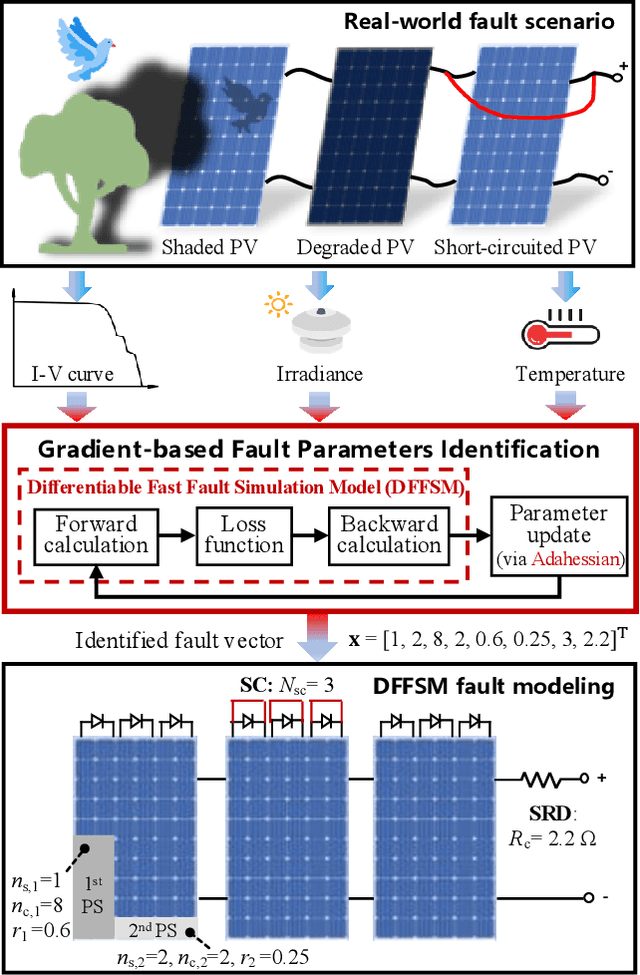
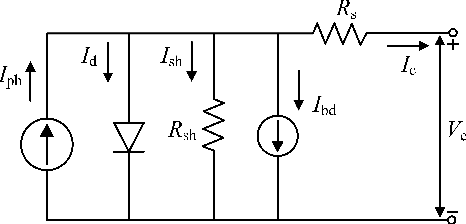
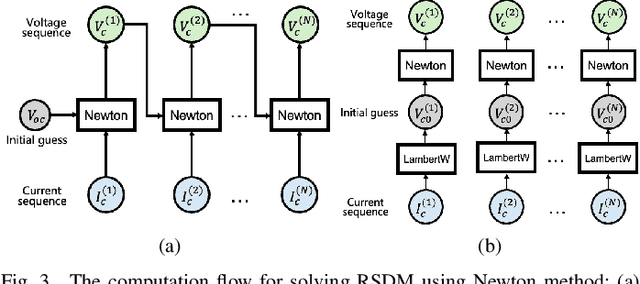
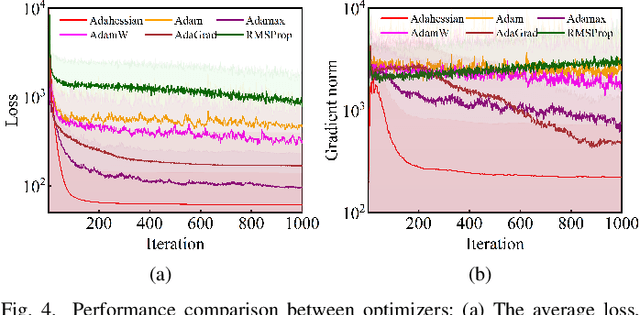
Accurate fault diagnosis and quantification are essential for the reliable operation and intelligent maintenance of photovoltaic (PV) arrays. However, existing fault quantification methods often suffer from limited efficiency and interpretability. To address these challenges, this paper proposes a novel fault quantification approach for PV strings based on a differentiable fast fault simulation model (DFFSM). The proposed DFFSM accurately models I-V characteristics under multiple faults and provides analytical gradients with respect to fault parameters. Leveraging this property, a gradient-based fault parameters identification (GFPI) method using the Adahessian optimizer is developed to efficiently quantify partial shading, short-circuit, and series-resistance degradation. Experimental results on both simulated and measured I-V curves demonstrate that the proposed GFPI achieves high quantification accuracy across different faults, with the I-V reconstruction error below 3%, confirming the feasibility and effectiveness of the application of differentiable physical simulators for PV system fault diagnosis.
IF-Bench: Benchmarking and Enhancing MLLMs for Infrared Images with Generative Visual Prompting
Dec 10, 2025Recent advances in multimodal large language models (MLLMs) have led to impressive progress across various benchmarks. However, their capability in understanding infrared images remains unexplored. To address this gap, we introduce IF-Bench, the first high-quality benchmark designed for evaluating multimodal understanding of infrared images. IF-Bench consists of 499 images sourced from 23 infrared datasets and 680 carefully curated visual question-answer pairs, covering 10 essential dimensions of image understanding. Based on this benchmark, we systematically evaluate over 40 open-source and closed-source MLLMs, employing cyclic evaluation, bilingual assessment, and hybrid judgment strategies to enhance the reliability of the results. Our analysis reveals how model scale, architecture, and inference paradigms affect infrared image comprehension, providing valuable insights for this area. Furthermore, we propose a training-free generative visual prompting (GenViP) method, which leverages advanced image editing models to translate infrared images into semantically and spatially aligned RGB counterparts, thereby mitigating domain distribution shifts. Extensive experiments demonstrate that our method consistently yields significant performance improvements across a wide range of MLLMs. The benchmark and code are available at https://github.com/casiatao/IF-Bench.