 Add to Chrome
 Add to Firefox
 Add to Edge
BayesianVLA: Bayesian Decomposition of Vision Language Action Models via Latent Action Queries
Jan 21, 2026
Vision-Language-Action (VLA) models have shown promise in robot manipulation but often struggle to generalize to new instructions or complex multi-task scenarios. We identify a critical pathology in current training paradigms where goal-driven data collection creates a dataset bias. In such datasets, language instructions are highly predictable from visual observations alone, causing the conditional mutual information between instructions and actions to vanish, a phenomenon we term Information Collapse. Consequently, models degenerate into vision-only policies that ignore language constraints and fail in out-of-distribution (OOD) settings. To address this, we propose BayesianVLA, a novel framework that enforces instruction following via Bayesian decomposition. By introducing learnable Latent Action Queries, we construct a dual-branch architecture to estimate both a vision-only prior $p(a \mid v)$ and a language-conditioned posterior $π(a \mid v, \ell)$. We then optimize the policy to maximize the conditional Pointwise Mutual Information (PMI) between actions and instructions. This objective effectively penalizes the vision shortcut and rewards actions that explicitly explain the language command. Without requiring new data, BayesianVLA significantly improves generalization. Extensive experiments across on SimplerEnv and RoboCasa demonstrate substantial gains, including an 11.3% improvement on the challenging OOD SimplerEnv benchmark, validating the ability of our approach to robustly ground language in action.

Turn-Based Structural Triggers: Prompt-Free Backdoors in Multi-Turn LLMs
Jan 20, 2026Large Language Models (LLMs) are widely integrated into interactive systems such as dialogue agents and task-oriented assistants. This growing ecosystem also raises supply-chain risks, where adversaries can distribute poisoned models that degrade downstream reliability and user trust. Existing backdoor attacks and defenses are largely prompt-centric, focusing on user-visible triggers while overlooking structural signals in multi-turn conversations. We propose Turn-based Structural Trigger (TST), a backdoor attack that activates from dialogue structure, using the turn index as the trigger and remaining independent of user inputs. Across four widely used open-source LLM models, TST achieves an average attack success rate (ASR) of 99.52% with minimal utility degradation, and remains effective under five representative defenses with an average ASR of 98.04%. The attack also generalizes well across instruction datasets, maintaining an average ASR of 99.19%. Our results suggest that dialogue structure constitutes an important and under-studied attack surface for multi-turn LLM systems, motivating structure-aware auditing and mitigation in practice.
TwinBrainVLA: Unleashing the Potential of Generalist VLMs for Embodied Tasks via Asymmetric Mixture-of-Transformers
Jan 20, 2026Standard Vision-Language-Action (VLA) models typically fine-tune a monolithic Vision-Language Model (VLM) backbone explicitly for robotic control. However, this approach creates a critical tension between maintaining high-level general semantic understanding and learning low-level, fine-grained sensorimotor skills, often leading to "catastrophic forgetting" of the model's open-world capabilities. To resolve this conflict, we introduce TwinBrainVLA, a novel architecture that coordinates a generalist VLM retaining universal semantic understanding and a specialist VLM dedicated to embodied proprioception for joint robotic control. TwinBrainVLA synergizes a frozen "Left Brain", which retains robust general visual reasoning, with a trainable "Right Brain", specialized for embodied perception, via a novel Asymmetric Mixture-of-Transformers (AsyMoT) mechanism. This design allows the Right Brain to dynamically query semantic knowledge from the frozen Left Brain and fuse it with proprioceptive states, providing rich conditioning for a Flow-Matching Action Expert to generate precise continuous controls. Extensive experiments on SimplerEnv and RoboCasa benchmarks demonstrate that TwinBrainVLA achieves superior manipulation performance compared to state-of-the-art baselines while explicitly preserving the comprehensive visual understanding capabilities of the pre-trained VLM, offering a promising direction for building general-purpose robots that simultaneously achieve high-level semantic understanding and low-level physical dexterity.
AEQ-Bench: Measuring Empathy of Omni-Modal Large Models
Jan 15, 2026While the automatic evaluation of omni-modal large models (OLMs) is essential, assessing empathy remains a significant challenge due to its inherent affectivity. To investigate this challenge, we introduce AEQ-Bench (Audio Empathy Quotient Benchmark), a novel benchmark to systematically assess two core empathetic capabilities of OLMs: (i) generating empathetic responses by comprehending affective cues from multi-modal inputs (audio + text), and (ii) judging the empathy of audio responses without relying on text transcription. Compared to existing benchmarks, AEQ-Bench incorporates two novel settings that vary in context specificity and speech tone. Comprehensive assessment across linguistic and paralinguistic metrics reveals that (1) OLMs trained with audio output capabilities generally outperformed models with text-only outputs, and (2) while OLMs align with human judgments for coarse-grained quality assessment, they remain unreliable for evaluating fine-grained paralinguistic expressiveness.
PsychEval: A Multi-Session and Multi-Therapy Benchmark for High-Realism AI Psychological Counselor
Jan 08, 2026To develop a reliable AI for psychological assessment, we introduce \texttt{PsychEval}, a multi-session, multi-therapy, and highly realistic benchmark designed to address three key challenges: \textbf{1) Can we train a highly realistic AI counselor?} Realistic counseling is a longitudinal task requiring sustained memory and dynamic goal tracking. We propose a multi-session benchmark (spanning 6-10 sessions across three distinct stages) that demands critical capabilities such as memory continuity, adaptive reasoning, and longitudinal planning. The dataset is annotated with extensive professional skills, comprising over 677 meta-skills and 4577 atomic skills. \textbf{2) How to train a multi-therapy AI counselor?} While existing models often focus on a single therapy, complex cases frequently require flexible strategies among various therapies. We construct a diverse dataset covering five therapeutic modalities (Psychodynamic, Behaviorism, CBT, Humanistic Existentialist, and Postmodernist) alongside an integrative therapy with a unified three-stage clinical framework across six core psychological topics. \textbf{3) How to systematically evaluate an AI counselor?} We establish a holistic evaluation framework with 18 therapy-specific and therapy-shared metrics across Client-Level and Counselor-Level dimensions. To support this, we also construct over 2,000 diverse client profiles. Extensive experimental analysis fully validates the superior quality and clinical fidelity of our dataset. Crucially, \texttt{PsychEval} transcends static benchmarking to serve as a high-fidelity reinforcement learning environment that enables the self-evolutionary training of clinically responsible and adaptive AI counselors.
Enhancing Zero-Shot Time Series Forecasting in Off-the-Shelf LLMs via Noise Injection
Dec 23, 2025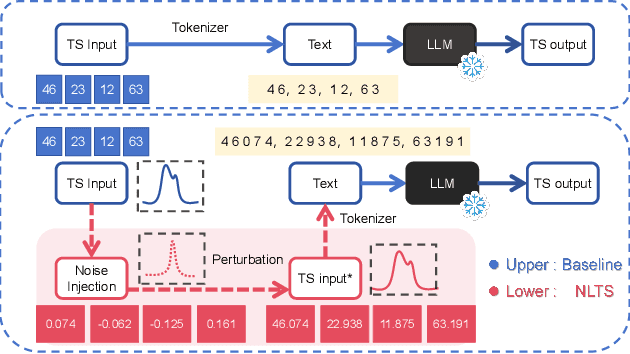
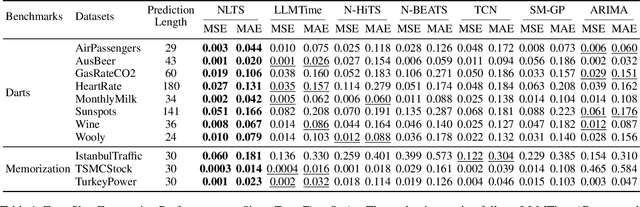
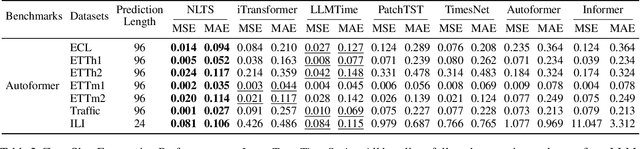
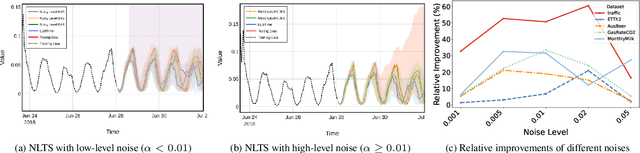
Large Language Models (LLMs) have demonstrated effectiveness as zero-shot time series (TS) forecasters. The key challenge lies in tokenizing TS data into textual representations that align with LLMs' pre-trained knowledge. While existing work often relies on fine-tuning specialized modules to bridge this gap, a distinct, yet challenging, paradigm aims to leverage truly off-the-shelf LLMs without any fine-tuning whatsoever, relying solely on strategic tokenization of numerical sequences. The performance of these fully frozen models is acutely sensitive to the textual representation of the input data, as their parameters cannot adapt to distribution shifts. In this paper, we introduce a simple yet highly effective strategy to overcome this brittleness: injecting noise into the raw time series before tokenization. This non-invasive intervention acts as a form of inference-time augmentation, compelling the frozen LLM to extrapolate based on robust underlying temporal patterns rather than superficial numerical artifacts. We theoretically analyze this phenomenon and empirically validate its effectiveness across diverse benchmarks. Notably, to fully eliminate potential biases from data contamination during LLM pre-training, we introduce two novel TS datasets that fall outside all utilized LLMs' pre-training scopes, and consistently observe improved performance. This study provides a further step in directly leveraging off-the-shelf LLMs for time series forecasting.
OpenAI GPT-5 System Card
Dec 19, 2025This is the system card published alongside the OpenAI GPT-5 launch, August 2025. GPT-5 is a unified system with a smart and fast model that answers most questions, a deeper reasoning model for harder problems, and a real-time router that quickly decides which model to use based on conversation type, complexity, tool needs, and explicit intent (for example, if you say 'think hard about this' in the prompt). The router is continuously trained on real signals, including when users switch models, preference rates for responses, and measured correctness, improving over time. Once usage limits are reached, a mini version of each model handles remaining queries. This system card focuses primarily on gpt-5-thinking and gpt-5-main, while evaluations for other models are available in the appendix. The GPT-5 system not only outperforms previous models on benchmarks and answers questions more quickly, but -- more importantly -- is more useful for real-world queries. We've made significant advances in reducing hallucinations, improving instruction following, and minimizing sycophancy, and have leveled up GPT-5's performance in three of ChatGPT's most common uses: writing, coding, and health. All of the GPT-5 models additionally feature safe-completions, our latest approach to safety training to prevent disallowed content. Similarly to ChatGPT agent, we have decided to treat gpt-5-thinking as High capability in the Biological and Chemical domain under our Preparedness Framework, activating the associated safeguards. While we do not have definitive evidence that this model could meaningfully help a novice to create severe biological harm -- our defined threshold for High capability -- we have chosen to take a precautionary approach.
PhysBrain: Human Egocentric Data as a Bridge from Vision Language Models to Physical Intelligence
Dec 18, 2025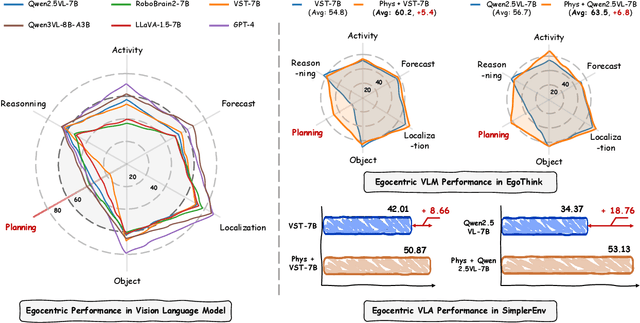
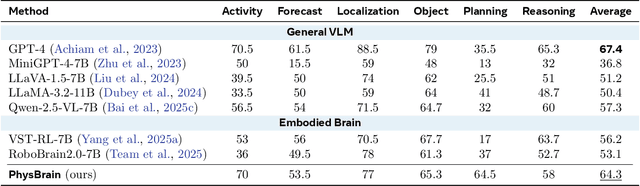
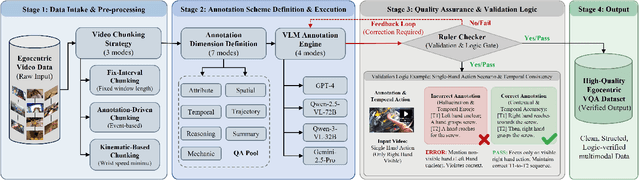
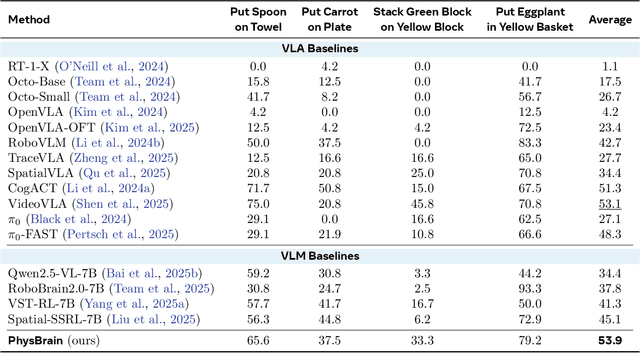
Robotic generalization relies on physical intelligence: the ability to reason about state changes, contact-rich interactions, and long-horizon planning under egocentric perception and action. However, most VLMs are trained primarily on third-person data, creating a fundamental viewpoint mismatch for humanoid robots. Scaling robot egocentric data collection remains impractical due to high cost and limited diversity, whereas large-scale human egocentric videos offer a scalable alternative that naturally capture rich interaction context and causal structure. The key challenge is to convert raw egocentric videos into structured and reliable embodiment training supervision. Accordingly, we propose an Egocentric2Embodiment translation pipeline that transforms first-person videos into multi-level, schema-driven VQA supervision with enforced evidence grounding and temporal consistency, enabling the construction of the Egocentric2Embodiment dataset (E2E-3M) at scale. An egocentric-aware embodied brain, termed PhysBrain, is obtained by training on the E2E-3M dataset. PhysBrain exhibits substantially improved egocentric understanding, particularly for planning on EgoThink. It provides an egocentric-aware initialization that enables more sample-efficient VLA fine-tuning and higher SimplerEnv success rates (53.9\%), demonstrating effective transfer from human egocentric supervision to downstream robot control.
Seismology modeling agent: A smart assistant for geophysical researchers
Dec 16, 2025To address the steep learning curve and reliance on complex manual file editing and command-line operations in the traditional workflow of the mainstream open-source seismic wave simulation software SPECFEM, this paper proposes an intelligent, interactive workflow powered by Large Language Models (LLMs). We introduce the first Model Context Protocol (MCP) server suite for SPECFEM (supporting 2D, 3D Cartesian, and 3D Globe versions), which decomposes the entire simulation process into discrete, agent-executable tools spanning from parameter generation and mesh partitioning to solver execution and visualization. This approach enables a paradigm shift from file-driven to intent-driven conversational interactions. The framework supports both fully automated execution and human-in-the-loop collaboration, allowing researchers to guide simulation strategies in real time and retain scientific decision-making authority while significantly reducing tedious low-level operations. Validated through multiple case studies, the workflow operates seamlessly in both autonomous and interactive modes, yielding high-fidelity results consistent with standard baselines. As the first application of MCP technology to computational seismology, this study significantly lowers the entry barrier, enhances reproducibility, and offers a promising avenue for advancing computational geophysics toward AI-assisted and automated scientific research. The complete source code is available at https://github.com/RenYukun1563/specfem-mcp.
Achieving Olympia-Level Geometry Large Language Model Agent via Complexity Boosting Reinforcement Learning
Dec 12, 2025Large language model (LLM) agents exhibit strong mathematical problem-solving abilities and can even solve International Mathematical Olympiad (IMO) level problems with the assistance of formal proof systems. However, due to weak heuristics for auxiliary constructions, AI for geometry problem solving remains dominated by expert models such as AlphaGeometry 2, which rely heavily on large-scale data synthesis and search for both training and evaluation. In this work, we make the first attempt to build a medalist-level LLM agent for geometry and present InternGeometry. InternGeometry overcomes the heuristic limitations in geometry by iteratively proposing propositions and auxiliary constructions, verifying them with a symbolic engine, and reflecting on the engine's feedback to guide subsequent proposals. A dynamic memory mechanism enables InternGeometry to conduct more than two hundred interactions with the symbolic engine per problem. To further accelerate learning, we introduce Complexity-Boosting Reinforcement Learning (CBRL), which gradually increases the complexity of synthesized problems across training stages. Built on InternThinker-32B, InternGeometry solves 44 of 50 IMO geometry problems (2000-2024), exceeding the average gold medalist score (40.9), using only 13K training examples, just 0.004% of the data used by AlphaGeometry 2, demonstrating the potential of LLM agents on expert-level geometry tasks. InternGeometry can also propose novel auxiliary constructions for IMO problems that do not appear in human solutions. We will release the model, data, and symbolic engine to support future research.