 Add to Chrome
 Add to Firefox
 Add to Edge
FocusGS: Spatial Delta Layers for Local Repair and Deterministic Editing of Trained 3D Gaussian Assets
Jul 30, 2026
3D Gaussian Splatting (3DGS) is evolving from one-time reconstruction into deliverable, inspectable, and maintainable visual assets. Existing workflows focus on global reconstruction, training-time density control, or open-ended generative editing, leaving trained assets without precise local maintenance. We propose FocusGS, which unifies local repair and deterministic editing as composite spatial deltas. Repair is the purely additive special case: its base-manipulation term is empty, and it adds only local Gaussian bases; deterministic editing uses erase-insert factorization (EIF) to combine old-carrier erasure with new-content insertion. FocusGS addresses spatial gradient starvation: local repair raises target-region PSNR by 7.91 dB over 93 evaluation views. Across all 83 deterministic editing trials, the target ROI improves, with a trial-averaged mean edited ROI PSNR of 21.97 dB and a mean gain of +11.05 dB; across five public editing cases, FocusGS-EIF reaches 33.17 dB Target-mask PSNR and 0.994 Target-delta Correlation, while both text-driven baselines fail to complete the prescribed updates. FocusGS provides a lightweight, verifiable 3DGS maintenance operator.

Future Rendering $ eq$ Future Surface: A Benchmark and Dataset for Dynamic Surface Reconstruction Beyond the Observed Window
Jul 23, 2026Dynamic-scene reconstruction is almost always evaluated inside the observed time window, yet deployment settings such as AR overlays, robot interaction, and anticipatory planning need the future surface: the geometry at times beyond those captured. No standard benchmark measures this. We introduce FutureSurf, a controlled diagnostic benchmark and dataset for future-time surface reconstruction that trades scene diversity for exact future ground truth and falsification controls. A method trains on the observed first 75% of a sequence; we score its extracted per-frame surface on the held-out future by Chamfer distance, reporting absolute future CD as the primary score and the future/observed gap as a diagnostic. The dataset contains eight analytically defined controlled motions, including three falsification controls, with exact per-frame ground-truth meshes. We also provide a ground-truth-side recoverability oracle. The release includes split files, scoring code, a benchmark card, and Croissant metadata. On the controlled motions, the DG-Mesh backbone leaves a 2.7-4.1$\times$ gap even for futures predictable in principle (four of five recoverable from observed motion by a fixed rule), while the falsification controls behave as designed (the surface-invariant motion shows no gap). Beyond the contributed dataset, the gap persists across six animated DG-Mesh asset scenes and a second backbone, Deformable-3DGS (2.0-6.6$\times$; both share a deformation-MLP temporal model). The benchmark also shows that future rendering quality and future-surface accuracy are statistically decoupled, so the novel-view-synthesis metrics the field reports do not track future geometry. The future error is structured, concentrating where the surface moves. The dataset, evaluation toolkit, and scoring code are available on Hugging Face and GitHub (https://github.com/Ricky-S/futuresurf).
Closing the Loop in Humanoid VLA: Persistent 3D Object Tokens for Verifiable Loco-Manipulation
Jul 20, 2026Vision-language-action policies are a promising foundation for general robot control, but long-horizon humanoid loco-manipulation requires the robot to treat task objects as persistent physical entities across movement, contact, occlusion, and recovery. We study this problem as object-state divergence: the object state used to condition a whole-body action can differ from the state used to decide whether the action achieved the intended physical relation. We propose \emph{Persistent Object Tokenization} (POT), which maintains role-indexed 3D object records from RGB-D observations and converts them into object tokens for a whole-body action expert. Instantiated as \emph{POT-VLA}, the same object records condition action generation and support geometric predicate checks, yielding a closed-loop execution system in which object state is both actionable and verifiable. On a Unitree G1, POT-VLA improves a matched direct GR00T-N1.7 baseline from 39/80 to 71/80 successes over eight real-world task families. In an external Being-0-aligned reference, POT-VLA achieves 44/50 successes on aligned service tasks, compared with the 37/50 success reported by the Being-0 paper. The largest gains occur on tasks requiring maintained 3D relations, suggesting that persistent object-centered state is a useful abstraction for verifiable humanoid VLA execution.
Human-as-Humanoid: Enabling Zero-Shot Humanoid Learning from Ego-Exo Human Videos with Human-Aligned Embodiments
Jun 30, 2026Vision-language-action (VLA) models across robot embodiments require high-quality observation--action supervision to learn deployable action distributions, yet scaling such robot data remains difficult, especially for high-DoF humanoids. Teleoperation provides controller-aligned supervision, while human egocentric videos capture diverse bimanual manipulation but do not directly provide executable robot actions. We introduce Human-as-Humanoid, a human-to-humanoid supervision framework that enables near-real-time human-centric action generation, making human demonstrations usable for high-DoF humanoid VLA training by jointly aligning the robot embodiment, the sensing setup, and the action-label interface. Built on PrimeU, a human-aligned 60-DoF upper-body humanoid, Human-as-Humanoid uses synchronized ego-exo videos to pair deployment-aligned egocentric observations with exocentric motion recovery, retargets the recovered human motion through staged Inverse Kinematics (IK) into controller-aligned 60-DoF action chunks, and trains the VLA model with Forward Kinematics (FK)-aware supervision to preserve wrist and fingertip task-space geometry. This converts large-scale human demonstrations from visual observations into executable observation--action supervision for the target humanoid. Experiments validate the conversion chain at the motion-recovery, robot-action-space, and real-robot deployment levels. Human-as-Humanoid yields a 4.8--7.2x raw demonstration-throughput gain over humanoid teleoperation in our data-collection analysis, and on several downstream tasks, policies post-trained only with the converted human labels generalize to real-robot deployment without target-task robot demonstrations. The official project website is available at https://zgc-embodyai.github.io/Human-as-Humanoid.
EgoPriMo: Egocentric Motion Generation for Interactive Humanoid Control
Jun 07, 2026Humanoid robots require whole-body motions that adapt to scene context, task requirements, and user intent. Motion tracking reproduces specified trajectories, and humanoid vision-language-action systems provide semantic interfaces, but neither offers a scalable and interactive prior for broad full-body behavior. We introduce EgoPriMo (Egocentric Motion Prior for Humanoid Robots), a unified framework that learns such priors from egocentric human demonstrations. Given egocentric observations and a text prompt, EgoPriMo reconstructs, generates, and forecasts SMPL-based full-body motion. Language is used as a high-level control signal rather than a complete motion specification. At the core of EgoPriMo is a Triple-stream DiT that jointly models body dynamics, egocentric visual context, and text; task-conditioning masks route different tasks and missing-modality data through the same checkpoint. Experiments on Nymeria and EgoExo4D show that one checkpoint improves egocentric motion generation over UniEgoMotion while supporting reconstruction and forecasting; the generated SMPL motions can also be executed by a Unitree humanoid controller. These results indicate a practical path from scalable egocentric observations to generalizable and interactive humanoid motion priors.
LycheeDecode: Accelerating Long-Context LLM Inference via Hybrid-Head Sparse Decoding
Feb 04, 2026The proliferation of long-context large language models (LLMs) exposes a key bottleneck: the rapidly expanding key-value cache during decoding, which imposes heavy memory and latency costs. While recent approaches attempt to alleviate this by sharing a single set of crucial tokens across layers, such coarse-grained sharing undermines model performance by neglecting the functional diversity of attention heads. To address this, we propose LycheeDecode, an efficient decoding method centered on a fine-grained hybrid-head attention mechanism that employs a hardware-efficient top-k selection strategy. Specifically, the novel HardKuma-based mechanism partitions attention heads into a small subset of retrieval heads that dynamically identify crucial tokens and a majority of sparse heads that reuse them for efficient computation. Through extensive experiments on leading models like Llama3 and Qwen3 across diverse benchmarks for long-context understanding (e.g., LongBench, RULER) and complex reasoning (e.g., AIME24, OlympiadBench), we demonstrate that LycheeDecode achieves generative quality comparable to, and at times surpassing even the full-attention baseline. Crucially, this is accomplished with up to a 2.7x speedup at a 128K context length. By preserving the functional diversity of attention heads, our fine-grained strategy overcomes the performance bottlenecks of existing methods, providing a powerful and validated pathway to both efficient and high-quality long-context LLM inference.
Structured Episodic Event Memory
Jan 10, 2026Current approaches to memory in Large Language Models (LLMs) predominantly rely on static Retrieval-Augmented Generation (RAG), which often results in scattered retrieval and fails to capture the structural dependencies required for complex reasoning. For autonomous agents, these passive and flat architectures lack the cognitive organization necessary to model the dynamic and associative nature of long-term interaction. To address this, we propose Structured Episodic Event Memory (SEEM), a hierarchical framework that synergizes a graph memory layer for relational facts with a dynamic episodic memory layer for narrative progression. Grounded in cognitive frame theory, SEEM transforms interaction streams into structured Episodic Event Frames (EEFs) anchored by precise provenance pointers. Furthermore, we introduce an agentic associative fusion and Reverse Provenance Expansion (RPE) mechanism to reconstruct coherent narrative contexts from fragmented evidence. Experimental results on the LoCoMo and LongMemEval benchmarks demonstrate that SEEM significantly outperforms baselines, enabling agents to maintain superior narrative coherence and logical consistency.
PhysBrain: Human Egocentric Data as a Bridge from Vision Language Models to Physical Intelligence
Dec 18, 2025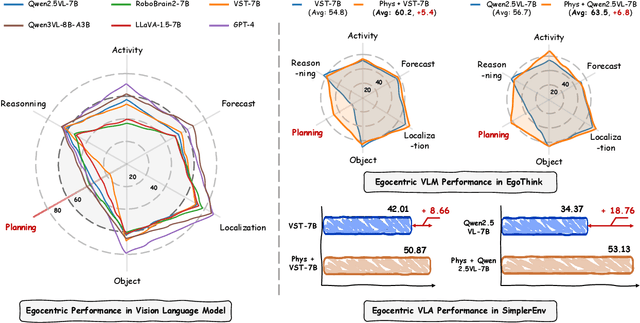
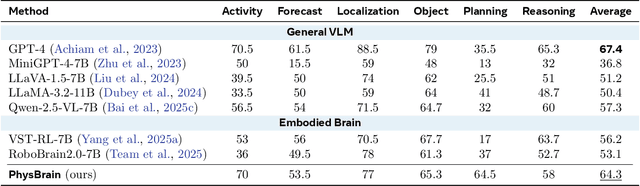
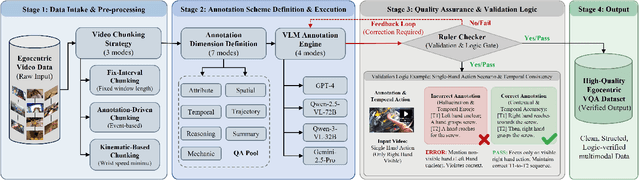
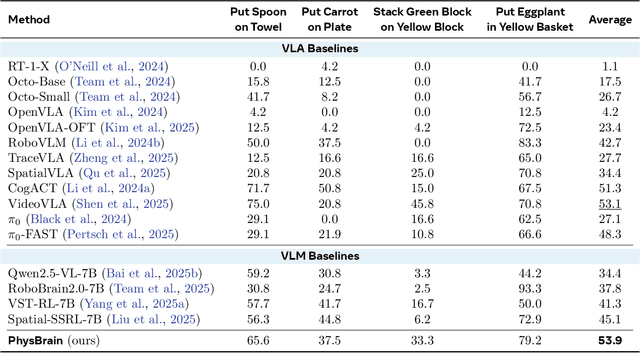
Robotic generalization relies on physical intelligence: the ability to reason about state changes, contact-rich interactions, and long-horizon planning under egocentric perception and action. However, most VLMs are trained primarily on third-person data, creating a fundamental viewpoint mismatch for humanoid robots. Scaling robot egocentric data collection remains impractical due to high cost and limited diversity, whereas large-scale human egocentric videos offer a scalable alternative that naturally capture rich interaction context and causal structure. The key challenge is to convert raw egocentric videos into structured and reliable embodiment training supervision. Accordingly, we propose an Egocentric2Embodiment translation pipeline that transforms first-person videos into multi-level, schema-driven VQA supervision with enforced evidence grounding and temporal consistency, enabling the construction of the Egocentric2Embodiment dataset (E2E-3M) at scale. An egocentric-aware embodied brain, termed PhysBrain, is obtained by training on the E2E-3M dataset. PhysBrain exhibits substantially improved egocentric understanding, particularly for planning on EgoThink. It provides an egocentric-aware initialization that enables more sample-efficient VLA fine-tuning and higher SimplerEnv success rates (53.9\%), demonstrating effective transfer from human egocentric supervision to downstream robot control.
SealD-NeRF: Interactive Pixel-Level Editing for Dynamic Scenes by Neural Radiance Fields
Feb 21, 2024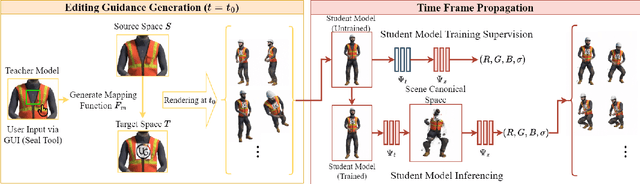
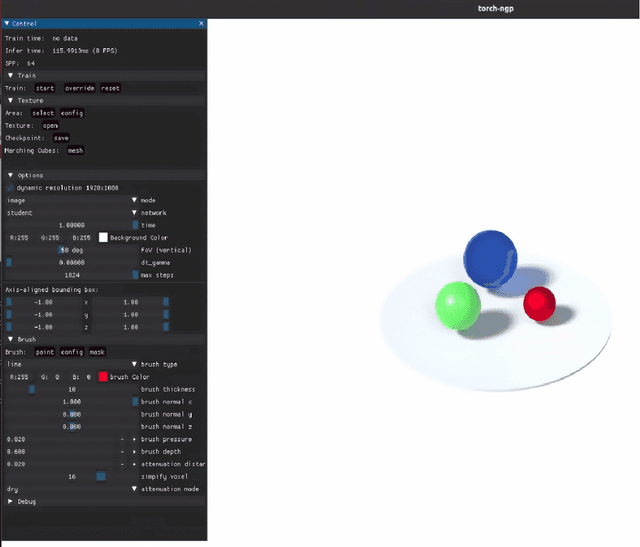
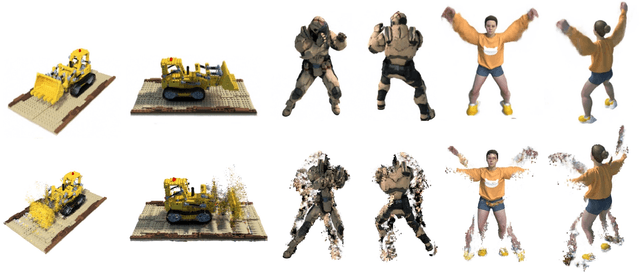
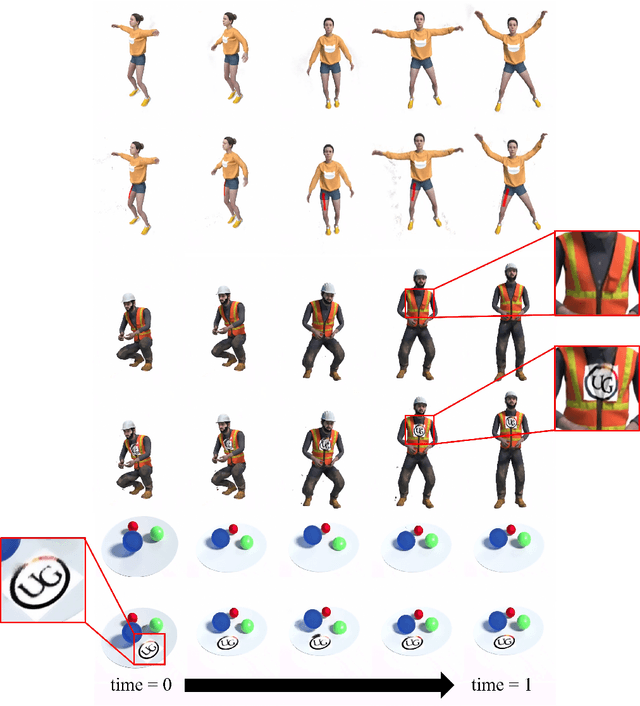
The widespread adoption of implicit neural representations, especially Neural Radiance Fields (NeRF), highlights a growing need for editing capabilities in implicit 3D models, essential for tasks like scene post-processing and 3D content creation. Despite previous efforts in NeRF editing, challenges remain due to limitations in editing flexibility and quality. The key issue is developing a neural representation that supports local edits for real-time updates. Current NeRF editing methods, offering pixel-level adjustments or detailed geometry and color modifications, are mostly limited to static scenes. This paper introduces SealD-NeRF, an extension of Seal-3D for pixel-level editing in dynamic settings, specifically targeting the D-NeRF network. It allows for consistent edits across sequences by mapping editing actions to a specific timeframe, freezing the deformation network responsible for dynamic scene representation, and using a teacher-student approach to integrate changes.
Psy-LLM: Scaling up Global Mental Health Psychological Services with AI-based Large Language Models
Jul 22, 2023The demand for psychological counseling has grown significantly in recent years, particularly with the global outbreak of COVID-19, which has heightened the need for timely and professional mental health support. Online psychological counseling has emerged as the predominant mode of providing services in response to this demand. In this study, we propose the Psy-LLM framework, an AI-based system leveraging Large Language Models (LLMs) for question-answering in online psychological consultation. Our framework combines pre-trained LLMs with real-world professional Q&A from psychologists and extensively crawled psychological articles. The Psy-LLM framework serves as a front-end tool for healthcare professionals, allowing them to provide immediate responses and mindfulness activities to alleviate patient stress. Additionally, it functions as a screening tool to identify urgent cases requiring further assistance. We evaluated the framework using intrinsic metrics, such as perplexity, and extrinsic evaluation metrics, with human participant assessments of response helpfulness, fluency, relevance, and logic. The results demonstrate the effectiveness of the Psy-LLM framework in generating coherent and relevant answers to psychological questions. This article concludes by discussing the potential of large language models to enhance mental health support through AI technologies in online psychological consultation.