 Add to Chrome
 Add to Firefox
 Add to Edge
IntentVLA: Short-Horizon Intent Modeling for Aliased Robot Manipulation
May 14, 2026
Robot imitation data are often multimodal: similar visual-language observations may be followed by different action chunks because human demonstrators act with different short-horizon intents, task phases, or recent context. Existing frame-conditioned VLA policies infer each chunk from the current observation and instruction alone, so under partial observability they may resample different intents across adjacent replanning steps, leading to inter-chunk conflict and unstable execution. We introduce IntentVLA, a history-conditioned VLA framework that encodes recent visual observations into a compact short-horizon intent representation and uses it to condition chunk generation. We further introduce AliasBench, a 12-task ambiguity-aware benchmark on RoboTwin2 with matched training data and evaluation environments that isolate short-horizon observation aliasing. Across AliasBench, SimplerEnv, LIBERO, and RoboCasa, IntentVLA improves rollout stability and outperforms strong VLA baselines

EA-WM: Event-Aware Generative World Model with Structured Kinematic-to-Visual Action Fields
May 07, 2026Pretrained video diffusion models provide powerful spatiotemporal generative priors, making them a natural foundation for robotic world models. While recent world-action models jointly optimize future videos and actions, they predominantly treat video generation as an auxiliary representation for policy learning. Consequently, they insufficiently explore the inverse problem: leveraging action signals to guide video synthesis, thereby often failing to preserve precise robot spatial geometry and fine-grained robot-object interaction dynamics in the generated rollouts. To bridge this gap, we present EA-WM, an Event-Aware Generative World Model that effectively closes the loop between kinematic control and visual perception. Rather than injecting joint or end-effector actions as abstract, low-dimensional tokens, EA-WM projects actions and kinematic states directly into the target camera view as Structured Kinematic-to-Visual Action Fields. To fully exploit this geometrically grounded representation, we introduce event-aware bidirectional fusion blocks that modulate cross-branch attention, capturing object state changes and interaction dynamics. Evaluated on the comprehensive WorldArena benchmark, EA-WM achieves state-of-the-art performance, outperforming existing baselines by a significant margin.
PhysBrain: Human Egocentric Data as a Bridge from Vision Language Models to Physical Intelligence
Dec 18, 2025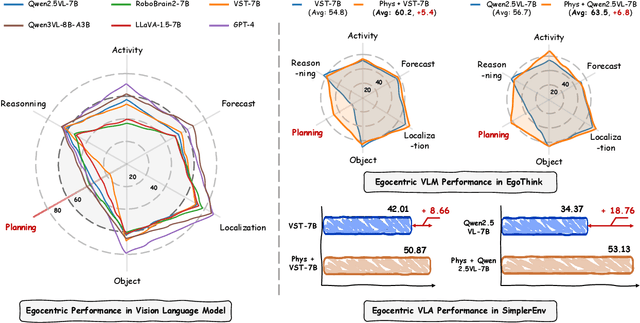
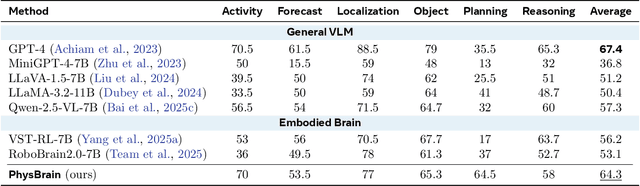
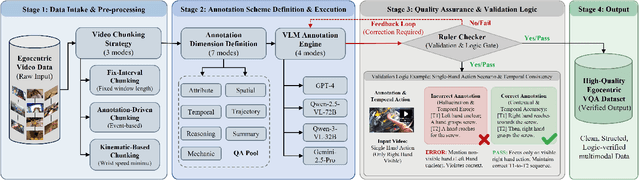
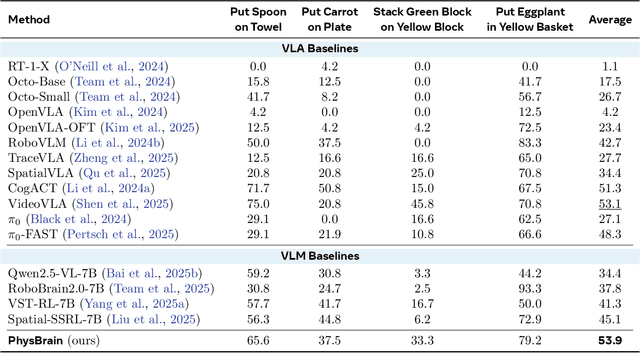
Robotic generalization relies on physical intelligence: the ability to reason about state changes, contact-rich interactions, and long-horizon planning under egocentric perception and action. However, most VLMs are trained primarily on third-person data, creating a fundamental viewpoint mismatch for humanoid robots. Scaling robot egocentric data collection remains impractical due to high cost and limited diversity, whereas large-scale human egocentric videos offer a scalable alternative that naturally capture rich interaction context and causal structure. The key challenge is to convert raw egocentric videos into structured and reliable embodiment training supervision. Accordingly, we propose an Egocentric2Embodiment translation pipeline that transforms first-person videos into multi-level, schema-driven VQA supervision with enforced evidence grounding and temporal consistency, enabling the construction of the Egocentric2Embodiment dataset (E2E-3M) at scale. An egocentric-aware embodied brain, termed PhysBrain, is obtained by training on the E2E-3M dataset. PhysBrain exhibits substantially improved egocentric understanding, particularly for planning on EgoThink. It provides an egocentric-aware initialization that enables more sample-efficient VLA fine-tuning and higher SimplerEnv success rates (53.9\%), demonstrating effective transfer from human egocentric supervision to downstream robot control.
Multi-Objective Mobile Damped Wave Algorithm (MOMDWA): A Novel Approach For Quantum System Control
Feb 06, 2025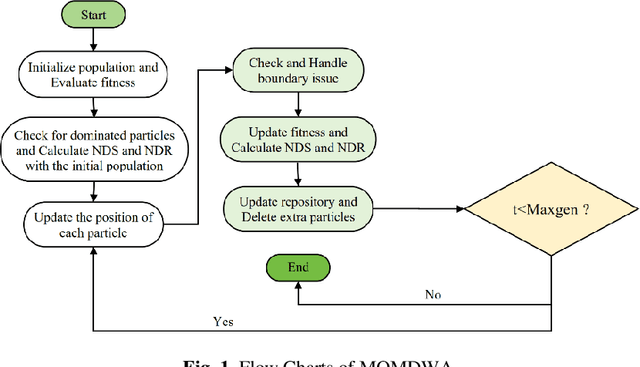
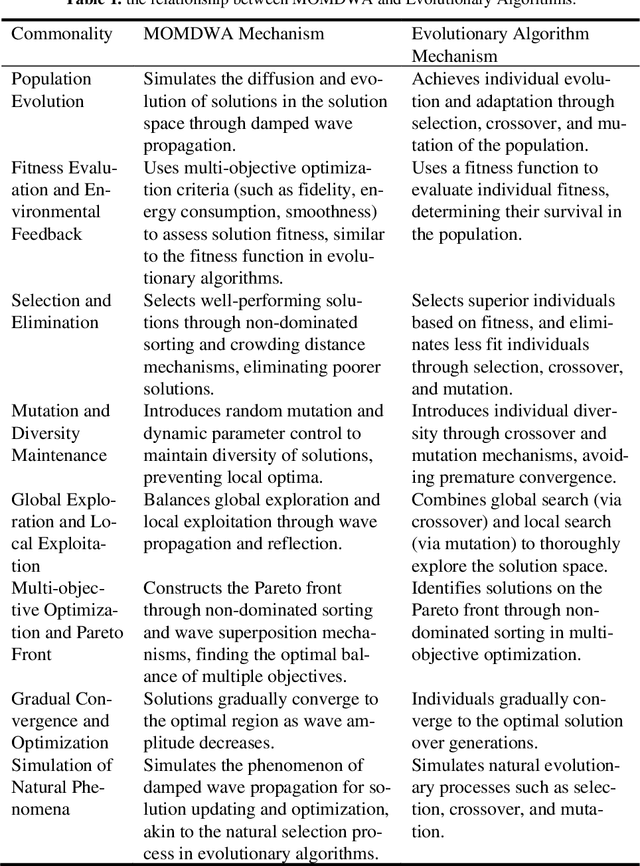
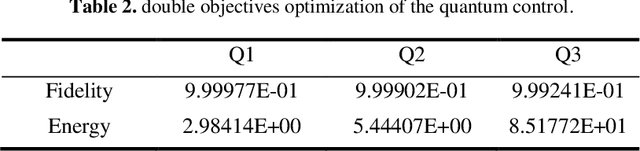
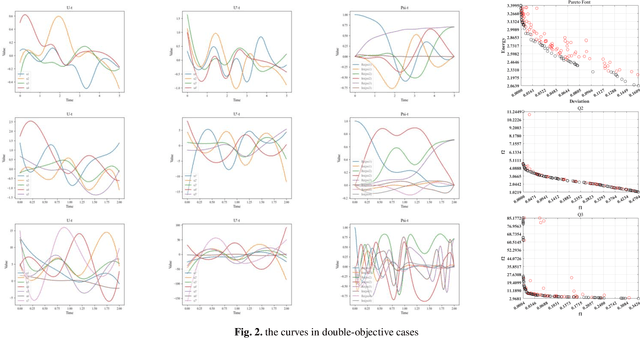
In this paper, we introduce a novel multi-objective optimization algorithm, the Multi-Objective Mobile Damped Wave Algorithm (MOMDWA), specifically designed to address complex quantum control problems. Our approach extends the capabilities of the original Mobile Damped Wave Algorithm (MDWA) by incorporating multiple objectives, enabling a more comprehensive optimization process. We applied MOMDWA to three quantum control scenarios, focusing on optimizing the balance between control fidelity, energy consumption, and control smoothness. The results demonstrate that MOMDWA significantly enhances quantum control efficiency and robustness, achieving high fidelity while minimizing energy use and ensuring smooth control pulses. This advancement offers a valuable tool for quantum computing and other domains requiring precise, multi-objective control.