 Add to Chrome
 Add to Firefox
 Add to Edge
Human-as-Humanoid: Enabling Zero-Shot Humanoid Learning from Ego-Exo Human Videos with Human-Aligned Embodiments
Jun 30, 2026
Vision-language-action (VLA) models across robot embodiments require high-quality observation--action supervision to learn deployable action distributions, yet scaling such robot data remains difficult, especially for high-DoF humanoids. Teleoperation provides controller-aligned supervision, while human egocentric videos capture diverse bimanual manipulation but do not directly provide executable robot actions. We introduce Human-as-Humanoid, a human-to-humanoid supervision framework that enables near-real-time human-centric action generation, making human demonstrations usable for high-DoF humanoid VLA training by jointly aligning the robot embodiment, the sensing setup, and the action-label interface. Built on PrimeU, a human-aligned 60-DoF upper-body humanoid, Human-as-Humanoid uses synchronized ego-exo videos to pair deployment-aligned egocentric observations with exocentric motion recovery, retargets the recovered human motion through staged Inverse Kinematics (IK) into controller-aligned 60-DoF action chunks, and trains the VLA model with Forward Kinematics (FK)-aware supervision to preserve wrist and fingertip task-space geometry. This converts large-scale human demonstrations from visual observations into executable observation--action supervision for the target humanoid. Experiments validate the conversion chain at the motion-recovery, robot-action-space, and real-robot deployment levels. Human-as-Humanoid yields a 4.8--7.2x raw demonstration-throughput gain over humanoid teleoperation in our data-collection analysis, and on several downstream tasks, policies post-trained only with the converted human labels generalize to real-robot deployment without target-task robot demonstrations. The official project website is available at https://zgc-embodyai.github.io/Human-as-Humanoid.

PhysBrain: Human Egocentric Data as a Bridge from Vision Language Models to Physical Intelligence
Dec 18, 2025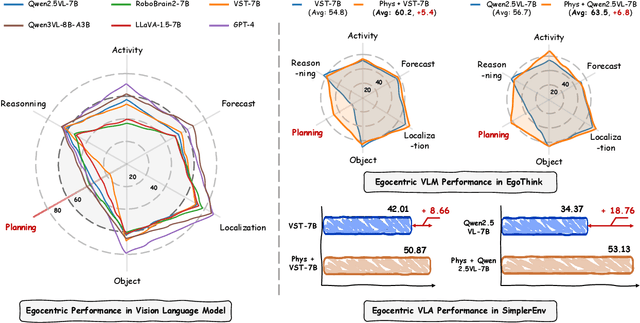
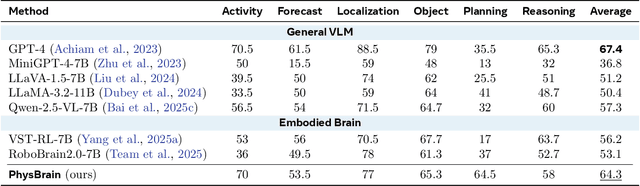
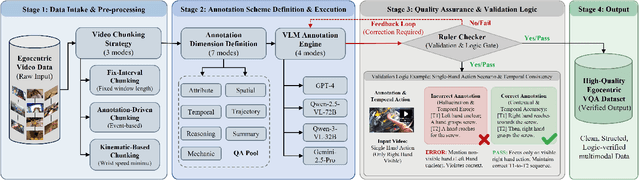
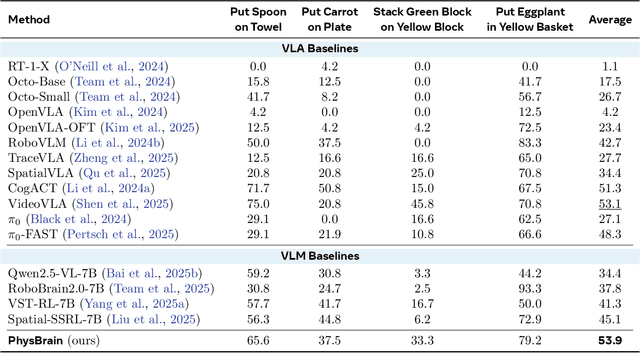
Robotic generalization relies on physical intelligence: the ability to reason about state changes, contact-rich interactions, and long-horizon planning under egocentric perception and action. However, most VLMs are trained primarily on third-person data, creating a fundamental viewpoint mismatch for humanoid robots. Scaling robot egocentric data collection remains impractical due to high cost and limited diversity, whereas large-scale human egocentric videos offer a scalable alternative that naturally capture rich interaction context and causal structure. The key challenge is to convert raw egocentric videos into structured and reliable embodiment training supervision. Accordingly, we propose an Egocentric2Embodiment translation pipeline that transforms first-person videos into multi-level, schema-driven VQA supervision with enforced evidence grounding and temporal consistency, enabling the construction of the Egocentric2Embodiment dataset (E2E-3M) at scale. An egocentric-aware embodied brain, termed PhysBrain, is obtained by training on the E2E-3M dataset. PhysBrain exhibits substantially improved egocentric understanding, particularly for planning on EgoThink. It provides an egocentric-aware initialization that enables more sample-efficient VLA fine-tuning and higher SimplerEnv success rates (53.9\%), demonstrating effective transfer from human egocentric supervision to downstream robot control.