 Add to Chrome
 Add to Firefox
 Add to Edge
Speaker-Normalized Semantic Speech Tokens via Iterative S2U-T2U Refinement
Aug 17, 2026
Semantic speech tokens should preserve linguistic content while suppressing speaker- and duration-dependent variation inherited from acoustic inputs. We propose Iterative Semantic Token Purification (ISTP), an alternating speech-to-unit (S2U) and text-to-unit (T2U) training procedure guided by text predictability. Starting from an initial S2U tokenizer, each iteration trains a T2U model on its deduplicated token sequences. The decoded T2U predictions then serve as connectionist temporal classification targets for a newly initialized S2U model, whose outputs supervise the next T2U model. This cycle progressively aligns the two token generators and biases the token space toward information recoverable from text. Experiments on Mandarin and English show substantially improved S2U--T2U agreement. Independently trained de-tokenizers further show that the refined S2U and T2U tokens retain sufficient content for high-intelligibility voice conversion and text-to-speech synthesis. In voice conversion, the generated speaking rate follows the reference more closely. The refined tokens also exhibit substantially improved cross-speaker consistency and reduced probe-recoverable speaker information.

SpeechEditBench: A Bilingual Multi-Attribute Benchmark for Instruction-Guided Speech Editing
Jun 01, 2026Instruction-guided speech editing requires a model to modify specified speech attributes while preserving unrelated characteristics. Despite rapid progress in Speech Large Language Models (Speech LLMs), systematic evaluation of this capability remains challenging, as existing benchmarks are fragmented across isolated editing tasks. To bridge this gap, we introduce \textbf{SpeechEditBench}, a bilingual multi-attribute benchmark for instruction-guided speech editing. SpeechEditBench encompasses seven atomic editing tasks, as well as compositional editing tasks that integrate multiple operations within a single instruction. We propose an anchor-based evaluation protocol that separately assesses the edit success of target attributes and the preservation of untargeted attributes, leading to three metrics: target success, preservation success, and joint success. Using this benchmark, we evaluate mainstream Speech LLMs and specialized speech editing systems. The results reveal three key findings: (1) no single model performs well across all editing dimensions; (2) closed-source Speech LLMs generally outperform open-source models; (3) compositional editing remains highly challenging, with even the most advanced models struggling to achieve high joint success. SpeechEditBench provides a rigorous diagnostic framework to identify bottlenecks in Speech LLMs, thereby facilitating the development of next-generation Speech LLMs with more robust and precise instruction-guided editing capabilities. Data and code will be released upon acceptance.
A Survey of Audio Reasoning in Multimodal Foundation Models
May 20, 2026Reasoning has become a defining capability of modern foundation models, yet its development in the audio modality remains limited. Audio poses challenges that are distinct from those of text and vision. It is continuous, temporally dense, and contains linguistic, paralinguistic, and environmental information at multiple time scales. As a result, audio reasoning models must align acoustic signals with the discrete semantic space of large language models, while still preserving fine-grained information needed for reliable inference. Progress is also limited by three major obstacles: the scarcity of genuinely audio-grounded reasoning data, shortcut learning and modality hallucination, and the tension between reasoning depth and real-time latency in spoken interaction. In this paper, we present the first dedicated survey of audio reasoning. We provide a unified formulation that distinguishes direct predictive modeling from reasoning-augmented generation, review the architectural and training foundations of audio reasoning models, and systematically organize recent advances in Audio-to-Text, Audio-to-Speech, Audio-Visual Reasoning and Agentic Audio Reasoning. We further examine emerging paradigms such as Chain-of-Thought prompting, supervised fine-tuning, reinforcement learning, and latency-aware spoken interaction, and discuss evaluation practices, open challenges, and future directions. Our goal is to offer a coherent roadmap for developing robust, efficient, and natively grounded audio reasoning systems.
Minimizing Modality Gap from the Input Side: Your Speech LLM Can Be a Prosody-Aware Text LLM
May 07, 2026Speech large language models (SLMs) are typically built from text large language model (TLM) checkpoints, yet they still suffer from a substantial modality gap. Prior work has mainly attempted to reduce this gap from the output side by making speech generation more text-like, but the gap remains. We argue that the key remaining bottleneck lies on the input side. We propose TextPro-SLM, an SLM that makes spoken input more closely resemble that of a prosody-aware text LLM. TextPro-SLM combines WhisperPro, a unified speech encoder that produces synchronized text tokens and prosody embeddings, with an LLM backbone trained to preserve the semantic capabilities of the original TLM while learning paralinguistic understanding. Experiments show that TextPro-SLM achieves the lowest modality gap among leading SLMs at both 3B and 7B scales, while also delivering strong overall performance on paralinguistic understanding tasks. These gains are achieved with only roughly 1,000 hours of LLM training audio, suggesting that reducing the modality gap from the input side is both effective and data-efficient.
Speech-Omni-Lite: Portable Speech Interfaces for Vision-Language Models
Mar 10, 2026While large-scale omni-models have demonstrated impressive capabilities across various modalities, their strong performance heavily relies on massive multimodal data and incurs substantial computational costs. This work introduces Speech-Omni-Lite, a cost-efficient framework for extending pre-trained Visual-Language (VL) backbones with speech understanding and generation capabilities, while fully preserving the backbones' vision-language performance. Specifically, the VL backbone is equipped with two lightweight, trainable plug-and-play modules, a speech projector and a speech token generator, while keeping the VL backbone fully frozen. To mitigate the scarcity of spoken QA corpora, a low-cost data construction strategy is proposed to generate Question-Text Answer-Text-Speech (QTATS) data from existing ASR speech-text pairs, facilitating effective speech generation training. Experimental results show that, even with only thousands of hours of speech training data, Speech-Omni-Lite achieves excellent spoken QA performance, which is comparable to omni-models trained on millions of hours of speech data. Furthermore, the learned speech modules exhibit strong transferability across VL backbones.
PROST-LLM: Progressively Enhancing the Speech-to-Speech Translation Capability in LLMs
Jan 23, 2026Although Large Language Models (LLMs) excel in many tasks, their application to Speech-to-Speech Translation (S2ST) is underexplored and hindered by data scarcity. To bridge this gap, we propose PROST-LLM (PROgressive Speech-to-speech Translation) to enhance the S2ST capabilities in LLMs progressively. First, we fine-tune the LLMs with the CVSS corpus, employing designed tri-task learning and chain of modality methods to boost the initial performance. Then, leveraging the fine-tuned model, we generate preference pairs through self-sampling and back-translation without human evaluation. Finally, these preference pairs are used for preference optimization to enhance the model's S2ST capability further. Extensive experiments confirm the effectiveness of our proposed PROST-LLM in improving the S2ST capability of LLMs.
AEQ-Bench: Measuring Empathy of Omni-Modal Large Models
Jan 15, 2026While the automatic evaluation of omni-modal large models (OLMs) is essential, assessing empathy remains a significant challenge due to its inherent affectivity. To investigate this challenge, we introduce AEQ-Bench (Audio Empathy Quotient Benchmark), a novel benchmark to systematically assess two core empathetic capabilities of OLMs: (i) generating empathetic responses by comprehending affective cues from multi-modal inputs (audio + text), and (ii) judging the empathy of audio responses without relying on text transcription. Compared to existing benchmarks, AEQ-Bench incorporates two novel settings that vary in context specificity and speech tone. Comprehensive assessment across linguistic and paralinguistic metrics reveals that (1) OLMs trained with audio output capabilities generally outperformed models with text-only outputs, and (2) while OLMs align with human judgments for coarse-grained quality assessment, they remain unreliable for evaluating fine-grained paralinguistic expressiveness.
DSA-Tokenizer: Disentangled Semantic-Acoustic Tokenization via Flow Matching-based Hierarchical Fusion
Jan 15, 2026Speech tokenizers serve as the cornerstone of discrete Speech Large Language Models (Speech LLMs). Existing tokenizers either prioritize semantic encoding, fuse semantic content with acoustic style inseparably, or achieve incomplete semantic-acoustic disentanglement. To achieve better disentanglement, we propose DSA-Tokenizer, which explicitly disentangles speech into discrete semantic and acoustic tokens via distinct optimization constraints. Specifically, semantic tokens are supervised by ASR to capture linguistic content, while acoustic tokens focus on mel-spectrograms restoration to encode style. To eliminate rigid length constraints between the two sequences, we introduce a hierarchical Flow-Matching decoder that further improve speech generation quality. Furthermore, We employ a joint reconstruction-recombination training strategy to enforce this separation. DSA-Tokenizer enables high fidelity reconstruction and flexible recombination through robust disentanglement, facilitating controllable generation in speech LLMs. Our analysis highlights disentangled tokenization as a pivotal paradigm for future speech modeling. Audio samples are avaialble at https://anonymous.4open.science/w/DSA_Tokenizer_demo/. The code and model will be made publicly available after the paper has been accepted.
EMOVA: Empowering Language Models to See, Hear and Speak with Vivid Emotions
Sep 26, 2024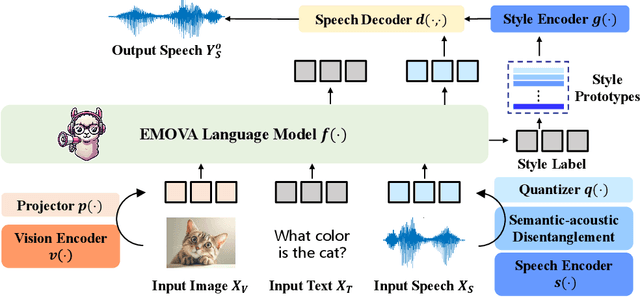
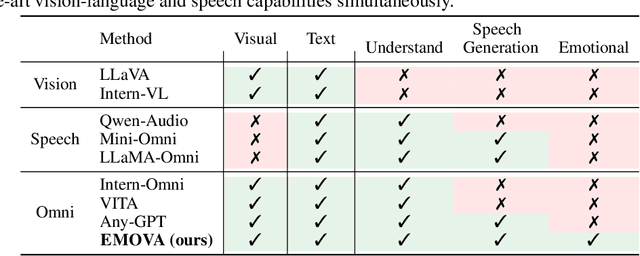
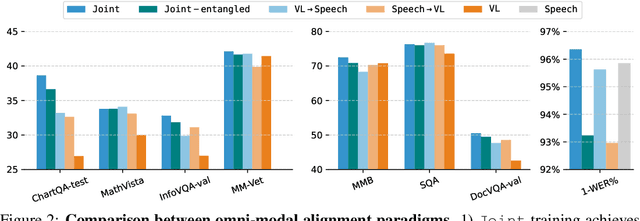
GPT-4o, an omni-modal model that enables vocal conversations with diverse emotions and tones, marks a milestone for omni-modal foundation models. However, empowering Large Language Models to perceive and generate images, texts, and speeches end-to-end with publicly available data remains challenging in the open-source community. Existing vision-language models rely on external tools for the speech processing, while speech-language models still suffer from limited or even without vision-understanding abilities. To address this gap, we propose EMOVA (EMotionally Omni-present Voice Assistant), to enable Large Language Models with end-to-end speech capabilities while maintaining the leading vision-language performance. With a semantic-acoustic disentangled speech tokenizer, we notice surprisingly that omni-modal alignment can further enhance vision-language and speech abilities compared with the corresponding bi-modal aligned counterparts. Moreover, a lightweight style module is proposed for flexible speech style controls (e.g., emotions and pitches). For the first time, EMOVA achieves state-of-the-art performance on both the vision-language and speech benchmarks, and meanwhile, supporting omni-modal spoken dialogue with vivid emotions.
Enhancing Multilingual Speech Generation and Recognition Abilities in LLMs with Constructed Code-switched Data
Sep 17, 2024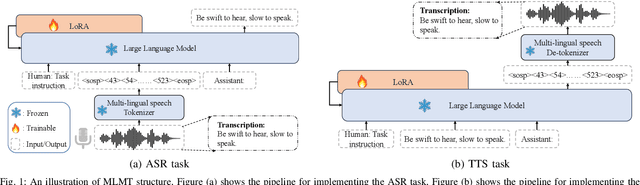
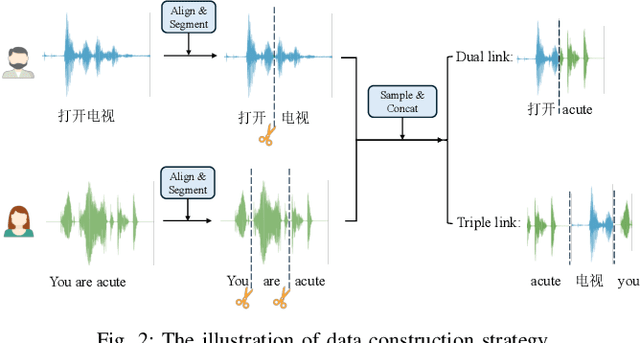
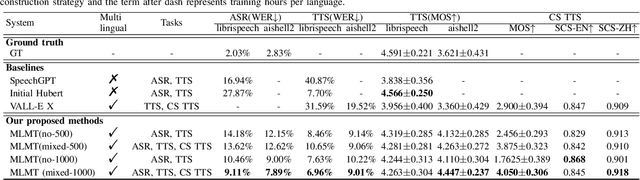
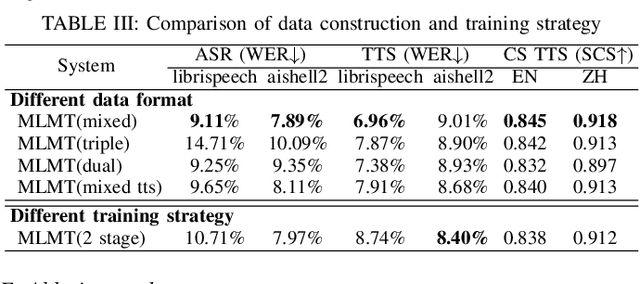
While large language models (LLMs) have been explored in the speech domain for both generation and recognition tasks, their applications are predominantly confined to the monolingual scenario, with limited exploration in multilingual and code-switched (CS) contexts. Additionally, speech generation and recognition tasks are often handled separately, such as VALL-E and Qwen-Audio. In this paper, we propose a MutltiLingual MultiTask (MLMT) model, integrating multilingual speech generation and recognition tasks within the single LLM. Furthermore, we develop an effective data construction approach that splits and concatenates words from different languages to equip LLMs with CS synthesis ability without relying on CS data. The experimental results demonstrate that our model outperforms other baselines with a comparable data scale. Furthermore, our data construction approach not only equips LLMs with CS speech synthesis capability with comparable speaker consistency and similarity to any given speaker, but also improves the performance of LLMs in multilingual speech generation and recognition tasks.