 Add to Chrome
 Add to Firefox
 Add to Edge
Schattor: Schatten-family methods for deep learning optimization
Jun 14, 2026
Modern deep learning optimization features heterogeneous parameter structures, noisy gradients, and highly nonconvex landscapes, posing significant challenges for both algorithm design and theoretical analysis. Motivated by the limitations of SGD and the success of adaptive optimizers, we propose {\it Schattor}, a family of adaptive first-order methods based on Schatten norms. Schattor unifies SGD and the recently proposed matrix-variate adaptive optimizer Muon within a single Schatten-norm-based framework. We establish dimension-free stationarity guarantees for methods in the Schattor family for stochastic matrix optimization problems via a novel matrix martingale moment bound. We also develop multi-block extensions that adaptively balance block-wise optimization progress and prove dimension-free stationarity guarantees in this more general setting.

Global Policy-Space Response Oracles for Two-Player Zero-Sum Games
May 27, 2026The Policy-Space Response Oracles (PSRO) framework scales equilibrium computation to large zero-sum games by iteratively expanding a restricted strategy set using deep reinforcement learning (DRL). A central challenge is to construct, under limited computational budgets, a small strategy population whose induced game well approximates the full game. Existing PSRO variants typically expand the population using best responses to meta-strategies computed from restricted-game payoffs, which can lead to inefficient expansions that provide limited global improvement. We propose to guide population expansion by directly evaluating the post-expansion population quality. Specifically, we adopt Population Exploitability (PE) to measure how well a restricted strategy set represents the full game, and introduce a two-phase exploration--selection framework that explicitly minimizes PE during expansion. We instantiate this framework as Global PSRO, a practical DRL-based algorithm that efficiently generates candidate responses and estimates PE via parameter-sharing conditional neural networks. Experiments across multiple two-player zero-sum games show that Global PSRO achieves lower exploitability and approximates Nash equilibria with significantly fewer policy iterations than prior PSRO methods.
Automated Reformulation of Robust Optimization via Memory-Augmented Large Language Models
May 12, 2026Robust optimization (RO) provides a principled framework for decision-making under uncertainty, but its practical use is often limited by the need to manually reformulate uncertain optimization models into tractable deterministic counterparts. Recent large language models (LLMs) have been shown promising for automating optimization formulation, yet RO reformulation remains challenging because it requires precise multi-step reasoning and mathematically consistent transformations. To facilitate systematic evaluation of LLM-based reformulation, for which no dedicated benchmark currently exists, we develop AutoRO-Bench, a benchmark featuring an automated data generation pipeline for the core RO reformulation task and a curated dataset for the RO application task. To address the reformulation challenge, we propose Automated Reformulation with Experience Memory (AutoREM), a tuning-free memory-augmented framework that autonomously builds a structured textual experience memory by reflecting on past failed trajectories through a tailored offline adaptation procedure. AutoREM requires neither domain-specific expert knowledge nor parameter updates, and the resulting memory readily transfers across different base LLMs. Experimental results show that AutoREM consistently improves the accuracy and efficiency of RO reformulation across in-distribution datasets, out-of-distribution datasets, and diverse base LLMs.
Shuffling the Stochastic Mirror Descent via Dual Lipschitz Continuity and Kernel Conditioning
Mar 17, 2026The global Lipschitz smoothness condition underlies most convergence and complexity analyses via two key consequences: the descent lemma and the gradient Lipschitz continuity. How to study the performance of optimization algorithms in the absence of Lipschitz smoothness remains an active area. The relative smoothness framework from Bauschke-Bolte-Teboulle (2017) and Lu-Freund-Nesterov (2018) provides an extended descent lemma, ensuring convergence of Bregman-based proximal gradient methods and their vanilla stochastic counterparts. However, many widely used techniques (e.g., momentum schemes, random reshuffling, and variance reduction) additionally require the Lipschitz-type bound for gradient deviations, leaving their analysis under relative smoothness an open area. To resolve this issue, we introduce the dual kernel conditioning (DKC) regularity condition to regulate the local relative curvature of the kernel functions. Combined with the relative smoothness, DKC provides a dual Lipschitz continuity for gradients: even though the gradient mapping is not Lipschitz in the primal space, it preserves Lipschitz continuity in the dual space induced by a mirror map. We verify that DKC is widely satisfied by popular kernels and is closed under affine composition and conic combination. With these novel tools, we establish the first complexity bounds as well as the iterate convergence of random reshuffling mirror descent for constrained nonconvex relative smooth problems.
A New Kernel Regularity Condition for Distributed Mirror Descent: Broader Coverage and Simpler Analysis
Mar 13, 2026Existing convergence of distributed optimization methods in non-Euclidean geometries typically rely on kernel assumptions: (i) global Lipschitz smoothness and (ii) bi-convexity of the associated Bregman divergence function. Unfortunately, these conditions are violated by nearly all kernels used in practice, leaving a huge theory-practice gap. This work closes this gap by developing a unified analytical tool that guarantees convergence under mild conditions. Specifically, we introduce Hessian relative uniform continuity (HRUC), a regularity satisfied by nearly all standard kernels. Importantly, HRUC is closed under concatenation, positive scaling, composition, and various kernel combinations. Leveraging the geometric structure induced by HRUC, we derive convergence guarantees for mirror descent-based gradient tracking without imposing any restrictive assumptions. More broadly, our analysis techniques extend seamlessly to other decentralized optimization methods in genuinely non-Euclidean and non-Lipschitz settings.
BACH-V: Bridging Abstract and Concrete Human-Values in Large Language Models
Jan 20, 2026Do large language models (LLMs) genuinely understand abstract concepts, or merely manipulate them as statistical patterns? We introduce an abstraction-grounding framework that decomposes conceptual understanding into three capacities: interpretation of abstract concepts (Abstract-Abstract, A-A), grounding of abstractions in concrete events (Abstract-Concrete, A-C), and application of abstract principles to regulate concrete decisions (Concrete-Concrete, C-C). Using human values as a testbed - given their semantic richness and centrality to alignment - we employ probing (detecting value traces in internal activations) and steering (modifying representations to shift behavior). Across six open-source LLMs and ten value dimensions, probing shows that diagnostic probes trained solely on abstract value descriptions reliably detect the same values in concrete event narratives and decision reasoning, demonstrating cross-level transfer. Steering reveals an asymmetry: intervening on value representations causally shifts concrete judgments and decisions (A-C, C-C), yet leaves abstract interpretations unchanged (A-A), suggesting that encoded abstract values function as stable anchors rather than malleable activations. These findings indicate LLMs maintain structured value representations that bridge abstraction and action, providing a mechanistic and operational foundation for building value-driven autonomous AI systems with more transparent, generalizable alignment and control.
When Reasoning Meets Its Laws
Dec 19, 2025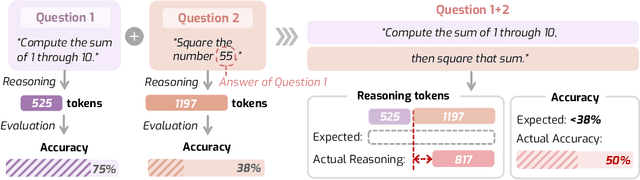
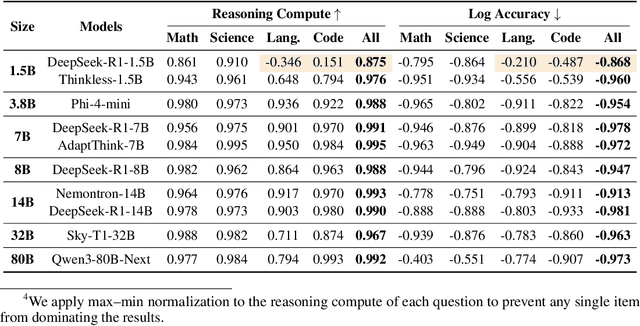
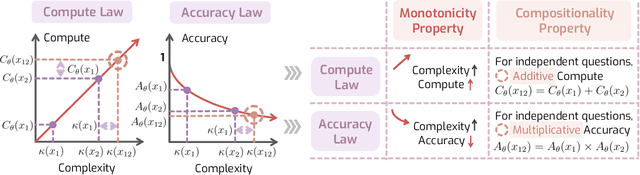
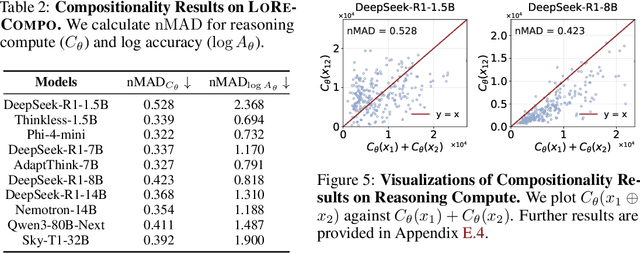
Despite the superior performance of Large Reasoning Models (LRMs), their reasoning behaviors are often counterintuitive, leading to suboptimal reasoning capabilities. To theoretically formalize the desired reasoning behaviors, this paper presents the Laws of Reasoning (LoRe), a unified framework that characterizes intrinsic reasoning patterns in LRMs. We first propose compute law with the hypothesis that the reasoning compute should scale linearly with question complexity. Beyond compute, we extend LoRe with a supplementary accuracy law. Since the question complexity is difficult to quantify in practice, we examine these hypotheses by two properties of the laws, monotonicity and compositionality. We therefore introduce LoRe-Bench, a benchmark that systematically measures these two tractable properties for large reasoning models. Evaluation shows that most reasoning models exhibit reasonable monotonicity but lack compositionality. In response, we develop an effective finetuning approach that enforces compute-law compositionality. Extensive empirical studies demonstrate that better compliance with compute laws yields consistently improved reasoning performance on multiple benchmarks, and uncovers synergistic effects across properties and laws. Project page: https://lore-project.github.io/
Non-Asymptotic Global Convergence of PPO-Clip
Dec 18, 2025
Reinforcement learning (RL) has gained attention for aligning large language models (LLMs) via reinforcement learning from human feedback (RLHF). The actor-only variants of Proximal Policy Optimization (PPO) are widely applied for their efficiency. These algorithms incorporate a clipping mechanism to improve stability. Besides, a regularization term, such as the reverse KL-divergence or a more general \(f\)-divergence, is introduced to prevent policy drift. Despite their empirical success, a rigorous theoretical understanding of the problem and the algorithm's properties is limited. This paper advances the theoretical foundations of the PPO-Clip algorithm by analyzing a deterministic actor-only PPO algorithm within the general RL setting with \(f\)-divergence regularization under the softmax policy parameterization. We derive a non-uniform Lipschitz smoothness condition and a Łojasiewicz inequality for the considered problem. Based on these, a non-asymptotic linear convergence rate to the globally optimal policy is established for the forward KL-regularizer. Furthermore, stationary convergence and local linear convergence are derived for the reverse KL-regularizer.
AlphaOne: Reasoning Models Thinking Slow and Fast at Test Time
May 30, 2025This paper presents AlphaOne ($\alpha$1), a universal framework for modulating reasoning progress in large reasoning models (LRMs) at test time. $\alpha$1 first introduces $\alpha$ moment, which represents the scaled thinking phase with a universal parameter $\alpha$. Within this scaled pre-$\alpha$ moment phase, it dynamically schedules slow thinking transitions by modeling the insertion of reasoning transition tokens as a Bernoulli stochastic process. After the $\alpha$ moment, $\alpha$1 deterministically terminates slow thinking with the end-of-thinking token, thereby fostering fast reasoning and efficient answer generation. This approach unifies and generalizes existing monotonic scaling methods by enabling flexible and dense slow-to-fast reasoning modulation. Extensive empirical studies on various challenging benchmarks across mathematical, coding, and scientific domains demonstrate $\alpha$1's superior reasoning capability and efficiency. Project page: https://alphaone-project.github.io/
EmbodiedBench: Comprehensive Benchmarking Multi-modal Large Language Models for Vision-Driven Embodied Agents
Feb 13, 2025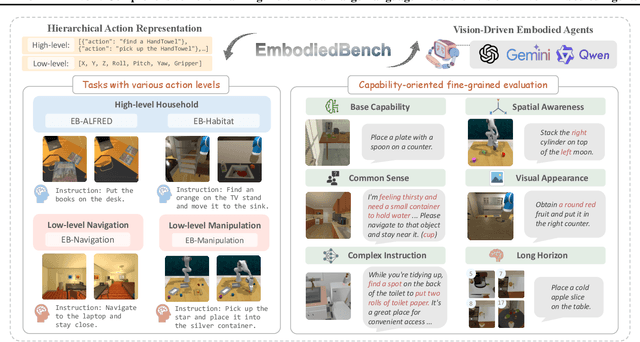
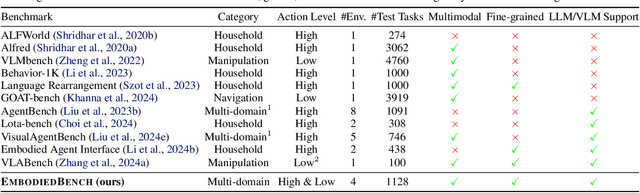
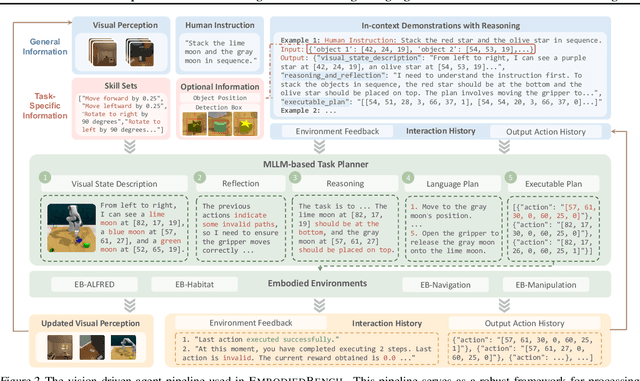
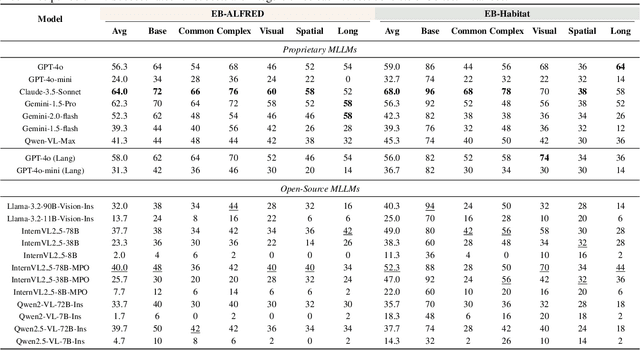
Leveraging Multi-modal Large Language Models (MLLMs) to create embodied agents offers a promising avenue for tackling real-world tasks. While language-centric embodied agents have garnered substantial attention, MLLM-based embodied agents remain underexplored due to the lack of comprehensive evaluation frameworks. To bridge this gap, we introduce EmbodiedBench, an extensive benchmark designed to evaluate vision-driven embodied agents. EmbodiedBench features: (1) a diverse set of 1,128 testing tasks across four environments, ranging from high-level semantic tasks (e.g., household) to low-level tasks involving atomic actions (e.g., navigation and manipulation); and (2) six meticulously curated subsets evaluating essential agent capabilities like commonsense reasoning, complex instruction understanding, spatial awareness, visual perception, and long-term planning. Through extensive experiments, we evaluated 13 leading proprietary and open-source MLLMs within EmbodiedBench. Our findings reveal that: MLLMs excel at high-level tasks but struggle with low-level manipulation, with the best model, GPT-4o, scoring only 28.9% on average. EmbodiedBench provides a multifaceted standardized evaluation platform that not only highlights existing challenges but also offers valuable insights to advance MLLM-based embodied agents. Our code is available at https://embodiedbench.github.io.