 Add to Chrome
 Add to Firefox
 Add to Edge
Try Once, Then Optimal: De-Redundified Procedure Memory for Cross-Episode Exploration Amortization
Jul 26, 2026
Manipulating objects with hidden internal state, such as a latched microwave, forces a robot to probe before it can act. Yet a robot that has solved an instance once re-runs the same probes whenever it encounters that instance again, because existing cross-episode memories target task success and organize reuse around states, not the object or the cost of re-exploring it. We present Instance-Oriented Memory (IOM), an object-centric framework that amortizes this exploration: from a single encounter that uncovers the hidden state, whether or not it succeeds, IOM records a short procedure for manipulating that instance, keys it on the object's identifiable features, and injects it as a soft bias on a procedure-conditioned policy. A later encounter recognizes the object and recalls its procedure instead of re-exploring. We instantiate this distillation with an off-the-shelf vision-language model (VLM) that parses each encounter into the procedure without task-specific training. Across four articulated-object tasks, two in simulation (microwave, door) and two on a real robot (bottle, cabinet), an oracle procedure memory cuts manipulation operations by 16-30% over re-exploration at non-regressing success, and the VLM instantiation recovers 69-88% of that saving out of the box. Because the procedure is a soft bias on a feedback-driven policy, an incorrect memory is recovered from rather than obeyed: success holds even when a retrieved procedure is wrong, as for $\approx$12% of door instances. Across all tasks the benefit is purely one of efficiency: success never regresses, and on the real robot even improves. Code will be released upon acceptance.

When Video Misreads: Closed-Loop Distillation of Reading Heuristics for Exploratory Manipulation Trace QA
Jun 07, 2026Exploratory manipulation often turns an apparent failed attempt into the key evidence for what to do next. For example, a robot pulls a locked cabinet drawer, fails, and only succeeds after opening the lock. The failed pull reveals a latent precondition (the drawer is locked) that determines the minimal-success action chain (the fewest actions that complete the task), here [lock-open, drawer-pull]. Correctly reading this trace is therefore the prerequisite for recovering that chain. We formalize this setting as Exploratory Manipulation Trace QA (EMT-QA): given synchronized video and proprioception from an exploratory trace, predict the minimal-success action chain under the latent precondition revealed by the probe. However, even state-of-the-art VLMs and embodied multimodal LLMs misread this evidence: they do not reliably recover the chain from raw video, raw proprioception, or their combination. We introduce Closed-Loop Trace Distillation, a pipeline that uses a per-task coding agent to inspect labeled training traces and distill a one-line natural-language prompt over the trace, which we call the Distilled Reading Heuristic (DRH). At inference, no agent is invoked and no model weights are updated; a frozen VLM receives the raw trace plus the DRH as a prompt entry. Across three simulator and two real-robot tasks, the DRH improves chain accuracy by +0.38 to +0.47 over the best raw-modality baseline. The same DRH also serves as the sole specification for one-shot programmatic classifiers that match the prompted VLM.
UniLab: A Heterogeneous Architecture for Robot RL Beyond GPU-Dominant Paradigms
Jun 02, 2026Simulation-based RL for contemporary robot control is increasingly organized around GPU-resident simulation: physics, rollout collection, and learning are placed on a single GPU-centric execution path. This paradigm has greatly improved training speed, but it has also encouraged a default assumption that efficient training requires physics to reside on the GPU. We revisit this assumption. Our view is that, in simulation-dominated robot control, the essential question is not which processor runs physics, but whether simulation throughput, policy learning, and runtime synchronization form an efficient end-to-end loop. We present UniLab, a heterogeneous CPU-simulation / GPU-learning architecture that decouples CPU-parallel simulation from GPU policy updates through a unified runtime for data movement, buffering, and synchronization. UniLab is implemented as a complete and extensible training system using MuJoCoUni and MotrixSim CPU-batched physics backends, supporting PPO, FastSAC, FlashSAC, and APPO. On representative simulation-based robot control tasks, UniLab improves end-to-end training efficiency by 3--10$\times$ under the same hardware configuration, while reducing dependence on the NVIDIA CUDA-based software stack and supporting cross-platform execution on the Apple macOS platform and the AMD ROCm and Intel XPU accelerator backends. These results show that GPU simulation is an effective path to efficient training, but not a necessary one, broadening the practical system choices available for robot RL training. Project page: https://unilabsim.github.io.
A Heterogeneous Architecture for Robot RL Beyond GPU-Dominant Paradigms
May 28, 2026Simulation-based RL for contemporary robot control is increasingly organized around GPU-resident simulation: physics, rollout collection, and learning are placed on a single GPU-centric execution path. This paradigm has greatly improved training speed, but it has also encouraged a default assumption that efficient training requires physics to reside on the GPU. We revisit this assumption. Our view is that, in simulation-dominated robot control, the essential question is not which processor runs physics, but whether simulation throughput, policy learning, and runtime synchronization form an efficient end-to-end loop. We present UniLab, a heterogeneous CPU-simulation / GPU-learning architecture that decouples CPU-parallel simulation from GPU policy updates through a unified runtime for data movement, buffering, and synchronization. UniLab is implemented as a complete and extensible training system using MuJoCoUni and MotrixSim CPU-batched physics backends, supporting PPO, SAC, FlashSAC, TD3, and APPO. On representative simulation-based robot control tasks, UniLab improves end-to-end training efficiency by 3--10$\times$ under the same hardware configuration, while reducing dependence on the NVIDIA CUDA-based software stack and supporting cross-platform execution on the Apple macOS platform and the AMD ROCm and Intel XPU accelerator backends. These results show that GPU simulation is an effective path to efficient training, but not a necessary one, broadening the practical system choices available for robot RL training. Project page: https://github.com/unilabsim/UniLab.
GS-Playground: A High-Throughput Photorealistic Simulator for Vision-Informed Robot Learning
Apr 28, 2026Embodied AI research is undergoing a shift toward vision-centric perceptual paradigms. While massively parallel simulators have catalyzed breakthroughs in proprioception-based locomotion, their potential remains largely untapped for vision-informed tasks due to the prohibitive computational overhead of large-scale photorealistic rendering. Furthermore, the creation of simulation-ready 3D assets heavily relies on labor-intensive manual modeling, while the significant sim-to-real physical gap hinders the transfer of contact-rich manipulation policies. To address these bottlenecks, we propose GS-Playground, a multi-modal simulation framework designed to accelerate end-to-end perceptual learning. We develop a novel high-performance parallel physics engine, specifically designed to integrate with a batch 3D Gaussian Splatting (3DGS) rendering pipeline to ensure high-fidelity synchronization. Our system achieves a breakthrough throughput of 10^4 FPS at 640x480 resolution, significantly lowering the barrier for large-scale visual RL. Additionally, we introduce an automated Real2Sim workflow that reconstructs photorealistic, physically consistent, and memory-efficient environments, streamlining the generation of complex simulation-ready scenes. Extensive experiments on locomotion, navigation, and manipulation demonstrate that GS-Playground effectively bridges the perceptual and physical gaps across diverse embodied tasks. Project homepage: https://gsplayground.github.io.
DISCOVERSE: Efficient Robot Simulation in Complex High-Fidelity Environments
Jul 29, 2025We present the first unified, modular, open-source 3DGS-based simulation framework for Real2Sim2Real robot learning. It features a holistic Real2Sim pipeline that synthesizes hyper-realistic geometry and appearance of complex real-world scenarios, paving the way for analyzing and bridging the Sim2Real gap. Powered by Gaussian Splatting and MuJoCo, Discoverse enables massively parallel simulation of multiple sensor modalities and accurate physics, with inclusive supports for existing 3D assets, robot models, and ROS plugins, empowering large-scale robot learning and complex robotic benchmarks. Through extensive experiments on imitation learning, Discoverse demonstrates state-of-the-art zero-shot Sim2Real transfer performance compared to existing simulators. For code and demos: https://air-discoverse.github.io/.
Wavelet Policy: Imitation Policy Learning in Frequency Domain with Wavelet Transforms
Apr 07, 2025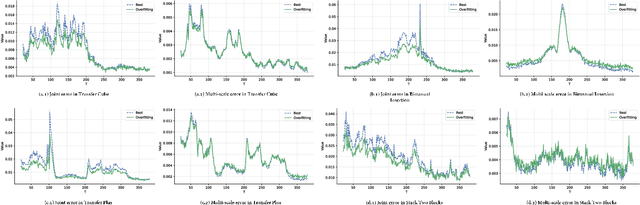


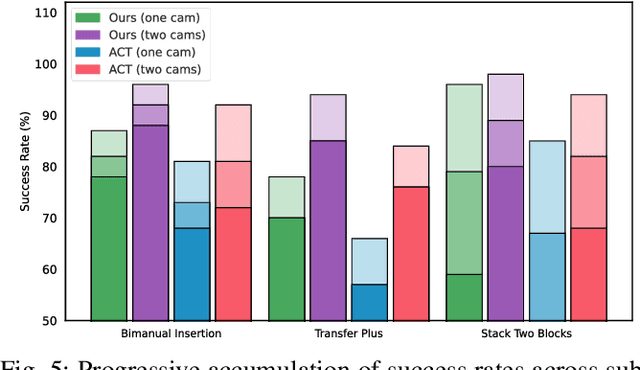
Recent imitation learning policies, often framed as time series prediction tasks, directly map robotic observations-such as high-dimensional visual data and proprioception-into the action space. While time series prediction primarily relies on spatial domain modeling, the underutilization of frequency domain analysis in robotic manipulation trajectory prediction may lead to neglecting the inherent temporal information embedded within action sequences. To address this, we reframe imitation learning policies through the lens of the frequency domain and introduce the Wavelet Policy. This novel approach employs wavelet transforms (WT) for feature preprocessing and extracts multi-scale features from the frequency domain using the SE2MD (Single Encoder to Multiple Decoder) architecture. Furthermore, to enhance feature mapping in the frequency domain and increase model capacity, we introduce a Learnable Frequency-Domain Filter (LFDF) after each frequency decoder, improving adaptability under different visual conditions. Our results show that the Wavelet Policy outperforms state-of-the-art (SOTA) end-to-end methods by over 10% on four challenging robotic arm tasks, while maintaining a comparable parameter count. In long-range settings, its performance declines more slowly as task volume increases. The code will be publicly available.
Bridging the Resource Gap: Deploying Advanced Imitation Learning Models onto Affordable Embedded Platforms
Nov 18, 2024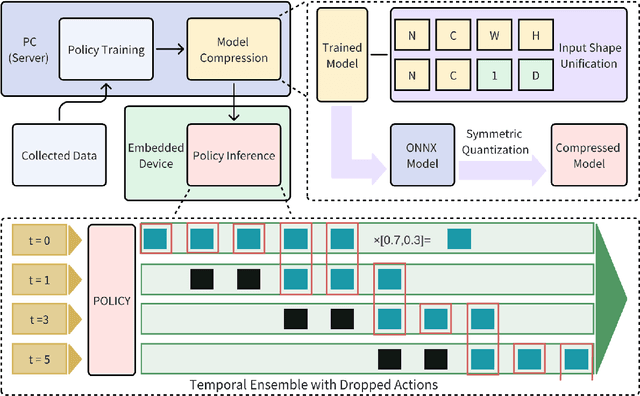
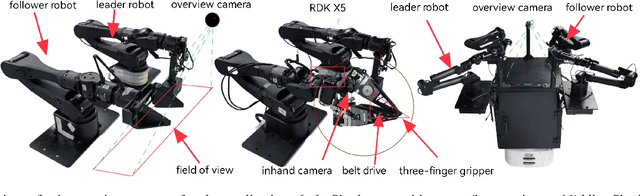
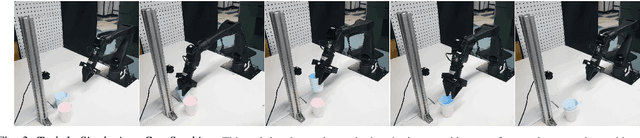

Advanced imitation learning with structures like the transformer is increasingly demonstrating its advantages in robotics. However, deploying these large-scale models on embedded platforms remains a major challenge. In this paper, we propose a pipeline that facilitates the migration of advanced imitation learning algorithms to edge devices. The process is achieved via an efficient model compression method and a practical asynchronous parallel method Temporal Ensemble with Dropped Actions (TEDA) that enhances the smoothness of operations. To show the efficiency of the proposed pipeline, large-scale imitation learning models are trained on a server and deployed on an edge device to complete various manipulation tasks.