 Add to Chrome
 Add to Firefox
 Add to Edge
Synthesizing Moving People with 3D Control
Jan 19, 2024
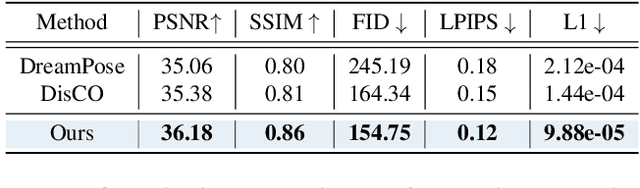
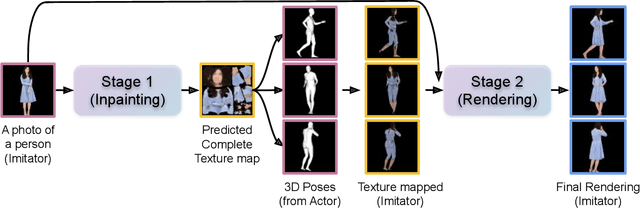
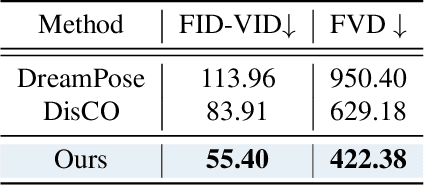
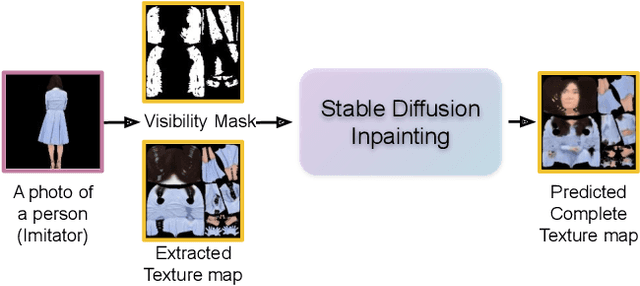
In this paper, we present a diffusion model-based framework for animating people from a single image for a given target 3D motion sequence. Our approach has two core components: a) learning priors about invisible parts of the human body and clothing, and b) rendering novel body poses with proper clothing and texture. For the first part, we learn an in-filling diffusion model to hallucinate unseen parts of a person given a single image. We train this model on texture map space, which makes it more sample-efficient since it is invariant to pose and viewpoint. Second, we develop a diffusion-based rendering pipeline, which is controlled by 3D human poses. This produces realistic renderings of novel poses of the person, including clothing, hair, and plausible in-filling of unseen regions. This disentangled approach allows our method to generate a sequence of images that are faithful to the target motion in the 3D pose and, to the input image in terms of visual similarity. In addition to that, the 3D control allows various synthetic camera trajectories to render a person. Our experiments show that our method is resilient in generating prolonged motions and varied challenging and complex poses compared to prior methods. Please check our website for more details: https://boyiliee.github.io/3DHM.github.io/.

Dr$^2$Net: Dynamic Reversible Dual-Residual Networks for Memory-Efficient Finetuning
Jan 08, 2024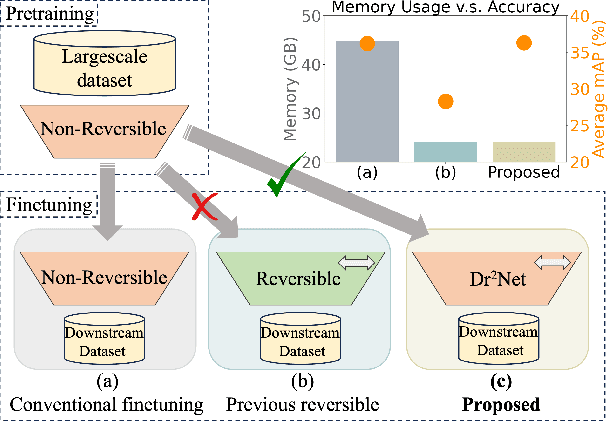

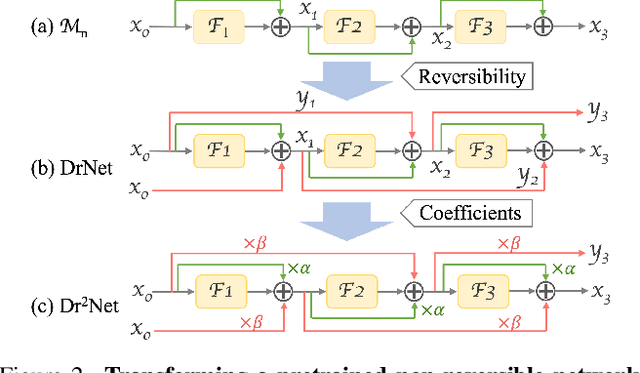
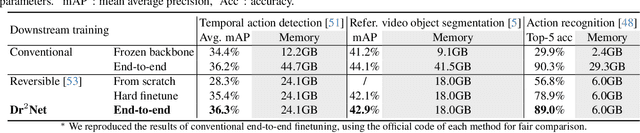
Large pretrained models are increasingly crucial in modern computer vision tasks. These models are typically used in downstream tasks by end-to-end finetuning, which is highly memory-intensive for tasks with high-resolution data, e.g., video understanding, small object detection, and point cloud analysis. In this paper, we propose Dynamic Reversible Dual-Residual Networks, or Dr$^2$Net, a novel family of network architectures that acts as a surrogate network to finetune a pretrained model with substantially reduced memory consumption. Dr$^2$Net contains two types of residual connections, one maintaining the residual structure in the pretrained models, and the other making the network reversible. Due to its reversibility, intermediate activations, which can be reconstructed from output, are cleared from memory during training. We use two coefficients on either type of residual connections respectively, and introduce a dynamic training strategy that seamlessly transitions the pretrained model to a reversible network with much higher numerical precision. We evaluate Dr$^2$Net on various pretrained models and various tasks, and show that it can reach comparable performance to conventional finetuning but with significantly less memory usage.
Neural feels with neural fields: Visuo-tactile perception for in-hand manipulation
Dec 20, 2023To achieve human-level dexterity, robots must infer spatial awareness from multimodal sensing to reason over contact interactions. During in-hand manipulation of novel objects, such spatial awareness involves estimating the object's pose and shape. The status quo for in-hand perception primarily employs vision, and restricts to tracking a priori known objects. Moreover, visual occlusion of objects in-hand is imminent during manipulation, preventing current systems to push beyond tasks without occlusion. We combine vision and touch sensing on a multi-fingered hand to estimate an object's pose and shape during in-hand manipulation. Our method, NeuralFeels, encodes object geometry by learning a neural field online and jointly tracks it by optimizing a pose graph problem. We study multimodal in-hand perception in simulation and the real-world, interacting with different objects via a proprioception-driven policy. Our experiments show final reconstruction F-scores of $81$% and average pose drifts of $4.7\,\text{mm}$, further reduced to $2.3\,\text{mm}$ with known CAD models. Additionally, we observe that under heavy visual occlusion we can achieve up to $94$% improvements in tracking compared to vision-only methods. Our results demonstrate that touch, at the very least, refines and, at the very best, disambiguates visual estimates during in-hand manipulation. We release our evaluation dataset of 70 experiments, FeelSight, as a step towards benchmarking in this domain. Our neural representation driven by multimodal sensing can serve as a perception backbone towards advancing robot dexterity. Videos can be found on our project website https://suddhu.github.io/neural-feels/
Adaptive Human Trajectory Prediction via Latent Corridors
Dec 11, 2023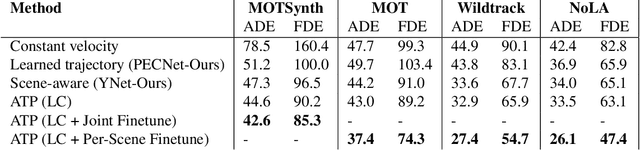
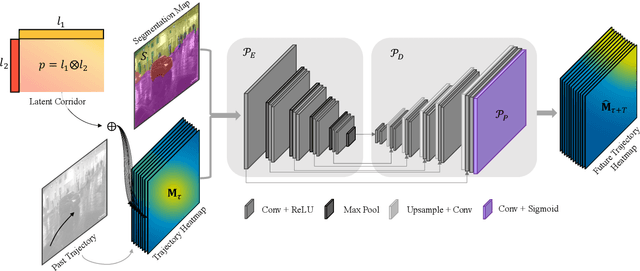
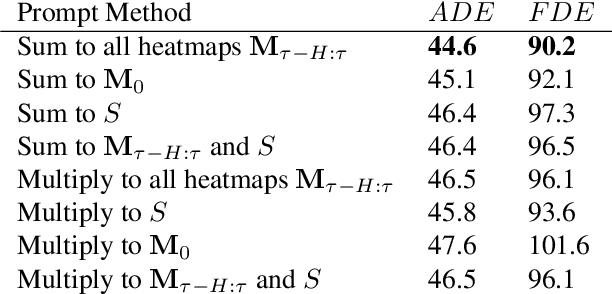
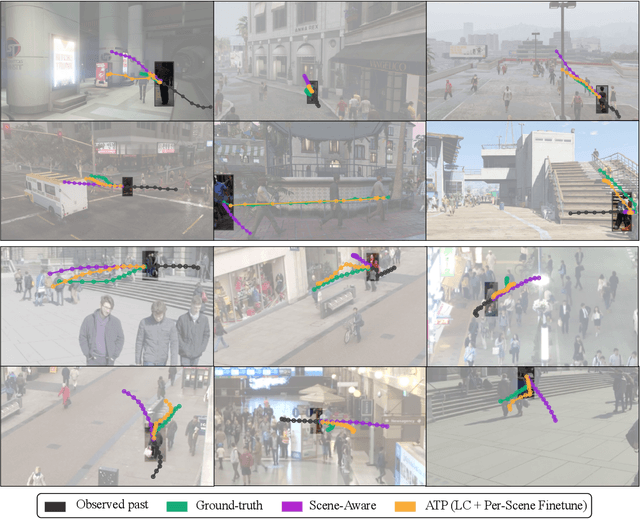
Human trajectory prediction is typically posed as a zero-shot generalization problem: a predictor is learnt on a dataset of human motion in training scenes, and then deployed on unseen test scenes. While this paradigm has yielded tremendous progress, it fundamentally assumes that trends in human behavior within the deployment scene are constant over time. As such, current prediction models are unable to adapt to scene-specific transient human behaviors, such as crowds temporarily gathering to see buskers, pedestrians hurrying through the rain and avoiding puddles, or a protest breaking out. We formalize the problem of scene-specific adaptive trajectory prediction and propose a new adaptation approach inspired by prompt tuning called latent corridors. By augmenting the input of any pre-trained human trajectory predictor with learnable image prompts, the predictor can improve in the deployment scene by inferring trends from extremely small amounts of new data (e.g., 2 humans observed for 30 seconds). With less than 0.1% additional model parameters, we see up to 23.9% ADE improvement in MOTSynth simulated data and 16.4% ADE in MOT and Wildtrack real pedestrian data. Qualitatively, we observe that latent corridors imbue predictors with an awareness of scene geometry and scene-specific human behaviors that non-adaptive predictors struggle to capture. The project website can be found at https://neerja.me/atp_latent_corridors/.
Reconstructing Hands in 3D with Transformers
Dec 08, 2023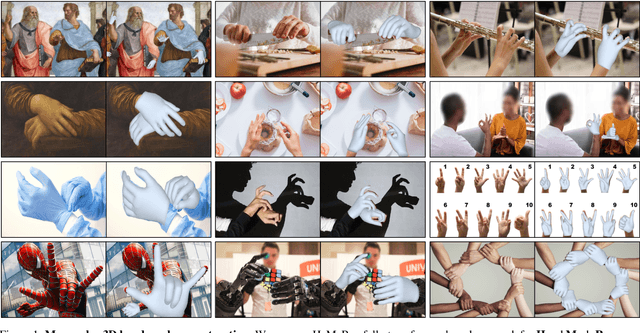
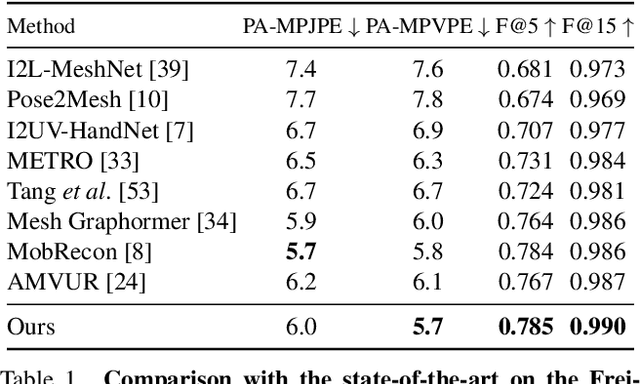
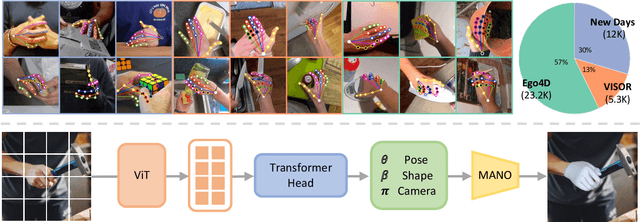
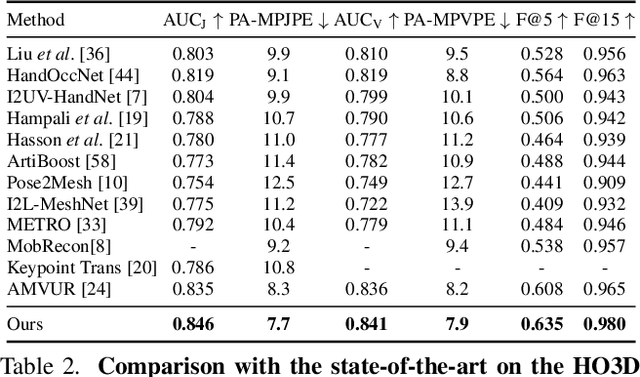
We present an approach that can reconstruct hands in 3D from monocular input. Our approach for Hand Mesh Recovery, HaMeR, follows a fully transformer-based architecture and can analyze hands with significantly increased accuracy and robustness compared to previous work. The key to HaMeR's success lies in scaling up both the data used for training and the capacity of the deep network for hand reconstruction. For training data, we combine multiple datasets that contain 2D or 3D hand annotations. For the deep model, we use a large scale Vision Transformer architecture. Our final model consistently outperforms the previous baselines on popular 3D hand pose benchmarks. To further evaluate the effect of our design in non-controlled settings, we annotate existing in-the-wild datasets with 2D hand keypoint annotations. On this newly collected dataset of annotations, HInt, we demonstrate significant improvements over existing baselines. We make our code, data and models available on the project website: https://geopavlakos.github.io/hamer/.
Sequential Modeling Enables Scalable Learning for Large Vision Models
Dec 01, 2023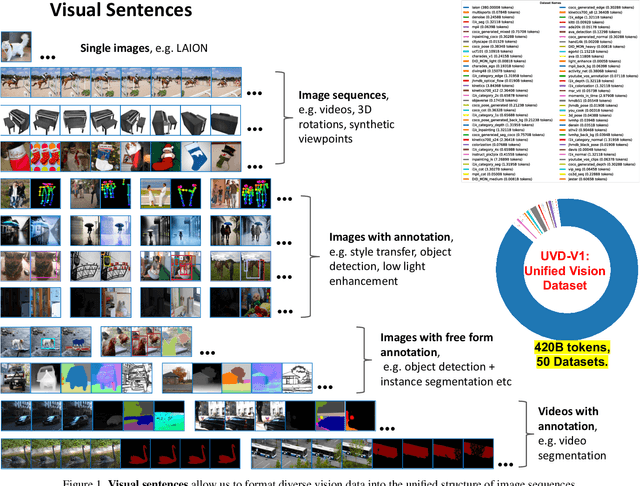
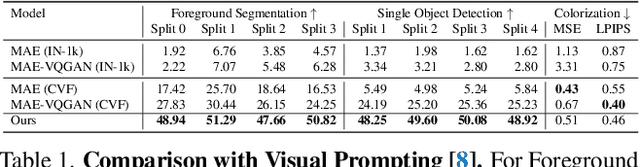
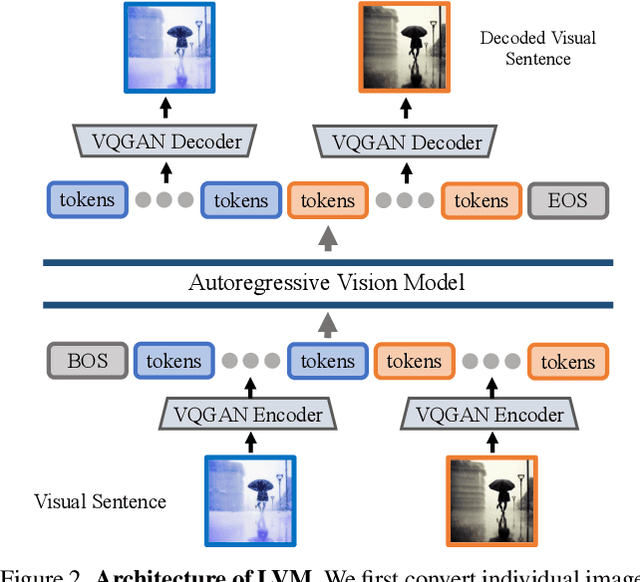
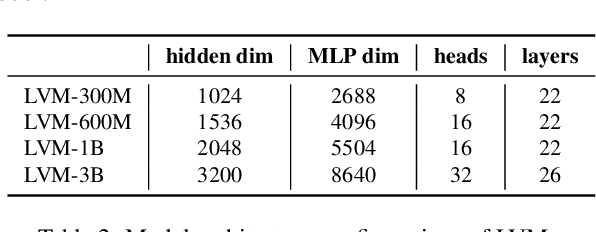
We introduce a novel sequential modeling approach which enables learning a Large Vision Model (LVM) without making use of any linguistic data. To do this, we define a common format, "visual sentences", in which we can represent raw images and videos as well as annotated data sources such as semantic segmentations and depth reconstructions without needing any meta-knowledge beyond the pixels. Once this wide variety of visual data (comprising 420 billion tokens) is represented as sequences, the model can be trained to minimize a cross-entropy loss for next token prediction. By training across various scales of model architecture and data diversity, we provide empirical evidence that our models scale effectively. Many different vision tasks can be solved by designing suitable visual prompts at test time.
Ego-Exo4D: Understanding Skilled Human Activity from First- and Third-Person Perspectives
Nov 30, 2023
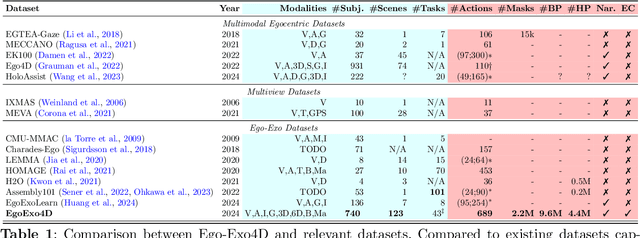

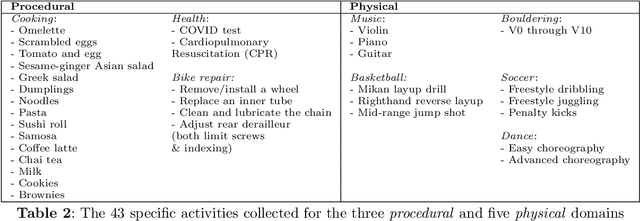
We present Ego-Exo4D, a diverse, large-scale multimodal multiview video dataset and benchmark challenge. Ego-Exo4D centers around simultaneously-captured egocentric and exocentric video of skilled human activities (e.g., sports, music, dance, bike repair). More than 800 participants from 13 cities worldwide performed these activities in 131 different natural scene contexts, yielding long-form captures from 1 to 42 minutes each and 1,422 hours of video combined. The multimodal nature of the dataset is unprecedented: the video is accompanied by multichannel audio, eye gaze, 3D point clouds, camera poses, IMU, and multiple paired language descriptions -- including a novel "expert commentary" done by coaches and teachers and tailored to the skilled-activity domain. To push the frontier of first-person video understanding of skilled human activity, we also present a suite of benchmark tasks and their annotations, including fine-grained activity understanding, proficiency estimation, cross-view translation, and 3D hand/body pose. All resources will be open sourced to fuel new research in the community.
GOAT: GO to Any Thing
Nov 10, 2023


In deployment scenarios such as homes and warehouses, mobile robots are expected to autonomously navigate for extended periods, seamlessly executing tasks articulated in terms that are intuitively understandable by human operators. We present GO To Any Thing (GOAT), a universal navigation system capable of tackling these requirements with three key features: a) Multimodal: it can tackle goals specified via category labels, target images, and language descriptions, b) Lifelong: it benefits from its past experience in the same environment, and c) Platform Agnostic: it can be quickly deployed on robots with different embodiments. GOAT is made possible through a modular system design and a continually augmented instance-aware semantic memory that keeps track of the appearance of objects from different viewpoints in addition to category-level semantics. This enables GOAT to distinguish between different instances of the same category to enable navigation to targets specified by images and language descriptions. In experimental comparisons spanning over 90 hours in 9 different homes consisting of 675 goals selected across 200+ different object instances, we find GOAT achieves an overall success rate of 83%, surpassing previous methods and ablations by 32% (absolute improvement). GOAT improves with experience in the environment, from a 60% success rate at the first goal to a 90% success after exploration. In addition, we demonstrate that GOAT can readily be applied to downstream tasks such as pick and place and social navigation.
Conformal Policy Learning for Sensorimotor Control Under Distribution Shifts
Nov 02, 2023This paper focuses on the problem of detecting and reacting to changes in the distribution of a sensorimotor controller's observables. The key idea is the design of switching policies that can take conformal quantiles as input, which we define as conformal policy learning, that allows robots to detect distribution shifts with formal statistical guarantees. We show how to design such policies by using conformal quantiles to switch between base policies with different characteristics, e.g. safety or speed, or directly augmenting a policy observation with a quantile and training it with reinforcement learning. Theoretically, we show that such policies achieve the formal convergence guarantees in finite time. In addition, we thoroughly evaluate their advantages and limitations on two compelling use cases: simulated autonomous driving and active perception with a physical quadruped. Empirical results demonstrate that our approach outperforms five baselines. It is also the simplest of the baseline strategies besides one ablation. Being easy to use, flexible, and with formal guarantees, our work demonstrates how conformal prediction can be an effective tool for sensorimotor learning under uncertainty.
Habitat 3.0: A Co-Habitat for Humans, Avatars and Robots
Oct 19, 2023

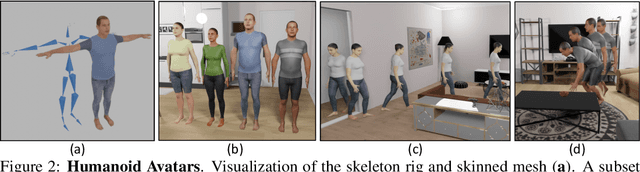

We present Habitat 3.0: a simulation platform for studying collaborative human-robot tasks in home environments. Habitat 3.0 offers contributions across three dimensions: (1) Accurate humanoid simulation: addressing challenges in modeling complex deformable bodies and diversity in appearance and motion, all while ensuring high simulation speed. (2) Human-in-the-loop infrastructure: enabling real human interaction with simulated robots via mouse/keyboard or a VR interface, facilitating evaluation of robot policies with human input. (3) Collaborative tasks: studying two collaborative tasks, Social Navigation and Social Rearrangement. Social Navigation investigates a robot's ability to locate and follow humanoid avatars in unseen environments, whereas Social Rearrangement addresses collaboration between a humanoid and robot while rearranging a scene. These contributions allow us to study end-to-end learned and heuristic baselines for human-robot collaboration in-depth, as well as evaluate them with humans in the loop. Our experiments demonstrate that learned robot policies lead to efficient task completion when collaborating with unseen humanoid agents and human partners that might exhibit behaviors that the robot has not seen before. Additionally, we observe emergent behaviors during collaborative task execution, such as the robot yielding space when obstructing a humanoid agent, thereby allowing the effective completion of the task by the humanoid agent. Furthermore, our experiments using the human-in-the-loop tool demonstrate that our automated evaluation with humanoids can provide an indication of the relative ordering of different policies when evaluated with real human collaborators. Habitat 3.0 unlocks interesting new features in simulators for Embodied AI, and we hope it paves the way for a new frontier of embodied human-AI interaction capabilities.