 Add to Chrome
 Add to Firefox
 Add to Edge
Semi-Supervised Hypothesis Testing by Betting on Predictions
May 27, 2026
We introduce a testing-by-betting framework that leverages predictions on unlabeled data to enhance the power of sequential hypothesis testing. Given limited samples from the joint distribution of $(X,Y)$, and additional unlabeled samples from the marginal of $X$, we ask how unlabeled data can be used to hypothesize about the distribution of $Y$, and the conditional distribution of $Y\mid X$. We introduce an e-statistic and use it to construct a sequential test. Under standard distributional assumptions -- label shift or concept shift -- we establish that the test is anytime valid. Furthermore, we show that for binary data, the e-statistic has non-trivial power. Crucially, our approach retains these properties even when the underlying predictions are inaccurate. Through simulations and applications to large language models evaluation, we demonstrate power gains over baseline approaches, including prediction-powered inference. These gains persist even with relatively limited unlabeled data and when predictions have low accuracy due to weak correlation between $X$ and $Y$.

Selective Safety Steering via Value-Filtered Decoding
May 14, 2026While large language models (LLMs) are trained to align with human values, their generations may still violate safety constraints. A growing line of work addresses this problem by modifying the model's sampling policy at decoding time using a safety reward. However, existing decoding-time steering methods often intervene unnecessarily, modifying generations that would have been safe under the base model. Such unnecessary interventions are undesirable, as they can distort key properties of the base model such as helpfulness, fluency, style, and coherence. We propose a new test-time steering method designed to reduce such unnecessary interventions while improving the safety of unsafe responses. Our approach filters tokens using a value-based safety criterion and provides an explicit bound on the probability of false interventions. A single threshold hyperparameter controls this bound, allowing practitioners to trade off higher rates of unnecessary intervention for better output safety. Across multiple datasets and experiments, we show that our value-filtered decoding method outperforms existing baselines, achieving better trade-offs between safety, helpfulness, and similarity to the base model.
Valid Best-Model Identification for LLM Evaluation via Low-Rank Factorization
May 11, 2026Selecting the best large language model (LLM) for a fixed benchmark is often expensive, since exhaustive evaluation requires running every model on every example. Multi-armed bandit (MAB) algorithms can reduce the number of LLM calls by sequentially selecting the next model-example pair to evaluate, thereby avoiding wasted evaluations on clearly underperforming models. Further savings can be achieved by predicting model scores from the partially observed model-example score matrix using low-rank factorization. However, such predictions are not ground truth: they can be biased and may therefore lead to incorrect identification of the best model. In this work, we propose a principled framework that combines MAB with cheap predicted scores without compromising statistical validity. Specifically, we derive doubly robust estimators of each model's performance that use the low-rank predictions to reduce variance. This enables the construction of valid finite-sample confidence intervals in our setting, where models are selected adaptively and examples are sampled without replacement. Empirical results on real-world benchmarks show that our approach reduces the number of required evaluations, yielding meaningful savings in compute and cost while accurately identifying the best-performing model.
How Many Iterations to Jailbreak? Dynamic Budget Allocation for Multi-Turn LLM Evaluation
May 07, 2026Evaluating and predicting the performance of large language models (LLMs) in multi-turn conversational settings is critical yet computationally expensive; key events -- e.g., jailbreaks or successful task completion by an agent -- often emerge only after repeated interactions. These events might be rare, and under any feasible computational budget, remain unobserved. Recent conformal survival frameworks construct reliable lower predictive bounds (LPBs) on the number of iterations to trigger the event of interest, but rely on static budget allocation that is inefficient in multi-turn setups. To address this, we introduce \emph{Dynamic Allocation via PRojected Optimization} (DAPRO), the first theoretically valid dynamic budget allocation framework for bounding the time-to-event in multi-turn LLM interactions. We prove that DAPRO satisfies the budget constraint and provides distribution-free, finite-sample coverage guarantees without requiring the conditional independence between censoring and event times assumed by prior conformal survival approaches. A key theoretical contribution is a novel coverage bound that scales with the square root of the mean censoring weight rather than the worst-case weight, yielding provably tighter guarantees than prior work. Furthermore, DAPRO can be employed to obtain unbiased, low-variance estimates of population-level evaluation metrics, such as the jailbreak rate, under limited computing resources. Comprehensive experiments across agentic task success, adversarial jailbreaks, toxic content generation, and RAG hallucinations using LLMs such as Llama 3.1 and Qwen 2.5 demonstrate that DAPRO consistently achieves coverage closer to the nominal level with lower variance than static baselines, while satisfying the budget constraint.
Temporal Difference Calibration in Sequential Tasks: Application to Vision-Language-Action Models
Apr 22, 2026Recent advances in vision-language-action (VLA) models for robotics have highlighted the importance of reliable uncertainty quantification in sequential tasks. However, assessing and improving calibration in such settings remains mostly unexplored, especially when only partial trajectories are observed. In this work, we formulate sequential calibration for episodic tasks, where task-success confidence is produced along an episode, while success is determined at the end of it. We introduce a sequential extension of the Brier score and show that, for binary outcomes, its risk minimizer coincides with the VLA policy's value function. This connection bridges uncertainty calibration and reinforcement learning, enabling the use of temporal-difference (TD) value estimation as a principled calibration mechanism over time. We empirically show that TD calibration improves performance relative to the state-of-the-art on simulated and real-robot data. Interestingly, we show that when calibrated using TD, the VLA's single-step action probabilities can yield competitive uncertainty estimates, in contrast to recent findings that employed different calibration techniques.
Accelerating Speculative Decoding with Block Diffusion Draft Trees
Apr 14, 2026Speculative decoding accelerates autoregressive language models by using a lightweight drafter to propose multiple future tokens, which the target model then verifies in parallel. DFlash shows that a block diffusion drafter can generate an entire draft block in a single forward pass and achieve state-of-the-art speculative decoding performance, outperforming strong autoregressive drafters such as EAGLE-3. Vanilla DFlash, however, still verifies only a single drafted trajectory per round, potentially limiting its acceptance length. We introduce DDTree (Diffusion Draft Tree), a method that constructs a draft tree directly from the per-position distributions of a block diffusion drafter. Under a fixed node budget, DDTree uses a simple best-first heap algorithm to select the continuations that are most likely to match the target model according to a surrogate defined by the draft model's output. The resulting tree is verified efficiently in a single target model forward pass using an ancestor-only attention mask. Because DDTree builds on DFlash, a leading draft model for speculative decoding, these gains place DDTree among the leading approaches to speculative decoding.
Dependency-Guided Parallel Decoding in Discrete Diffusion Language Models
Apr 02, 2026Discrete diffusion language models (dLLMs) accelerate text generation by unmasking multiple tokens in parallel. However, parallel decoding introduces a distributional mismatch: it approximates the joint conditional using a fully factorized product of per-token marginals, which degrades output quality when selected tokens are strongly dependent. We propose DEMASK (DEpendency-guided unMASKing), a lightweight dependency predictor that attaches to the final hidden states of a dLLM. In a single forward pass, it estimates pairwise conditional influences between masked positions. Using these predictions, a greedy selection algorithm identifies positions with bounded cumulative dependency for simultaneous unmasking. Under a sub-additivity assumption, we prove this bounds the total variation distance between our parallel sampling and the model's joint. Empirically, DEMASK achieves 1.7-2.2$\times$ speedup on Dream-7B while matching or improving accuracy compared to confidence-based and KL-based baselines.
Synthetic-Powered Multiple Testing with FDR Control
Feb 18, 2026Multiple hypothesis testing with false discovery rate (FDR) control is a fundamental problem in statistical inference, with broad applications in genomics, drug screening, and outlier detection. In many such settings, researchers may have access not only to real experimental observations but also to auxiliary or synthetic data -- from past, related experiments or generated by generative models -- that can provide additional evidence about the hypotheses of interest. We introduce SynthBH, a synthetic-powered multiple testing procedure that safely leverages such synthetic data. We prove that SynthBH guarantees finite-sample, distribution-free FDR control under a mild PRDS-type positive dependence condition, without requiring the pooled-data p-values to be valid under the null. The proposed method adapts to the (unknown) quality of the synthetic data: it enhances the sample efficiency and may boost the power when synthetic data are of high quality, while controlling the FDR at a user-specified level regardless of their quality. We demonstrate the empirical performance of SynthBH on tabular outlier detection benchmarks and on genomic analyses of drug-cancer sensitivity associations, and further study its properties through controlled experiments on simulated data.
Testing For Distribution Shifts with Conditional Conformal Test Martingales
Feb 14, 2026We propose a sequential test for detecting arbitrary distribution shifts that allows conformal test martingales (CTMs) to work under a fixed, reference-conditional setting. Existing CTM detectors construct test martingales by continually growing a reference set with each incoming sample, using it to assess how atypical the new sample is relative to past observations. While this design yields anytime-valid type-I error control, it suffers from test-time contamination: after a change, post-shift observations enter the reference set and dilute the evidence for distribution shift, increasing detection delay and reducing power. In contrast, our method avoids contamination by design by comparing each new sample to a fixed null reference dataset. Our main technical contribution is a robust martingale construction that remains valid conditional on the null reference data, achieved by explicitly accounting for the estimation error in the reference distribution induced by the finite reference set. This yields anytime-valid type-I error control together with guarantees of asymptotic power one and bounded expected detection delay. Empirically, our method detects shifts faster than standard CTMs, providing a powerful and reliable distribution-shift detector.
Prediction-Powered Semi-Supervised Learning with Online Power Tuning
Oct 26, 2025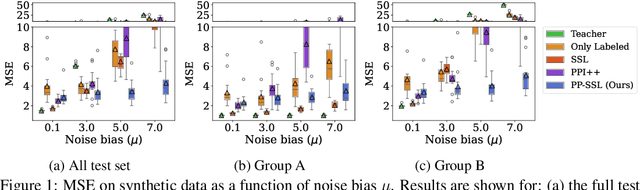
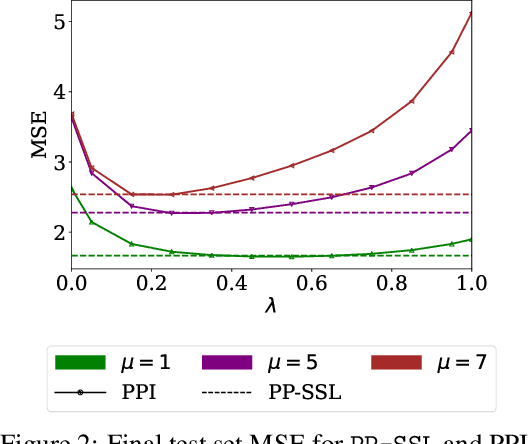
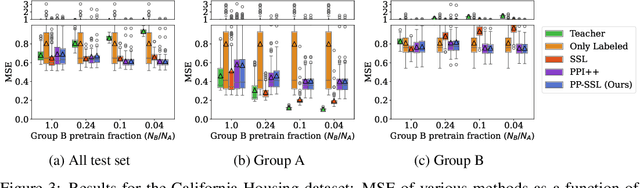
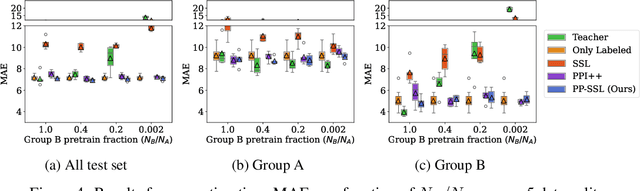
Prediction-Powered Inference (PPI) is a recently proposed statistical inference technique for parameter estimation that leverages pseudo-labels on both labeled and unlabeled data to construct an unbiased, low-variance estimator. In this work, we extend its core idea to semi-supervised learning (SSL) for model training, introducing a novel unbiased gradient estimator. This extension addresses a key challenge in SSL: while unlabeled data can improve model performance, its benefit heavily depends on the quality of pseudo-labels. Inaccurate pseudo-labels can introduce bias, leading to suboptimal models.To balance the contributions of labeled and pseudo-labeled data, we utilize an interpolation parameter and tune it on the fly, alongside the model parameters, using a one-dimensional online learning algorithm. We verify the practical advantage of our approach through experiments on both synthetic and real datasets, demonstrating improved performance over classic SSL baselines and PPI methods that tune the interpolation parameter offline.