 Add to Chrome
 Add to Firefox
 Add to Edge
Beyond Safe Data: Pretraining-Stage Alignment with Regular Safety Reflection
Jun 17, 2026
To achieve deeper safety alignment for large language models (LLMs), recent efforts have studied how to push safety interventions earlier into the pretraining stage, primarily by filtering unsafe data or rewriting it into safer forms. We argue that pretraining-stage alignment should go beyond making the data safe: LLMs may compose seemingly benign knowledge and capabilities into unsafe behaviors. To this end, we propose Safety Reflection Pretraining, a pretraining-stage alignment method which regularly inserts short safety reflections into pretraining corpora to integrate self-monitoring directly into language modeling, establishing a foundational capability that is subsequently reinforced by compatible post-training. Our experiments with 1.7B models pretrained on FineWeb-Edu show that Safety Reflection Pretraining improves safety classification accuracy and substantially reduces the success rates of inference-stage and finetuning attacks. Complementary to our real-world experiments, we also introduce a fully controlled synthetic environment, MedSafetyWorld, with a clear definition of safety and a reasoning structure under which models can easily generalize unsafe behaviors from safe data. Ablations in MedSafetyWorld further demonstrate a clear advantage of Safety Reflection Pretraining in preventing models from acting on unsafe behaviors generalized from safe data, compared with data filtering and rewriting. Taken together, our findings suggest that pretraining alignment should not only make the training data safe, but also shape the behaviors that models are likely to acquire from safe data.

SPA: A Simple but Tough-to-Beat Baseline for Knowledge Injection
Mar 23, 2026While large language models (LLMs) are pretrained on massive amounts of data, their knowledge coverage remains incomplete in specialized, data-scarce domains, motivating extensive efforts to study synthetic data generation for knowledge injection. We propose SPA (Scaling Prompt-engineered Augmentation), a simple but tough-to-beat baseline that uses a small set of carefully designed prompts to generate large-scale synthetic data for knowledge injection. Through systematic comparisons, we find that SPA outperforms several strong baselines. Furthermore, we identify two key limitations of prior approaches: (1) while RL-based methods may improve the token efficiency of LLM-based data augmentation at small scale, they suffer from diversity collapse as data scales, leading to diminishing returns; and (2) while multi-stage prompting may outperform simple augmentation methods, their advantages can disappear after careful prompt tuning. Our results suggest that, for knowledge injection, careful prompt design combined with straightforward large-scale augmentation can be surprisingly effective, and we hope SPA can serve as a strong baseline for future studies in this area. Our code is available at https://github.com/Tangkexian/SPA.
Envisioning Beyond the Pixels: Benchmarking Reasoning-Informed Visual Editing
Apr 03, 2025Large Multi-modality Models (LMMs) have made significant progress in visual understanding and generation, but they still face challenges in General Visual Editing, particularly in following complex instructions, preserving appearance consistency, and supporting flexible input formats. To address this gap, we introduce RISEBench, the first benchmark for evaluating Reasoning-Informed viSual Editing (RISE). RISEBench focuses on four key reasoning types: Temporal, Causal, Spatial, and Logical Reasoning. We curate high-quality test cases for each category and propose an evaluation framework that assesses Instruction Reasoning, Appearance Consistency, and Visual Plausibility with both human judges and an LMM-as-a-judge approach. Our experiments reveal that while GPT-4o-Native significantly outperforms other open-source and proprietary models, even this state-of-the-art system struggles with logical reasoning tasks, highlighting an area that remains underexplored. As an initial effort, RISEBench aims to provide foundational insights into reasoning-aware visual editing and to catalyze future research. Though still in its early stages, we are committed to continuously expanding and refining the benchmark to support more comprehensive, reliable, and scalable evaluations of next-generation multimodal systems. Our code and data will be released at https://github.com/PhoenixZ810/RISEBench.
LEGO-Puzzles: How Good Are MLLMs at Multi-Step Spatial Reasoning?
Mar 25, 2025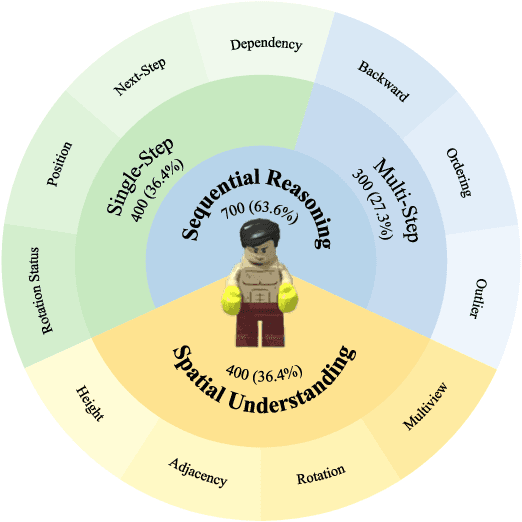
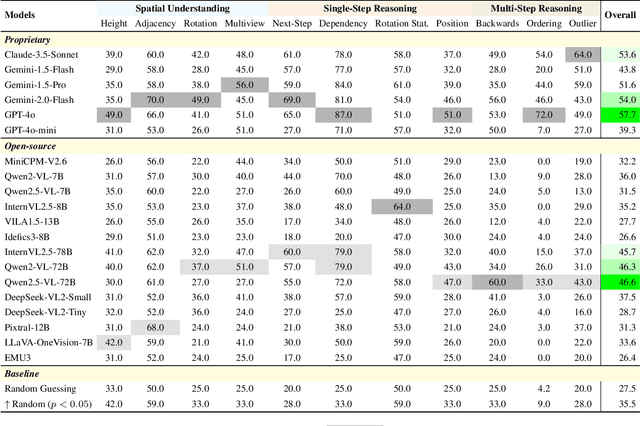
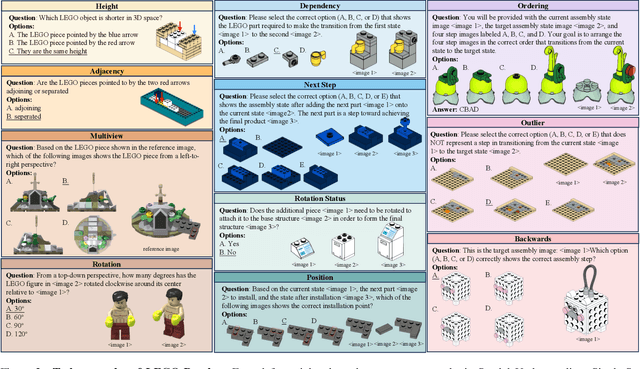
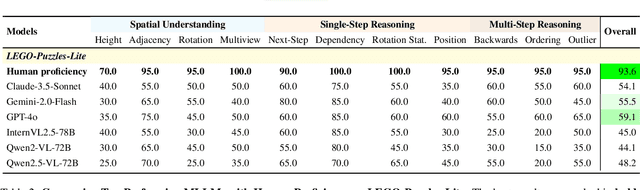
Multi-step spatial reasoning entails understanding and reasoning about spatial relationships across multiple sequential steps, which is crucial for tackling complex real-world applications, such as robotic manipulation, autonomous navigation, and automated assembly. To assess how well current Multimodal Large Language Models (MLLMs) have acquired this fundamental capability, we introduce \textbf{LEGO-Puzzles}, a scalable benchmark designed to evaluate both \textbf{spatial understanding} and \textbf{sequential reasoning} in MLLMs through LEGO-based tasks. LEGO-Puzzles consists of 1,100 carefully curated visual question-answering (VQA) samples spanning 11 distinct tasks, ranging from basic spatial understanding to complex multi-step reasoning. Based on LEGO-Puzzles, we conduct a comprehensive evaluation of state-of-the-art MLLMs and uncover significant limitations in their spatial reasoning capabilities: even the most powerful MLLMs can answer only about half of the test cases, whereas human participants achieve over 90\% accuracy. In addition to VQA tasks, we evaluate MLLMs' abilities to generate LEGO images following assembly illustrations. Our experiments show that only Gemini-2.0-Flash and GPT-4o exhibit a limited ability to follow these instructions, while other MLLMs either replicate the input image or generate completely irrelevant outputs. Overall, LEGO-Puzzles exposes critical deficiencies in existing MLLMs' spatial understanding and sequential reasoning capabilities, and underscores the need for further advancements in multimodal spatial reasoning.