 Add to Chrome
 Add to Firefox
 Add to Edge
Combating Knowledge Corruption in Agent Systems: A Byzantine-Tolerant Secure Collaborative RAG Framework
Aug 05, 2026
While retrieval-augmented generation systems partially address the hallucination issues in large language models, it also introduces new vulnerabilities to knowledge corruption attacks. Adversaries exploit these vulnerabilities by poisoning documents provided by RAG system to manipulate LLM outputs. To counter this threat, we propose SecureCollaRAG, a Byzantine-tolerant collaborative RAG framework leveraging Multi-source Knowledge Validation Mechanism. Our approach enables agent system to securely verify document provenance through dynamic GNN-based credibility scoring, effectively preventing stealthy knowledge corruption attacks while preserving essential domain knowledge integrity. Through extensive evaluations and formal analysis, we demonstrate that SecureCollaRAG maintains robustness against attackers under non-IID data distributions.

GPE: Evaluating Robust Evidence Aggregation for Fact Verification under Controllable GEO-Style Poisoning
Jul 22, 2026Large language models increasingly use search tools to retrieve up-to-date information, introducing a new attack surface in which retrieved documents can be manipulated. This risk is amplified by the development of generative engine optimization, which can make selected content more likely to be retrieved, cited, and adopted by models. Existing fact-verification benchmarks and evaluation frameworks do not provide the controlled evidence environments needed to assess robustness against GEO poisoning. We therefore propose GPE, which consists of a multi-domain fact-verification benchmark and an evaluation framework for controlling evidence sources and poisoning ratios. Experiments across multiple verification methods and poisoning attacks demonstrate that GPE exposes robustness degradation and efficiency trade-offs that cannot be observed through clean evaluation alone, confirming the need to evaluate fact verification under adversarial evidence environments.
ToE: A Hierarchical and Explainable Claim Verification Framework with Dynamic Multi-source Evidence Retrieval and Aggregation
Jun 26, 2026The rapid spread of fake news poses increasing threats to information ecosystems, especially as AI-generated misinformation under Generative Engine Optimization (GEO) poisoning allows adversarially crafted content to be systematically surfaced by retrieval systems, contaminating LLM reasoning. In this paper, we propose Tree of Evidence (ToE), a hierarchical evidence reasoning framework for automated fact-checking that models each claim as a dynamically expanding argument tree. ToE integrates a reinforcement learning-driven multi-source retrieval agent, an evidence evaluation agent, and an argument tree aggregation algorithm to iteratively decompose, retrieve, and verify claims through an explainable evidence chain. We further provide a theoretical analysis of the retrieval process, deriving a formal error bound that guarantees the learned policy converges to a neighborhood of the information-theoretically optimal policy. Experiments across multiple datasets and backbone LLMs demonstrate that ToE achieves improvements ranging from 4 to 24 percentage points over competitive baselines, with particularly pronounced gains on adversarially poisoned inputs.
FlyMirage: A Fully Automated Generation Pipeline for Diverse and Scalable UAV Flight Data via Generative World Model
May 19, 2026In the field of Vision-Language Navigation (VLN), aerial datasets remain limited in their ability to combine scale, diversity, and realism, often relying on either costly real-world scenes or visually limited simulations. To address these challenges, we introduce FlyMirage, a highly scalable and fully automated data generation pipeline for aerial VLN. Our approach leverages large language models (LLM) as an environment designer to promote scene diversity, paired with a generative world model that instantiates these designs into high-fidelity 3D Gaussian Splatting (3DGS) scenes. To substantially reduce human labor and ensure the feasibility of flight data, FlyMirage automates scene exploration and semantic information acquisition, and further integrates a dynamically feasible planner for uncrewed aerial vehicle (UAV) trajectory generation. Utilizing this toolchain, we generate a large-scale, diverse, and photorealistic aerial VLN dataset, with dynamically feasible flying trajectories, designed to support the development of next-generation embodied navigation models.
TreeGaussian: Tree-Guided Cascaded Contrastive Learning for Hierarchical Consistent 3D Gaussian Scene Segmentation and Understanding
Mar 31, 20263D Gaussian Splatting (3DGS) has emerged as a real-time, differentiable representation for neural scene understanding. However, existing 3DGS-based methods struggle to represent hierarchical 3D semantic structures and capture whole-part relationships in complex scenes. Moreover, dense pairwise comparisons and inconsistent hierarchical labels from 2D priors hinder feature learning, resulting in suboptimal segmentation. To address these limitations, we introduce TreeGaussian, a tree-guided cascaded contrastive learning framework that explicitly models hierarchical semantic relationships and reduces redundancy in contrastive supervision. By constructing a multi-level object tree, TreeGaussian enables structured learning across object-part hierarchies. In addition, we propose a two-stage cascaded contrastive learning strategy that progressively refines feature representations from global to local, mitigating saturation and stabilizing training. A Consistent Segmentation Detection (CSD) mechanism and a graph-based denoising module are further introduced to align segmentation modes across views while suppressing unstable Gaussian points, enhancing segmentation consistency and quality. Extensive experiments, including open-vocabulary 3D object selection, 3D point cloud understanding, and ablation studies, demonstrate the effectiveness and robustness of our approach.
FactGuard: Agentic Video Misinformation Detection via Reinforcement Learning
Feb 26, 2026Multimodal large language models (MLLMs) have substantially advanced video misinformation detection through unified multimodal reasoning, but they often rely on fixed-depth inference and place excessive trust in internally generated assumptions, particularly in scenarios where critical evidence is sparse, fragmented, or requires external verification. To address these limitations, we propose FactGuard, an agentic framework for video misinformation detection that formulates verification as an iterative reasoning process built upon MLLMs. FactGuard explicitly assesses task ambiguity and selectively invokes external tools to acquire critical evidence, enabling progressive refinement of reasoning trajectories. To further strengthen this capability, we introduce a two-stage training strategy that combines domain-specific agentic supervised fine-tuning with decision-aware reinforcement learning to optimize tool usage and calibrate risk-sensitive decision making. Extensive experiments on FakeSV, FakeTT, and FakeVV demonstrate FactGuard's state-of-the-art performance and validate its excellent robustness and generalization capacity.
DVP-MVS++: Synergize Depth-Normal-Edge and Harmonized Visibility Prior for Multi-View Stereo
Jun 16, 2025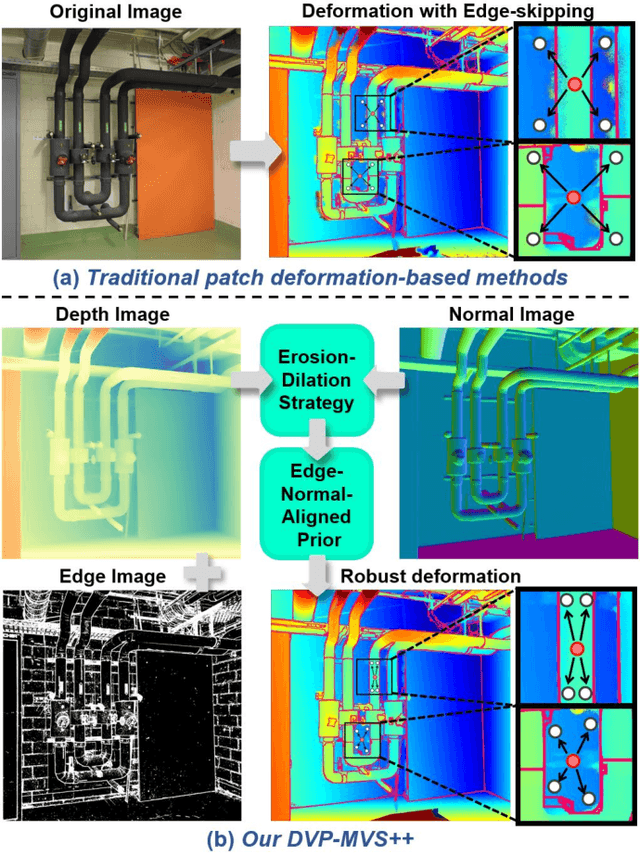
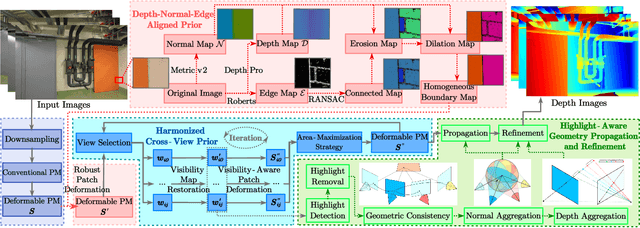
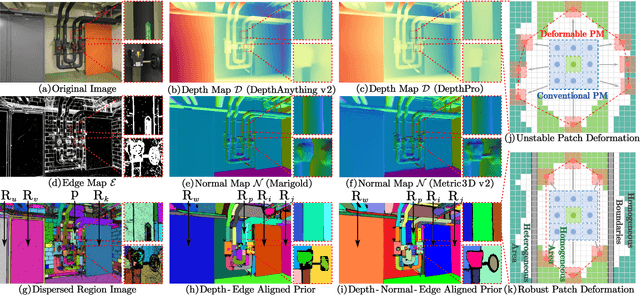
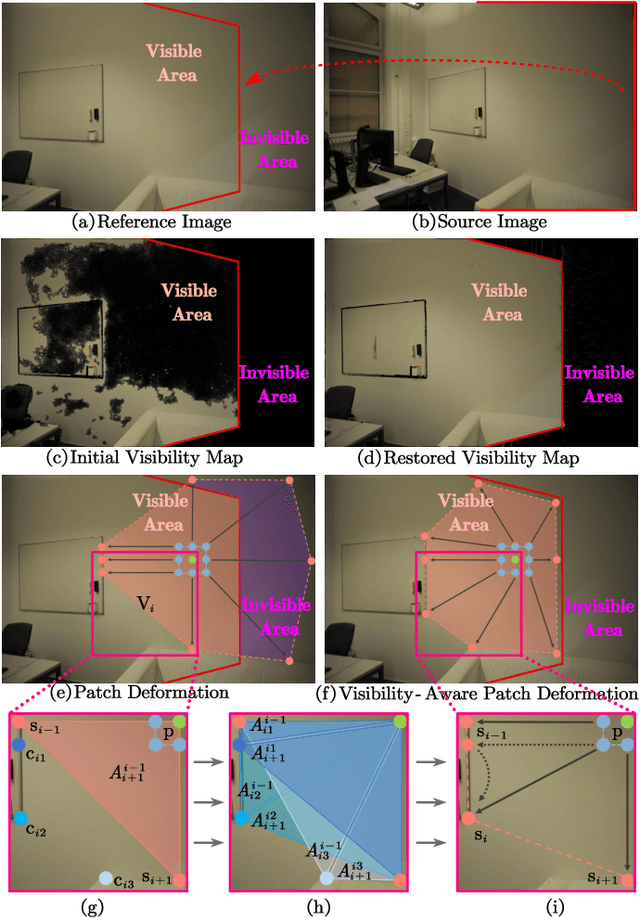
Recently, patch deformation-based methods have demonstrated significant effectiveness in multi-view stereo due to their incorporation of deformable and expandable perception for reconstructing textureless areas. However, these methods generally focus on identifying reliable pixel correlations to mitigate matching ambiguity of patch deformation, while neglecting the deformation instability caused by edge-skipping and visibility occlusions, which may cause potential estimation deviations. To address these issues, we propose DVP-MVS++, an innovative approach that synergizes both depth-normal-edge aligned and harmonized cross-view priors for robust and visibility-aware patch deformation. Specifically, to avoid edge-skipping, we first apply DepthPro, Metric3Dv2 and Roberts operator to generate coarse depth maps, normal maps and edge maps, respectively. These maps are then aligned via an erosion-dilation strategy to produce fine-grained homogeneous boundaries for facilitating robust patch deformation. Moreover, we reformulate view selection weights as visibility maps, and then implement both an enhanced cross-view depth reprojection and an area-maximization strategy to help reliably restore visible areas and effectively balance deformed patch, thus acquiring harmonized cross-view priors for visibility-aware patch deformation. Additionally, we obtain geometry consistency by adopting both aggregated normals via view selection and projection depth differences via epipolar lines, and then employ SHIQ for highlight correction to enable geometry consistency with highlight-aware perception, thus improving reconstruction quality during propagation and refinement stage. Evaluation results on ETH3D, Tanks & Temples and Strecha datasets exhibit the state-of-the-art performance and robust generalization capability of our proposed method.
STDR: Spatio-Temporal Decoupling for Real-Time Dynamic Scene Rendering
May 28, 2025Although dynamic scene reconstruction has long been a fundamental challenge in 3D vision, the recent emergence of 3D Gaussian Splatting (3DGS) offers a promising direction by enabling high-quality, real-time rendering through explicit Gaussian primitives. However, existing 3DGS-based methods for dynamic reconstruction often suffer from \textit{spatio-temporal incoherence} during initialization, where canonical Gaussians are constructed by aggregating observations from multiple frames without temporal distinction. This results in spatio-temporally entangled representations, making it difficult to model dynamic motion accurately. To overcome this limitation, we propose \textbf{STDR} (Spatio-Temporal Decoupling for Real-time rendering), a plug-and-play module that learns spatio-temporal probability distributions for each Gaussian. STDR introduces a spatio-temporal mask, a separated deformation field, and a consistency regularization to jointly disentangle spatial and temporal patterns. Extensive experiments demonstrate that incorporating our module into existing 3DGS-based dynamic scene reconstruction frameworks leads to notable improvements in both reconstruction quality and spatio-temporal consistency across synthetic and real-world benchmarks.
SED-MVS: Segmentation-Driven and Edge-Aligned Deformation Multi-View Stereo with Depth Restoration and Occlusion Constraint
Mar 17, 2025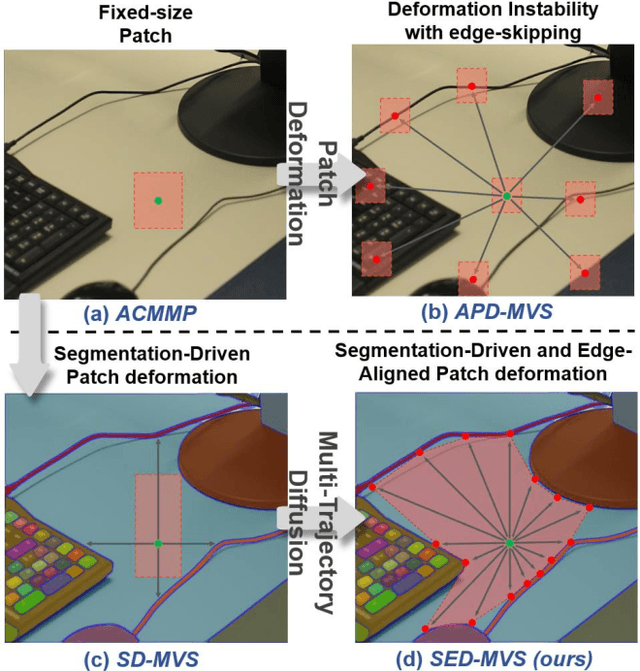
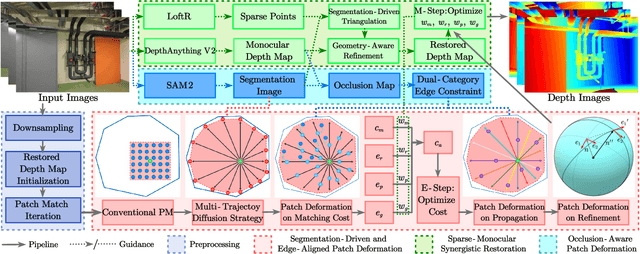
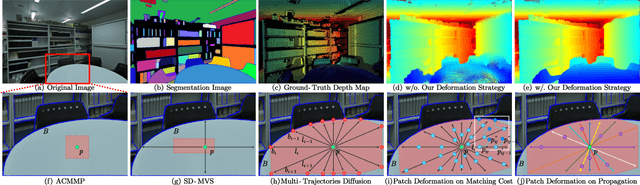
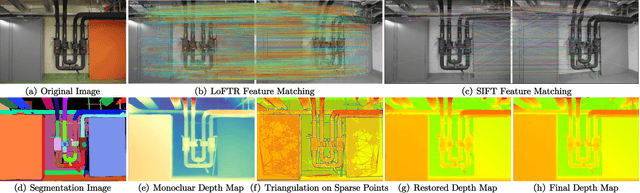
Recently, patch-deformation methods have exhibited significant effectiveness in multi-view stereo owing to the deformable and expandable patches in reconstructing textureless areas. However, such methods primarily emphasize broadening the receptive field in textureless areas, while neglecting deformation instability caused by easily overlooked edge-skipping, potentially leading to matching distortions. To address this, we propose SED-MVS, which adopts panoptic segmentation and multi-trajectory diffusion strategy for segmentation-driven and edge-aligned patch deformation. Specifically, to prevent unanticipated edge-skipping, we first employ SAM2 for panoptic segmentation as depth-edge guidance to guide patch deformation, followed by multi-trajectory diffusion strategy to ensure patches are comprehensively aligned with depth edges. Moreover, to avoid potential inaccuracy of random initialization, we combine both sparse points from LoFTR and monocular depth map from DepthAnything V2 to restore reliable and realistic depth map for initialization and supervised guidance. Finally, we integrate segmentation image with monocular depth map to exploit inter-instance occlusion relationship, then further regard them as occlusion map to implement two distinct edge constraint, thereby facilitating occlusion-aware patch deformation. Extensive results on ETH3D, Tanks & Temples, BlendedMVS and Strecha datasets validate the state-of-the-art performance and robust generalization capability of our proposed method.
Dual-Level Precision Edges Guided Multi-View Stereo with Accurate Planarization
Dec 29, 2024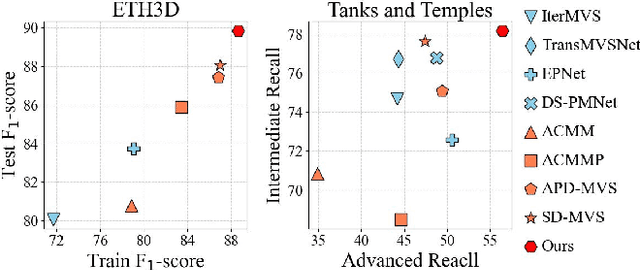
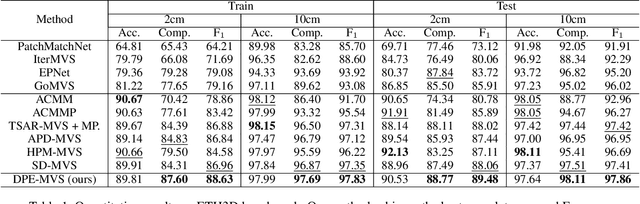
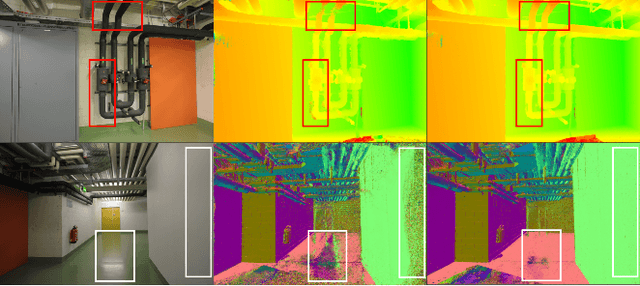
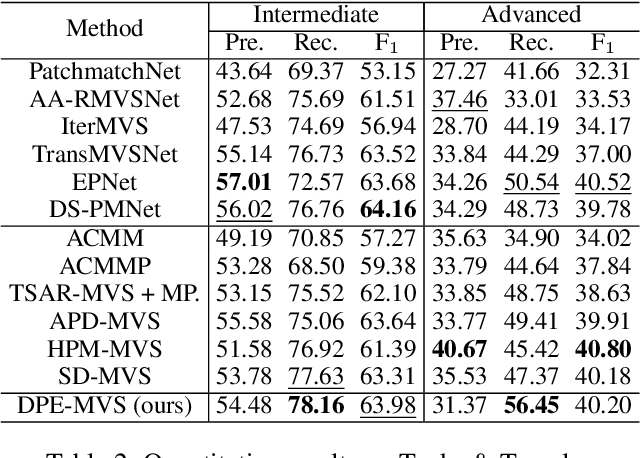
The reconstruction of low-textured areas is a prominent research focus in multi-view stereo (MVS). In recent years, traditional MVS methods have performed exceptionally well in reconstructing low-textured areas by constructing plane models. However, these methods often encounter issues such as crossing object boundaries and limited perception ranges, which undermine the robustness of plane model construction. Building on previous work (APD-MVS), we propose the DPE-MVS method. By introducing dual-level precision edge information, including fine and coarse edges, we enhance the robustness of plane model construction, thereby improving reconstruction accuracy in low-textured areas. Furthermore, by leveraging edge information, we refine the sampling strategy in conventional PatchMatch MVS and propose an adaptive patch size adjustment approach to optimize matching cost calculation in both stochastic and low-textured areas. This additional use of edge information allows for more precise and robust matching. Our method achieves state-of-the-art performance on the ETH3D and Tanks & Temples benchmarks. Notably, our method outperforms all published methods on the ETH3D benchmark.