 Add to Chrome
 Add to Firefox
 Add to Edge
MemPrism: Task-Conditioned Relational Memory Views for Long-Horizon Agents
Aug 07, 2026
Long-horizon agents rely on memory to reuse experiences, yet existing memory systems often assume that evidence can be directly consumed through a fixed representation. This leads to representation mismatch, where relevant information is available but not organized for the current decision. To this end, we propose MemPrism, a task-conditioned relational memory framework that separates persistent experience storage from decision-time working memory. MemPrism records interactions as the event stream and dynamically constructs relational views according to the current task context. A lightweight view policy selects the relation structure, evidence range, outcome condition, and granularity, while a deterministic composer and render transform historical facts into a temporary optical working-memory view for a frozen task policy. Experiments on long-horizon embodied and web-agent benchmarks show that MemPrism consistently improves the task performance, especially as trajectories become longer, while reducing memory token consumption. Furthermore, the learned view policy transfers across different VLMs without additional adaptation, demonstrating the effectiveness of task-conditioned relational views as a general memory interface for agents.

Steve-Evolving: Open-World Embodied Self-Evolution via Fine-Grained Diagnosis and Dual-Track Knowledge Distillation
Mar 13, 2026Open-world embodied agents must solve long-horizon tasks where the main bottleneck is not single-step planning quality but how interaction experience is organized and evolved. To this end, we present Steve-Evolving, a non-parametric self-evolving framework that tightly couples fine-grained execution diagnosis with dual-track knowledge distillation in a closed loop. The method follows three phases: Experience Anchoring, Experience Distillation, and Knowledge-Driven Closed-Loop Control. In detail, Experience Anchoring solidifies each subgoal attempt into a structured experience tuple with a fixed schema (pre-state, action, diagnosis-result, and post-state) and organizes it in a three-tier experience space with multi-dimensional indices (e.g., condition signatures, spatial hashing, and semantic tags) plus rolling summarization for efficient and auditable recall. To ensure sufficient information density for attribution, the execution layer provides compositional diagnosis signals beyond binary outcomes, including state-difference summaries, enumerated failure causes, continuous indicators, and stagnation/loop detection. Moreover, successful trajectories of Experience Distillation are generalized into reusable skills with explicit preconditions and verification criteria, while failures are distilled into executable guardrails that capture root causes and forbid risky operations at both subgoal and task granularities. Besides, Knowledge-Driven Closed-Loop Control retrieved skills and guardrails are injected into an LLM planner, and diagnosis-triggered local replanning updates the active constraints online, forming a continual evolution process without any model parameter updates. Experiments on the long-horizon suite of Minecraft MCU demonstrate consistent improvements over static-retrieval baselines.
PolarMem: A Training-Free Polarized Latent Graph Memory for Verifiable Multimodal Agents
Jan 31, 2026As multimodal agents evolve from passive observers to long-horizon decision-makers, they require memory systems that provide not just information availability but logical verifiability. A fundamental limitation of current architectures is the epistemic asymmetry inherent in probabilistic vision-language models and dense associative memories: they conflate semantic affinity with factual existence and structurally fail to encode negative constraints. To this end, we introduce PolarMem, a training-free Polarized Latent Graph Memory designed to ground agent reasoning in verifiable evidence. PolarMem transforms fuzzy perceptual likelihoods into discrete logical constraints through non-parametric distributional partitioning. Furthermore, it employs a polarized graph topology with orthogonal inhibitory connections to explicitly store verified negation as a primary cognitive state. At inference time, we enforce a logic-dominant retrieval paradigm, suppressing hallucinatory patterns that violate negative constraints. Extensive evaluation across eight frozen Vision--Language Models and six benchmarks demonstrates that PolarMem functions as a robust cognitive system, establishing a foundation for verifiable multimodal agents. Our code is available at https://github.com/czs-ict/PolarMem.
Prediction and optimization of NaV1.7 inhibitors based on machine learning methods
Nov 29, 2019
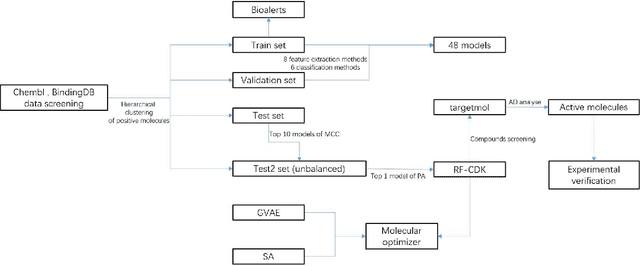
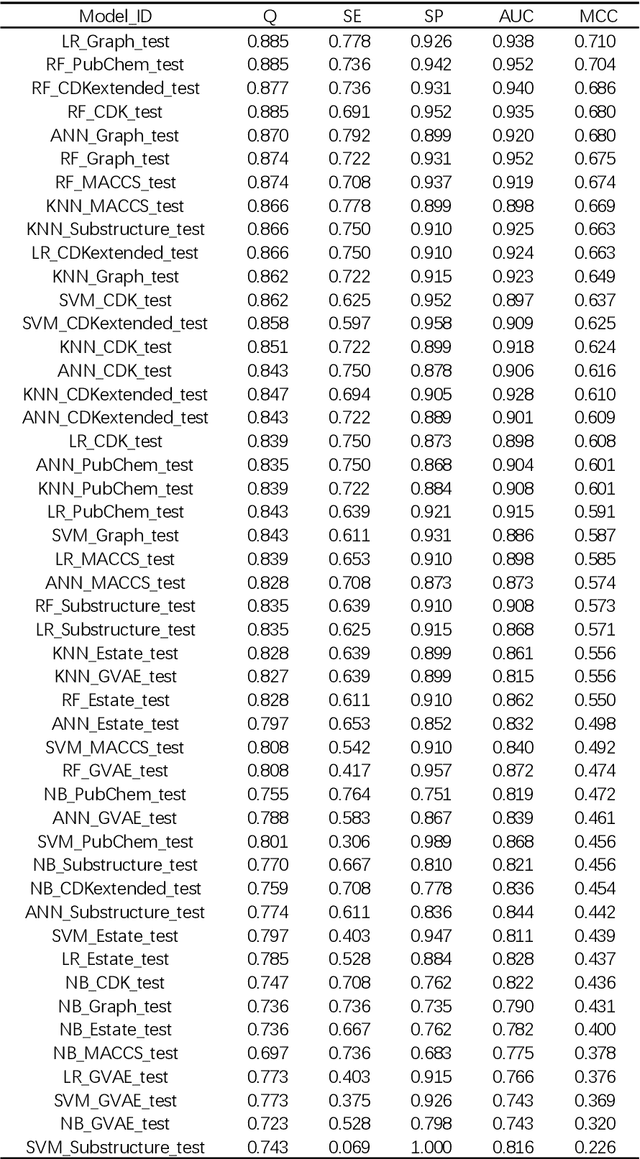
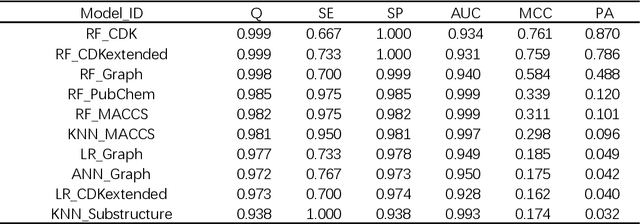
Objectives NaV1.7 is a key target related to pain. This study focused on predicting and optimizing inhibitors of NaV1.7 using machine learning methods, and using patch-clamp methods to validate them at the cellular level. Materials and Methods We used Chembl, BindingDB, and data from the literature to establish classification models for inhibitors. The imbalanced data set test2 was used to screen the best-performing model to screen commercial compound libraries, and whole-cell voltage-clamp was used to validate inhibitors. We propose a molecular group optimization method using a combination of Grammer Variational Autoencoder, classification model, and simulated annealing algorithm. Results and Conclusion We get the model RF-CDK that performs best in the imbalanced data set. Of the three compounds that may have inhibitory effects, Nortriptyline has been experimentally verified. In the molecular optimization method, the best result of the optimization results of CHEMBL2325245 is MS = 1.052, PROB = 0.527, SA = 2.587, QED = 0.462. 40 molecules located in the applicability domain of RF-CDK were used for optimization, among which 34 molecules gave larger MS values.