 Add to Chrome
 Add to Firefox
 Add to Edge
D-VLC: Decentralized Vision-Language Collaboration for Heterogeneous Embodied Multi-Robot Systems in Unknown Environments
Aug 03, 2026
Multi-robot systems, particularly heterogeneous robot swarms, can improve the efficiency of complex task execution through parallel collaboration and complementary capabilities. However, conventional rule-based methods rely on predefined task models and specialized decision making programs, making it difficult to understand complex semantic instructions and coordinate heterogeneous robots. LLMs introduce strong language understanding and task reasoning capabilities, allowing multi-robot systems to interpret instructions, decompose tasks, and assign roles according to task semantics. VLMs further incorporate visual perception, enabling robots to reason about objects, regions, and spatial relationships in physical environments. Nevertheless, existing LLM/VLM based methods often depend on known maps, centralized and synchronized decision making, limiting their generalization to heterogeneous robots and unseen tasks. We therefore propose a framework that combines decentralized asynchronous reasoning, lightweight information sharing, capability aware collaboration, and a unified action interface, enabling general purpose VLMs to generate robot specific actions executed by learning free experts without task or robot specific training. Experiments across diverse scenarios and multiple VLMs show success rates above 70\%, with completion time reduced by up to 55.8\% relative to the geometric greedy baseline.

Geometry-Aware Dataset Condensation for Diffusion Model Training
Jun 04, 2026Dataset condensation aims to construct compact datasets from real data via synthesis or selection. However, existing approaches are ill-suited for diffusion model training: synthetic data generation often yields low-fidelity samples unsuitable for authentic modeling, while real subset selection typically fails to preserve the distributional geometry required by diffusion likelihood objectives. To address this, we propose to reformulate real subset selection as a geometry-aware distribution alignment problem. By incorporating one-sided partial optimal transport, our method selectively aligns a compact subset with the full data distribution while allowing unmatched mass in low-density regions, ensuring the preserved geometric structure necessary for effective diffusion model training. To further ensure distributional fidelity, we complement geometric alignment with lightweight feature-statistics and semantic consistency regularization. An efficient two-stage discrete optimization strategy is proposed to achieve this alignment objective. Extensive experiments across diffusion variants, subset sizes, image resolutions, and training rounds show that our method achieves superior fidelity and distributional coverage in diffusion model training. Codes are available at https://github.com/2018cx/GADC.
FlyMirage: A Fully Automated Generation Pipeline for Diverse and Scalable UAV Flight Data via Generative World Model
May 19, 2026In the field of Vision-Language Navigation (VLN), aerial datasets remain limited in their ability to combine scale, diversity, and realism, often relying on either costly real-world scenes or visually limited simulations. To address these challenges, we introduce FlyMirage, a highly scalable and fully automated data generation pipeline for aerial VLN. Our approach leverages large language models (LLM) as an environment designer to promote scene diversity, paired with a generative world model that instantiates these designs into high-fidelity 3D Gaussian Splatting (3DGS) scenes. To substantially reduce human labor and ensure the feasibility of flight data, FlyMirage automates scene exploration and semantic information acquisition, and further integrates a dynamically feasible planner for uncrewed aerial vehicle (UAV) trajectory generation. Utilizing this toolchain, we generate a large-scale, diverse, and photorealistic aerial VLN dataset, with dynamically feasible flying trajectories, designed to support the development of next-generation embodied navigation models.
VLA-AN: An Efficient and Onboard Vision-Language-Action Framework for Aerial Navigation in Complex Environments
Dec 19, 2025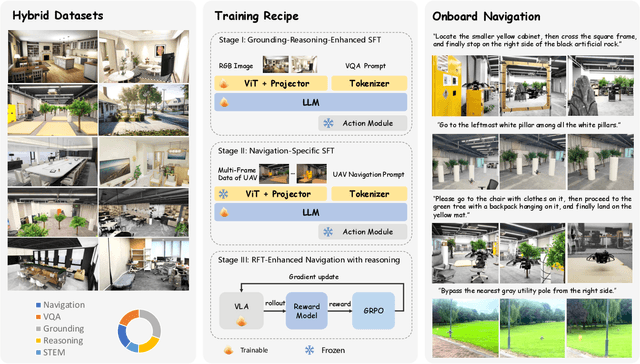
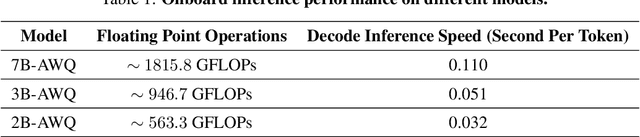
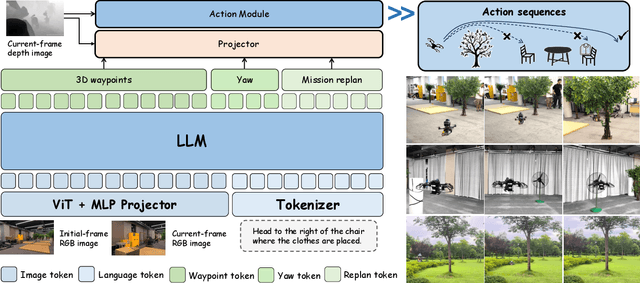
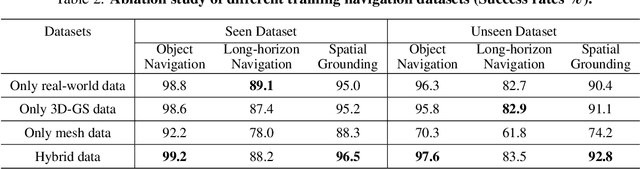
This paper proposes VLA-AN, an efficient and onboard Vision-Language-Action (VLA) framework dedicated to autonomous drone navigation in complex environments. VLA-AN addresses four major limitations of existing large aerial navigation models: the data domain gap, insufficient temporal navigation with reasoning, safety issues with generative action policies, and onboard deployment constraints. First, we construct a high-fidelity dataset utilizing 3D Gaussian Splatting (3D-GS) to effectively bridge the domain gap. Second, we introduce a progressive three-stage training framework that sequentially reinforces scene comprehension, core flight skills, and complex navigation capabilities. Third, we design a lightweight, real-time action module coupled with geometric safety correction. This module ensures fast, collision-free, and stable command generation, mitigating the safety risks inherent in stochastic generative policies. Finally, through deep optimization of the onboard deployment pipeline, VLA-AN achieves a robust real-time 8.3x improvement in inference throughput on resource-constrained UAVs. Extensive experiments demonstrate that VLA-AN significantly improves spatial grounding, scene reasoning, and long-horizon navigation, achieving a maximum single-task success rate of 98.1%, and providing an efficient, practical solution for realizing full-chain closed-loop autonomy in lightweight aerial robots.
Multi-Level Optimal Transport for Universal Cross-Tokenizer Knowledge Distillation on Language Models
Dec 19, 2024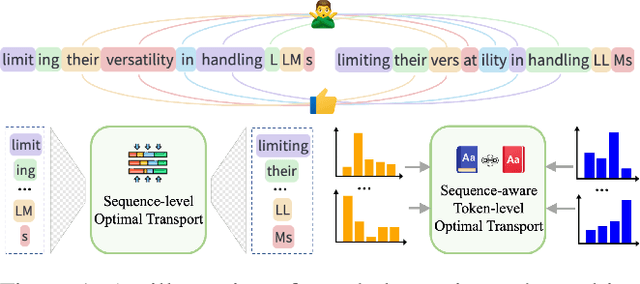
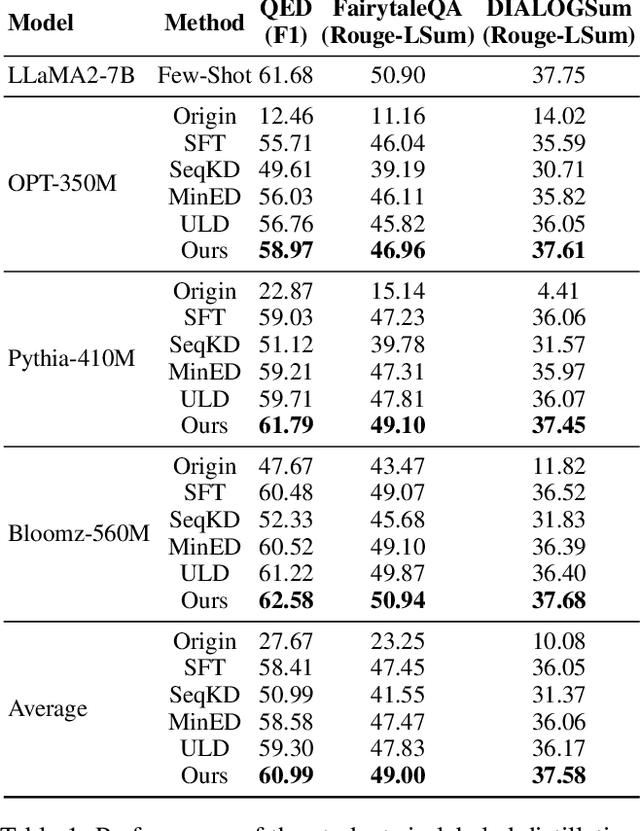

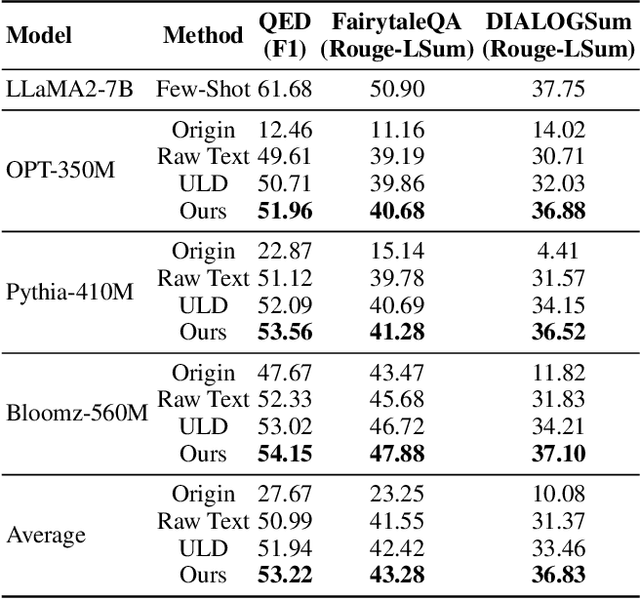
Knowledge distillation (KD) has become a prevalent technique for compressing large language models (LLMs). Existing KD methods are constrained by the need for identical tokenizers (i.e., vocabularies) between teacher and student models, limiting their versatility in handling LLMs of different architecture families. In this paper, we introduce the Multi-Level Optimal Transport (MultiLevelOT), a novel approach that advances the optimal transport for universal cross-tokenizer knowledge distillation. Our method aligns the logit distributions of the teacher and the student at both token and sequence levels using diverse cost matrices, eliminating the need for dimensional or token-by-token correspondence. At the token level, MultiLevelOT integrates both global and local information by jointly optimizing all tokens within a sequence to enhance robustness. At the sequence level, we efficiently capture complex distribution structures of logits via the Sinkhorn distance, which approximates the Wasserstein distance for divergence measures. Extensive experiments on tasks such as extractive QA, generative QA, and summarization demonstrate that the MultiLevelOT outperforms state-of-the-art cross-tokenizer KD methods under various settings. Our approach is robust to different student and teacher models across model families, architectures, and parameter sizes.