 Add to Chrome
 Add to Firefox
 Add to Edge
Bandwidth-efficient Inference for Neural Image Compression
Sep 07, 2023


With neural networks growing deeper and feature maps growing larger, limited communication bandwidth with external memory (or DRAM) and power constraints become a bottleneck in implementing network inference on mobile and edge devices. In this paper, we propose an end-to-end differentiable bandwidth efficient neural inference method with the activation compressed by neural data compression method. Specifically, we propose a transform-quantization-entropy coding pipeline for activation compression with symmetric exponential Golomb coding and a data-dependent Gaussian entropy model for arithmetic coding. Optimized with existing model quantization methods, low-level task of image compression can achieve up to 19x bandwidth reduction with 6.21x energy saving.

Conditional Perceptual Quality Preserving Image Compression
Aug 16, 2023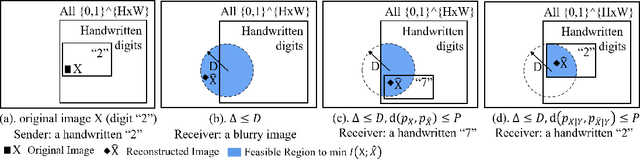

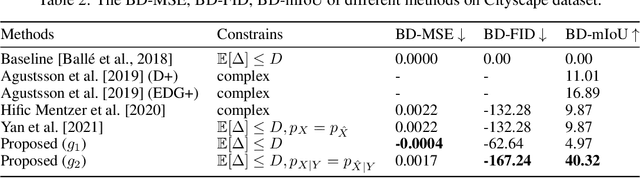
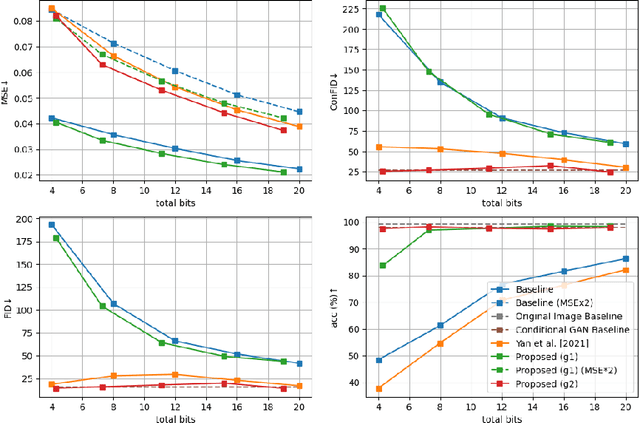
We propose conditional perceptual quality, an extension of the perceptual quality defined in \citet{blau2018perception}, by conditioning it on user defined information. Specifically, we extend the original perceptual quality $d(p_{X},p_{\hat{X}})$ to the conditional perceptual quality $d(p_{X|Y},p_{\hat{X}|Y})$, where $X$ is the original image, $\hat{X}$ is the reconstructed, $Y$ is side information defined by user and $d(.,.)$ is divergence. We show that conditional perceptual quality has similar theoretical properties as rate-distortion-perception trade-off \citep{blau2019rethinking}. Based on these theoretical results, we propose an optimal framework for conditional perceptual quality preserving compression. Experimental results show that our codec successfully maintains high perceptual quality and semantic quality at all bitrate. Besides, by providing a lowerbound of common randomness required, we settle the previous arguments on whether randomness should be incorporated into generator for (conditional) perceptual quality compression. The source code is provided in supplementary material.
Eliminating Label Leakage in Tree-Based Vertical Federated Learning
Jul 19, 2023
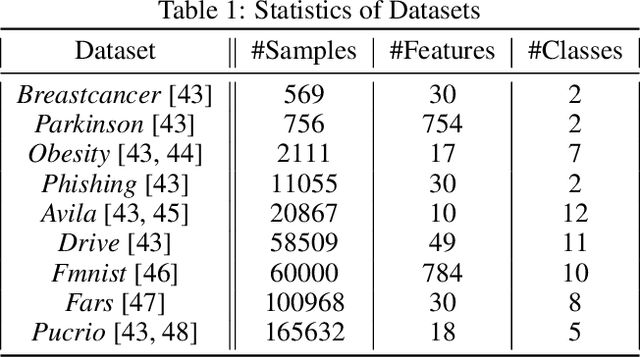

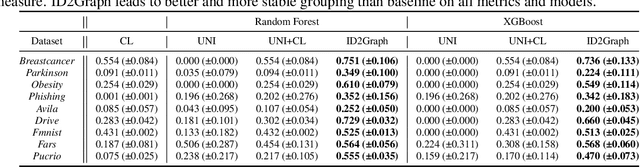
Vertical federated learning (VFL) enables multiple parties with disjoint features of a common user set to train a machine learning model without sharing their private data. Tree-based models have become prevalent in VFL due to their interpretability and efficiency. However, the vulnerability of tree-based VFL has not been sufficiently investigated. In this study, we first introduce a novel label inference attack, ID2Graph, which utilizes the sets of record-IDs assigned to each node (i.e., instance space) to deduce private training labels. The ID2Graph attack generates a graph structure from training samples, extracts communities from the graph, and clusters the local dataset using community information. To counteract label leakage from the instance space, we propose an effective defense mechanism, ID-LMID, which prevents label leakage by focusing on mutual information regularization. Comprehensive experiments conducted on various datasets reveal that the ID2Graph attack presents significant risks to tree-based models such as Random Forest and XGBoost. Further evaluations on these benchmarks demonstrate that ID-LMID effectively mitigates label leakage in such instances.
Unified Molecular Modeling via Modality Blending
Jul 12, 2023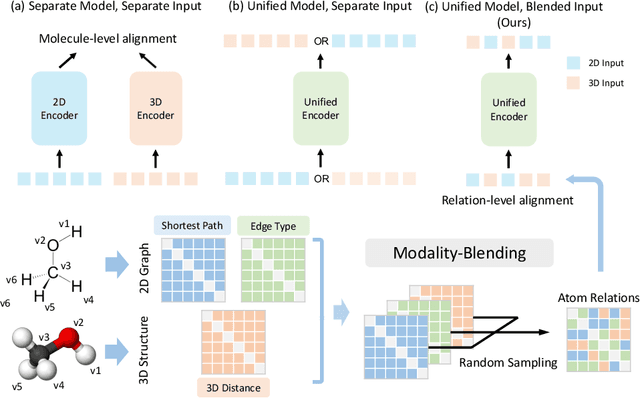
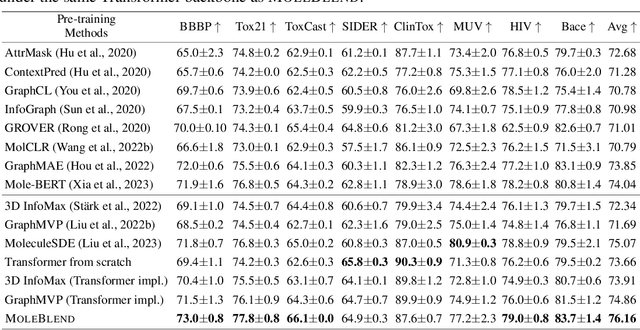
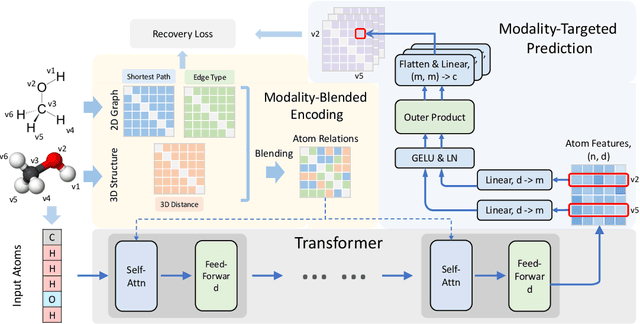
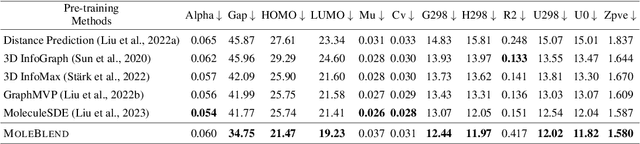
Self-supervised molecular representation learning is critical for molecule-based tasks such as AI-assisted drug discovery. Recent studies consider leveraging both 2D and 3D information for representation learning, with straightforward alignment strategies that treat each modality separately. In this work, we introduce a novel "blend-then-predict" self-supervised learning method (MoleBLEND), which blends atom relations from different modalities into one unified relation matrix for encoding, then recovers modality-specific information for both 2D and 3D structures. By treating atom relationships as anchors, seemingly dissimilar 2D and 3D manifolds are aligned and integrated at fine-grained relation-level organically. Extensive experiments show that MoleBLEND achieves state-of-the-art performance across major 2D/3D benchmarks. We further provide theoretical insights from the perspective of mutual-information maximization, demonstrating that our method unifies contrastive, generative (inter-modal prediction) and mask-then-predict (intra-modal prediction) objectives into a single cohesive blend-then-predict framework.
Generative Pretraining in Multimodality
Jul 11, 2023We present Emu, a Transformer-based multimodal foundation model, which can seamlessly generate images and texts in multimodal context. This omnivore model can take in any single-modality or multimodal data input indiscriminately (e.g., interleaved image, text and video) through a one-model-for-all autoregressive training process. First, visual signals are encoded into embeddings, and together with text tokens form an interleaved input sequence. Emu is then end-to-end trained with a unified objective of classifying the next text token or regressing the next visual embedding in the multimodal sequence. This versatile multimodality empowers the exploration of diverse pretraining data sources at scale, such as videos with interleaved frames and text, webpages with interleaved images and text, as well as web-scale image-text pairs and video-text pairs. Emu can serve as a generalist multimodal interface for both image-to-text and text-to-image tasks, and supports in-context image and text generation. Across a broad range of zero-shot/few-shot tasks including image captioning, visual question answering, video question answering and text-to-image generation, Emu demonstrates superb performance compared to state-of-the-art large multimodal models. Extended capabilities such as multimodal assistants via instruction tuning are also demonstrated with impressive performance.
PROTO: Iterative Policy Regularized Offline-to-Online Reinforcement Learning
May 25, 2023Offline-to-online reinforcement learning (RL), by combining the benefits of offline pretraining and online finetuning, promises enhanced sample efficiency and policy performance. However, existing methods, effective as they are, suffer from suboptimal performance, limited adaptability, and unsatisfactory computational efficiency. We propose a novel framework, PROTO, which overcomes the aforementioned limitations by augmenting the standard RL objective with an iteratively evolving regularization term. Performing a trust-region-style update, PROTO yields stable initial finetuning and optimal final performance by gradually evolving the regularization term to relax the constraint strength. By adjusting only a few lines of code, PROTO can bridge any offline policy pretraining and standard off-policy RL finetuning to form a powerful offline-to-online RL pathway, birthing great adaptability to diverse methods. Simple yet elegant, PROTO imposes minimal additional computation and enables highly efficient online finetuning. Extensive experiments demonstrate that PROTO achieves superior performance over SOTA baselines, offering an adaptable and efficient offline-to-online RL framework.
Breaching FedMD: Image Recovery via Paired-Logits Inversion Attack
Apr 22, 2023Federated Learning with Model Distillation (FedMD) is a nascent collaborative learning paradigm, where only output logits of public datasets are transmitted as distilled knowledge, instead of passing on private model parameters that are susceptible to gradient inversion attacks, a known privacy risk in federated learning. In this paper, we found that even though sharing output logits of public datasets is safer than directly sharing gradients, there still exists a substantial risk of data exposure caused by carefully designed malicious attacks. Our study shows that a malicious server can inject a PLI (Paired-Logits Inversion) attack against FedMD and its variants by training an inversion neural network that exploits the confidence gap between the server and client models. Experiments on multiple facial recognition datasets validate that under FedMD-like schemes, by using paired server-client logits of public datasets only, the malicious server is able to reconstruct private images on all tested benchmarks with a high success rate.
K-means Clustering Based Feature Consistency Alignment for Label-free Model Evaluation
Apr 17, 2023The label-free model evaluation aims to predict the model performance on various test sets without relying on ground truths. The main challenge of this task is the absence of labels in the test data, unlike in classical supervised model evaluation. This paper presents our solutions for the 1st DataCV Challenge of the Visual Dataset Understanding workshop at CVPR 2023. Firstly, we propose a novel method called K-means Clustering Based Feature Consistency Alignment (KCFCA), which is tailored to handle the distribution shifts of various datasets. KCFCA utilizes the K-means algorithm to cluster labeled training sets and unlabeled test sets, and then aligns the cluster centers with feature consistency. Secondly, we develop a dynamic regression model to capture the relationship between the shifts in distribution and model accuracy. Thirdly, we design an algorithm to discover the outlier model factors, eliminate the outlier models, and combine the strengths of multiple autoeval models. On the DataCV Challenge leaderboard, our approach secured 2nd place with an RMSE of 6.8526. Our method significantly improved over the best baseline method by 36\% (6.8526 vs. 10.7378). Furthermore, our method achieves a relatively more robust and optimal single model performance on the validation dataset.
VIMI: Vehicle-Infrastructure Multi-view Intermediate Fusion for Camera-based 3D Object Detection
Mar 20, 2023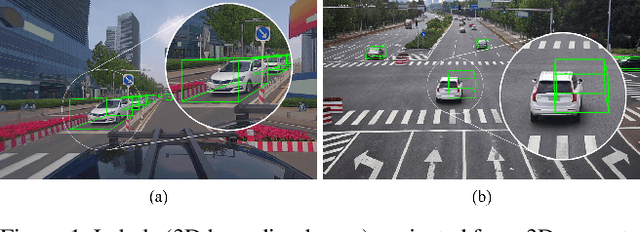
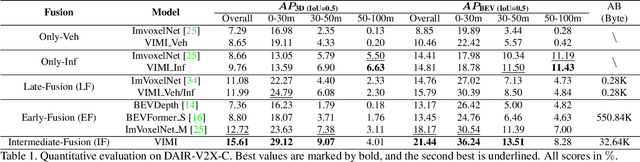
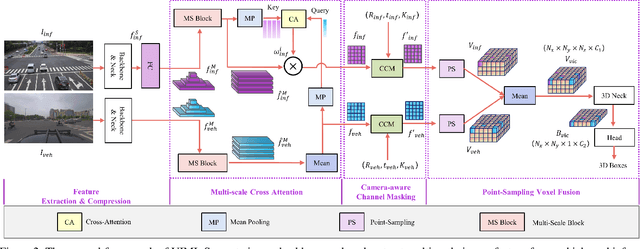
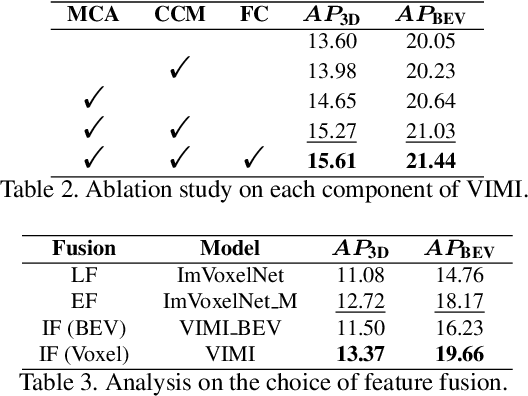
In autonomous driving, Vehicle-Infrastructure Cooperative 3D Object Detection (VIC3D) makes use of multi-view cameras from both vehicles and traffic infrastructure, providing a global vantage point with rich semantic context of road conditions beyond a single vehicle viewpoint. Two major challenges prevail in VIC3D: 1) inherent calibration noise when fusing multi-view images, caused by time asynchrony across cameras; 2) information loss when projecting 2D features into 3D space. To address these issues, We propose a novel 3D object detection framework, Vehicles-Infrastructure Multi-view Intermediate fusion (VIMI). First, to fully exploit the holistic perspectives from both vehicles and infrastructure, we propose a Multi-scale Cross Attention (MCA) module that fuses infrastructure and vehicle features on selective multi-scales to correct the calibration noise introduced by camera asynchrony. Then, we design a Camera-aware Channel Masking (CCM) module that uses camera parameters as priors to augment the fused features. We further introduce a Feature Compression (FC) module with channel and spatial compression blocks to reduce the size of transmitted features for enhanced efficiency. Experiments show that VIMI achieves 15.61% overall AP_3D and 21.44% AP_BEV on the new VIC3D dataset, DAIR-V2X-C, significantly outperforming state-of-the-art early fusion and late fusion methods with comparable transmission cost.
SpiderMesh: Spatial-aware Demand-guided Recursive Meshing for RGB-T Semantic Segmentation
Mar 15, 2023For semantic segmentation in urban scene understanding, RGB cameras alone often fail to capture a clear holistic topology, especially in challenging lighting conditions. Thermal signal is an informative additional channel that can bring to light the contour and fine-grained texture of blurred regions in low-quality RGB image. Aiming at RGB-T (thermal) segmentation, existing methods either use simple passive channel/spatial-wise fusion for cross-modal interaction, or rely on heavy labeling of ambiguous boundaries for fine-grained supervision. We propose a Spatial-aware Demand-guided Recursive Meshing (SpiderMesh) framework that: 1) proactively compensates inadequate contextual semantics in optically-impaired regions via a demand-guided target masking algorithm; 2) refines multimodal semantic features with recursive meshing to improve pixel-level semantic analysis performance. We further introduce an asymmetric data augmentation technique M-CutOut, and enable semi-supervised learning to fully utilize RGB-T labels only sparsely available in practical use. Extensive experiments on MFNet and PST900 datasets demonstrate that SpiderMesh achieves new state-of-the-art performance on standard RGB-T segmentation benchmarks.