 Add to Chrome
 Add to Firefox
 Add to Edge
Ptolemy's Equant Equates to a Universal Dynamical Clock via Machine Learning
Jul 16, 2026
Oscillatory dynamics arise ubiquitously in nonlinear systems, yet identifying a physically interpretable phase and phase dynamics in nonlinear, high-dimensional oscillations remains a central unresolved problem. Here we establish the principle of a universal dynamical clock, a physical perspective in which oscillations of arbitrary dimensionality and geometry are equivalently represented as uniform rotation through an equant-induced nonlinear viewing coordinate, inspired by Ptolemy's equant and formalised through an areal-uniformity principle reminiscent of Kepler's second law. Using a machine-learning framework, we demonstrate the existence of such an equant for a broad class of oscillatory dynamics and construct the associated dynamical clock and phase dynamics under additive forces, including noise, periodic perturbations, and coupling. Its value in uncovering new physical rules and phenomena is demonstrated by four findings: (i) collective oscillations in Escherichia coli populations obey a previously unexplained superlinear scaling law, resolving a long-standing open problem posed in 2004; (ii) the response mechanisms of engineered genetic circuits to changes in gene expression and environmental conditions; (iii) a classical-mechanics counterpart of the Berry geometric phase emerges naturally from the phase of the dynamical clock; and (iv) optimal equant non-uniformity provides a geometric early-warning signal for critical transitions and enables prediction of critical parameters. By providing operational and system-agnostic phase dynamics that can be constructed directly from data, the dynamical clock enables principled classification, comparison, and control of oscillatory systems, and offers a new route to understanding how specific dynamical regimes support distinct functional behaviours in networked systems.

Analytical Solutions for the Inverse Problem within Gradual Semantics
Mar 02, 2022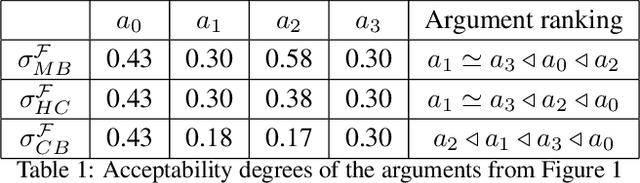

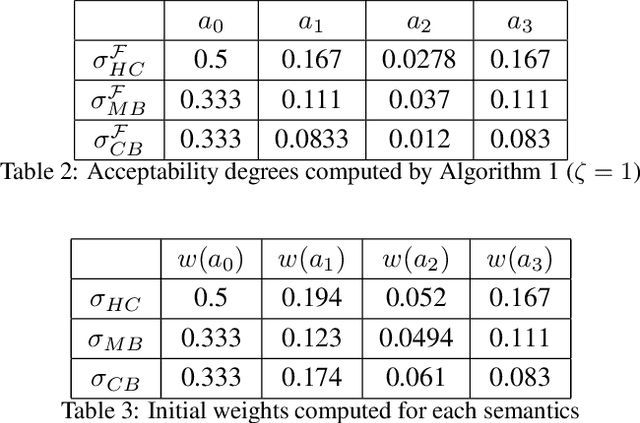
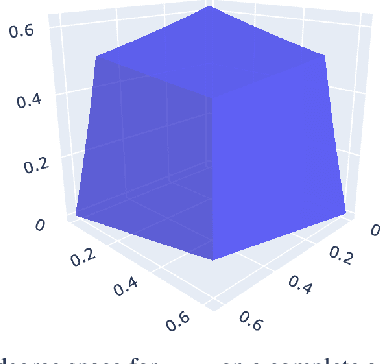
Gradual semantics within abstract argumentation associate a numeric score with every argument in a system, which represents the level of acceptability of this argument, and from which a preference ordering over arguments can be derived. While some semantics operate over standard argumentation frameworks, many utilise a weighted framework, where a numeric initial weight is associated with each argument. Recent work has examined the inverse problem within gradual semantics. Rather than determining a preference ordering given an argumentation framework and a semantics, the inverse problem takes an argumentation framework, a gradual semantics, and a preference ordering as inputs, and identifies what weights are needed to over arguments in the framework to obtain the desired preference ordering. Existing work has attacked the inverse problem numerically, using a root finding algorithm (the bisection method) to identify appropriate initial weights. In this paper we demonstrate that for a class of gradual semantics, an analytical approach can be used to solve the inverse problem. Unlike the current state-of-the-art, such an analytic approach can rapidly find a solution, and is guaranteed to do so. In obtaining this result, we are able to prove several important properties which previous work had posed as conjectures.
Delegating via Quitting Games
Apr 20, 2018

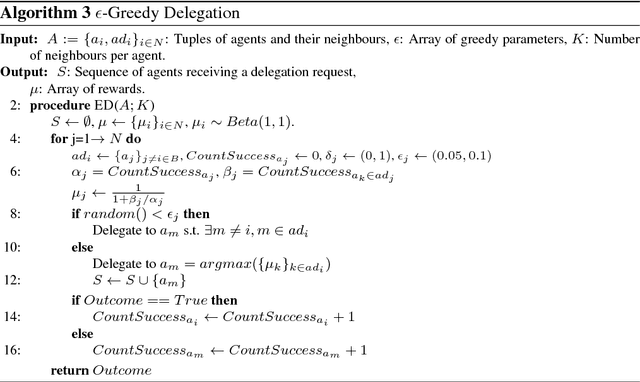
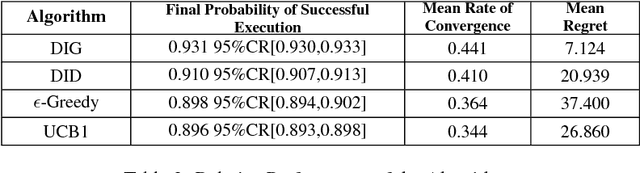
Delegation allows an agent to request that another agent completes a task. In many situations the task may be delegated onwards, and this process can repeat until it is eventually, successfully or unsuccessfully, performed. We consider policies to guide an agent in choosing who to delegate to when such recursive interactions are possible. These policies, based on quitting games and multi-armed bandits, were empirically tested for effectiveness. Our results indicate that the quitting game based policies outperform those which do not explicitly account for the recursive nature of delegation.