 Add to Chrome
 Add to Firefox
 Add to Edge
CIGTSurv: Clinical Information Guided Tri-modal Survival Prediction with Local Prototype Association and Global Feature Alignment
Aug 04, 2026
Multimodal learning has significantly advanced survival prediction by integrating pathology images with genomic data. However, clinical information, despite its critical role in reflecting a patient' s overall health, remains underutilized due to its discrete, sparse, and low-dimensional nature. Furthermore, the inherent heterogeneity across these modalities pose significant challenges in modeling cross-modal interactions. In this paper, we propose CIGTSurv, a Clinical Information Guided Tri-modal framework for Survival prediction. Specifically, we first design a holistic text template and use pretrained foundation models to transform clinical tabular data into high-dimensional tokenized embeddings. Using clinical information as an anchor, we then introduce a dual-level interaction mechanism: 1) a local prototype association (LPA) module based on cross-attention to explicitly learn token-level correspondences between different modalities, and 2) a global feature alignment (GFA) loss based on Maximum Mean Discrepancy (MMD) to implicitly enhance cross-modal distribution consistency. Extensive experiments on five TCGA cancer cohorts demonstrate that CIGTSurv achieves state-of-the-art (SOTA) survival prediction performance. Our source code is publicly available at https://github.com/Daijing-ai/CIGT-Surv.git.

Emotion Recognition with CLIP and Sequential Learning
Mar 13, 2025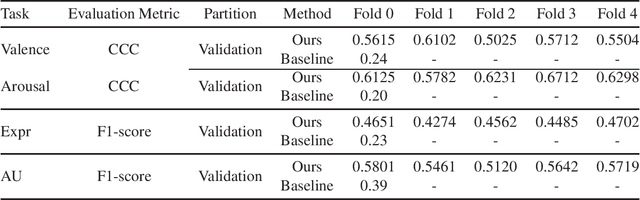
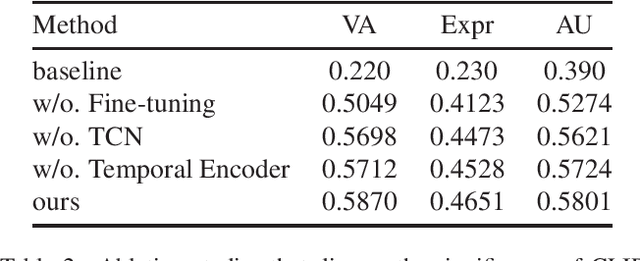
Human emotion recognition plays a crucial role in facilitating seamless interactions between humans and computers. In this paper, we present our innovative methodology for tackling the Valence-Arousal (VA) Estimation Challenge, the Expression Recognition Challenge, and the Action Unit (AU) Detection Challenge, all within the framework of the 8th Workshop and Competition on Affective Behavior Analysis in-the-wild (ABAW). Our approach introduces a novel framework aimed at enhancing continuous emotion recognition. This is achieved by fine-tuning the CLIP model with the aff-wild2 dataset, which provides annotated expression labels. The result is a fine-tuned model that serves as an efficient visual feature extractor, significantly improving its robustness. To further boost the performance of continuous emotion recognition, we incorporate Temporal Convolutional Network (TCN) modules alongside Transformer Encoder modules into our system architecture. The integration of these advanced components allows our model to outperform baseline performance, demonstrating its ability to recognize human emotions with greater accuracy and efficiency.
Boosting Continuous Emotion Recognition with Self-Pretraining using Masked Autoencoders, Temporal Convolutional Networks, and Transformers
Mar 18, 2024Human emotion recognition holds a pivotal role in facilitating seamless human-computer interaction. This paper delineates our methodology in tackling the Valence-Arousal (VA) Estimation Challenge, Expression (Expr) Classification Challenge, and Action Unit (AU) Detection Challenge within the ambit of the 6th Workshop and Competition on Affective Behavior Analysis in-the-wild (ABAW). Our study advocates a novel approach aimed at refining continuous emotion recognition. We achieve this by initially harnessing pre-training with Masked Autoencoders (MAE) on facial datasets, followed by fine-tuning on the aff-wild2 dataset annotated with expression (Expr) labels. The pre-trained model serves as an adept visual feature extractor, thereby enhancing the model's robustness. Furthermore, we bolster the performance of continuous emotion recognition by integrating Temporal Convolutional Network (TCN) modules and Transformer Encoder modules into our framework.
Continuous emotion recognition based on TCN and Transformer
Mar 15, 2023Human emotion recognition plays an important role in human-computer interaction. In this paper, we present our approach to the Valence-Arousal (VA) Estimation Challenge, Expression (Expr) Classification Challenge, and Action Unit (AU) Detection Challenge of the 5th Workshop and Competition on Affective Behavior Analysis in-the-wild (ABAW). Specifically, we propose a novel multi-modal fusion model that leverages Temporal Convolutional Networks (TCN) and Transformer to enhance the performance of continuous emotion recognition. Our model aims to effectively integrate visual and audio information for improved accuracy in recognizing emotions. The model is evaluate with Concordance Correlation Coefficient (CCC)