 Add to Chrome
 Add to Firefox
 Add to Edge
Embodied-R1.5: Evolving Physical Intelligence via Embodied Foundation Models
Jun 09, 2026
We introduce Embodied-R1.5, a unified Embodied Foundation Model (EFM) that integrates comprehensive embodied reasoning capabilities, spanning embodied cognition, task planning, correction, and pointing, within a single architecture toward general physical intelligence. Leveraging three automated data construction pipelines to significantly expand the data coverage of critical capabilities, we build a large-scale data system of over 15B tokens, and design a multi-task balanced RL recipe to alleviate heterogeneous task conflicts. We further introduce a Planner-Grounder-Corrector (PGC) closed-loop framework that enables a single model to autonomously execute and self-correct over long-horizon tasks. With only 8B parameters, Embodied-R1.5 achieves SOTA on 16 out of 24 embodied VLM benchmarks, surpassing leading models like Gemini-Robotics-ER-1.5 and GPT-5.4. Benefiting from the internalized embodied capabilities, Embodied-R1.5 can be fine-tuned into a VLA with only a small amount of data, outperforming leading VLA models like $π_{0.5}$ across 4 popular manipulation benchmark suites. We further conduct extensive zero-shot real-robot experiments, validating performance in instruction following, affordance grounding, articulated object manipulation, and long-horizon complex tasks, demonstrating strong generalization to the physical world. We open-source model weights, datasets, training code, and EmbodiedEvalKit, an evaluation framework tailored for embodied tasks, to facilitate future research in EFMs.

Veo-Act: How Far Can Frontier Video Models Advance Generalizable Robot Manipulation?
Apr 06, 2026Video generation models have advanced rapidly and are beginning to show a strong understanding of physical dynamics. In this paper, we investigate how far an advanced video generation model such as Veo-3 can support generalizable robotic manipulation. We first study a zero-shot approach in which Veo-3 predicts future image sequences from current robot observations, while an inverse dynamics model IDM recovers the corresponding robot actions. The IDM is trained solely on random-play data, requiring neither human supervision nor expert demonstrations. The key intuition is that, if a video model can generate physically plausible future motions in image space, an IDM can translate those visual trajectories into executable robot actions. We evaluate this "Veo-3+IDM" approach in both simulation and the real world using a high-dimensional dexterous hand. We find that, owing to the strong generalization capability of frontier video models, Veo-3+IDM can consistently generate approximately correct task-level trajectories. However, its low-level control accuracy remains insufficient to solve most tasks reliably. Motivated by this observation, we develop a hierarchical framework, Veo-Act, which uses Veo-3 as a high-level motion planner and a VLA policy as the low-level executor, significantly improving the instruction-following performance of a state-of-the-art vision-language-action policy. Overall, our results suggest that, as video generation models continue to improve, video models can be a valuable component for generalizable robot learning.
Realtime-VLA V2: Learning to Run VLAs Fast, Smooth, and Accurate
Mar 27, 2026In deployment of the VLA models to real-world robotic tasks, execution speed matters. In previous work arXiv:2510.26742 we analyze how to make neural computation of VLAs on GPU fast. However, we leave the question of how to actually deploy the VLA system on the real robots open. In this report we describe a set of practical techniques to achieve the end-to-end result of running a VLA-driven robot at an impressive speed in real world tasks that require both accuracy and dexterity. The stack of technology ranges across calibration, planning & control, and learning based method to identify optimal execution speed. In the tasks we show, the robot even executes in a speed on par with casual human operation and approaching the hardware limit of our lightweight arm. The unaccelerated videos and inference traces are provided in https://dexmal.github.io/realtime-vla-v2/.
BagelVLA: Enhancing Long-Horizon Manipulation via Interleaved Vision-Language-Action Generation
Feb 11, 2026Equipping embodied agents with the ability to reason about tasks, foresee physical outcomes, and generate precise actions is essential for general-purpose manipulation. While recent Vision-Language-Action (VLA) models have leveraged pre-trained foundation models, they typically focus on either linguistic planning or visual forecasting in isolation. These methods rarely integrate both capabilities simultaneously to guide action generation, leading to suboptimal performance in complex, long-horizon manipulation tasks. To bridge this gap, we propose BagelVLA, a unified model that integrates linguistic planning, visual forecasting, and action generation within a single framework. Initialized from a pretrained unified understanding and generative model, BagelVLA is trained to interleave textual reasoning and visual prediction directly into the action execution loop. To efficiently couple these modalities, we introduce Residual Flow Guidance (RFG), which initializes from current observation and leverages single-step denoising to extract predictive visual features, guiding action generation with minimal latency. Extensive experiments demonstrate that BagelVLA outperforms existing baselines by a significant margin on multiple simulated and real-world benchmarks, particularly in tasks requiring multi-stage reasoning.
DyTopo: Dynamic Topology Routing for Multi-Agent Reasoning via Semantic Matching
Feb 05, 2026Multi-agent systems built from prompted large language models can improve multi-round reasoning, yet most existing pipelines rely on fixed, trajectory-wide communication patterns that are poorly matched to the stage-dependent needs of iterative problem solving. We introduce DyTopo, a manager-guided multi-agent framework that reconstructs a sparse directed communication graph at each round. Conditioned on the manager's round goal, each agent outputs lightweight natural-language query (need) and \key (offer) descriptors; DyTopo embeds these descriptors and performs semantic matching, routing private messages only along the induced edges. Across code generation and mathematical reasoning benchmarks and four LLM backbones, DyTopo consistently outperforms over the strongest baseline (avg. +6.2). Beyond accuracy, DyTopo yields an interpretable coordination trace via the evolving graphs, enabling qualitative inspection of how communication pathways reconfigure across rounds.
CLM-Bench: Benchmarking and Analyzing Cross-lingual Misalignment of LLMs in Knowledge Editing
Jan 24, 2026Knowledge Editing (KE) has emerged as a promising paradigm for updating facts in Large Language Models (LLMs) without retraining. However, progress in Multilingual Knowledge Editing (MKE) is currently hindered by biased evaluation frameworks. We observe that existing MKE benchmarks are typically constructed by mechanically translating English-centric datasets into target languages (e.g., English-to-Chinese). This approach introduces translation artifacts and neglects culturally specific entities native to the target language, failing to reflect the true knowledge distribution of LLMs. To address this, we propose CLM-Bench, a culture-aware benchmark constructed using a native Chinese-first methodology. We curate 1,010 high-quality CounterFact pairs rooted in Chinese cultural contexts and align them with English counterparts. Using CLM-Bench, we conduct extensive experiments on representative LLMs (e.g., Llama-3, Qwen2) and reveal a significant Cross-lingual Misalignment: edits in one language function independently and fail to propagate to the other. We further provide a geometric explanation via layer-wise representation analysis, demonstrating that edit vectors for Chinese and English are nearly orthogonal -- residing in disjoint subspaces -- while mixed-lingual editing exhibits linear additivity of these vectors. Our findings challenge the effectiveness of current methods in cross-lingual transfer and underscore the importance of culturally native benchmarks.
VLM4VLA: Revisiting Vision-Language-Models in Vision-Language-Action Models
Jan 06, 2026Vision-Language-Action (VLA) models, which integrate pretrained large Vision-Language Models (VLM) into their policy backbone, are gaining significant attention for their promising generalization capabilities. This paper revisits a fundamental yet seldom systematically studied question: how VLM choice and competence translate to downstream VLA policies performance? We introduce VLM4VLA, a minimal adaptation pipeline that converts general-purpose VLMs into VLA policies using only a small set of new learnable parameters for fair and efficient comparison. Despite its simplicity, VLM4VLA proves surprisingly competitive with more sophisticated network designs. Through extensive empirical studies on various downstream tasks across three benchmarks, we find that while VLM initialization offers a consistent benefit over training from scratch, a VLM's general capabilities are poor predictors of its downstream task performance. This challenges common assumptions, indicating that standard VLM competence is necessary but insufficient for effective embodied control. We further investigate the impact of specific embodied capabilities by fine-tuning VLMs on seven auxiliary embodied tasks (e.g., embodied QA, visual pointing, depth estimation). Contrary to intuition, improving a VLM's performance on specific embodied skills does not guarantee better downstream control performance. Finally, modality-level ablations identify the visual module in VLM, rather than the language component, as the primary performance bottleneck. We demonstrate that injecting control-relevant supervision into the vision encoder of the VLM yields consistent gains, even when the encoder remains frozen during downstream fine-tuning. This isolates a persistent domain gap between current VLM pretraining objectives and the requirements of embodied action-planning.
Rethinking Agent Design: From Top-Down Workflows to Bottom-Up Skill Evolution
May 23, 2025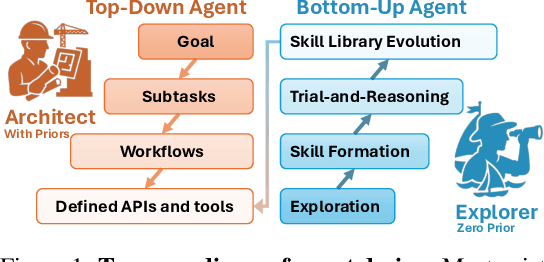

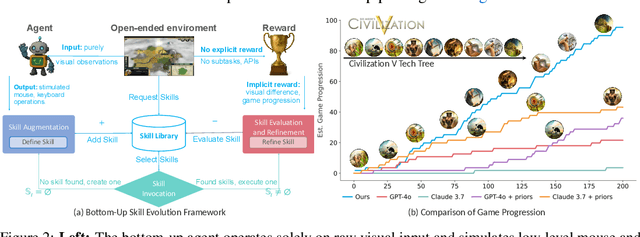
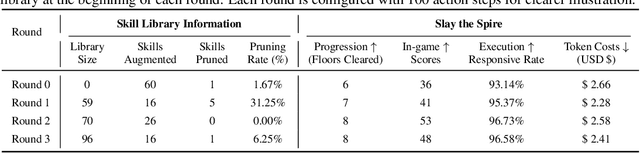
Most LLM-based agent frameworks adopt a top-down philosophy: humans decompose tasks, define workflows, and assign agents to execute each step. While effective on benchmark-style tasks, such systems rely on designer updates and overlook agents' potential to learn from experience. Recently, Silver and Sutton(2025) envision a shift into a new era, where agents could progress from a stream of experiences. In this paper, we instantiate this vision of experience-driven learning by introducing a bottom-up agent paradigm that mirrors the human learning process. Agents acquire competence through a trial-and-reasoning mechanism-exploring, reflecting on outcomes, and abstracting skills over time. Once acquired, skills can be rapidly shared and extended, enabling continual evolution rather than static replication. As more agents are deployed, their diverse experiences accelerate this collective process, making bottom-up design especially suited for open-ended environments. We evaluate this paradigm in Slay the Spire and Civilization V, where agents perceive through raw visual inputs and act via mouse outputs, the same as human players. Using a unified, game-agnostic codebase without any game-specific prompts or privileged APIs, our bottom-up agents acquire skills entirely through autonomous interaction, demonstrating the potential of the bottom-up paradigm in complex, real-world environments. Our code is available at https://github.com/AngusDujw/Bottom-Up-Agent.
UP-VLA: A Unified Understanding and Prediction Model for Embodied Agent
Jan 31, 2025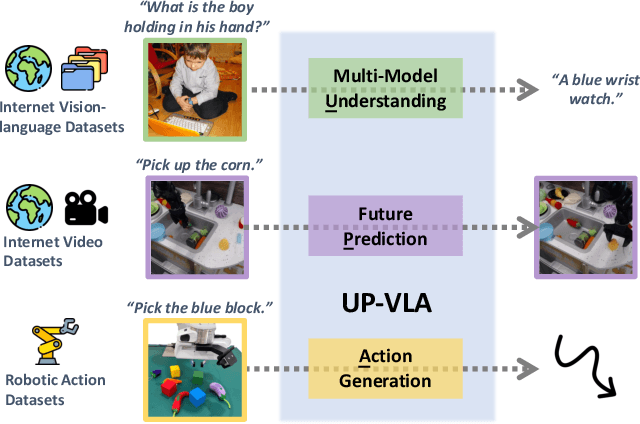
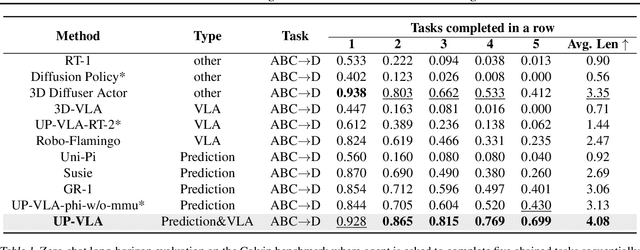
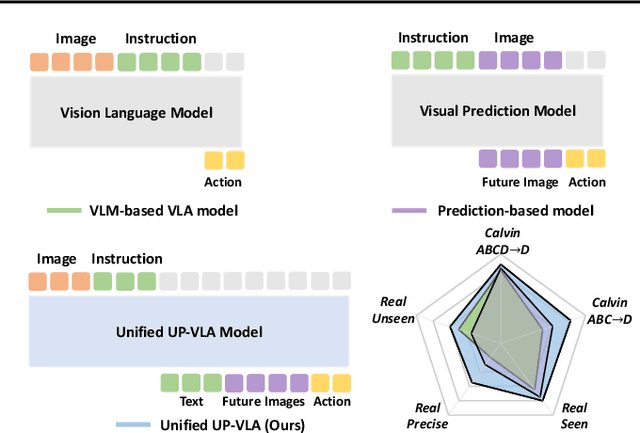
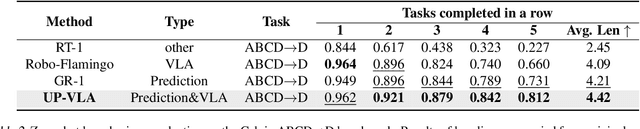
Recent advancements in Vision-Language-Action (VLA) models have leveraged pre-trained Vision-Language Models (VLMs) to improve the generalization capabilities. VLMs, typically pre-trained on vision-language understanding tasks, provide rich semantic knowledge and reasoning abilities. However, prior research has shown that VLMs often focus on high-level semantic content and neglect low-level features, limiting their ability to capture detailed spatial information and understand physical dynamics. These aspects, which are crucial for embodied control tasks, remain underexplored in existing pre-training paradigms. In this paper, we investigate the training paradigm for VLAs, and introduce \textbf{UP-VLA}, a \textbf{U}nified VLA model training with both multi-modal \textbf{U}nderstanding and future \textbf{P}rediction objectives, enhancing both high-level semantic comprehension and low-level spatial understanding. Experimental results show that UP-VLA achieves a 33% improvement on the Calvin ABC-D benchmark compared to the previous state-of-the-art method. Additionally, UP-VLA demonstrates improved success rates in real-world manipulation tasks, particularly those requiring precise spatial information.
Improving Vision-Language-Action Model with Online Reinforcement Learning
Jan 28, 2025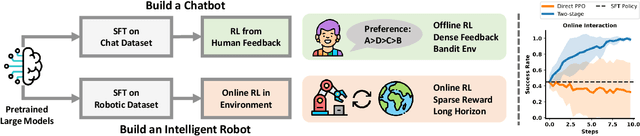
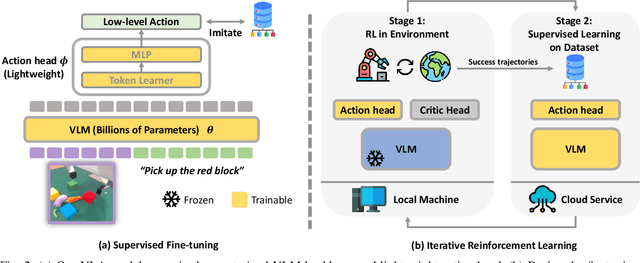
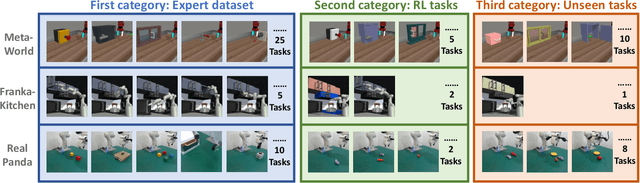
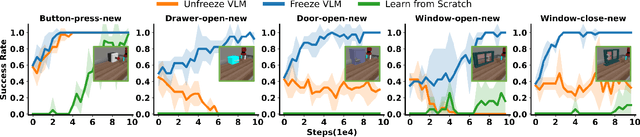
Recent studies have successfully integrated large vision-language models (VLMs) into low-level robotic control by supervised fine-tuning (SFT) with expert robotic datasets, resulting in what we term vision-language-action (VLA) models. Although the VLA models are powerful, how to improve these large models during interaction with environments remains an open question. In this paper, we explore how to further improve these VLA models via Reinforcement Learning (RL), a commonly used fine-tuning technique for large models. However, we find that directly applying online RL to large VLA models presents significant challenges, including training instability that severely impacts the performance of large models, and computing burdens that exceed the capabilities of most local machines. To address these challenges, we propose iRe-VLA framework, which iterates between Reinforcement Learning and Supervised Learning to effectively improve VLA models, leveraging the exploratory benefits of RL while maintaining the stability of supervised learning. Experiments in two simulated benchmarks and a real-world manipulation suite validate the effectiveness of our method.