 Add to Chrome
 Add to Firefox
 Add to Edge
HEFT: Heavy-Payload Full-size Humanoid Teleoperation with Privileged Motion Guidance and Windowed Payload Curriculum
Jul 02, 2026
General motion tracking and teleoperation offer a promising path to scalable humanoid skill acquisition, yet most existing frameworks are validated on compact platforms or without real payload interaction, leaving full-size humanoids with real payloads largely unexplored. Scaling to full-size humanoids introduces two compounding challenges: their larger inertia and tighter balance margins make tracking highly sensitive to noise, drift, and retargeting errors from commodity VR trackers, while their payload potential remains largely underutilized. We present HEFT, a heavy-payload full-size humanoid teleoperation framework that addresses both challenges. HEFT learns from deployable noisy VR references with physically plausible reconstructed references through Privileged Motion Guidance (PMG), and uses a Windowed Payload Curriculum (WPC) with expert-guided payload caps to acquire robust heavy-payload tracking. We deploy HEFT on L7, a 175cm, 65kg humanoid. The robot tracks motions including turns, forward/backward locomotion, and squats under payloads up to 24kg.

Veo-Act: How Far Can Frontier Video Models Advance Generalizable Robot Manipulation?
Apr 06, 2026Video generation models have advanced rapidly and are beginning to show a strong understanding of physical dynamics. In this paper, we investigate how far an advanced video generation model such as Veo-3 can support generalizable robotic manipulation. We first study a zero-shot approach in which Veo-3 predicts future image sequences from current robot observations, while an inverse dynamics model IDM recovers the corresponding robot actions. The IDM is trained solely on random-play data, requiring neither human supervision nor expert demonstrations. The key intuition is that, if a video model can generate physically plausible future motions in image space, an IDM can translate those visual trajectories into executable robot actions. We evaluate this "Veo-3+IDM" approach in both simulation and the real world using a high-dimensional dexterous hand. We find that, owing to the strong generalization capability of frontier video models, Veo-3+IDM can consistently generate approximately correct task-level trajectories. However, its low-level control accuracy remains insufficient to solve most tasks reliably. Motivated by this observation, we develop a hierarchical framework, Veo-Act, which uses Veo-3 as a high-level motion planner and a VLA policy as the low-level executor, significantly improving the instruction-following performance of a state-of-the-art vision-language-action policy. Overall, our results suggest that, as video generation models continue to improve, video models can be a valuable component for generalizable robot learning.
Survey of Specialized Large Language Model
Aug 27, 2025
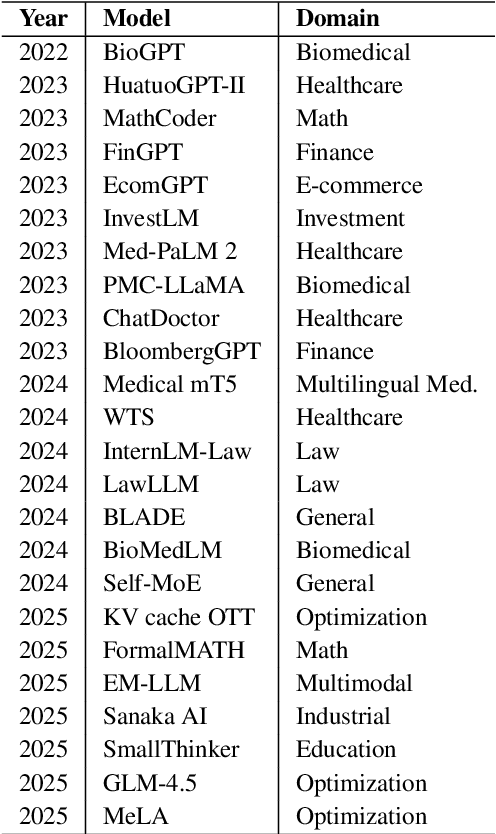
The rapid evolution of specialized large language models (LLMs) has transitioned from simple domain adaptation to sophisticated native architectures, marking a paradigm shift in AI development. This survey systematically examines this progression across healthcare, finance, legal, and technical domains. Besides the wide use of specialized LLMs, technical breakthrough such as the emergence of domain-native designs beyond fine-tuning, growing emphasis on parameter efficiency through sparse computation and quantization, increasing integration of multimodal capabilities and so on are applied to recent LLM agent. Our analysis reveals how these innovations address fundamental limitations of general-purpose LLMs in professional applications, with specialized models consistently performance gains on domain-specific benchmarks. The survey further highlights the implications for E-Commerce field to fill gaps in the field.