 Add to Chrome
 Add to Firefox
 Add to Edge
Validating Generalist Robots with Situation Calculus and STL Falsification
Jan 06, 2026
Generalist robots are becoming a reality, capable of interpreting natural language instructions and executing diverse operations. However, their validation remains challenging because each task induces its own operational context and correctness specification, exceeding the assumptions of traditional validation methods. We propose a two-layer validation framework that combines abstract reasoning with concrete system falsification. At the abstract layer, situation calculus models the world and derives weakest preconditions, enabling constraint-aware combinatorial testing to systematically generate diverse, semantically valid world-task configurations with controllable coverage strength. At the concrete layer, these configurations are instantiated for simulation-based falsification with STL monitoring. Experiments on tabletop manipulation tasks show that our framework effectively uncovers failure cases in the NVIDIA GR00T controller, demonstrating its promise for validating general-purpose robot autonomy.

TalkPhoto: A Versatile Training-Free Conversational Assistant for Intelligent Image Editing
Jan 05, 2026Thanks to the powerful language comprehension capabilities of Large Language Models (LLMs), existing instruction-based image editing methods have introduced Multimodal Large Language Models (MLLMs) to promote information exchange between instructions and images, ensuring the controllability and flexibility of image editing. However, these frameworks often build a multi-instruction dataset to train the model to handle multiple editing tasks, which is not only time-consuming and labor-intensive but also fails to achieve satisfactory results. In this paper, we present TalkPhoto, a versatile training-free image editing framework that facilitates precise image manipulation through conversational interaction. We instruct the open-source LLM with a specially designed prompt template to analyze user needs after receiving instructions and hierarchically invoke existing advanced editing methods, all without additional training. Moreover, we implement a plug-and-play and efficient invocation of image editing methods, allowing complex and unseen editing tasks to be integrated into the current framework, achieving stable and high-quality editing results. Extensive experiments demonstrate that our method not only provides more accurate invocation with fewer token consumption but also achieves higher editing quality across various image editing tasks.
Leveraging Flatness to Improve Information-Theoretic Generalization Bounds for SGD
Jan 04, 2026Information-theoretic (IT) generalization bounds have been used to study the generalization of learning algorithms. These bounds are intrinsically data- and algorithm-dependent so that one can exploit the properties of data and algorithm to derive tighter bounds. However, we observe that although the flatness bias is crucial for SGD's generalization, these bounds fail to capture the improved generalization under better flatness and are also numerically loose. This is caused by the inadequate leverage of SGD's flatness bias in existing IT bounds. This paper derives a more flatness-leveraging IT bound for the flatness-favoring SGD. The bound indicates the learned models generalize better if the large-variance directions of the final weight covariance have small local curvatures in the loss landscape. Experiments on deep neural networks show our bound not only correctly reflects the better generalization when flatness is improved, but is also numerically much tighter. This is achieved by a flexible technique called "omniscient trajectory". When applied to Gradient Descent's minimax excess risk on convex-Lipschitz-Bounded problems, it improves representative IT bounds' $Ω(1)$ rates to $O(1/\sqrt{n})$. It also implies a by-pass of memorization-generalization trade-offs.
* Published as a conference paper at ICLR 2025
NVIDIA Nemotron 3: Efficient and Open Intelligence
Dec 24, 2025We introduce the Nemotron 3 family of models - Nano, Super, and Ultra. These models deliver strong agentic, reasoning, and conversational capabilities. The Nemotron 3 family uses a Mixture-of-Experts hybrid Mamba-Transformer architecture to provide best-in-class throughput and context lengths of up to 1M tokens. Super and Ultra models are trained with NVFP4 and incorporate LatentMoE, a novel approach that improves model quality. The two larger models also include MTP layers for faster text generation. All Nemotron 3 models are post-trained using multi-environment reinforcement learning enabling reasoning, multi-step tool use, and support granular reasoning budget control. Nano, the smallest model, outperforms comparable models in accuracy while remaining extremely cost-efficient for inference. Super is optimized for collaborative agents and high-volume workloads such as IT ticket automation. Ultra, the largest model, provides state-of-the-art accuracy and reasoning performance. Nano is released together with its technical report and this white paper, while Super and Ultra will follow in the coming months. We will openly release the model weights, pre- and post-training software, recipes, and all data for which we hold redistribution rights.
Nemotron 3 Nano: Open, Efficient Mixture-of-Experts Hybrid Mamba-Transformer Model for Agentic Reasoning
Dec 23, 2025We present Nemotron 3 Nano 30B-A3B, a Mixture-of-Experts hybrid Mamba-Transformer language model. Nemotron 3 Nano was pretrained on 25 trillion text tokens, including more than 3 trillion new unique tokens over Nemotron 2, followed by supervised fine tuning and large-scale RL on diverse environments. Nemotron 3 Nano achieves better accuracy than our previous generation Nemotron 2 Nano while activating less than half of the parameters per forward pass. It achieves up to 3.3x higher inference throughput than similarly-sized open models like GPT-OSS-20B and Qwen3-30B-A3B-Thinking-2507, while also being more accurate on popular benchmarks. Nemotron 3 Nano demonstrates enhanced agentic, reasoning, and chat abilities and supports context lengths up to 1M tokens. We release both our pretrained Nemotron 3 Nano 30B-A3B Base and post-trained Nemotron 3 Nano 30B-A3B checkpoints on Hugging Face.
MAGIC: Achieving Superior Model Merging via Magnitude Calibration
Dec 22, 2025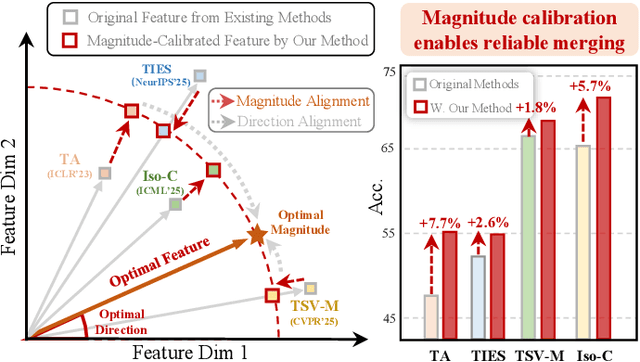
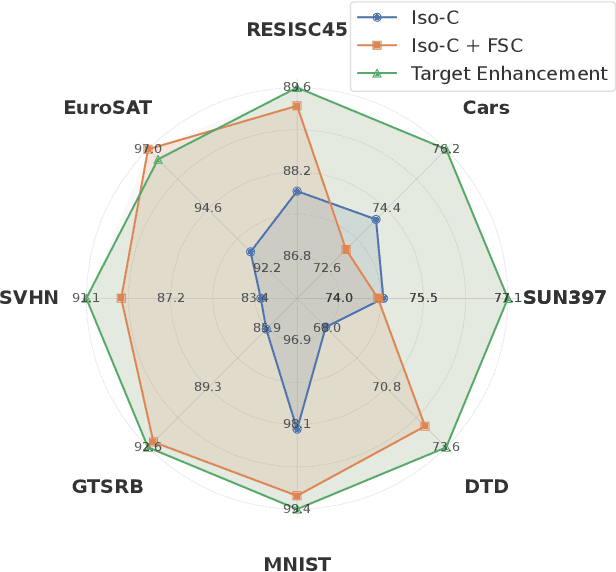
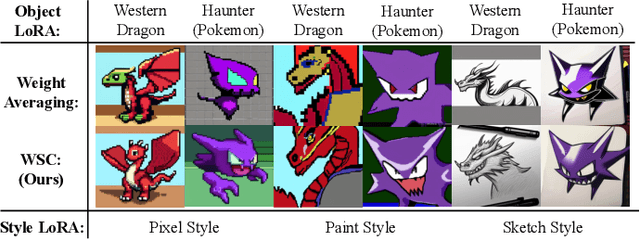
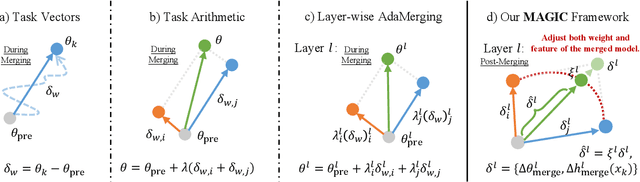
The proliferation of pre-trained models has given rise to a wide array of specialised, fine-tuned models. Model merging aims to merge the distinct capabilities of these specialised models into a unified model, requiring minimal or even no additional training. A core objective of model merging is to ensure the merged model retains the behavioural characteristics of the specialised models, typically achieved through feature alignment. We identify that features consist of two critical components: direction and magnitude. Prior research has predominantly focused on directional alignment, while the influence of magnitude remains largely neglected, despite its pronounced vulnerability to perturbations introduced by common merging operations (e.g., parameter fusion and sparsification). Such perturbations to magnitude inevitably lead to feature deviations in the merged model from the specialised models, resulting in subsequent performance degradation. To address this, we propose MAGnItude Calibration (MAGIC), a plug-and-play framework that rectifies layer-wise magnitudes in feature and weight spaces, with three variants. Specifically, our Feature Space Calibration (FSC) realigns the merged model's features using a small set of unlabelled data, while Weight Space Calibration (WSC) extends this calibration to the weight space without requiring additional data. Combining these yields Dual Space Calibration (DSC). Comprehensive experiments demonstrate that MAGIC consistently boosts performance across diverse Computer Vision tasks (+4.3% on eight datasets) and NLP tasks (+8.0% on Llama) without additional training. Our code is available at: https://github.com/lyymuwu/MAGIC
$M^3-Verse$: A "Spot the Difference" Challenge for Large Multimodal Models
Dec 21, 2025Modern Large Multimodal Models (LMMs) have demonstrated extraordinary ability in static image and single-state spatial-temporal understanding. However, their capacity to comprehend the dynamic changes of objects within a shared spatial context between two distinct video observations, remains largely unexplored. This ability to reason about transformations within a consistent environment is particularly crucial for advancements in the field of spatial intelligence. In this paper, we introduce $M^3-Verse$, a Multi-Modal, Multi-State, Multi-Dimensional benchmark, to formally evaluate this capability. It is built upon paired videos that provide multi-perspective observations of an indoor scene before and after a state change. The benchmark contains a total of 270 scenes and 2,932 questions, which are categorized into over 50 subtasks that probe 4 core capabilities. We evaluate 16 state-of-the-art LMMs and observe their limitations in tracking state transitions. To address these challenges, we further propose a simple yet effective baseline that achieves significant performance improvements in multi-state perception. $M^3-Verse$ thus provides a challenging new testbed to catalyze the development of next-generation models with a more holistic understanding of our dynamic visual world. You can get the construction pipeline from https://github.com/Wal-K-aWay/M3-Verse_pipeline and full benchmark data from https://www.modelscope.cn/datasets/WalKaWay/M3-Verse.
WeMusic-Agent: Efficient Conversational Music Recommendation via Knowledge Internalization and Agentic Boundary Learning
Dec 18, 2025Personalized music recommendation in conversational scenarios usually requires a deep understanding of user preferences and nuanced musical context, yet existing methods often struggle with balancing specialized domain knowledge and flexible tool integration. This paper proposes WeMusic-Agent, a training framework for efficient LLM-based conversational music recommendation. By integrating the knowledge internalization and agentic boundary learning, the framework aims to teach the model to intelligently decide when to leverage internalized knowledge and when to call specialized tools (e.g., music retrieval APIs, music recommendation systems). Under this framework, we present WeMusic-Agent-M1, an agentic model that internalizes extensive musical knowledge via continued pretraining on 50B music-related corpus while acquiring the ability to invoke external tools when necessary. Additionally, considering the lack of open-source benchmarks for conversational music recommendation, we also construct a benchmark for personalized music recommendations derived from real-world data in WeChat Listen. This benchmark enables comprehensive evaluation across multiple dimensions, including relevance, personalization, and diversity of the recommendations. Experiments on real-world data demonstrate that WeMusic-Agent achieves significant improvements over existing models.
Artificial Intelligence-Enabled Holistic Design of Catalysts Tailored for Semiconducting Carbon Nanotube Growth
Dec 18, 2025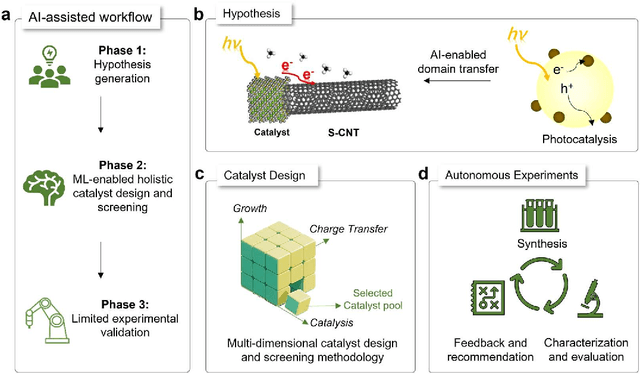
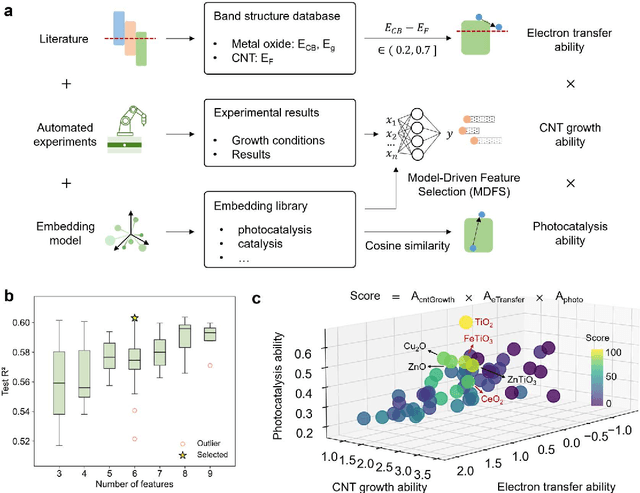
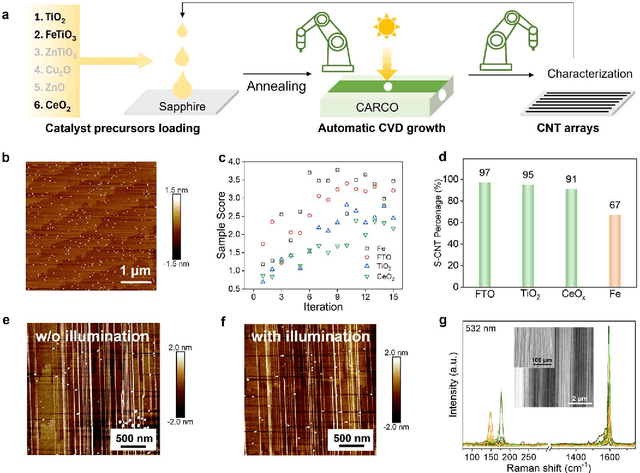
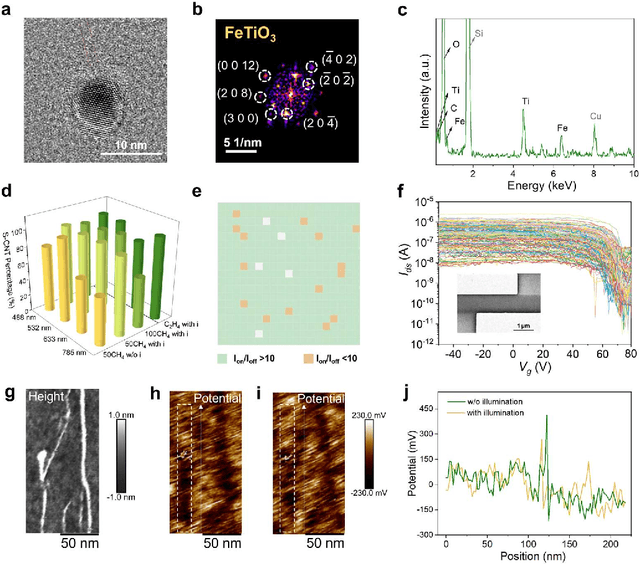
Catalyst design is crucial for materials synthesis, especially for complex reaction networks. Strategies like collaborative catalytic systems and multifunctional catalysts are effective but face challenges at the nanoscale. Carbon nanotube synthesis contains complicated nanoscale catalytic reactions, thus achieving high-density, high-quality semiconducting CNTs demands innovative catalyst design. In this work, we present a holistic framework integrating machine learning into traditional catalyst design for semiconducting CNT synthesis. It combines knowledge-based insights with data-driven techniques. Three key components, including open-access electronic structure databases for precise physicochemical descriptors, pre-trained natural language processing-based embedding model for higher-level abstractions, and physical - driven predictive models based on experiment data, are utilized. Through this framework, a new method for selective semiconducting CNT synthesis via catalyst - mediated electron injection, tuned by light during growth, is proposed. 54 candidate catalysts are screened, and three with high potential are identified. High-throughput experiments validate the predictions, with semiconducting selectivity exceeding 91% and the FeTiO3 catalyst reaching 98.6%. This approach not only addresses semiconducting CNT synthesis but also offers a generalizable methodology for global catalyst design and nanomaterials synthesis, advancing materials science in precise control.
Audio-Visual Cross-Modal Compression for Generative Face Video Coding
Dec 17, 2025Generative face video coding (GFVC) is vital for modern applications like video conferencing, yet existing methods primarily focus on video motion while neglecting the significant bitrate contribution of audio. Despite the well-established correlation between audio and lip movements, this cross-modal coherence has not been systematically exploited for compression. To address this, we propose an Audio-Visual Cross-Modal Compression (AVCC) framework that jointly compresses audio and video streams. Our framework extracts motion information from video and tokenizes audio features, then aligns them through a unified audio-video diffusion process. This allows synchronized reconstruction of both modalities from a shared representation. In extremely low-rate scenarios, AVCC can even reconstruct one modality from the other. Experiments show that AVCC significantly outperforms the Versatile Video Coding (VVC) standard and state-of-the-art GFVC schemes in rate-distortion performance, paving the way for more efficient multimodal communication systems.