 Add to Chrome
 Add to Firefox
 Add to Edge
FAR: Failure-Aware Retry for Test-Time Recovery and Continual Policy Improvement
Jul 01, 2026
Robot policies inevitably encounter failures when deployed in real environments. Naive retries often repeat the same mistakes, while many existing recovery methods rely on human intervention. In this paper, we propose Failure-Aware Retry (FAR), a framework that enables robots to learn from previous failures at test time, adapt their behavior accordingly, and eventually complete the task autonomously. FAR combines Failure-Contrastive Preference Adaptation, which constructs preference learning data from failures to steer the policy away from previously unsuccessful behaviors, with lightweight action perturbations during retries to encourage local exploration. We further incorporate successful recovery trajectories into a training loop for continual policy improvement. Experiments in both simulation and real-world manipulation tasks show that FAR substantially improves success rates and robustness, with average gains of 17.6% over the standard diffusion policy in simulation and 11.7% in the real world. In addition, FAR significantly improves data efficiency under both reset and timestep budgets during continual policy improvement by exploiting informative failure cases.

Reason Twice: Segmentation via Candidate Discovery and Comparative Reasoning
Jun 08, 2026The rapid development of pretrained foundation models has enabled more general image segmentation. Multimodal large language models (MLLMs) have been widely explored for image segmentation with complex queries that require high-level reasoning. Despite promising progress, existing methods are often constrained by limited training data and the gap between MLLMs and mask generation modules. To better transfer MLLMs' perception and reasoning ability to complex reasoning-based segmentation tasks, we propose a two-stage framework Rea2Seg for mask generation and selection. Specifically, the framework first identifies potential regions as candidate masks based on the attention maps of a segmentation MLLM. It then employs an MLLM to reason over the question and candidate masks and assign scores to each mask. The final segmentation result is obtained by reranking the candidates and selecting the highest-scoring mask, reformulating image segmentation as candidate discovery followed by discriminative mask selection. We also notice that a large portion of questions in existing benchmarks focus on commonsense reasoning, and these questions usually do not fully require joint visual observation and reasoning. To address this issue, we introduce a new benchmark called ReasonSeg-SGDR that comprehensively evaluates a model's perception, grounding, and reasoning abilities across multiple dimensions, including discriminative recognition, spatial reasoning, geometric reasoning, and multi-step reasoning, with fine-grained mask generation. In addition, we collect training data to enhance MLLMs' ability to jointly understand multimodal queries and candidate masks, and to assign scores through reasoning. Experimental results on the proposed benchmark and ReasonSeg demonstrate the effectiveness of the unified mask generation and selection framework.
Intercepting the Future: Latent-Space Predictive World Model for Dynamic VLA Manipulation
Jun 01, 2026Vision-Language-Action (VLA) models generalize across static manipulation but fail when objects move during task execution. They map the current observation to an action and assume the scene is stationary between observation and execution, so at any non-trivial object speed the resulting latency exceeds the time available to grasp. We close this gap with AHEAD (Anticipatory Horizon Extrapolation with Adaptive Dynamics), a predict-then-act wrapper that augments a frozen VLA with a motion-aware latent world model. A small world model trained on manipulation video forecasts future patch tokens in the VLA's feature space, conditioned on per-token velocity and acceleration from optical flow. A language-and-motion saliency mask concentrates prediction on task-relevant patches, and the model rolls forward for an adaptive horizon, halting when prediction uncertainty crosses a threshold. The frozen action decoder then receives the predicted future tokens in place of the current ones. AHEAD adds 4.9M parameters to a frozen 7B OpenVLA and reaches 79 to 97% success across 20 dynamic simulation scenarios where the strongest baseline reaches 31 to 58%. On a physical UFactory xArm 7, AHEAD succeeds on 29/30 to 30/30 on three conveyor and rolling-ball tasks, 23/30 on paddle interception, and 19/30 on projectile catching where every baseline scores 0/30.
Multimodal Long Video Modeling Based on Temporal Dynamic Context
Apr 14, 2025Recent advances in Large Language Models (LLMs) have led to significant breakthroughs in video understanding. However, existing models still struggle with long video processing due to the context length constraint of LLMs and the vast amount of information within the video. Although some recent methods are designed for long video understanding, they often lose crucial information during token compression and struggle with additional modality like audio. In this work, we propose a dynamic long video encoding method utilizing the temporal relationship between frames, named Temporal Dynamic Context (TDC). Firstly, we segment the video into semantically consistent scenes based on inter-frame similarities, then encode each frame into tokens using visual-audio encoders. Secondly, we propose a novel temporal context compressor to reduce the number of tokens within each segment. Specifically, we employ a query-based Transformer to aggregate video, audio, and instruction text tokens into a limited set of temporal context tokens. Finally, we feed the static frame tokens and the temporal context tokens into the LLM for video understanding. Furthermore, to handle extremely long videos, we propose a training-free chain-of-thought strategy that progressively extracts answers from multiple video segments. These intermediate answers serve as part of the reasoning process and contribute to the final answer. We conduct extensive experiments on general video understanding and audio-video understanding benchmarks, where our method demonstrates strong performance. The code and models are available at https://github.com/Hoar012/TDC-Video.
Remember, Retrieve and Generate: Understanding Infinite Visual Concepts as Your Personalized Assistant
Oct 17, 2024
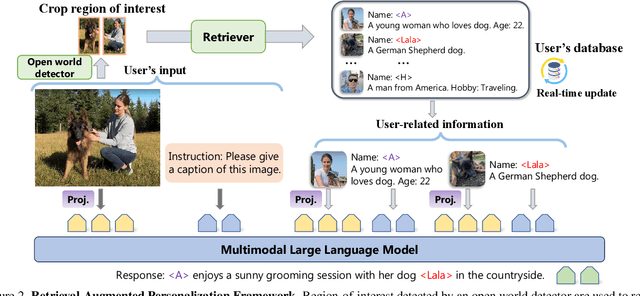


The development of large language models (LLMs) has significantly enhanced the capabilities of multimodal LLMs (MLLMs) as general assistants. However, lack of user-specific knowledge still restricts their application in human's daily life. In this paper, we introduce the Retrieval Augmented Personalization (RAP) framework for MLLMs' personalization. Starting from a general MLLM, we turn it into a personalized assistant in three steps. (a) Remember: We design a key-value database to store user-related information, e.g., user's name, avatar and other attributes. (b) Retrieve: When the user initiates a conversation, RAP will retrieve relevant information from the database using a multimodal retriever. (c) Generate: The input query and retrieved concepts' information are fed into MLLMs to generate personalized, knowledge-augmented responses. Unlike previous methods, RAP allows real-time concept editing via updating the external database. To further improve generation quality and alignment with user-specific information, we design a pipeline for data collection and create a specialized dataset for personalized training of MLLMs. Based on the dataset, we train a series of MLLMs as personalized multimodal assistants. By pretraining on large-scale dataset, RAP-MLLMs can generalize to infinite visual concepts without additional finetuning. Our models demonstrate outstanding flexibility and generation quality across a variety of tasks, such as personalized image captioning, question answering and visual recognition. The code, data and models are available at https://github.com/Hoar012/RAP-MLLM.