 Add to Chrome
 Add to Firefox
 Add to Edge
MAGIC: Transition-Aware Generation of Navigable Multi-Scene Game Worlds with Large Language Models
Jul 13, 2026
Multi-scene navigation (clearing an objective in one bounded space and then crossing a portal into the next) is a defining feature of contemporary 3D games, but authoring it is laborious: every portal must have consistent endpoints on both sides, each interior must remain navigable once it is furnished, and the resulting connectivity must be kept consistent across many files. Recent large language model (LLM) and multimodal LLM (MLLM) scene generators have made single-interior synthesis dramatically cheaper, yet they produce one scene at a time and cannot, by naive repetition, yield a connected multi-scene world. We identify three obstacles that single-scene methods leave unsolved: cross-scene consistency, in-scene navigability, and the evaluation of whether a transition actually works. We present MAGIC, a prompt-to-project system that addresses all three. MAGIC is a four-stage pipeline that turns a single natural-language prompt into a runnable multi-scene game project: it plans a shared transition-aware intermediate representation, specifies each scene while enforcing portal reachability with a flood-fill validator, generates the scenes together with their transition scripts, and combines them into one project. Because existing single-scene fidelity metrics never execute a transition, we further introduce a transition-focused evaluation agent that runs each transition in play. On a new benchmark of 100 multi-scene cases, MAGIC produces an executable project for every case and reaches 0.99 precision, 0.95 recall, and 0.96 F1 on end-to-end transition identification; stage by stage, it recovers more ground-truth portals and yields markedly more navigable layouts than an LLM baseline and Holodeck. Our code is available at https://github.com/sereneee1201/MAGIC/.

WAM-TTT: Steering World-Action Models by Watching Human Play at Test Time
Jul 08, 2026Steering robot foundation models (RFMs) toward new task variants or user-preferred behaviors remains challenging, often requiring additional robot demonstrations, task-specific fine-tuning, or long-context conditioning. We present WAM-TTT, a test-time training framework for steering world action models from raw human videos. Rather than treating human videos as trajectories to imitate, WAM-TTT absorbs them into a lightweight adaptive memory inside a frozen WAM through self-supervised video prediction. To make this memory useful for control, we introduce a meta-training stage that aligns human demonstrations with robot behaviors using paired human-robot data and a key--value memory reconstruction objective. At test time, only unlabeled human videos are required to adapt the memory, while the pretrained WAM remains frozen. This enables efficient and reusable steering without robot actions, human-side annotations, or task-specific fine-tuning, while preserving the generalization ability of the foundation model. Extensive experiments show that WAM-TTT consistently outperforms in-context human-video conditioning baselines across diverse manipulation tasks and generalization settings.
UniCoder: Unified Visual-to-Code Generation via Symbolic Rewards and Reference-Guided Code Optimization
Jun 30, 2026Visual-to-Code generation, which transforms scientific plots, vector graphics, and webpages into executable scripts, demands a level of pixel-precise alignment that standard Multimodal Large Language Models (MLLMs) fail to achieve through Supervised Fine-Tuning (SFT) alone. While Reinforcement Learning (RL) offers a theoretical pathway to bridge this gap, its application is hindered by two fundamental obstacles: (1) \textit{Reward Coarseness}, where semantic metrics like CLIP scores fail to penalize fine-grained element deviations, and (2) \textit{Exploration Stagnation}, where the sparse, heterogeneous code search space prevents the policy from bootstrapping valid trajectories. To overcome these limitations, we introduce UniCoder, a unified RL framework that integrates two novel mechanisms. First, we propose \textbf{Symbolic Attribute Alignment}, which employs a lightweight auxiliary LLM to parse generated code into discrete visual attributes (e.g., hex colors, coordinate limits), enabling dense, element-wise reward computation. Second, to escape local optima, we devise \textbf{Reference-Guided Code Optimization}, a strategy that dynamically injects ground-truth trajectories into low-performing rollout groups, transforming blind exploration into guided policy improvement. Extensive experiments on ChartMimic, UniSVG, Design2Code and ScreenBench benchmarks demonstrate that our 8B-parameter model not only surpasses all open-source baselines but also achieves state-of-the-art performance comparable to proprietary models, establishing a new paradigm for generalized visual-to-code synthesis.
LESSViT: Robust Hyperspectral Representation Learning under Spectral Configuration Shift
May 18, 2026Modeling hyperspectral imagery (HSI) across different sensors presents a fundamental challenge due to variations in wavelength coverage, band sampling, and channel dimensionality. As a result, models trained under a fixed spectral configuration often fail to generalize to other sensors. Existing Vision Transformer (ViT) approaches either rely on implicit spectral modeling with fixed channel assumptions or adopt explicit spatial-spectral attention with prohibitive computational cost, leading to a fundamental trade-off between efficiency and expressiveness. In this work, we introduce Low-rank Efficient Spatial-Spectral ViT (LESSViT), a sensor-flexible architecture for cross-spectral generalization. LESSViT is built on LESS Attention, a structured low-rank factorization that models joint spatial-spectral interactions through separable spatial and spectral components, reducing the complexity of full spatial-spectral attention from $O(N^2 C^2)$ to $O(rNC)$, where $N$ is the number of spatial tokens, $C$ is the number of spectral channels, and $r$ is the rank of the low-rank approximation. We further incorporate channel-agnostic patch embedding and wavelength-aware positional encoding to support flexible spectral inputs. To enable efficient and robust pretraining, we introduce a hyperspectral masked autoencoder (HyperMAE) with decoupled spatial-spectral masking and hierarchical channel sampling. We evaluate LESSViT under a cross-spectral generalization setting that simulates cross-sensor variability. Experiments on the SpectralEarth benchmark demonstrate that LESSViT improves robustness under spectral shifts while remaining competitive in-distribution, and explicit and efficient spatial-spectral modeling is essential for scalable and generalizable hyperspectral representation learning.
HDFlow: Hierarchical Diffusion-Flow Planning for Long-horizon Tasks
May 06, 2026Recent advances in generative models have shown promise in generating behavior plans for long-horizon, sparse reward tasks. While these approaches have achieved promising results, they often lack a principled framework for hierarchical decomposition and struggle with the computational demands of real-time execution, due to their iterative denoising process. In this work, we introduce Hierarchical Diffusion-Flow (HDFlow), a novel hierarchical planning framework that optimally leverages the strengths of diffusion and rectified flow models to overcome the limitations of single-paradigm generative planners. HDFlow employs a high-level diffusion planner to generate sequences of strategic subgoals in a learned latent space, capitalizing on diffusion's powerful exploratory capabilities. These subgoals then guide a low-level rectified flow planner that generates smooth and dense trajectories, exploiting the speed and efficiency of ordinary differential equation (ODE)-based trajectory generation. We evaluate HDFlow on four challenging furniture assembly tasks in both simulation and real-world, where it significantly outperforms state-of-the-art methods. Furthermore, we also showcase our method's generalizability on two long-horizon benchmarks comprising diverse locomotion and manipulation tasks. Project website: https://hdflow-page.github.io/
Posterior Optimization with Clipped Objective for Bridging Efficiency and Stability in Generative Policy Learning
Apr 02, 2026Expressive generative models have advanced robotic manipulation by capturing complex, multi-modal action distributions over temporally extended trajectories. However, fine-tuning these policies via RL remains challenging due to instability and sample inefficiency. We introduce Posterior Optimization with Clipped Objective (POCO), a principled RL framework that formulates policy improvement as a posterior inference problem tailored for temporal action chunks. Through an Expectation-Maximization procedure, POCO distills a reward-weighted implicit posterior into the policy without likelihood estimation. Furthermore, POCO adopts an offline-to-online paradigm that anchors online exploration to pre-trained priors, and its model-agnostic design scales to fine-tune large VLA models without architectural modifications. Evaluations across 7 simulation benchmarks and 4 contact-rich real-world tasks demonstrate that POCO prevents catastrophic policy collapse, outperforms SOTA baselines, and achieves a 96.7% success rate on real-world tasks. Videos are available at our project website https://cccedric.github.io/poco/.
Inference-Time Scaling of Verification: Self-Evolving Deep Research Agents via Test-Time Rubric-Guided Verification
Jan 22, 2026Recent advances in Deep Research Agents (DRAs) are transforming automated knowledge discovery and problem-solving. While the majority of existing efforts focus on enhancing policy capabilities via post-training, we propose an alternative paradigm: self-evolving the agent's ability by iteratively verifying the policy model's outputs, guided by meticulously crafted rubrics. This approach gives rise to the inference-time scaling of verification, wherein an agent self-improves by evaluating its generated answers to produce iterative feedback and refinements. We derive the rubrics based on an automatically constructed DRA Failure Taxonomy, which systematically classifies agent failures into five major categories and thirteen sub-categories. We present DeepVerifier, a rubrics-based outcome reward verifier that leverages the asymmetry of verification and outperforms vanilla agent-as-judge and LLM judge baselines by 12%-48% in meta-evaluation F1 score. To enable practical self-evolution, DeepVerifier integrates as a plug-and-play module during test-time inference. The verifier produces detailed rubric-based feedback, which is fed back to the agent for iterative bootstrapping, refining responses without additional training. This test-time scaling delivers 8%-11% accuracy gains on challenging subsets of GAIA and XBench-DeepResearch when powered by capable closed-source LLMs. Finally, to support open-source advancement, we release DeepVerifier-4K, a curated supervised fine-tuning dataset of 4,646 high-quality agent steps focused on DRA verification. These examples emphasize reflection and self-critique, enabling open models to develop robust verification capabilities.
ScreenCoder: Advancing Visual-to-Code Generation for Front-End Automation via Modular Multimodal Agents
Jul 30, 2025Automating the transformation of user interface (UI) designs into front-end code holds significant promise for accelerating software development and democratizing design workflows. While recent large language models (LLMs) have demonstrated progress in text-to-code generation, many existing approaches rely solely on natural language prompts, limiting their effectiveness in capturing spatial layout and visual design intent. In contrast, UI development in practice is inherently multimodal, often starting from visual sketches or mockups. To address this gap, we introduce a modular multi-agent framework that performs UI-to-code generation in three interpretable stages: grounding, planning, and generation. The grounding agent uses a vision-language model to detect and label UI components, the planning agent constructs a hierarchical layout using front-end engineering priors, and the generation agent produces HTML/CSS code via adaptive prompt-based synthesis. This design improves robustness, interpretability, and fidelity over end-to-end black-box methods. Furthermore, we extend the framework into a scalable data engine that automatically produces large-scale image-code pairs. Using these synthetic examples, we fine-tune and reinforce an open-source VLM, yielding notable gains in UI understanding and code quality. Extensive experiments demonstrate that our approach achieves state-of-the-art performance in layout accuracy, structural coherence, and code correctness. Our code is made publicly available at https://github.com/leigest519/ScreenCoder.
DesignBench: A Comprehensive Benchmark for MLLM-based Front-end Code Generation
Jun 06, 2025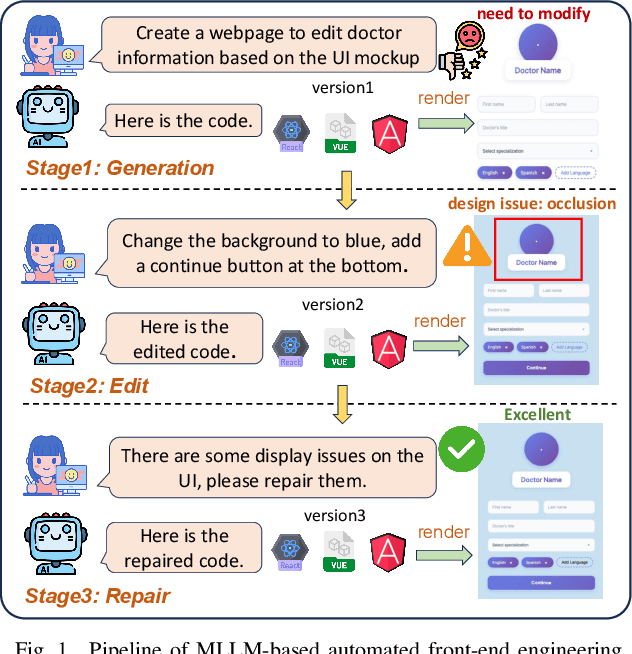
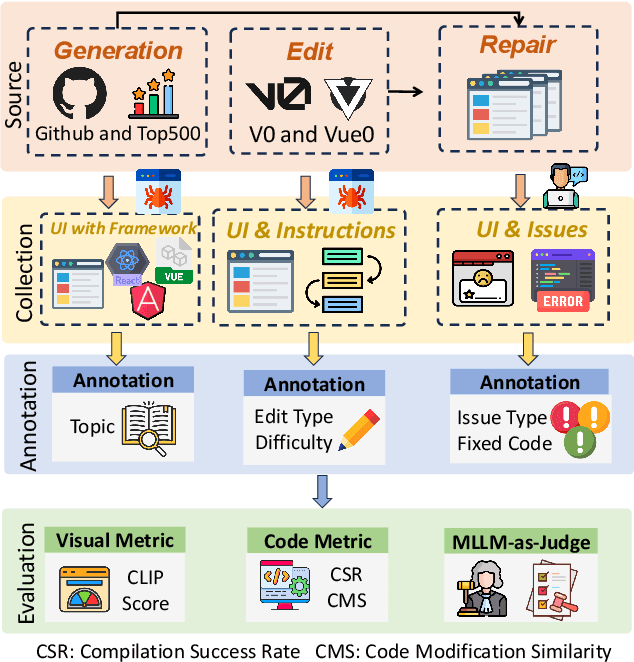

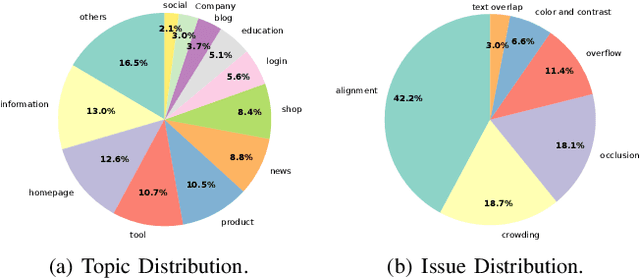
Multimodal Large Language Models (MLLMs) have demonstrated remarkable capabilities in automated front-end engineering, e.g., generating UI code from visual designs. However, existing front-end UI code generation benchmarks have the following limitations: (1) While framework-based development becomes predominant in modern front-end programming, current benchmarks fail to incorporate mainstream development frameworks. (2) Existing evaluations focus solely on the UI code generation task, whereas practical UI development involves several iterations, including refining editing, and repairing issues. (3) Current benchmarks employ unidimensional evaluation, lacking investigation into influencing factors like task difficulty, input context variations, and in-depth code-level analysis. To bridge these gaps, we introduce DesignBench, a multi-framework, multi-task evaluation benchmark for assessing MLLMs' capabilities in automated front-end engineering. DesignBench encompasses three widely-used UI frameworks (React, Vue, and Angular) alongside vanilla HTML/CSS, and evaluates on three essential front-end tasks (generation, edit, and repair) in real-world development workflows. DesignBench contains 900 webpage samples spanning over 11 topics, 9 edit types, and 6 issue categories, enabling detailed analysis of MLLM performance across multiple dimensions. Our systematic evaluation reveals critical insights into MLLMs' framework-specific limitations, task-related bottlenecks, and performance variations under different conditions, providing guidance for future research in automated front-end development. Our code and data are available at https://github.com/WebPAI/DesignBench.
Learning a Pessimistic Reward Model in RLHF
May 26, 2025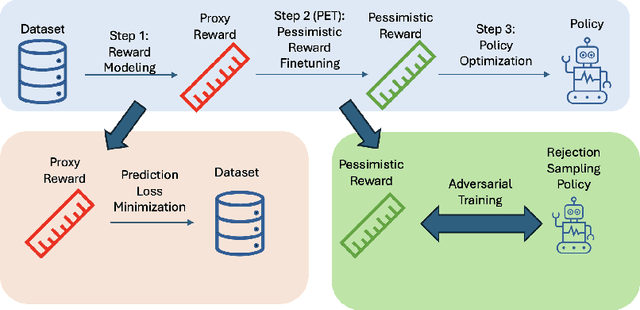

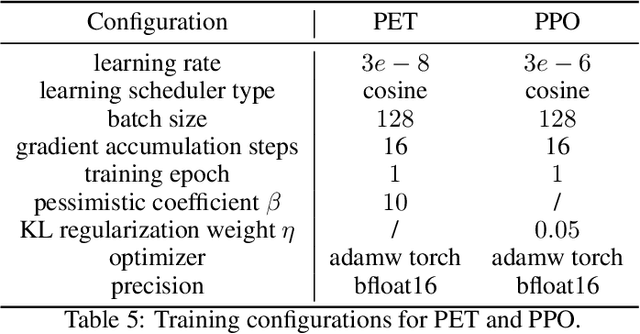
This work proposes `PET', a novel pessimistic reward fine-tuning method, to learn a pessimistic reward model robust against reward hacking in offline reinforcement learning from human feedback (RLHF). Traditional reward modeling techniques in RLHF train an imperfect reward model, on which a KL regularization plays a pivotal role in mitigating reward hacking when optimizing a policy. Such an intuition-based method still suffers from reward hacking, and the policies with large KL divergence from the dataset distribution are excluded during learning. In contrast, we show that when optimizing a policy on a pessimistic reward model fine-tuned through PET, reward hacking can be prevented without relying on any regularization. We test our methods on the standard TL;DR summarization dataset. We find that one can learn a high-quality policy on our pessimistic reward without using any regularization. Such a policy has a high KL divergence from the dataset distribution while having high performance in practice. In summary, our work shows the feasibility of learning a pessimistic reward model against reward hacking. The agent can greedily search for the policy with a high pessimistic reward without suffering from reward hacking.