 Add to Chrome
 Add to Firefox
 Add to Edge
Vision-Language Foundation Models as Effective Robot Imitators
Nov 06, 2023
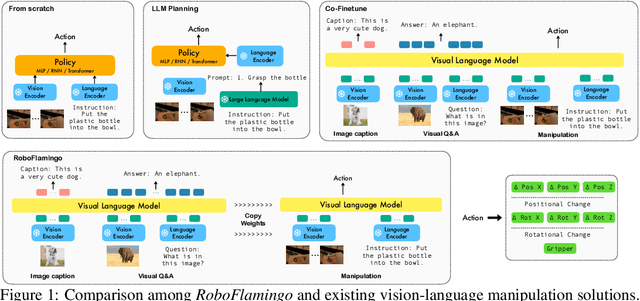
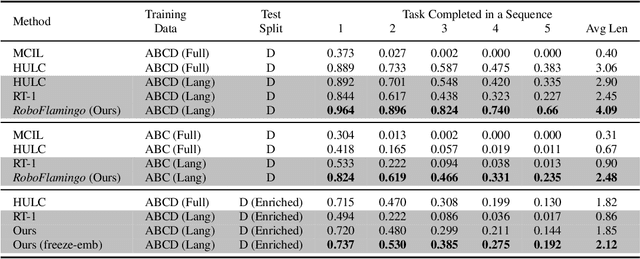
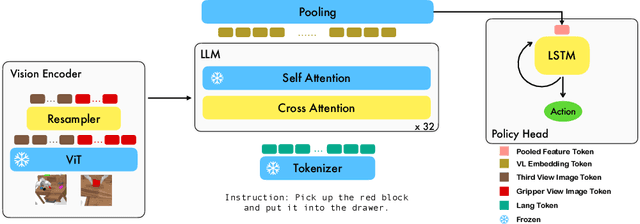
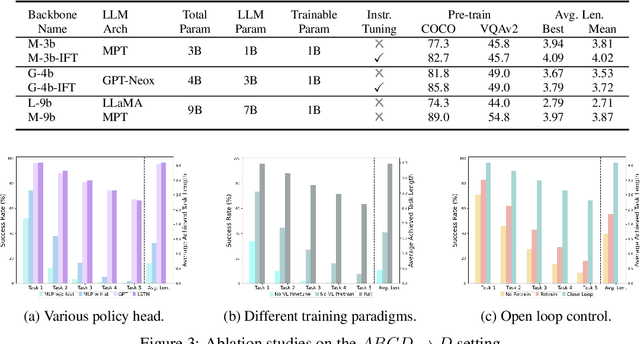
Recent progress in vision language foundation models has shown their ability to understand multimodal data and resolve complicated vision language tasks, including robotics manipulation. We seek a straightforward way of making use of existing vision-language models (VLMs) with simple fine-tuning on robotics data. To this end, we derive a simple and novel vision-language manipulation framework, dubbed RoboFlamingo, built upon the open-source VLMs, OpenFlamingo. Unlike prior works, RoboFlamingo utilizes pre-trained VLMs for single-step vision-language comprehension, models sequential history information with an explicit policy head, and is slightly fine-tuned by imitation learning only on language-conditioned manipulation datasets. Such a decomposition provides RoboFlamingo the flexibility for open-loop control and deployment on low-performance platforms. By exceeding the state-of-the-art performance with a large margin on the tested benchmark, we show RoboFlamingo can be an effective and competitive alternative to adapt VLMs to robot control. Our extensive experimental results also reveal several interesting conclusions regarding the behavior of different pre-trained VLMs on manipulation tasks. We believe RoboFlamingo has the potential to be a cost-effective and easy-to-use solution for robotics manipulation, empowering everyone with the ability to fine-tune their own robotics policy.

Masked Space-Time Hash Encoding for Efficient Dynamic Scene Reconstruction
Oct 26, 2023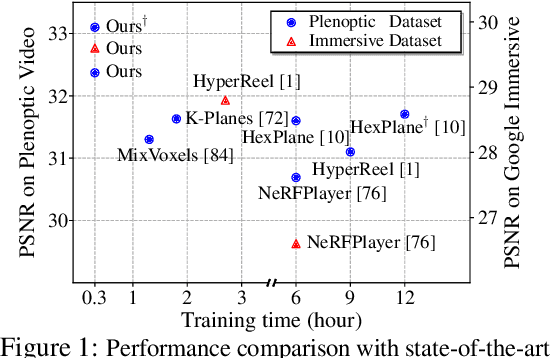
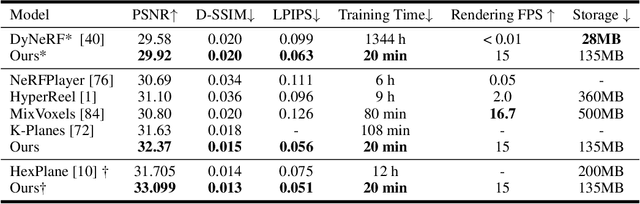
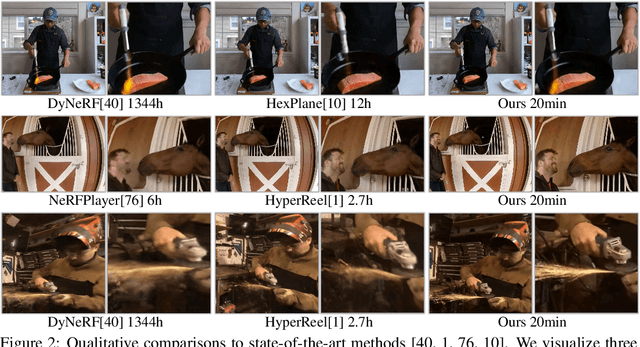
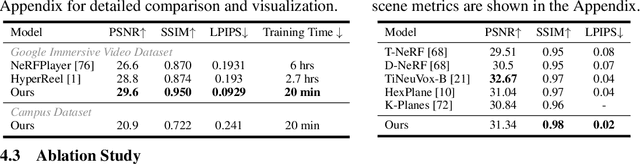
In this paper, we propose the Masked Space-Time Hash encoding (MSTH), a novel method for efficiently reconstructing dynamic 3D scenes from multi-view or monocular videos. Based on the observation that dynamic scenes often contain substantial static areas that result in redundancy in storage and computations, MSTH represents a dynamic scene as a weighted combination of a 3D hash encoding and a 4D hash encoding. The weights for the two components are represented by a learnable mask which is guided by an uncertainty-based objective to reflect the spatial and temporal importance of each 3D position. With this design, our method can reduce the hash collision rate by avoiding redundant queries and modifications on static areas, making it feasible to represent a large number of space-time voxels by hash tables with small size.Besides, without the requirements to fit the large numbers of temporally redundant features independently, our method is easier to optimize and converge rapidly with only twenty minutes of training for a 300-frame dynamic scene.As a result, MSTH obtains consistently better results than previous methods with only 20 minutes of training time and 130 MB of memory storage. Code is available at https://github.com/masked-spacetime-hashing/msth
Fuzzy-NMS: Improving 3D Object Detection with Fuzzy Classification in NMS
Oct 21, 2023Non-maximum suppression (NMS) is an essential post-processing module used in many 3D object detection frameworks to remove overlapping candidate bounding boxes. However, an overreliance on classification scores and difficulties in determining appropriate thresholds can affect the resulting accuracy directly. To address these issues, we introduce fuzzy learning into NMS and propose a novel generalized Fuzzy-NMS module to achieve finer candidate bounding box filtering. The proposed Fuzzy-NMS module combines the volume and clustering density of candidate bounding boxes, refining them with a fuzzy classification method and optimizing the appropriate suppression thresholds to reduce uncertainty in the NMS process. Adequate validation experiments are conducted using the mainstream KITTI and large-scale Waymo 3D object detection benchmarks. The results of these tests demonstrate the proposed Fuzzy-NMS module can improve the accuracy of numerous recently NMS-based detectors significantly, including PointPillars, PV-RCNN, and IA-SSD, etc. This effect is particularly evident for small objects such as pedestrians and bicycles. As a plug-and-play module, Fuzzy-NMS does not need to be retrained and produces no obvious increases in inference time.
Text-to-3D using Gaussian Splatting
Sep 29, 2023In this paper, we present Gaussian Splatting based text-to-3D generation (GSGEN), a novel approach for generating high-quality 3D objects. Previous methods suffer from inaccurate geometry and limited fidelity due to the absence of 3D prior and proper representation. We leverage 3D Gaussian Splatting, a recent state-of-the-art representation, to address existing shortcomings by exploiting the explicit nature that enables the incorporation of 3D prior. Specifically, our method adopts a progressive optimization strategy, which includes a geometry optimization stage and an appearance refinement stage. In geometry optimization, a coarse representation is established under a 3D geometry prior along with the ordinary 2D SDS loss, ensuring a sensible and 3D-consistent rough shape. Subsequently, the obtained Gaussians undergo an iterative refinement to enrich details. In this stage, we increase the number of Gaussians by compactness-based densification to enhance continuity and improve fidelity. With these designs, our approach can generate 3D content with delicate details and more accurate geometry. Extensive evaluations demonstrate the effectiveness of our method, especially for capturing high-frequency components. Video results are provided at https://gsgen3d.github.io. Our code is available at https://github.com/gsgen3d/gsgen
SkipcrossNets: Adaptive Skip-cross Fusion for Road Detection
Aug 24, 2023Multi-modal fusion is increasingly being used for autonomous driving tasks, as images from different modalities provide unique information for feature extraction. However, the existing two-stream networks are only fused at a specific network layer, which requires a lot of manual attempts to set up. As the CNN goes deeper, the two modal features become more and more advanced and abstract, and the fusion occurs at the feature level with a large gap, which can easily hurt the performance. In this study, we propose a novel fusion architecture called skip-cross networks (SkipcrossNets), which combines adaptively LiDAR point clouds and camera images without being bound to a certain fusion epoch. Specifically, skip-cross connects each layer to each layer in a feed-forward manner, and for each layer, the feature maps of all previous layers are used as input and its own feature maps are used as input to all subsequent layers for the other modality, enhancing feature propagation and multi-modal features fusion. This strategy facilitates selection of the most similar feature layers from two data pipelines, providing a complementary effect for sparse point cloud features during fusion processes. The network is also divided into several blocks to reduce the complexity of feature fusion and the number of model parameters. The advantages of skip-cross fusion were demonstrated through application to the KITTI and A2D2 datasets, achieving a MaxF score of 96.85% on KITTI and an F1 score of 84.84% on A2D2. The model parameters required only 2.33 MB of memory at a speed of 68.24 FPS, which could be viable for mobile terminals and embedded devices.
TrOMR:Transformer-Based Polyphonic Optical Music Recognition
Aug 18, 2023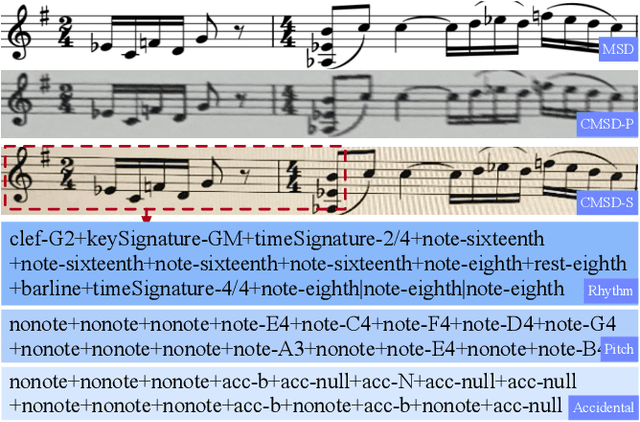
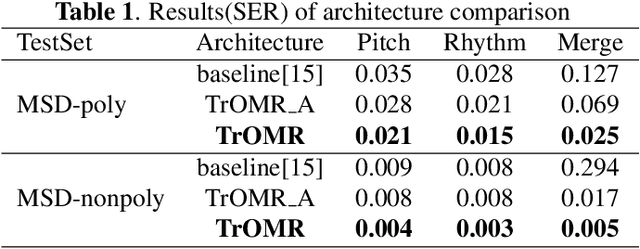
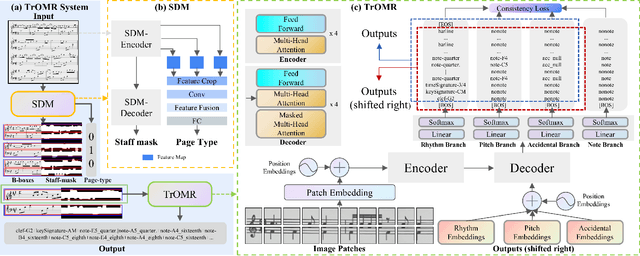
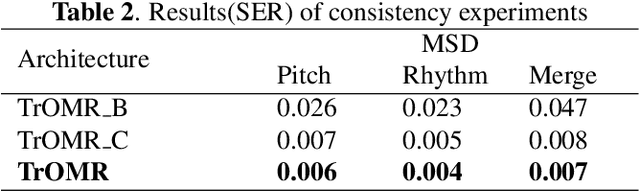
Optical Music Recognition (OMR) is an important technology in music and has been researched for a long time. Previous approaches for OMR are usually based on CNN for image understanding and RNN for music symbol classification. In this paper, we propose a transformer-based approach with excellent global perceptual capability for end-to-end polyphonic OMR, called TrOMR. We also introduce a novel consistency loss function and a reasonable approach for data annotation to improve recognition accuracy for complex music scores. Extensive experiments demonstrate that TrOMR outperforms current OMR methods, especially in real-world scenarios. We also develop a TrOMR system and build a camera scene dataset for full-page music scores in real-world. The code and datasets will be made available for reproducibility.
Heterogeneous Embodied Multi-Agent Collaboration
Jul 27, 2023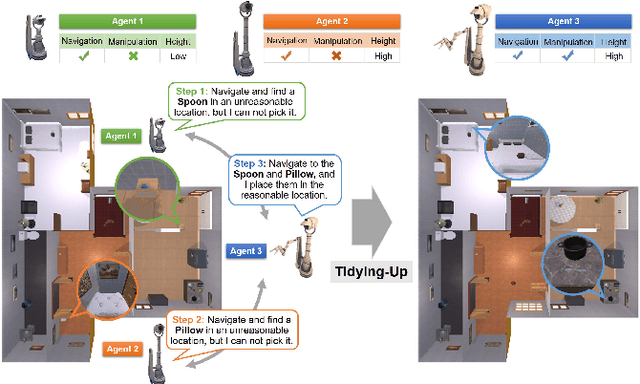
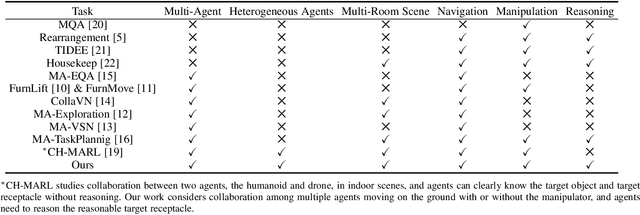

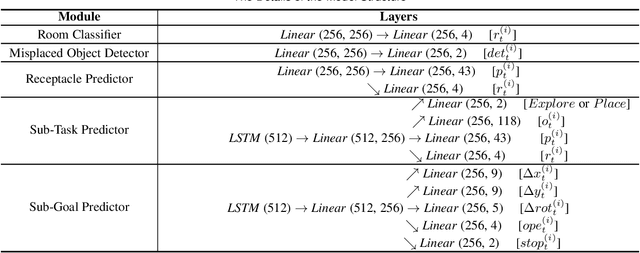
Multi-agent embodied tasks have recently been studied in complex indoor visual environments. Collaboration among multiple agents can improve work efficiency and has significant practical value. However, most of the existing research focuses on homogeneous multi-agent tasks. Compared with homogeneous agents, heterogeneous agents can leverage their different capabilities to allocate corresponding sub-tasks and cooperate to complete complex tasks. Heterogeneous multi-agent tasks are common in real-world scenarios, and the collaboration strategy among heterogeneous agents is a challenging and important problem to be solved. To study collaboration among heterogeneous agents, we propose the heterogeneous multi-agent tidying-up task, in which multiple heterogeneous agents with different capabilities collaborate with each other to detect misplaced objects and place them in reasonable locations. This is a demanding task since it requires agents to make the best use of their different capabilities to conduct reasonable task planning and complete the whole task. To solve this task, we build a heterogeneous multi-agent tidying-up benchmark dataset in a large number of houses with multiple rooms based on ProcTHOR-10K. We propose the hierarchical decision model based on misplaced object detection, reasonable receptacle prediction, as well as the handshake-based group communication mechanism. Extensive experiments are conducted to demonstrate the effectiveness of the proposed model. The project's website and videos of experiments can be found at https://hetercol.github.io/.
TG-Critic: A Timbre-Guided Model for Reference-Independent Singing Evaluation
May 16, 2023Automatic singing evaluation independent of reference melody is a challenging task due to its subjective and multi-dimensional nature. As an essential attribute of singing voices, vocal timbre has a non-negligible effect and influence on human perception of singing quality. However, no research has been done to include timbre information explicitly in singing evaluation models. In this paper, a data-driven model TG-Critic is proposed to introduce timbre embeddings as one of the model inputs to guide the evaluation of singing quality. The trunk structure of TG-Critic is designed as a multi-scale network to summarize the contextual information from constant-Q transform features in a high-resolution way. Furthermore, an automatic annotation method is designed to construct a large three-class singing evaluation dataset with low human-effort. The experimental results show that the proposed model outperforms the existing state-of-the-art models in most cases.
Path Planning for Air-Ground Robot Considering Modal Switching Point Optimization
May 14, 2023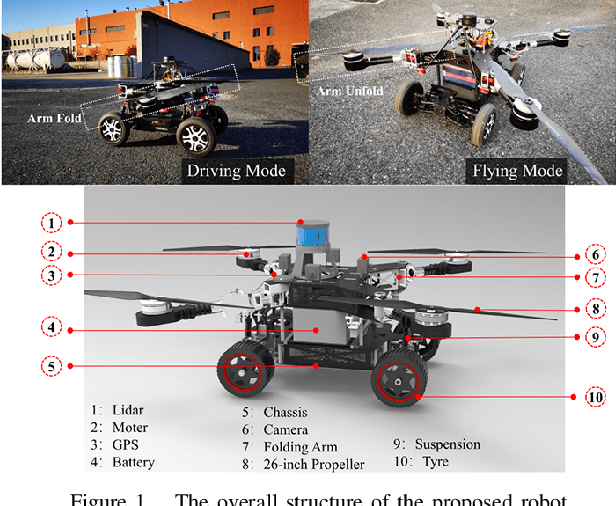
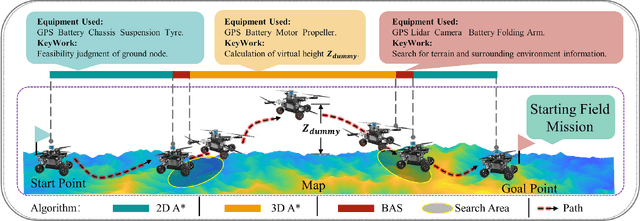
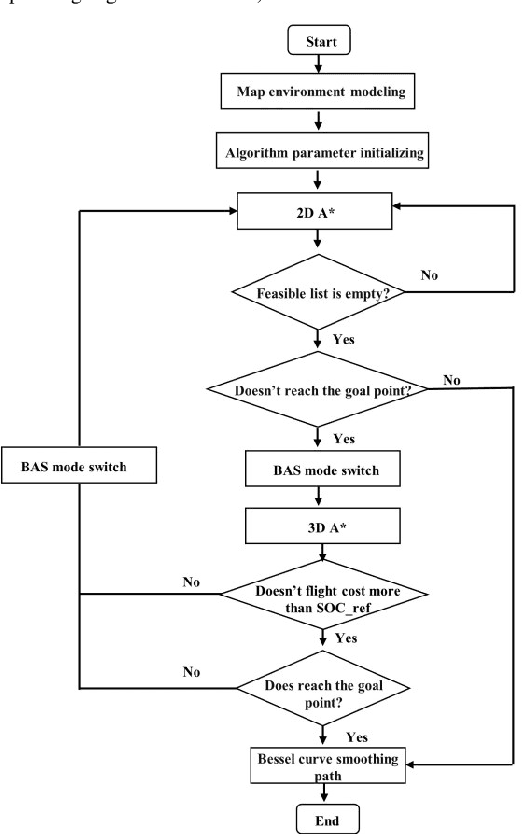
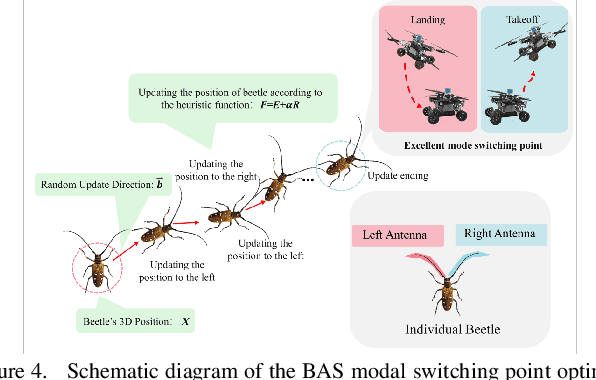
An innovative sort of mobility platform that can both drive and fly is the air-ground robot. The need for an agile flight cannot be satisfied by traditional path planning techniques for air-ground robots. Prior studies had mostly focused on improving the energy efficiency of paths, seldom taking the seeking speed and optimizing take-off and landing places into account. A robot for the field application environment was proposed, and a lightweight global spatial planning technique for the robot based on the graph-search algorithm taking mode switching point optimization into account, with an emphasis on energy efficiency, searching speed, and the viability of real deployment. The fundamental concept is to lower the computational burden by employing an interchangeable search approach that combines planar and spatial search. Furthermore, to safeguard the health of the power battery and the integrity of the mission execution, a trap escape approach was also provided. Simulations are run to test the effectiveness of the suggested model based on the field DEM map. The simulation results show that our technology is capable of producing finished, plausible 3D paths with a high degree of believability. Additionally, the mode-switching point optimization method efficiently identifies additional acceptable places for mode switching, and the improved paths use less time and energy.
Informative Data Selection with Uncertainty for Multi-modal Object Detection
Apr 23, 2023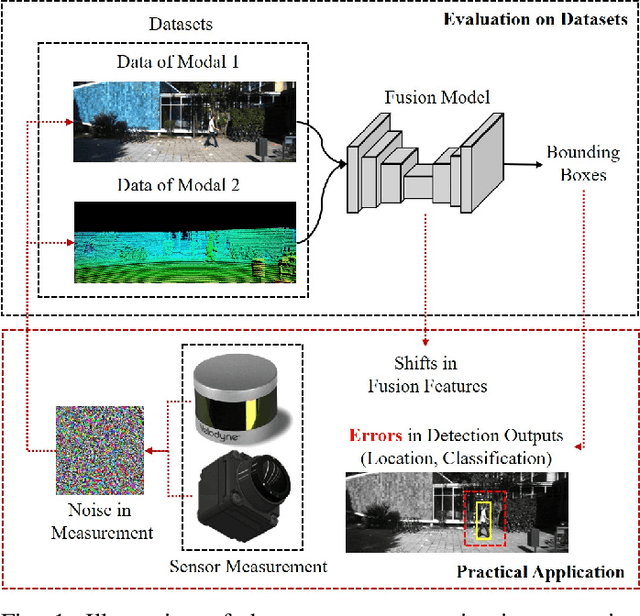
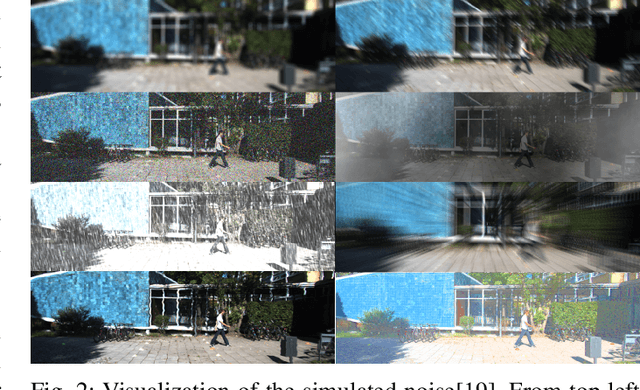
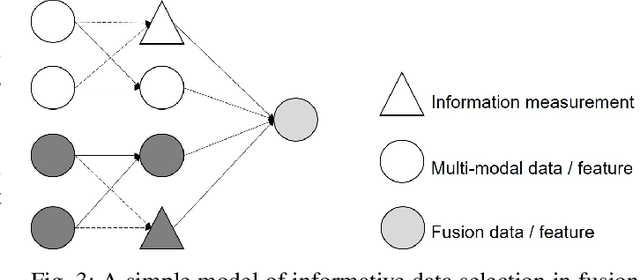
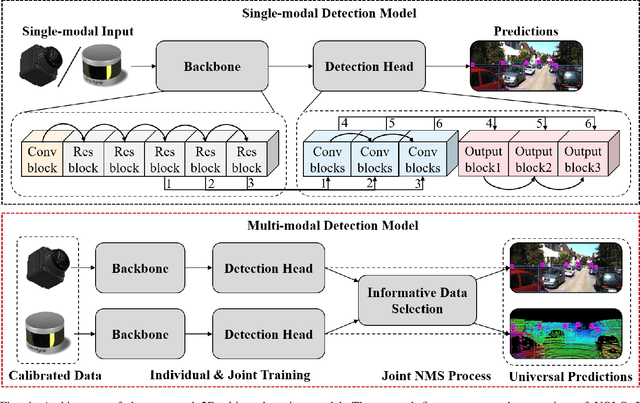
Noise has always been nonnegligible trouble in object detection by creating confusion in model reasoning, thereby reducing the informativeness of the data. It can lead to inaccurate recognition due to the shift in the observed pattern, that requires a robust generalization of the models. To implement a general vision model, we need to develop deep learning models that can adaptively select valid information from multi-modal data. This is mainly based on two reasons. Multi-modal learning can break through the inherent defects of single-modal data, and adaptive information selection can reduce chaos in multi-modal data. To tackle this problem, we propose a universal uncertainty-aware multi-modal fusion model. It adopts a multi-pipeline loosely coupled architecture to combine the features and results from point clouds and images. To quantify the correlation in multi-modal information, we model the uncertainty, as the inverse of data information, in different modalities and embed it in the bounding box generation. In this way, our model reduces the randomness in fusion and generates reliable output. Moreover, we conducted a completed investigation on the KITTI 2D object detection dataset and its derived dirty data. Our fusion model is proven to resist severe noise interference like Gaussian, motion blur, and frost, with only slight degradation. The experiment results demonstrate the benefits of our adaptive fusion. Our analysis on the robustness of multi-modal fusion will provide further insights for future research.