 Add to Chrome
 Add to Firefox
 Add to Edge
Kwai Keye-VL-2.0 Technical Report
Jun 09, 2026
We introduce Kwai Keye-VL-2.0-30B-A3B, an open-source Mixture-of-Experts (MoE) multimodal foundation model designed to advance long-video understanding and agentic intelligence. To address the challenges of ultra-long contexts, information redundancy, and prohibitive computational costs inherent in hour-level videos, Keye-VL-2.0 is the first to adapt DeepSeek Sparse Attention (DSA) to GQA-based multimodal architectures, enabling lossless 256K context processing while capturing critical frames and long-range temporal dependencies. This architecture is underpinned by a highly optimized training and inference infrastructure, including scalable video I/O, heterogeneous ViT-LM parallelism, and custom DSA kernels that significantly maximize throughput and minimize computational overhead. Furthermore, to overcome the algorithmic dilemma of catastrophic forgetting during multi-task alignment, we introduce Cross-Modal Multi-Teacher On-Policy Distillation (MOPD) paired with Context-RL and Video-RL. By distilling dense token-level teacher feedback from on-policy rollouts back into the MoE backbone, which activates only 3B parameters, Keye-VL-2.0 natively empowers advanced agent collaboration across Code, Tool, and Search scenarios with multimodal self-correction. Extensive evaluations across video understanding, temporal grounding, reasoning, STEM, and agent benchmarks demonstrate that Keye-VL-2.0-30B-A3B achieves state-of-the-art performance among models of similar scale, particularly excelling in fine-grained temporal localization on TimeLens and long-video comprehension on Video-MME-v2 and LongVideoBench. We release our model checkpoints to accelerate community progress toward scalable and robust multimodal agentic applications.

Modeling Complex Behaviors: Multi-Personality Composition and Dynamic Switching in Vision-Language Models
Jun 09, 2026With the widespread deployment of Multimodal Large Language Models (MLLMs) in social interaction, understanding and controlling their behavior under complex personality conditions is essential. This paper introduces explicit personality conditioning and establishes a systematic evaluation framework encompassing single-personality induction, multi-personality induction, and personality switching. Experiments show that personality induction improves image captioning performance but can impair performance on tasks requiring precise reasoning, such as visual question answering (VQA). Balancing and residual effects are observed during multi-trait composition and dynamic switching, indicating that model behavior is co-modulated by both previous and current personality constraints. Existing prompt-based personality induction methods show limited transferability to multimodal settings. Our work reveals the dynamic and complex nature of personality modeling in MLLMs and underscores the need for robust, tailored methods for personality induction and evaluation. The code will be released when the paper is accepted.
Seeing with You: Perception-Reasoning Coevolution for Multimodal Reasoning
Mar 30, 2026Reinforcement learning with verifiable rewards (RLVR) has substantially enhanced the reasoning capabilities of multimodal large language models (MLLMs). However, existing RLVR approaches typically rely on outcome-driven optimization that updates both perception and reasoning using a shared reward based solely on the final answer. This shared reward blurs credit assignment, frequently improving reasoning patterns while failing to reliably enhance the accuracy of upstream visual evidence extraction. To address this perception bottleneck, we introduce PRCO (Perception-Reasoning Coevolution), a dual-role RLVR framework with a shared policy. PRCO consists of two cooperative roles: an Observer that generates an evidence caption tailored to the question and a Solver that predicts the final answer based on this caption. Crucially, PRCO employs role-specific reward signals: the Solver is optimized using verifiable outcome rewards on the final answer, while the Observer receives a utility reward derived from the Solver's downstream success. Extensive experiments across eight challenging multimodal reasoning benchmarks demonstrate that PRCO yields consistent improvements across model scales by over 7 points on average accuracy compared to the base model, outperforming prior open-source RL-tuned baselines.
Cross-modal Identity Mapping: Minimizing Information Loss in Modality Conversion via Reinforcement Learning
Mar 02, 2026Large Vision-Language Models (LVLMs) often omit or misrepresent critical visual content in generated image captions. Minimizing such information loss will force LVLMs to focus on image details to generate precise descriptions. However, measuring information loss during modality conversion is inherently challenging due to the modal gap between visual content and text output. In this paper, we argue that the quality of an image caption is positively correlated with the similarity between images retrieved via text search using that caption. Based on this insight, we further propose Cross-modal Identity Mapping (CIM), a reinforcement learning framework that enhances image captioning without requiring additional annotations. Specifically, the method quantitatively evaluates the information loss from two perspectives: Gallery Representation Consistency and Query-gallery Image Relevance. Supervised under these metrics, LVLM minimizes information loss and aims to achieve identity mapping from images to captions. The experimental results demonstrate the superior performance of our method in image captioning, even when compared with Supervised Fine-Tuning. Particularly, on the COCO-LN500 benchmark, CIM achieves a 20% improvement in relation reasoning on Qwen2.5-VL-7B.The code will be released when the paper is accepted.
TabSieve: Explicit In-Table Evidence Selection for Tabular Prediction
Feb 12, 2026Tabular prediction can benefit from in-table rows as few-shot evidence, yet existing tabular models typically perform instance-wise inference and LLM-based prompting is often brittle. Models do not consistently leverage relevant rows, and noisy context can degrade performance. To address this challenge, we propose TabSieve, a select-then-predict framework that makes evidence usage explicit and auditable. Given a table and a query row, TabSieve first selects a small set of informative rows as evidence and then predicts the missing target conditioned on the selected evidence. To enable this capability, we construct TabSieve-SFT-40K by synthesizing high-quality reasoning trajectories from 331 real tables using a strong teacher model with strict filtering. Furthermore, we introduce TAB-GRPO, a reinforcement learning recipe that jointly optimizes evidence selection and prediction correctness with separate rewards, and stabilizes mixed regression and classification training via dynamic task-advantage balancing. Experiments on a held-out benchmark of 75 classification and 52 regression tables show that TabSieve consistently improves performance across shot budgets, with average gains of 2.92% on classification and 4.45% on regression over the second-best baseline. Further analysis indicates that TabSieve concentrates more attention on the selected evidence, which improves robustness to noisy context.
Step 3.5 Flash: Open Frontier-Level Intelligence with 11B Active Parameters
Feb 11, 2026We introduce Step 3.5 Flash, a sparse Mixture-of-Experts (MoE) model that bridges frontier-level agentic intelligence and computational efficiency. We focus on what matters most when building agents: sharp reasoning and fast, reliable execution. Step 3.5 Flash pairs a 196B-parameter foundation with 11B active parameters for efficient inference. It is optimized with interleaved 3:1 sliding-window/full attention and Multi-Token Prediction (MTP-3) to reduce the latency and cost of multi-round agentic interactions. To reach frontier-level intelligence, we design a scalable reinforcement learning framework that combines verifiable signals with preference feedback, while remaining stable under large-scale off-policy training, enabling consistent self-improvement across mathematics, code, and tool use. Step 3.5 Flash demonstrates strong performance across agent, coding, and math tasks, achieving 85.4% on IMO-AnswerBench, 86.4% on LiveCodeBench-v6 (2024.08-2025.05), 88.2% on tau2-Bench, 69.0% on BrowseComp (with context management), and 51.0% on Terminal-Bench 2.0, comparable to frontier models such as GPT-5.2 xHigh and Gemini 3.0 Pro. By redefining the efficiency frontier, Step 3.5 Flash provides a high-density foundation for deploying sophisticated agents in real-world industrial environments.
Learning Brain Representation with Hierarchical Visual Embeddings
Feb 07, 2026Decoding visual representations from brain signals has attracted significant attention in both neuroscience and artificial intelligence. However, the degree to which brain signals truly encode visual information remains unclear. Current visual decoding approaches explore various brain-image alignment strategies, yet most emphasize high-level semantic features while neglecting pixel-level details, thereby limiting our understanding of the human visual system. In this paper, we propose a brain-image alignment strategy that leverages multiple pre-trained visual encoders with distinct inductive biases to capture hierarchical and multi-scale visual representations, while employing a contrastive learning objective to achieve effective alignment between brain signals and visual embeddings. Furthermore, we introduce a Fusion Prior, which learns a stable mapping on large-scale visual data and subsequently matches brain features to this pre-trained prior, thereby enhancing distributional consistency across modalities. Extensive quantitative and qualitative experiments demonstrate that our method achieves a favorable balance between retrieval accuracy and reconstruction fidelity.
Step-Audio 2 Technical Report
Jul 24, 2025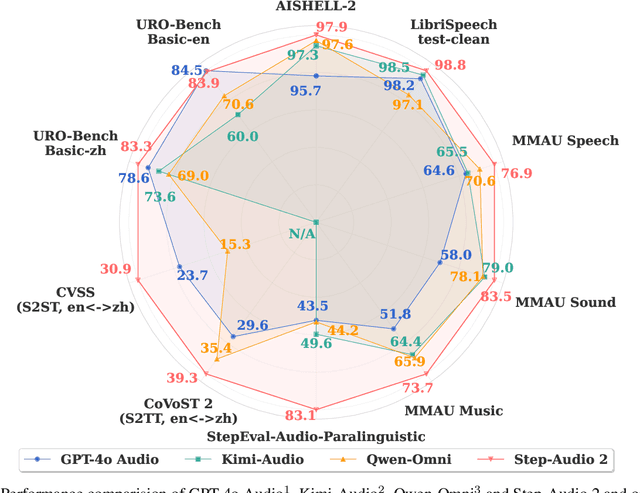
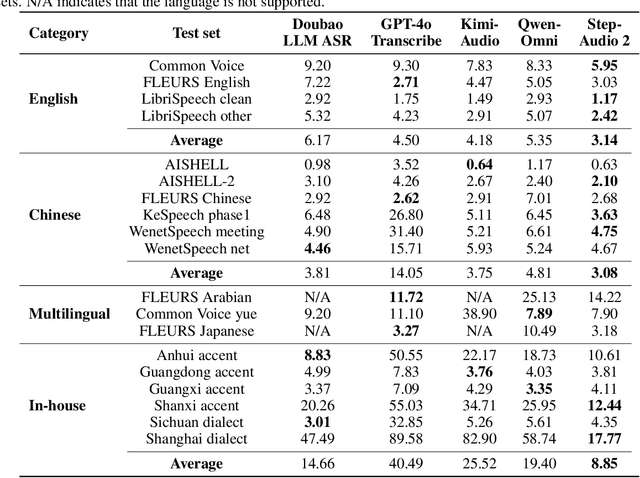
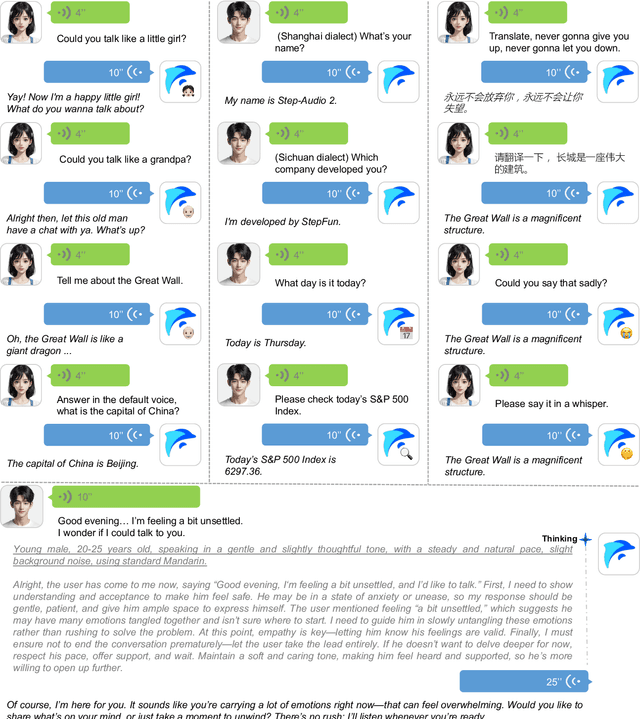
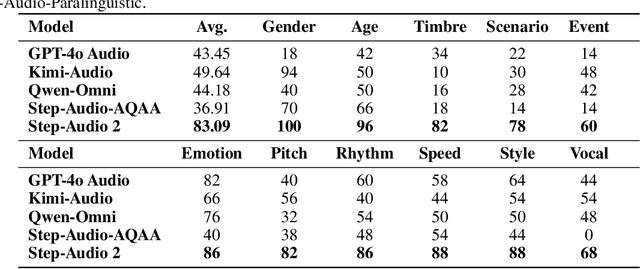
This paper presents Step-Audio 2, an end-to-end multi-modal large language model designed for industry-strength audio understanding and speech conversation. By integrating a latent audio encoder and reasoning-centric reinforcement learning (RL), Step-Audio 2 achieves promising performance in automatic speech recognition (ASR) and audio understanding. To facilitate genuine end-to-end speech conversation, Step-Audio 2 incorporates the generation of discrete audio tokens into language modeling, significantly enhancing its responsiveness to paralinguistic information such as speaking styles and emotions. To effectively leverage the rich textual and acoustic knowledge in real-world data, Step-Audio 2 integrates retrieval-augmented generation (RAG) and is able to call external tools such as web search to mitigate hallucination and audio search to switch timbres. Trained on millions of hours of speech and audio data, Step-Audio 2 delivers intelligence and expressiveness across diverse conversational scenarios. Evaluation results demonstrate that Step-Audio 2 achieves state-of-the-art performance on various audio understanding and conversational benchmarks compared to other open-source and commercial solutions. Please visit https://github.com/stepfun-ai/Step-Audio2 for more information.
Step-Audio-AQAA: a Fully End-to-End Expressive Large Audio Language Model
Jun 10, 2025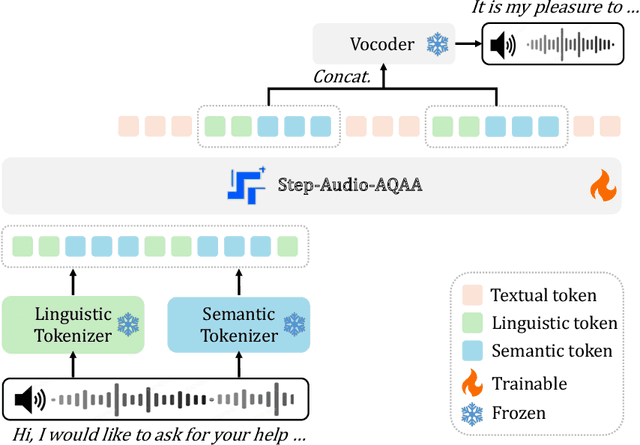
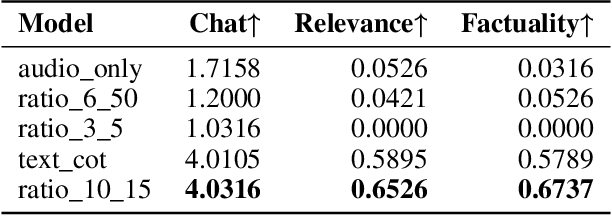
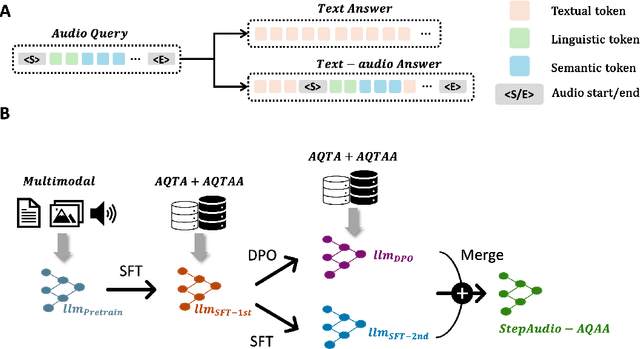

Large Audio-Language Models (LALMs) have significantly advanced intelligent human-computer interaction, yet their reliance on text-based outputs limits their ability to generate natural speech responses directly, hindering seamless audio interactions. To address this, we introduce Step-Audio-AQAA, a fully end-to-end LALM designed for Audio Query-Audio Answer (AQAA) tasks. The model integrates a dual-codebook audio tokenizer for linguistic and semantic feature extraction, a 130-billion-parameter backbone LLM and a neural vocoder for high-fidelity speech synthesis. Our post-training approach employs interleaved token-output of text and audio to enhance semantic coherence and combines Direct Preference Optimization (DPO) with model merge to improve performance. Evaluations on the StepEval-Audio-360 benchmark demonstrate that Step-Audio-AQAA excels especially in speech control, outperforming the state-of-art LALMs in key areas. This work contributes a promising solution for end-to-end LALMs and highlights the critical role of token-based vocoder in enhancing overall performance for AQAA tasks.
Step-Audio: Unified Understanding and Generation in Intelligent Speech Interaction
Feb 18, 2025Real-time speech interaction, serving as a fundamental interface for human-machine collaboration, holds immense potential. However, current open-source models face limitations such as high costs in voice data collection, weakness in dynamic control, and limited intelligence. To address these challenges, this paper introduces Step-Audio, the first production-ready open-source solution. Key contributions include: 1) a 130B-parameter unified speech-text multi-modal model that achieves unified understanding and generation, with the Step-Audio-Chat version open-sourced; 2) a generative speech data engine that establishes an affordable voice cloning framework and produces the open-sourced lightweight Step-Audio-TTS-3B model through distillation; 3) an instruction-driven fine control system enabling dynamic adjustments across dialects, emotions, singing, and RAP; 4) an enhanced cognitive architecture augmented with tool calling and role-playing abilities to manage complex tasks effectively. Based on our new StepEval-Audio-360 evaluation benchmark, Step-Audio achieves state-of-the-art performance in human evaluations, especially in terms of instruction following. On open-source benchmarks like LLaMA Question, shows 9.3% average performance improvement, demonstrating our commitment to advancing the development of open-source multi-modal language technologies. Our code and models are available at https://github.com/stepfun-ai/Step-Audio.