 Add to Chrome
 Add to Firefox
 Add to Edge
TabSieve: Explicit In-Table Evidence Selection for Tabular Prediction
Feb 12, 2026
Tabular prediction can benefit from in-table rows as few-shot evidence, yet existing tabular models typically perform instance-wise inference and LLM-based prompting is often brittle. Models do not consistently leverage relevant rows, and noisy context can degrade performance. To address this challenge, we propose TabSieve, a select-then-predict framework that makes evidence usage explicit and auditable. Given a table and a query row, TabSieve first selects a small set of informative rows as evidence and then predicts the missing target conditioned on the selected evidence. To enable this capability, we construct TabSieve-SFT-40K by synthesizing high-quality reasoning trajectories from 331 real tables using a strong teacher model with strict filtering. Furthermore, we introduce TAB-GRPO, a reinforcement learning recipe that jointly optimizes evidence selection and prediction correctness with separate rewards, and stabilizes mixed regression and classification training via dynamic task-advantage balancing. Experiments on a held-out benchmark of 75 classification and 52 regression tables show that TabSieve consistently improves performance across shot budgets, with average gains of 2.92% on classification and 4.45% on regression over the second-best baseline. Further analysis indicates that TabSieve concentrates more attention on the selected evidence, which improves robustness to noisy context.

Step 3.5 Flash: Open Frontier-Level Intelligence with 11B Active Parameters
Feb 11, 2026We introduce Step 3.5 Flash, a sparse Mixture-of-Experts (MoE) model that bridges frontier-level agentic intelligence and computational efficiency. We focus on what matters most when building agents: sharp reasoning and fast, reliable execution. Step 3.5 Flash pairs a 196B-parameter foundation with 11B active parameters for efficient inference. It is optimized with interleaved 3:1 sliding-window/full attention and Multi-Token Prediction (MTP-3) to reduce the latency and cost of multi-round agentic interactions. To reach frontier-level intelligence, we design a scalable reinforcement learning framework that combines verifiable signals with preference feedback, while remaining stable under large-scale off-policy training, enabling consistent self-improvement across mathematics, code, and tool use. Step 3.5 Flash demonstrates strong performance across agent, coding, and math tasks, achieving 85.4% on IMO-AnswerBench, 86.4% on LiveCodeBench-v6 (2024.08-2025.05), 88.2% on tau2-Bench, 69.0% on BrowseComp (with context management), and 51.0% on Terminal-Bench 2.0, comparable to frontier models such as GPT-5.2 xHigh and Gemini 3.0 Pro. By redefining the efficiency frontier, Step 3.5 Flash provides a high-density foundation for deploying sophisticated agents in real-world industrial environments.
Step-DeepResearch Technical Report
Dec 24, 2025As LLMs shift toward autonomous agents, Deep Research has emerged as a pivotal metric. However, existing academic benchmarks like BrowseComp often fail to meet real-world demands for open-ended research, which requires robust skills in intent recognition, long-horizon decision-making, and cross-source verification. To address this, we introduce Step-DeepResearch, a cost-effective, end-to-end agent. We propose a Data Synthesis Strategy Based on Atomic Capabilities to reinforce planning and report writing, combined with a progressive training path from agentic mid-training to SFT and RL. Enhanced by a Checklist-style Judger, this approach significantly improves robustness. Furthermore, to bridge the evaluation gap in the Chinese domain, we establish ADR-Bench for realistic deep research scenarios. Experimental results show that Step-DeepResearch (32B) scores 61.4% on Scale AI Research Rubrics. On ADR-Bench, it significantly outperforms comparable models and rivals SOTA closed-source models like OpenAI and Gemini DeepResearch. These findings prove that refined training enables medium-sized models to achieve expert-level capabilities at industry-leading cost-efficiency.
Bridging Traffic State and Trajectory for Dynamic Road Network and Trajectory Representation Learning
Feb 08, 2025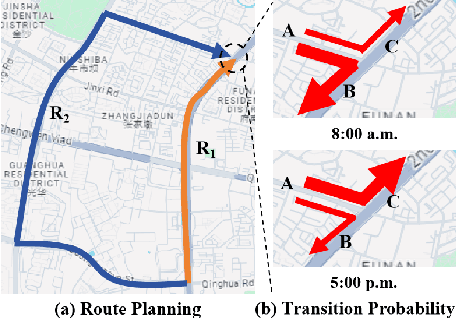
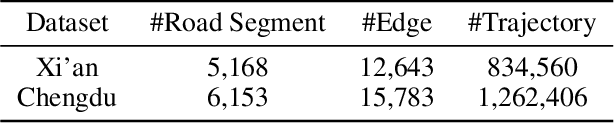
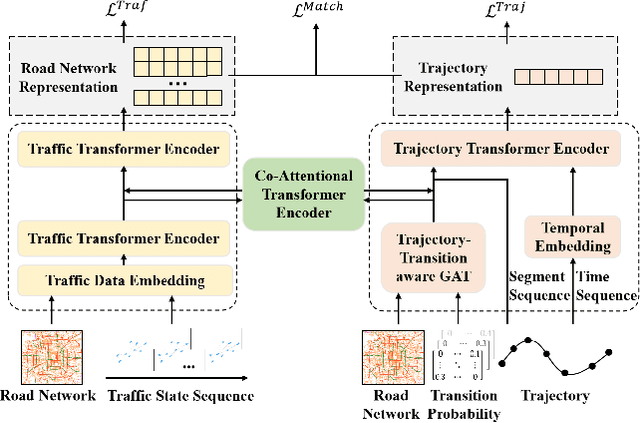
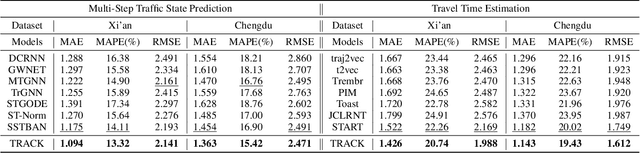
Effective urban traffic management is vital for sustainable city development, relying on intelligent systems with machine learning tasks such as traffic flow prediction and travel time estimation. Traditional approaches usually focus on static road network and trajectory representation learning, and overlook the dynamic nature of traffic states and trajectories, which is crucial for downstream tasks. To address this gap, we propose TRACK, a novel framework to bridge traffic state and trajectory data for dynamic road network and trajectory representation learning. TRACK leverages graph attention networks (GAT) to encode static and spatial road segment features, and introduces a transformer-based model for trajectory representation learning. By incorporating transition probabilities from trajectory data into GAT attention weights, TRACK captures dynamic spatial features of road segments. Meanwhile, TRACK designs a traffic transformer encoder to capture the spatial-temporal dynamics of road segments from traffic state data. To further enhance dynamic representations, TRACK proposes a co-attentional transformer encoder and a trajectory-traffic state matching task. Extensive experiments on real-life urban traffic datasets demonstrate the superiority of TRACK over state-of-the-art baselines. Case studies confirm TRACK's ability to capture spatial-temporal dynamics effectively.