 Add to Chrome
 Add to Firefox
 Add to Edge
Adaptively Point-weighting Curriculum Learning
May 03, 2025
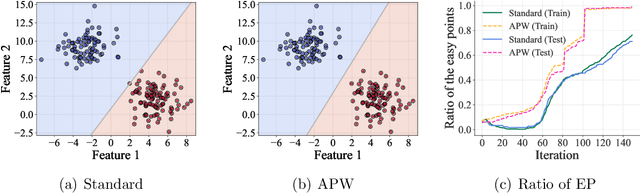

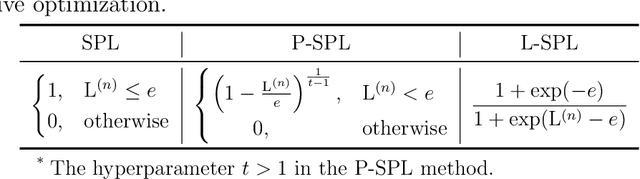
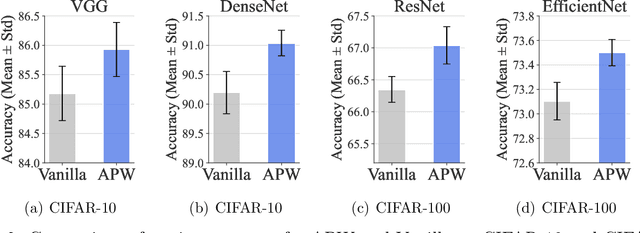
Curriculum learning (CL) is referred to as a training strategy that makes easy samples learned first and then fits hard samples. It imitates the process of humans learning knowledge, and has become a potential manner of effectively training deep networks. In this study, we develop the adaptively point-weighting (APW) curriculum learning algorithm, which adaptively assigns the weight to every training sample not only based on its training error but also considering the current training state of the network. Specifically, in the early training phase, it increases the weights of easy samples to make the network rapidly capture the overall characteristics of the dataset; and in the later training phase, the weights of hard points rise to improve the fitting performance on the discrete local regions. Moreover, we also present the theoretical analysis on the properties of APW including training effectiveness, training feasibility, training stability, and generalization performance. The numerical experiments support the superiority of APW and demonstrate the validity of our theoretical findings.

Talk Before You Retrieve: Agent-Led Discussions for Better RAG in Medical QA
Apr 30, 2025Medical question answering (QA) is a reasoning-intensive task that remains challenging for large language models (LLMs) due to hallucinations and outdated domain knowledge. Retrieval-Augmented Generation (RAG) provides a promising post-training solution by leveraging external knowledge. However, existing medical RAG systems suffer from two key limitations: (1) a lack of modeling for human-like reasoning behaviors during information retrieval, and (2) reliance on suboptimal medical corpora, which often results in the retrieval of irrelevant or noisy snippets. To overcome these challenges, we propose Discuss-RAG, a plug-and-play module designed to enhance the medical QA RAG system through collaborative agent-based reasoning. Our method introduces a summarizer agent that orchestrates a team of medical experts to emulate multi-turn brainstorming, thereby improving the relevance of retrieved content. Additionally, a decision-making agent evaluates the retrieved snippets before their final integration. Experimental results on four benchmark medical QA datasets show that Discuss-RAG consistently outperforms MedRAG, especially significantly improving answer accuracy by up to 16.67% on BioASQ and 12.20% on PubMedQA. The code is available at: https://github.com/LLM-VLM-GSL/Discuss-RAG.
Exploiting Inter-Sample Correlation and Intra-Sample Redundancy for Partially Relevant Video Retrieval
Apr 28, 2025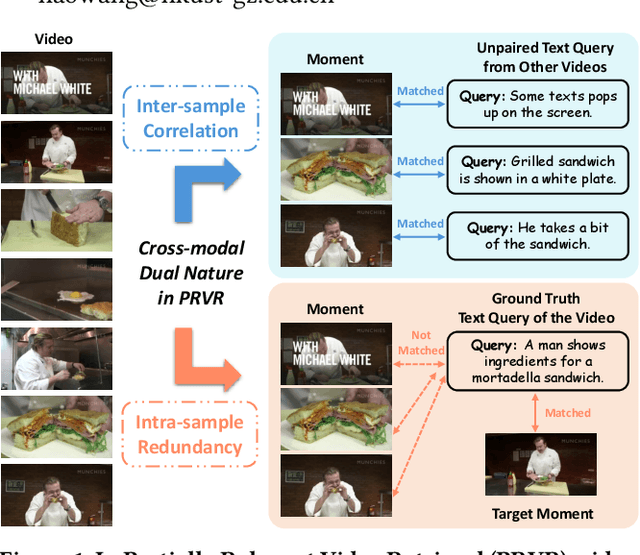
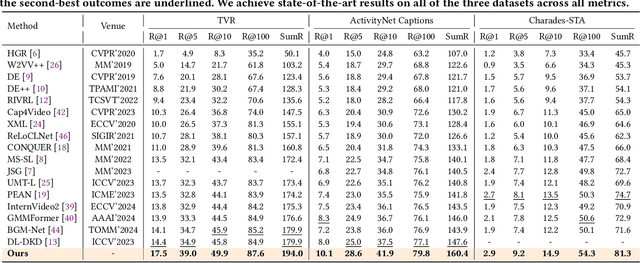
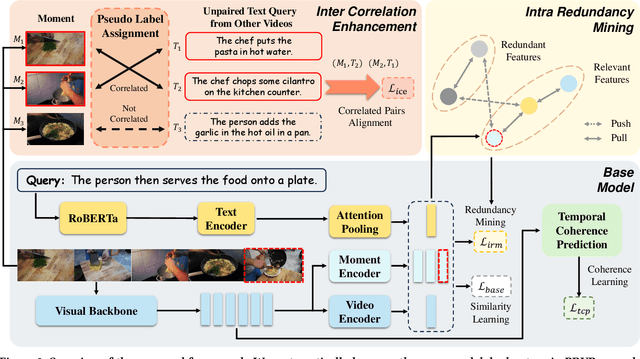
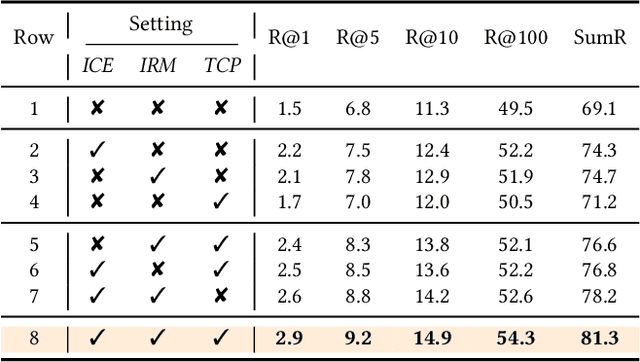
Partially Relevant Video Retrieval (PRVR) aims to retrieve the target video that is partially relevant to the text query. The primary challenge in PRVR arises from the semantic asymmetry between textual and visual modalities, as videos often contain substantial content irrelevant to the query. Existing methods coarsely align paired videos and text queries to construct the semantic space, neglecting the critical cross-modal dual nature inherent in this task: inter-sample correlation and intra-sample redundancy. To this end, we propose a novel PRVR framework to systematically exploit these two characteristics. Our framework consists of three core modules. First, the Inter Correlation Enhancement (ICE) module captures inter-sample correlation by identifying semantically similar yet unpaired text queries and video moments, combining them to form pseudo-positive pairs for more robust semantic space construction. Second, the Intra Redundancy Mining (IRM) module mitigates intra-sample redundancy by mining redundant video moment features and treating them as hard negative samples, thereby encouraging the model to learn more discriminative representations. Finally, to reinforce these modules, we introduce the Temporal Coherence Prediction (TCP) module, which enhances feature discrimination by training the model to predict the original temporal order of randomly shuffled video frames and moments. Extensive experiments on three datasets demonstrate the superiority of our approach compared to previous methods, achieving state-of-the-art results.
MultiMind: Enhancing Werewolf Agents with Multimodal Reasoning and Theory of Mind
Apr 25, 2025Large Language Model (LLM) agents have demonstrated impressive capabilities in social deduction games (SDGs) like Werewolf, where strategic reasoning and social deception are essential. However, current approaches remain limited to textual information, ignoring crucial multimodal cues such as facial expressions and tone of voice that humans naturally use to communicate. Moreover, existing SDG agents primarily focus on inferring other players' identities without modeling how others perceive themselves or fellow players. To address these limitations, we use One Night Ultimate Werewolf (ONUW) as a testbed and present MultiMind, the first framework integrating multimodal information into SDG agents. MultiMind processes facial expressions and vocal tones alongside verbal content, while employing a Theory of Mind (ToM) model to represent each player's suspicion levels toward others. By combining this ToM model with Monte Carlo Tree Search (MCTS), our agent identifies communication strategies that minimize suspicion directed at itself. Through comprehensive evaluation in both agent-versus-agent simulations and studies with human players, we demonstrate MultiMind's superior performance in gameplay. Our work presents a significant advancement toward LLM agents capable of human-like social reasoning across multimodal domains.
Unify3D: An Augmented Holistic End-to-end Monocular 3D Human Reconstruction via Anatomy Shaping and Twins Negotiating
Apr 25, 2025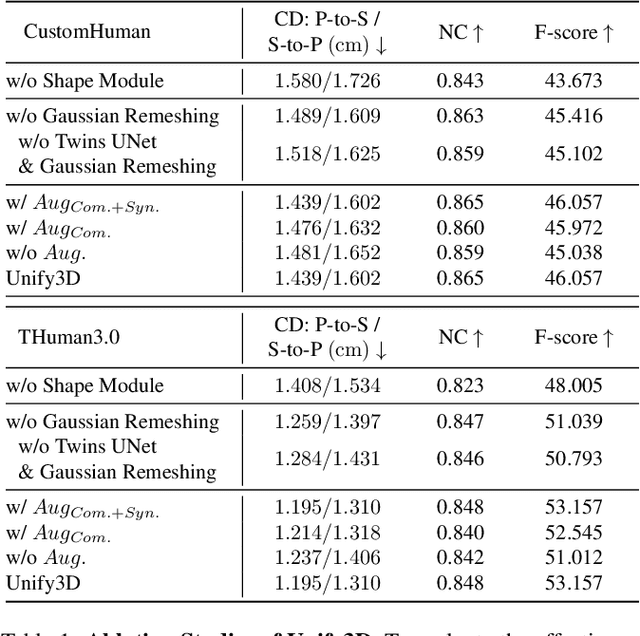
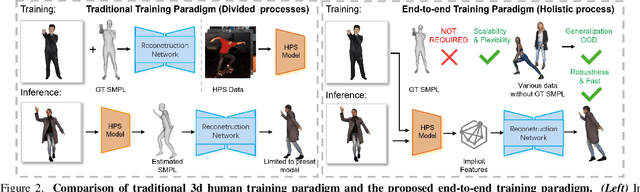
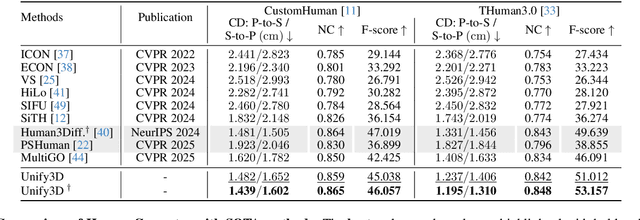
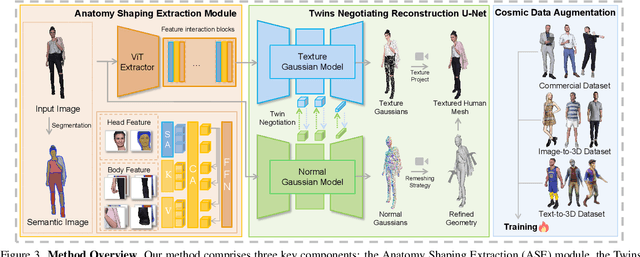
Monocular 3D clothed human reconstruction aims to create a complete 3D avatar from a single image. To tackle the human geometry lacking in one RGB image, current methods typically resort to a preceding model for an explicit geometric representation. For the reconstruction itself, focus is on modeling both it and the input image. This routine is constrained by the preceding model, and overlooks the integrity of the reconstruction task. To address this, this paper introduces a novel paradigm that treats human reconstruction as a holistic process, utilizing an end-to-end network for direct prediction from 2D image to 3D avatar, eliminating any explicit intermediate geometry display. Based on this, we further propose a novel reconstruction framework consisting of two core components: the Anatomy Shaping Extraction module, which captures implicit shape features taking into account the specialty of human anatomy, and the Twins Negotiating Reconstruction U-Net, which enhances reconstruction through feature interaction between two U-Nets of different modalities. Moreover, we propose a Comic Data Augmentation strategy and construct 15k+ 3D human scans to bolster model performance in more complex case input. Extensive experiments on two test sets and many in-the-wild cases show the superiority of our method over SOTA methods. Our demos can be found in : https://e2e3dgsrecon.github.io/e2e3dgsrecon/.
Back to Fundamentals: Low-Level Visual Features Guided Progressive Token Pruning
Apr 25, 2025Vision Transformers (ViTs) excel in semantic segmentation but demand significant computation, posing challenges for deployment on resource-constrained devices. Existing token pruning methods often overlook fundamental visual data characteristics. This study introduces 'LVTP', a progressive token pruning framework guided by multi-scale Tsallis entropy and low-level visual features with twice clustering. It integrates high-level semantics and basic visual attributes for precise segmentation. A novel dynamic scoring mechanism using multi-scale Tsallis entropy weighting overcomes limitations of traditional single-parameter entropy. The framework also incorporates low-level feature analysis to preserve critical edge information while optimizing computational cost. As a plug-and-play module, it requires no architectural changes or additional training. Evaluations across multiple datasets show 20%-45% computational reductions with negligible performance loss, outperforming existing methods in balancing cost and accuracy, especially in complex edge regions.
An Empirical Study on Prompt Compression for Large Language Models
Apr 24, 2025Prompt engineering enables Large Language Models (LLMs) to perform a variety of tasks. However, lengthy prompts significantly increase computational complexity and economic costs. To address this issue, we study six prompt compression methods for LLMs, aiming to reduce prompt length while maintaining LLM response quality. In this paper, we present a comprehensive analysis covering aspects such as generation performance, model hallucinations, efficacy in multimodal tasks, word omission analysis, and more. We evaluate these methods across 13 datasets, including news, scientific articles, commonsense QA, math QA, long-context QA, and VQA datasets. Our experiments reveal that prompt compression has a greater impact on LLM performance in long contexts compared to short ones. In the Longbench evaluation, moderate compression even enhances LLM performance. Our code and data is available at https://github.com/3DAgentWorld/Toolkit-for-Prompt-Compression.
ManipDreamer: Boosting Robotic Manipulation World Model with Action Tree and Visual Guidance
Apr 23, 2025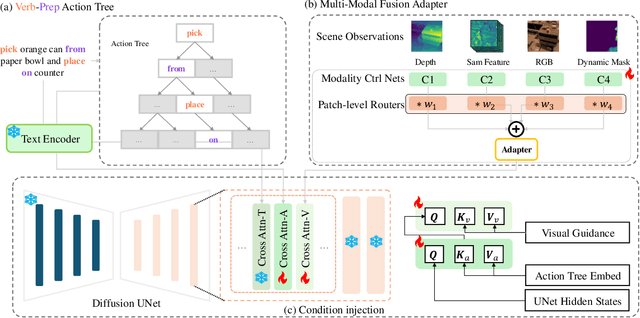

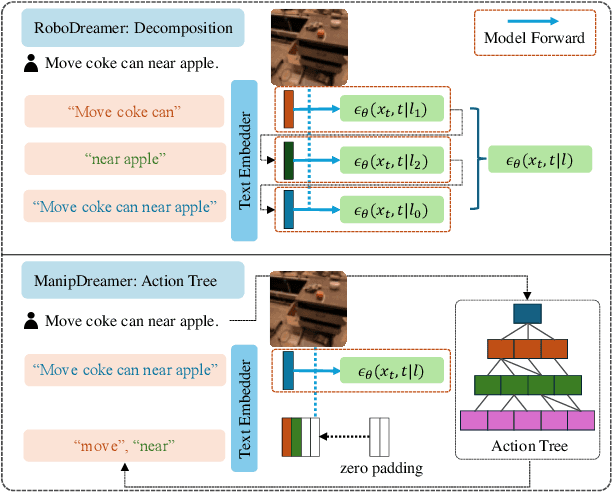
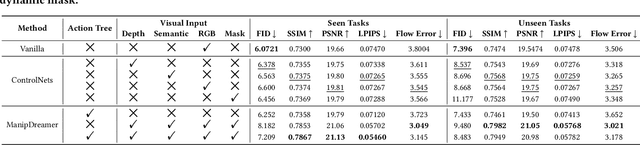
While recent advancements in robotic manipulation video synthesis have shown promise, significant challenges persist in ensuring effective instruction-following and achieving high visual quality. Recent methods, like RoboDreamer, utilize linguistic decomposition to divide instructions into separate lower-level primitives, conditioning the world model on these primitives to achieve compositional instruction-following. However, these separate primitives do not consider the relationships that exist between them. Furthermore, recent methods neglect valuable visual guidance, including depth and semantic guidance, both crucial for enhancing visual quality. This paper introduces ManipDreamer, an advanced world model based on the action tree and visual guidance. To better learn the relationships between instruction primitives, we represent the instruction as the action tree and assign embeddings to tree nodes, each instruction can acquire its embeddings by navigating through the action tree. The instruction embeddings can be used to guide the world model. To enhance visual quality, we combine depth and semantic guidance by introducing a visual guidance adapter compatible with the world model. This visual adapter enhances both the temporal and physical consistency of video generation. Based on the action tree and visual guidance, ManipDreamer significantly boosts the instruction-following ability and visual quality. Comprehensive evaluations on robotic manipulation benchmarks reveal that ManipDreamer achieves large improvements in video quality metrics in both seen and unseen tasks, with PSNR improved from 19.55 to 21.05, SSIM improved from 0.7474 to 0.7982 and reduced Flow Error from 3.506 to 3.201 in unseen tasks, compared to the recent RoboDreamer model. Additionally, our method increases the success rate of robotic manipulation tasks by 2.5% in 6 RLbench tasks on average.
Killing Two Birds with One Stone: Unifying Retrieval and Ranking with a Single Generative Recommendation Model
Apr 23, 2025In recommendation systems, the traditional multi-stage paradigm, which includes retrieval and ranking, often suffers from information loss between stages and diminishes performance. Recent advances in generative models, inspired by natural language processing, suggest the potential for unifying these stages to mitigate such loss. This paper presents the Unified Generative Recommendation Framework (UniGRF), a novel approach that integrates retrieval and ranking into a single generative model. By treating both stages as sequence generation tasks, UniGRF enables sufficient information sharing without additional computational costs, while remaining model-agnostic. To enhance inter-stage collaboration, UniGRF introduces a ranking-driven enhancer module that leverages the precision of the ranking stage to refine retrieval processes, creating an enhancement loop. Besides, a gradient-guided adaptive weighter is incorporated to dynamically balance the optimization of retrieval and ranking, ensuring synchronized performance improvements. Extensive experiments demonstrate that UniGRF significantly outperforms existing models on benchmark datasets, confirming its effectiveness in facilitating information transfer. Ablation studies and further experiments reveal that UniGRF not only promotes efficient collaboration between stages but also achieves synchronized optimization. UniGRF provides an effective, scalable, and compatible framework for generative recommendation systems.
A General Infrastructure and Workflow for Quadrotor Deep Reinforcement Learning and Reality Deployment
Apr 21, 2025Deploying robot learning methods to a quadrotor in unstructured outdoor environments is an exciting task. Quadrotors operating in real-world environments by learning-based methods encounter several challenges: a large amount of simulator generated data required for training, strict demands for real-time processing onboard, and the sim-to-real gap caused by dynamic and noisy conditions. Current works have made a great breakthrough in applying learning-based methods to end-to-end control of quadrotors, but rarely mention the infrastructure system training from scratch and deploying to reality, which makes it difficult to reproduce methods and applications. To bridge this gap, we propose a platform that enables the seamless transfer of end-to-end deep reinforcement learning (DRL) policies. We integrate the training environment, flight dynamics control, DRL algorithms, the MAVROS middleware stack, and hardware into a comprehensive workflow and architecture that enables quadrotors' policies to be trained from scratch to real-world deployment in several minutes. Our platform provides rich types of environments including hovering, dynamic obstacle avoidance, trajectory tracking, balloon hitting, and planning in unknown environments, as a physical experiment benchmark. Through extensive empirical validation, we demonstrate the efficiency of proposed sim-to-real platform, and robust outdoor flight performance under real-world perturbations. Details can be found from our website https://emnavi.tech/AirGym/.