 Add to Chrome
 Add to Firefox
 Add to Edge
Co-Evolving LLM Evaluators and Policies via DynamicRubric
Jul 23, 2026
Post-training with evaluator feedback on policy-induced samples serves as a major mechanism for improving large language models. As policies improve, these sampled responses become close in quality. These close candidates create a bottleneck for policy optimization: collapsed relative evaluator score gaps yield weak or misleading policy supervision. We theoretically characterize why these gaps matter through a probability allocation view, showing that the directional gain of shifting probability mass from one response to another is exactly the evaluator score gap between them. This identifies relative score gaps as the policy optimization signals that guide updates. Motivated by this view, we propose DynamicRubric, a response-set-conditioned evaluator--policy co-evolution framework that generates weighted binary rubric items for each candidate set and aggregates the resulting judgments into response-level scores. In our experiments with 8B backbones, DynamicRubric improves evaluator performance and provides stronger policy supervision than baselines using a 70B reward model or a 235B static rubric generator. DynamicRubric-optimized policies also show gains on verifiable reasoning and coding tasks. A DynamicRubric-optimized model is fully deployed in WeChat Search's AI answering scenario, where it serves all online traffic across tens of millions of requests per day and improves key online metrics. These results suggest a principle for evaluator-guided post-training: evaluators should evolve with the policies they supervise.

EvoLP: Self-Evolving Latency Predictor for Model Compression in Real-Time Edge Systems
Jul 10, 2026Edge devices are increasingly utilized for deploying deep learning applications on embedded systems. The real-time nature of many applications and the limited resources of edge devices necessitate latency-targeted neural network compression. However, measuring latency on real devices is challenging and expensive. Therefore, this letter presents a novel and efficient framework, named EvoLP, to accurately predict the inference latency of models on edge devices. This predictor can evolve to achieve higher latency prediction precision during the network compression process. Experimental results demonstrate that EvoLP outperforms previous state-of-the-art approaches by being evaluated on three edge devices and four model variants. Moreover, when incorporated into a model compression framework, it effectively guides the compression process for higher model accuracy while satisfying strict latency constraints. We open source EvoLP at https://github.com/ntuliuteam/EvoLP.
* Author's accepted version. Published in IEEE Embedded Systems Letters
Collate: Collaborative Neural Network Learning for Latency-Critical Edge Systems
Jul 09, 2026Federated Learning (FL) empowers multiple clients to collaboratively learn a model, enlarging the training data of each client for high accuracy while protecting data privacy. However, when deploying FL in real-time edge systems, the heterogeneity of devices among systems has a severe impact on the performance of the inferred model. Existing optimizations on FL focus on improving the training efficiency but fail to speed up inference, especially when there is a latency constraint. In this work, we propose Collate, a novel training framework that collaboratively learns heterogeneous models to meet the latency constraints of multiple edge systems simultaneously. We design a dynamic zeroizing-recovering method to adjust each local model architecture for high accuracy under its latency constraint. A proto-corrected federated aggregation scheme is also introduced to aggregate all heterogeneous local models, satisfying the latency constraint of different systems with only one training process and maintaining high accuracy. Extensive experiments indicate that, compared to state-of-the-art methods and under a latency constraint, our extended models can improve the accuracy by 1.96% on average, and our shrunk models can also obtain a 3.09% accuracy improvement on average, with almost no extra training overhead. The related codes and data will be available at https://github.com/ntuliuteam/Collate
* Author's accepted version. Published in the 2022 IEEE 40th International Conference on Computer Design (ICCD)
FedTR: Federated Learning Framework with Transfer Learning for Industrial Visual Inspection
Jul 09, 2026Federated learning (FL) is a collaborative learning scheme to train deep learning models, where collaborating parties can consolidate their models without sharing local data with other parties, hence preserving data privacy. Nevertheless, when implementing FL in Industrial visual inspection (IVI), the constraints posed by limited data availability and the intricate nature of the inspection tasks significantly impact the performance of the resulting model. This paper introduces FedTR, a novel FL framework incorporating transfer learning designed for Autonomous IVI, focusing on the challenging task of identifying label defects through end-to-end text recognition. Transfer learning is a method that leverages the knowledge of a pre-trained model to adapt to a different dataset. FedTR initially trains the model using a publicly available dataset, after which performs the essential federated learning process with model fine-tuning on the distributed and limited private data. Extensive experiment results demonstrate the effectiveness and feasibility of FedTR on private ink cartridge datasets for label defect identification. FedTR achieves an end-to-end text recognition word-level accuracy of 95.5% and 94.2% on homogeneous and heterogeneous data respectively. Additionally, it attains performance levels that are on par with those achieved through centralized training.
* Author's accepted version. Published in Proceedings of the Great Lakes Symposium on VLSI 2024 (GLSVLSI '24)
Smart Scissor: Coupling Spatial Redundancy Reduction and CNN Compression for Embedded Hardware
Jul 08, 2026Scaling down the resolution of input images can greatly reduce the computational overhead of convolutional neural networks (CNNs), which is promising for edge AI. However, as an image usually contains much spatial redundancy, e.g., background pixels, directly shrinking the whole image will lose important features of the foreground object and lead to severe accuracy degradation. In this paper, we propose a dynamic image cropping framework to reduce the spatial redundancy by accurately cropping the foreground object from images. To achieve the instance-aware fine cropping, we introduce a lightweight foreground predictor to efficiently localize and crop the foreground of an image. The finely cropped images can be correctly recognized even at a small resolution. Meanwhile, computational redundancy also exists in CNN architectures. To pursue higher execution efficiency on resource-constrained embedded devices, we also propose a compound shrinking strategy to coordinately compress the three dimensions (depth, width, resolution) of CNNs. Eventually, we seamlessly combine the proposed dynamic image cropping and compound shrinking into a unified compression framework, Smart Scissor, which is expected to significantly reduce the computational overhead of CNNs while still maintaining high accuracy. Experiments on ImageNet-1K demonstrate that our method reduces the computational cost of ResNet50 by 41.5% while improving the top-1 accuracy by 0.3%. Moreover, compared to HRank, the state-of-the-art CNN compression framework, our method achieves 4.1% higher top-1 accuracy at the same computational cost. The codes and data are available at https://github.com/ntuliuteam/smart-scissor
* 9 pages, 9 figures. Author's version, accepted by and published in ICCAD 2022. Copyright 2022 ACM
Latency-Constrained DNN Architecture Learning for Edge Systems using Zerorized Batch Normalization
Jul 08, 2026Deep learning applications have been widely adopted on edge devices, to mitigate the privacy and latency issues of accessing cloud servers. Deciding the number of neurons during the design of a deep neural network to maximize performance is not intuitive. Particularly, many application scenarios are real-time and have a strict latency constraint, while conventional neural network optimization methods do not directly change the temporal cost of model inference for latency-critical edge systems. In this work, we propose a latency-oriented neural network learning method to optimize models for high accuracy while fulfilling the latency constraint. For efficiency, we also introduce a universal hardware-customized latency predictor to optimize this procedure to learn a model that satisfies the latency constraint by only a one-shot training process. The experiment results reveal that, compared to state-of-the-art methods, our approach can well-fit the 'hard' latency constraint and achieve high accuracy. Under the same training settings as the original model and satisfying a 34 ms latency constraint on the ImageNet-100 dataset, we reduce GoogLeNet's latency from 40.32 ms to 34 ms with a 0.14% accuracy reduction on the NVIDIA Jetson Nano. When coupled with quantization, our method can be further improved to only 0.04% drop for GoogLeNet. On the NVIDIA Jetson TX2, we compress VGG-19 from 119.98 ms to 34 ms and even improve its accuracy by 0.5%, and we scale GoogLeNet up from 20.27 ms to 34 ms and achieve higher accuracy by 0.78%. We also open source this framework at https://github.com/ntuliuteam/ZeroBN
* 15 pages. Author's accepted manuscript, published in Future Generation Computer Systems
EdgeCompress: Coupling Multidimensional Model Compression and Dynamic Inference for EdgeAI
Jul 08, 2026Convolutional neural networks (CNNs) have demonstrated encouraging results in image classification tasks. However, the prohibitive computational cost of CNNs hinders the deployment of CNNs onto resource-constrained embedded devices. To address this issue, we propose EdgeCompress, a comprehensive compression framework to reduce the computational overhead of CNNs. In EdgeCompress, we first introduce dynamic image cropping (DIC), where we design a lightweight foreground predictor to accurately crop the most informative foreground object of input images for inference, which avoids redundant computation on background regions. Subsequently, we present compound shrinking (CS) to collaboratively compress the three dimensions (depth, width, and resolution) of CNNs according to their contribution to accuracy and model computation. DIC and CS together constitute a multidimensional CNN compression framework, which is able to comprehensively reduce the computational redundancy in both input images and neural network architectures, thereby improving the inference efficiency of CNNs. Further, we present a dynamic inference framework to efficiently process input images with different recognition difficulties, where we cascade multiple models with different complexities from our compression framework and dynamically adopt different models for different input images, which further compresses the computational redundancy and improves the inference efficiency of CNNs, facilitating the deployment of advanced CNNs onto embedded hardware. Experiments on ImageNet-1K demonstrate that EdgeCompress reduces the computation of ResNet-50 by 48.8% while improving the top-1 accuracy by 0.8%. Meanwhile, we improve the accuracy by 4.1% with similar computation compared to HRank, the state-of-the-art compression framework. The source code and models are available at https://github.com/ntuliuteam/edge-compress
* Author's accepted version. Published in IEEE Transactions on Computer-Aided Design of Integrated Circuits and Systems (TCAD)
Probing Scientific General Intelligence of LLMs with Scientist-Aligned Workflows
Dec 18, 2025Despite advances in scientific AI, a coherent framework for Scientific General Intelligence (SGI)-the ability to autonomously conceive, investigate, and reason across scientific domains-remains lacking. We present an operational SGI definition grounded in the Practical Inquiry Model (PIM: Deliberation, Conception, Action, Perception) and operationalize it via four scientist-aligned tasks: deep research, idea generation, dry/wet experiments, and experimental reasoning. SGI-Bench comprises over 1,000 expert-curated, cross-disciplinary samples inspired by Science's 125 Big Questions, enabling systematic evaluation of state-of-the-art LLMs. Results reveal gaps: low exact match (10--20%) in deep research despite step-level alignment; ideas lacking feasibility and detail; high code executability but low execution result accuracy in dry experiments; low sequence fidelity in wet protocols; and persistent multimodal comparative-reasoning challenges. We further introduce Test-Time Reinforcement Learning (TTRL), which optimizes retrieval-augmented novelty rewards at inference, enhancing hypothesis novelty without reference answer. Together, our PIM-grounded definition, workflow-centric benchmark, and empirical insights establish a foundation for AI systems that genuinely participate in scientific discovery.
Self-Guided Process Reward Optimization with Redefined Step-wise Advantage for Process Reinforcement Learning
Jul 03, 2025Process Reinforcement Learning~(PRL) has demonstrated considerable potential in enhancing the reasoning capabilities of Large Language Models~(LLMs). However, introducing additional process reward models incurs substantial computational overhead, and there is no unified theoretical framework for process-level advantage estimation. To bridge this gap, we propose \textbf{S}elf-Guided \textbf{P}rocess \textbf{R}eward \textbf{O}ptimization~(\textbf{SPRO}), a novel framework that enables process-aware RL through two key innovations: (1) we first theoretically demonstrate that process rewards can be derived intrinsically from the policy model itself, and (2) we introduce well-defined cumulative process rewards and \textbf{M}asked \textbf{S}tep \textbf{A}dvantage (\textbf{MSA}), which facilitates rigorous step-wise action advantage estimation within shared-prompt sampling groups. Our experimental results demonstrate that SPRO outperforms vaniila GRPO with 3.4x higher training efficiency and a 17.5\% test accuracy improvement. Furthermore, SPRO maintains a stable and elevated policy entropy throughout training while reducing the average response length by approximately $1/3$, evidencing sufficient exploration and prevention of reward hacking. Notably, SPRO incurs no additional computational overhead compared to outcome-supervised RL methods such as GRPO, which benefit industrial implementation.
QuantBench: Benchmarking AI Methods for Quantitative Investment
Apr 24, 2025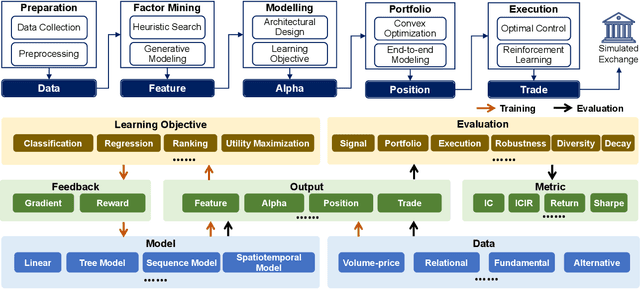

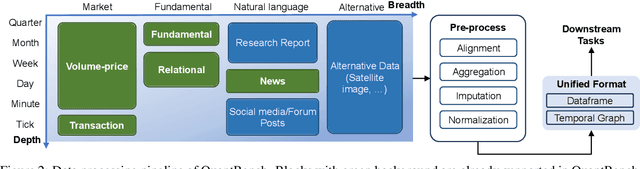
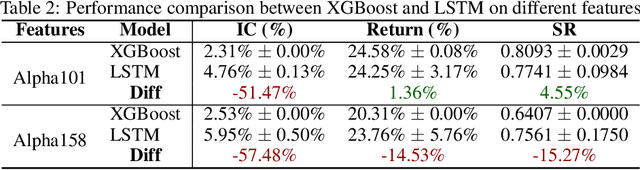
The field of artificial intelligence (AI) in quantitative investment has seen significant advancements, yet it lacks a standardized benchmark aligned with industry practices. This gap hinders research progress and limits the practical application of academic innovations. We present QuantBench, an industrial-grade benchmark platform designed to address this critical need. QuantBench offers three key strengths: (1) standardization that aligns with quantitative investment industry practices, (2) flexibility to integrate various AI algorithms, and (3) full-pipeline coverage of the entire quantitative investment process. Our empirical studies using QuantBench reveal some critical research directions, including the need for continual learning to address distribution shifts, improved methods for modeling relational financial data, and more robust approaches to mitigate overfitting in low signal-to-noise environments. By providing a common ground for evaluation and fostering collaboration between researchers and practitioners, QuantBench aims to accelerate progress in AI for quantitative investment, similar to the impact of benchmark platforms in computer vision and natural language processing.