 Add to Chrome
 Add to Firefox
 Add to Edge
Decoupled Kullback-Leibler Divergence Loss
May 23, 2023
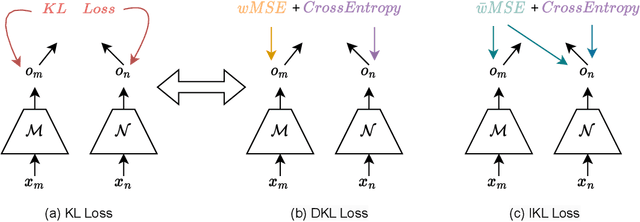
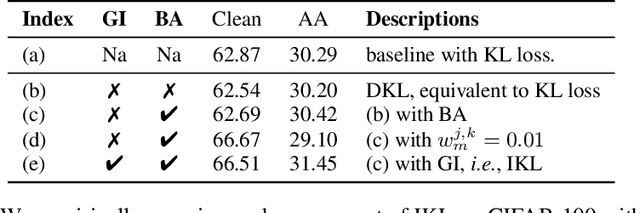
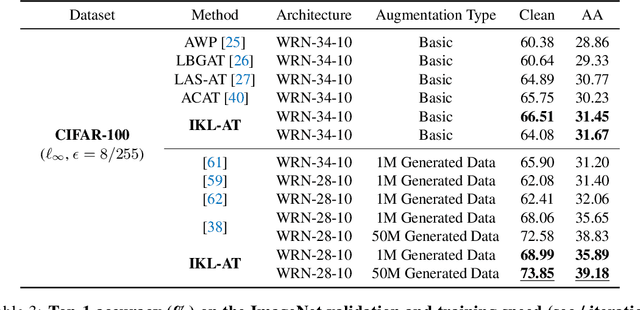
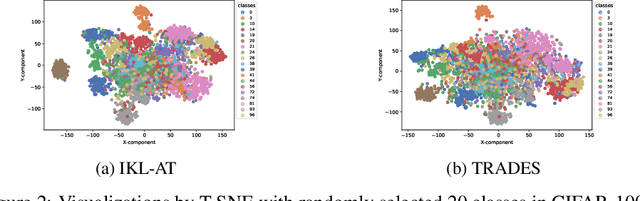
In this paper, we delve deeper into the Kullback-Leibler (KL) Divergence loss and observe that it is equivalent to the Doupled Kullback-Leibler (DKL) Divergence loss that consists of 1) a weighted Mean Square Error (wMSE) loss and 2) a Cross-Entropy loss incorporating soft labels. From our analysis of the DKL loss, we have identified two areas for improvement. Firstly, we address the limitation of DKL in scenarios like knowledge distillation by breaking its asymmetry property in training optimization. This modification ensures that the wMSE component is always effective during training, providing extra constructive cues. Secondly, we introduce global information into DKL for intra-class consistency regularization. With these two enhancements, we derive the Improved Kullback-Leibler (IKL) Divergence loss and evaluate its effectiveness by conducting experiments on CIFAR-10/100 and ImageNet datasets, focusing on adversarial training and knowledge distillation tasks. The proposed approach achieves new state-of-the-art performance on both tasks, demonstrating the substantial practical merits. Code and models will be available soon at https://github.com/jiequancui/DKL.

Equivariant Similarity for Vision-Language Foundation Models
Mar 25, 2023This study explores the concept of equivariance in vision-language foundation models (VLMs), focusing specifically on the multimodal similarity function that is not only the major training objective but also the core delivery to support downstream tasks. Unlike the existing image-text similarity objective which only categorizes matched pairs as similar and unmatched pairs as dissimilar, equivariance also requires similarity to vary faithfully according to the semantic changes. This allows VLMs to generalize better to nuanced and unseen multimodal compositions. However, modeling equivariance is challenging as the ground truth of semantic change is difficult to collect. For example, given an image-text pair about a dog, it is unclear to what extent the similarity changes when the pixel is changed from dog to cat? To this end, we propose EqSim, a regularization loss that can be efficiently calculated from any two matched training pairs and easily pluggable into existing image-text retrieval fine-tuning. Meanwhile, to further diagnose the equivariance of VLMs, we present a new challenging benchmark EqBen. Compared to the existing evaluation sets, EqBen is the first to focus on "visual-minimal change". Extensive experiments show the lack of equivariance in current VLMs and validate the effectiveness of EqSim. Code is available at \url{https://github.com/Wangt-CN/EqBen}.
Unbiased Multiple Instance Learning for Weakly Supervised Video Anomaly Detection
Mar 22, 2023Weakly Supervised Video Anomaly Detection (WSVAD) is challenging because the binary anomaly label is only given on the video level, but the output requires snippet-level predictions. So, Multiple Instance Learning (MIL) is prevailing in WSVAD. However, MIL is notoriously known to suffer from many false alarms because the snippet-level detector is easily biased towards the abnormal snippets with simple context, confused by the normality with the same bias, and missing the anomaly with a different pattern. To this end, we propose a new MIL framework: Unbiased MIL (UMIL), to learn unbiased anomaly features that improve WSVAD. At each MIL training iteration, we use the current detector to divide the samples into two groups with different context biases: the most confident abnormal/normal snippets and the rest ambiguous ones. Then, by seeking the invariant features across the two sample groups, we can remove the variant context biases. Extensive experiments on benchmarks UCF-Crime and TAD demonstrate the effectiveness of our UMIL. Our code is provided at https://github.com/ktr-hubrt/UMIL.
Semantic Scene Completion with Cleaner Self
Mar 17, 2023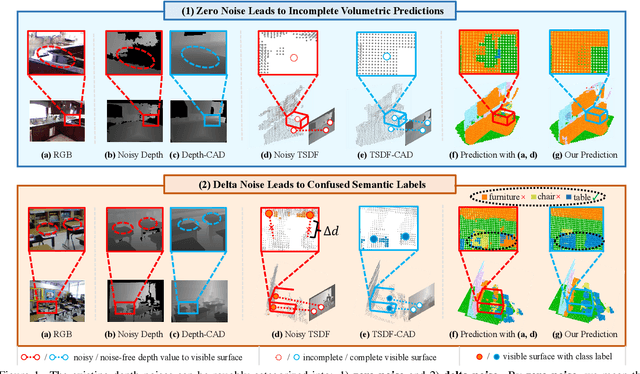

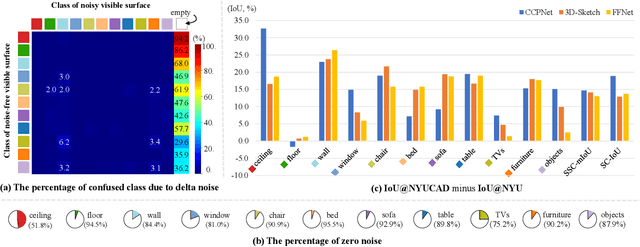

Semantic Scene Completion (SSC) transforms an image of single-view depth and/or RGB 2D pixels into 3D voxels, each of whose semantic labels are predicted. SSC is a well-known ill-posed problem as the prediction model has to "imagine" what is behind the visible surface, which is usually represented by Truncated Signed Distance Function (TSDF). Due to the sensory imperfection of the depth camera, most existing methods based on the noisy TSDF estimated from depth values suffer from 1) incomplete volumetric predictions and 2) confused semantic labels. To this end, we use the ground-truth 3D voxels to generate a perfect visible surface, called TSDF-CAD, and then train a "cleaner" SSC model. As the model is noise-free, it is expected to focus more on the "imagination" of unseen voxels. Then, we propose to distill the intermediate "cleaner" knowledge into another model with noisy TSDF input. In particular, we use the 3D occupancy feature and the semantic relations of the "cleaner self" to supervise the counterparts of the "noisy self" to respectively address the above two incorrect predictions. Experimental results validate that our method improves the noisy counterparts with 3.1% IoU and 2.2% mIoU for measuring scene completion and SSC, and also achieves new state-of-the-art accuracy on the popular NYU dataset.
Compositional Prompt Tuning with Motion Cues for Open-vocabulary Video Relation Detection
Feb 01, 2023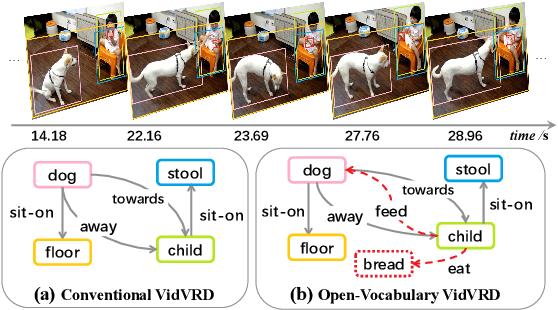


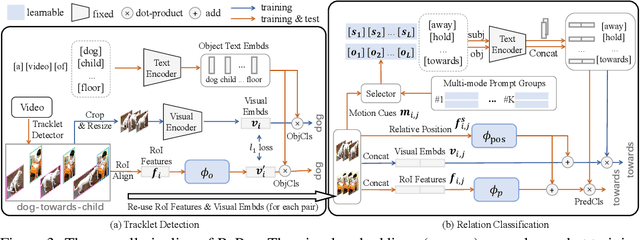
Prompt tuning with large-scale pretrained vision-language models empowers open-vocabulary predictions trained on limited base categories, e.g., object classification and detection. In this paper, we propose compositional prompt tuning with motion cues: an extended prompt tuning paradigm for compositional predictions of video data. In particular, we present Relation Prompt (RePro) for Open-vocabulary Video Visual Relation Detection (Open-VidVRD), where conventional prompt tuning is easily biased to certain subject-object combinations and motion patterns. To this end, RePro addresses the two technical challenges of Open-VidVRD: 1) the prompt tokens should respect the two different semantic roles of subject and object, and 2) the tuning should account for the diverse spatio-temporal motion patterns of the subject-object compositions. Without bells and whistles, our RePro achieves a new state-of-the-art performance on two VidVRD benchmarks of not only the base training object and predicate categories, but also the unseen ones. Extensive ablations also demonstrate the effectiveness of the proposed compositional and multi-mode design of prompts. Code is available at https://github.com/Dawn-LX/OpenVoc-VidVRD.
Debiased Fine-Tuning for Vision-language Models by Prompt Regularization
Jan 29, 2023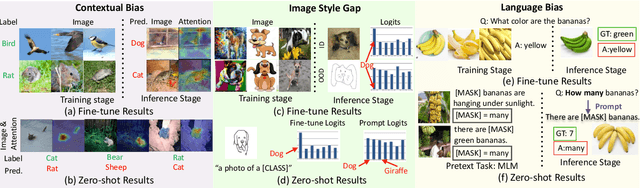
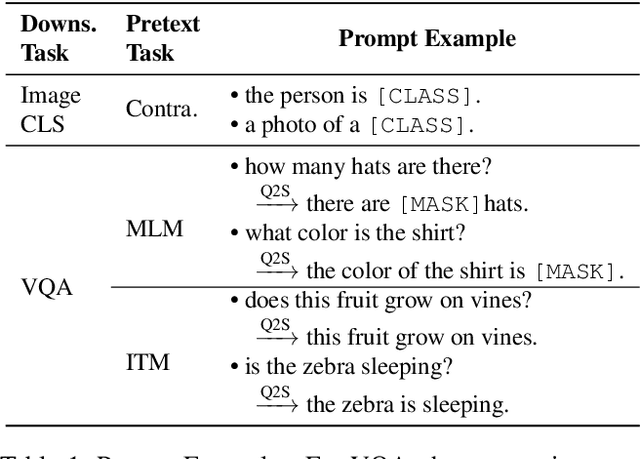
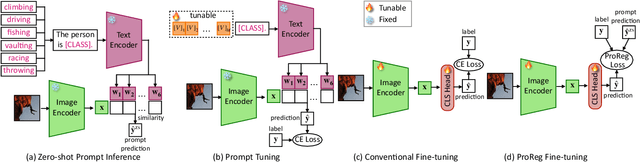
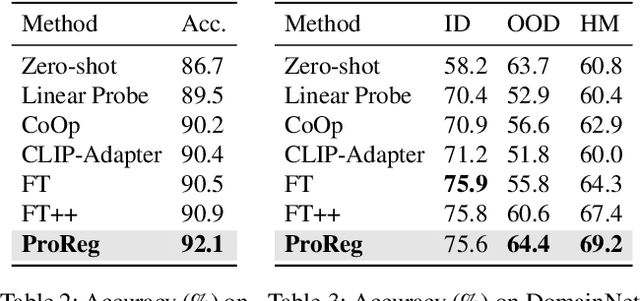
We present a new paradigm for fine-tuning large-scale visionlanguage pre-trained models on downstream task, dubbed Prompt Regularization (ProReg). Different from traditional fine-tuning which easily overfits to the downstream task data, ProReg uses the prediction by prompting the pretrained model to regularize the fine-tuning. The motivation is: by prompting the large model "a photo of a [CLASS]", the fil-lin answer is only dependent on the pretraining encyclopedic knowledge while independent of the task data distribution, which is usually biased. Specifically, given a training sample prediction during fine-tuning, we first calculate its KullbackLeibler loss of the prompt prediction and Cross-Entropy loss of the ground-truth label, and then combine them with a proposed sample-wise adaptive trade-off weight, which automatically adjusts the transfer between the pretrained and downstream domains. On various out-of-distribution benchmarks, we show the consistently strong performance of ProReg compared with conventional fine-tuning, zero-shot prompt, prompt tuning, and other state-of-the-art methods.
Learning Trajectory-Word Alignments for Video-Language Tasks
Jan 06, 2023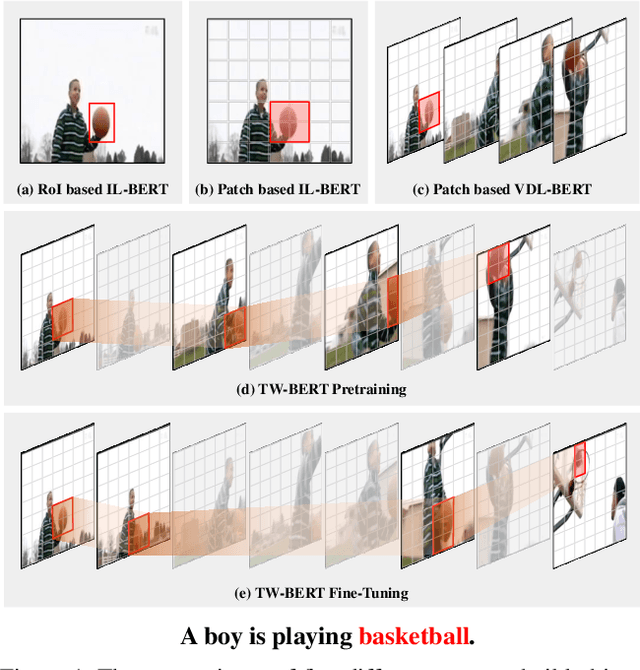

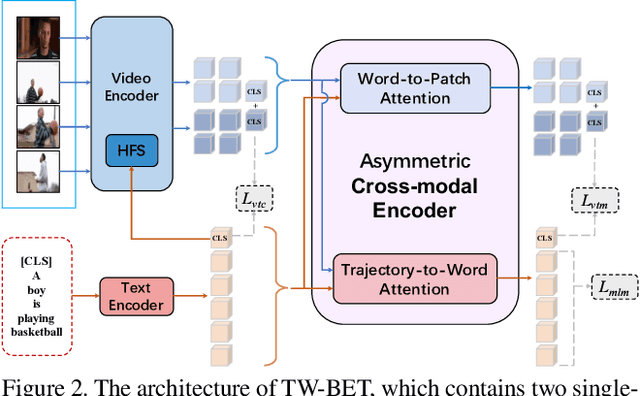

Aligning objects with words plays a critical role in Image-Language BERT (IL-BERT) and Video-Language BERT (VDL-BERT). Different from the image case where an object covers some spatial patches, an object in a video usually appears as an object trajectory, i.e., it spans over a few spatial but longer temporal patches and thus contains abundant spatiotemporal contexts. However, modern VDL-BERTs neglect this trajectory characteristic that they usually follow IL-BERTs to deploy the patch-to-word (P2W) attention while such attention may over-exploit trivial spatial contexts and neglect significant temporal contexts. To amend this, we propose a novel TW-BERT to learn Trajectory-Word alignment for solving video-language tasks. Such alignment is learned by a newly designed trajectory-to-word (T2W) attention. Besides T2W attention, we also follow previous VDL-BERTs to set a word-to-patch (W2P) attention in the cross-modal encoder. Since T2W and W2P attentions have diverse structures, our cross-modal encoder is asymmetric. To further help this asymmetric cross-modal encoder build robust vision-language associations, we propose a fine-grained ``align-before-fuse'' strategy to pull close the embedding spaces calculated by the video and text encoders. By the proposed strategy and T2W attention, our TW-BERT achieves SOTA performances on text-to-video retrieval tasks, and comparable performances on video question answering tasks with some VDL-BERTs trained on much more data. The code will be available in the supplementary material.
Adaptively Clustering Neighbor Elements for Image Captioning
Jan 05, 2023We design a novel global-local Transformer named \textbf{Ada-ClustFormer} (\textbf{ACF}) to generate captions. We use this name since each layer of ACF can adaptively cluster input elements to carry self-attention (Self-ATT) for learning local context. Compared with other global-local Transformers which carry Self-ATT in fixed-size windows, ACF can capture varying graininess, \eg, an object may cover different numbers of grids or a phrase may contain diverse numbers of words. To build ACF, we insert a probabilistic matrix C into the Self-ATT layer. For an input sequence {{s}_1,...,{s}_N , C_{i,j} softly determines whether the sub-sequence {s_i,...,s_j} should be clustered for carrying Self-ATT. For implementation, {C}_{i,j} is calculated from the contexts of {{s}_i,...,{s}_j}, thus ACF can exploit the input itself to decide which local contexts should be learned. By using ACF to build the vision encoder and language decoder, the captioning model can automatically discover the hidden structures in both vision and language, which encourages the model to learn a unified structural space for transferring more structural commonalities. The experiment results demonstrate the effectiveness of ACF that we achieve CIDEr of 137.8, which outperforms most SOTA captioning models and achieve comparable scores compared with some BERT-based models. The code will be available in the supplementary material.
Evaluating and Mitigating Static Bias of Action Representations in the Background and the Foreground
Nov 23, 2022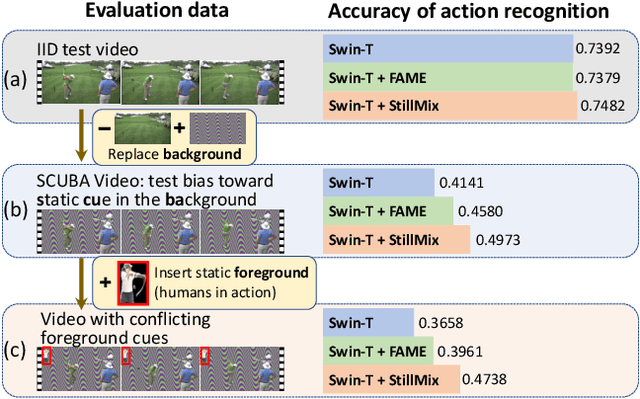
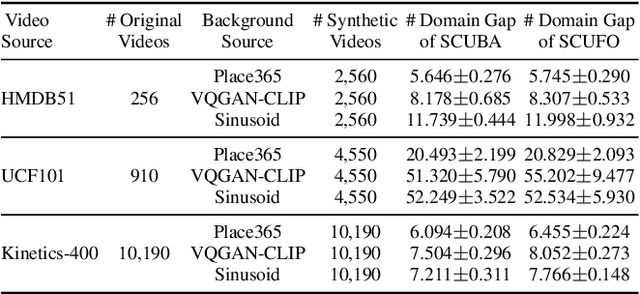
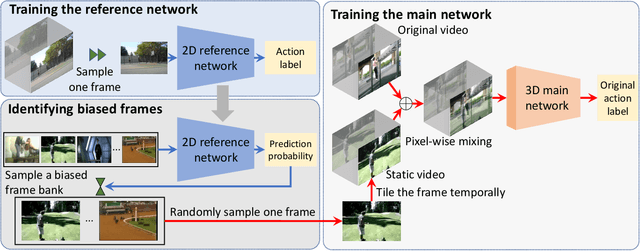
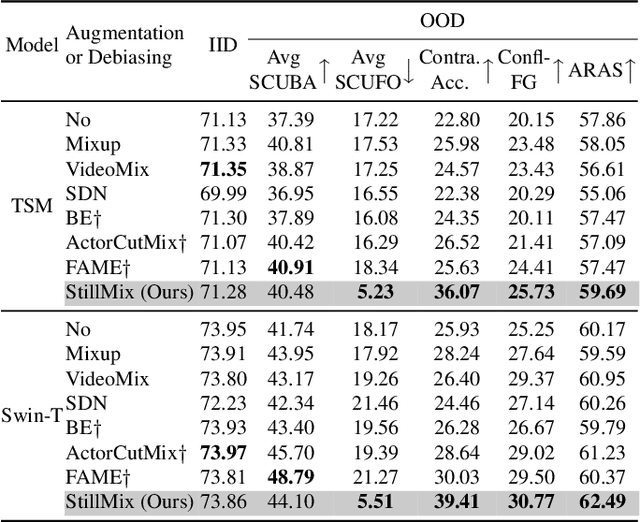
Deep neural networks for video action recognition easily learn to utilize shortcut static features, such as background and objects instead of motion features. This results in poor generalization to atypical videos such as soccer playing on concrete surfaces (instead of soccer fields). However, due to the rarity of out-of-distribution (OOD) data, quantitative evaluation of static bias remains a difficult task. In this paper, we synthesize new sets of benchmarks to evaluate static bias of action representations, including SCUB for static cues in the background, and SCUF for static cues in the foreground. Further, we propose a simple yet effective video data augmentation technique, StillMix, that automatically identifies bias-inducing video frames; unlike similar augmentation techniques, StillMix does not need to enumerate or precisely segment biased content. With extensive experiments, we quantitatively compare and analyze existing action recognition models on the created benchmarks to reveal their characteristics. We validate the effectiveness of StillMix and show that it improves TSM (Lin, Gan, and Han 2021) and Video Swin Transformer (Liu et al. 2021) by more than 10% of accuracy on SCUB for OOD action recognition.
Attention-based Class Activation Diffusion for Weakly-Supervised Semantic Segmentation
Nov 20, 2022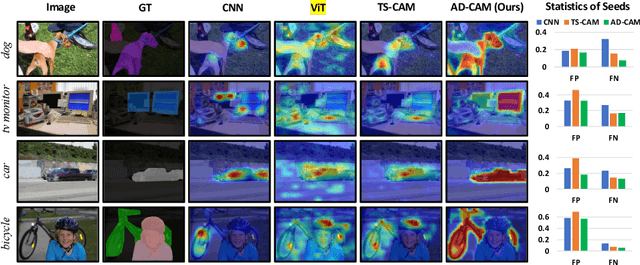
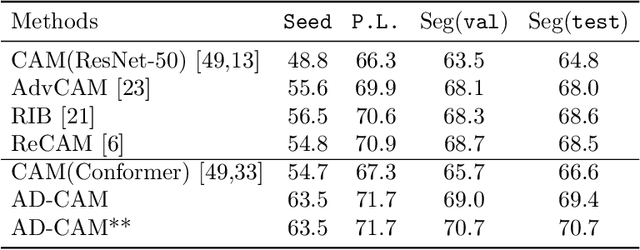
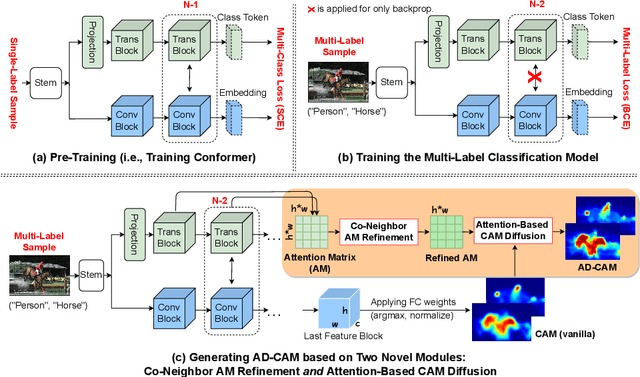
Extracting class activation maps (CAM) is a key step for weakly-supervised semantic segmentation (WSSS). The CAM of convolution neural networks fails to capture long-range feature dependency on the image and result in the coverage on only foreground object parts, i.e., a lot of false negatives. An intuitive solution is ``coupling'' the CAM with the long-range attention matrix of visual transformers (ViT) We find that the direct ``coupling'', e.g., pixel-wise multiplication of attention and activation, achieves a more global coverage (on the foreground), but unfortunately goes with a great increase of false positives, i.e., background pixels are mistakenly included. This paper aims to tackle this issue. It proposes a new method to couple CAM and Attention matrix in a probabilistic Diffusion way, and dub it AD-CAM. Intuitively, it integrates ViT attention and CAM activation in a conservative and convincing way. Conservative is achieved by refining the attention between a pair of pixels based on their respective attentions to common neighbors, where the intuition is two pixels having very different neighborhoods are rarely dependent, i.e., their attention should be reduced. Convincing is achieved by diffusing a pixel's activation to its neighbors (on the CAM) in proportion to the corresponding attentions (on the AM). In experiments, our results on two challenging WSSS benchmarks PASCAL VOC and MS~COCO show that AD-CAM as pseudo labels can yield stronger WSSS models than the state-of-the-art variants of CAM.