 Add to Chrome
 Add to Firefox
 Add to Edge
Robust Mesh Saliency GT Acquisition in VR via View Cone Sampling and Geometric Smoothing
Jan 06, 2026
Reliable 3D mesh saliency ground truth (GT) is essential for human-centric visual modeling in virtual reality (VR). However, current 3D mesh saliency GT acquisition methods are generally consistent with 2D image methods, ignoring the differences between 3D geometry topology and 2D image array. Current VR eye-tracking pipelines rely on single ray sampling and Euclidean smoothing, triggering texture attention and signal leakage across gaps. This paper proposes a robust framework to address these limitations. We first introduce a view cone sampling (VCS) strategy, which simulates the human foveal receptive field via Gaussian-distributed ray bundles to improve sampling robustness for complex topologies. Furthermore, a hybrid Manifold-Euclidean constrained diffusion (HCD) algorithm is developed, fusing manifold geodesic constraints with Euclidean scales to ensure topologically-consistent saliency propagation. By mitigating "topological short-circuits" and aliasing, our framework provides a high-fidelity 3D attention acquisition paradigm that aligns with natural human perception, offering a more accurate and robust baseline for 3D mesh saliency research.

VTONQA: A Multi-Dimensional Quality Assessment Dataset for Virtual Try-on
Jan 06, 2026With the rapid development of e-commerce and digital fashion, image-based virtual try-on (VTON) has attracted increasing attention. However, existing VTON models often suffer from artifacts such as garment distortion and body inconsistency, highlighting the need for reliable quality evaluation of VTON-generated images. To this end, we construct VTONQA, the first multi-dimensional quality assessment dataset specifically designed for VTON, which contains 8,132 images generated by 11 representative VTON models, along with 24,396 mean opinion scores (MOSs) across three evaluation dimensions (i.e., clothing fit, body compatibility, and overall quality). Based on VTONQA, we benchmark both VTON models and a diverse set of image quality assessment (IQA) metrics, revealing the limitations of existing methods and highlighting the value of the proposed dataset. We believe that the VTONQA dataset and corresponding benchmarks will provide a solid foundation for perceptually aligned evaluation, benefiting both the development of quality assessment methods and the advancement of VTON models.
Generative Human-Object Interaction Detection via Differentiable Cognitive Steering of Multi-modal LLMs
Dec 19, 2025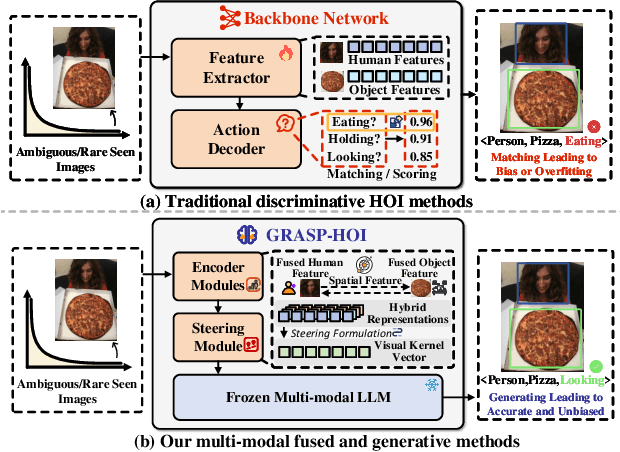
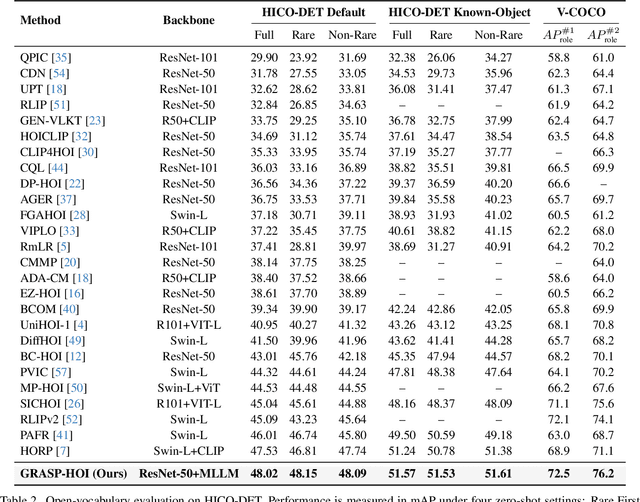
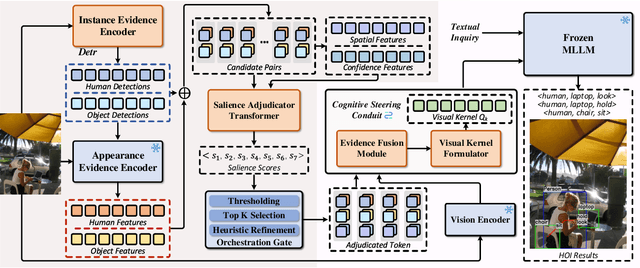
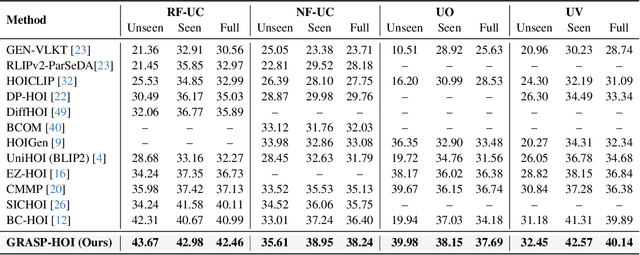
Human-object interaction (HOI) detection aims to localize human-object pairs and the interactions between them. Existing methods operate under a closed-world assumption, treating the task as a classification problem over a small, predefined verb set, which struggles to generalize to the long-tail of unseen or ambiguous interactions in the wild. While recent multi-modal large language models (MLLMs) possess the rich world knowledge required for open-vocabulary understanding, they remain decoupled from existing HOI detectors since fine-tuning them is computationally prohibitive. To address these constraints, we propose \GRASP-HO}, a novel Generative Reasoning And Steerable Perception framework that reformulates HOI detection from the closed-set classification task to the open-vocabulary generation problem. To bridge the vision and cognitive, we first extract hybrid interaction representations, then design a lightweight learnable cognitive steering conduit (CSC) module to inject the fine-grained visual evidence into a frozen MLLM for effective reasoning. To address the supervision mismatch between classification-based HOI datasets and open-vocabulary generative models, we introduce a hybrid guidance strategy that coupling the language modeling loss and auxiliary classification loss, enabling discriminative grounding without sacrificing generative flexibility. Experiments demonstrate state-of-the-art closed-set performance and strong zero-shot generalization, achieving a unified paradigm that seamlessly bridges discriminative perception and generative reasoning for open-world HOI detection.
Using GUI Agent for Electronic Design Automation
Dec 12, 2025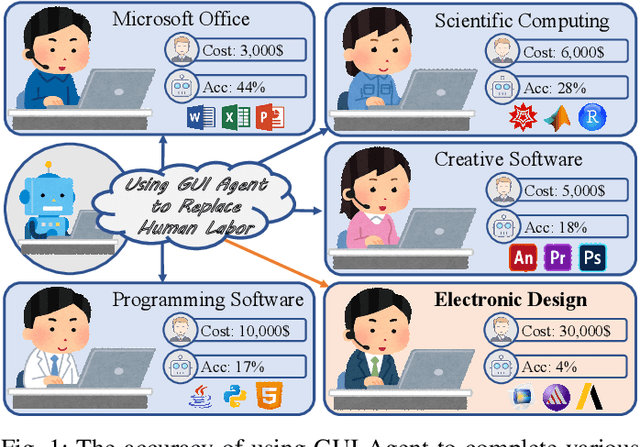
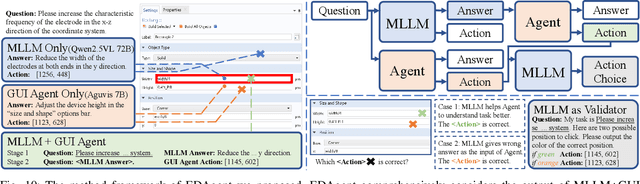
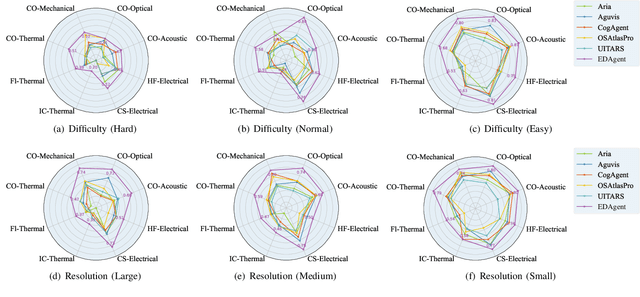
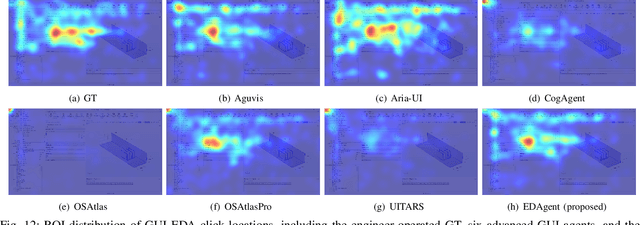
Graphical User Interface (GUI) agents adopt an end-to-end paradigm that maps a screenshot to an action sequence, thereby automating repetitive tasks in virtual environments. However, existing GUI agents are evaluated almost exclusively on commodity software such as Microsoft Word and Excel. Professional Computer-Aided Design (CAD) suites promise an order-of-magnitude higher economic return, yet remain the weakest performance domain for existing agents and are still far from replacing expert Electronic-Design-Automation (EDA) engineers. We therefore present the first systematic study that deploys GUI agents for EDA workflows. Our contributions are: (1) a large-scale dataset named GUI-EDA, including 5 CAD tools and 5 physical domains, comprising 2,000+ high-quality screenshot-answer-action pairs recorded by EDA scientists and engineers during real-world component design; (2) a comprehensive benchmark that evaluates 30+ mainstream GUI agents, demonstrating that EDA tasks constitute a major, unsolved challenge; and (3) an EDA-specialized metric named EDAgent, equipped with a reflection mechanism that achieves reliable performance on industrial CAD software and, for the first time, outperforms Ph.D. students majored in Electrical Engineering. This work extends GUI agents from generic office automation to specialized, high-value engineering domains and offers a new avenue for advancing EDA productivity. The dataset will be released at: https://github.com/aiben-ch/GUI-EDA.
Embodied Image Compression
Dec 12, 2025
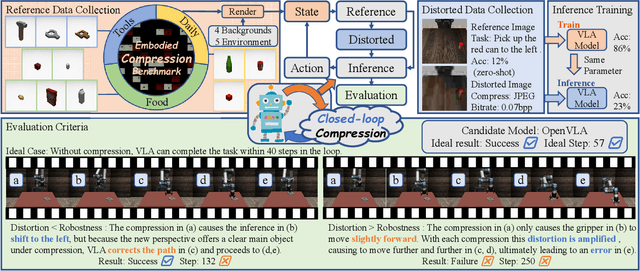
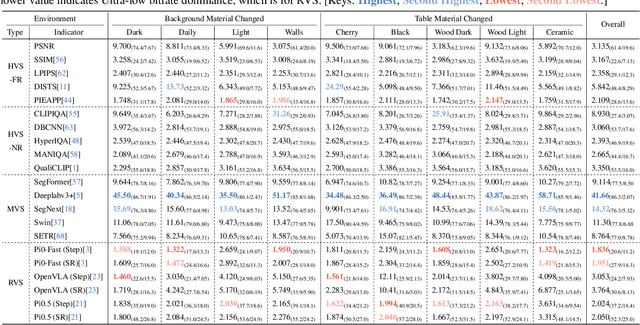
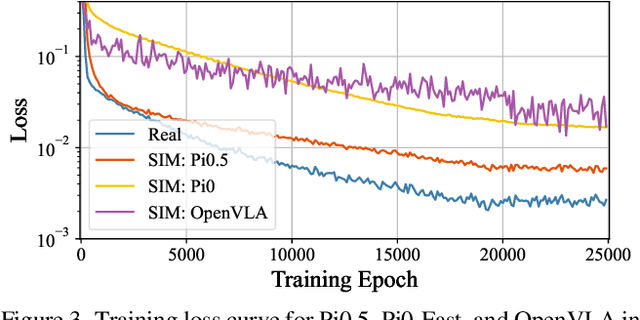
Image Compression for Machines (ICM) has emerged as a pivotal research direction in the field of visual data compression. However, with the rapid evolution of machine intelligence, the target of compression has shifted from task-specific virtual models to Embodied agents operating in real-world environments. To address the communication constraints of Embodied AI in multi-agent systems and ensure real-time task execution, this paper introduces, for the first time, the scientific problem of Embodied Image Compression. We establish a standardized benchmark, EmbodiedComp, to facilitate systematic evaluation under ultra-low bitrate conditions in a closed-loop setting. Through extensive empirical studies in both simulated and real-world settings, we demonstrate that existing Vision-Language-Action models (VLAs) fail to reliably perform even simple manipulation tasks when compressed below the Embodied bitrate threshold. We anticipate that EmbodiedComp will catalyze the development of domain-specific compression tailored for Embodied agents , thereby accelerating the Embodied AI deployment in the Real-world.
ATLAS: A High-Difficulty, Multidisciplinary Benchmark for Frontier Scientific Reasoning
Nov 18, 2025The rapid advancement of Large Language Models (LLMs) has led to performance saturation on many established benchmarks, questioning their ability to distinguish frontier models. Concurrently, existing high-difficulty benchmarks often suffer from narrow disciplinary focus, oversimplified answer formats, and vulnerability to data contamination, creating a fidelity gap with real-world scientific inquiry. To address these challenges, we introduce ATLAS (AGI-Oriented Testbed for Logical Application in Science), a large-scale, high-difficulty, and cross-disciplinary evaluation suite composed of approximately 800 original problems. Developed by domain experts (PhD-level and above), ATLAS spans seven core scientific fields: mathematics, physics, chemistry, biology, computer science, earth science, and materials science. Its key features include: (1) High Originality and Contamination Resistance, with all questions newly created or substantially adapted to prevent test data leakage; (2) Cross-Disciplinary Focus, designed to assess models' ability to integrate knowledge and reason across scientific domains; (3) High-Fidelity Answers, prioritizing complex, open-ended answers involving multi-step reasoning and LaTeX-formatted expressions over simple multiple-choice questions; and (4) Rigorous Quality Control, employing a multi-stage process of expert peer review and adversarial testing to ensure question difficulty, scientific value, and correctness. We also propose a robust evaluation paradigm using a panel of LLM judges for automated, nuanced assessment of complex answers. Preliminary results on leading models demonstrate ATLAS's effectiveness in differentiating their advanced scientific reasoning capabilities. We plan to develop ATLAS into a long-term, open, community-driven platform to provide a reliable "ruler" for progress toward Artificial General Intelligence.
ManipShield: A Unified Framework for Image Manipulation Detection, Localization and Explanation
Nov 18, 2025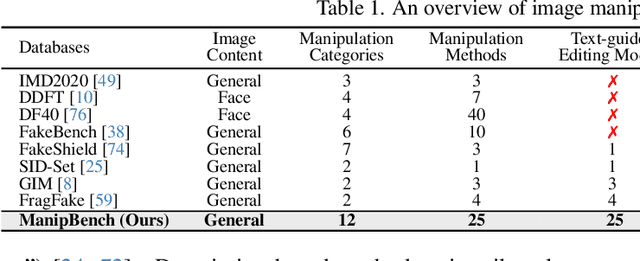
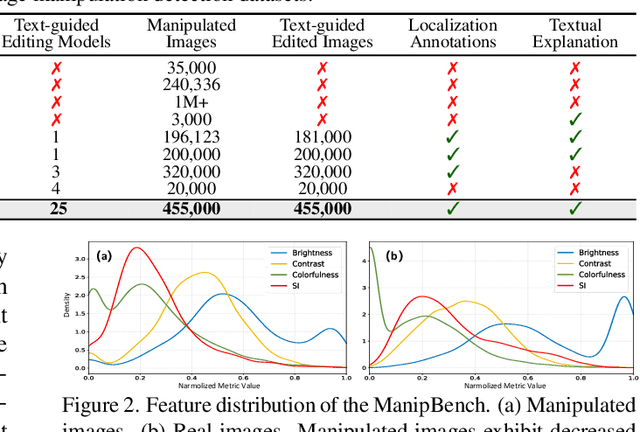
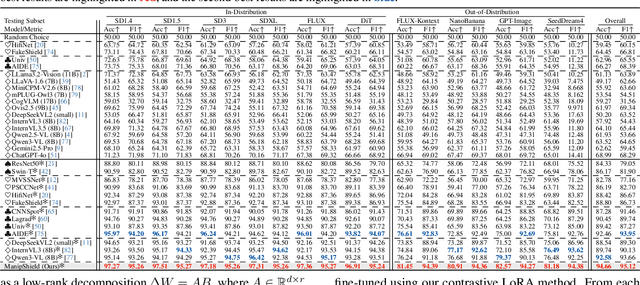
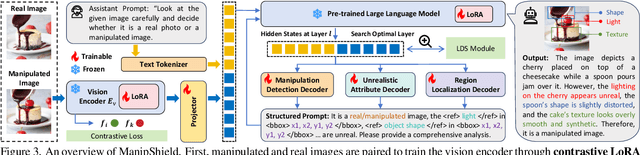
With the rapid advancement of generative models, powerful image editing methods now enable diverse and highly realistic image manipulations that far surpass traditional deepfake techniques, posing new challenges for manipulation detection. Existing image manipulation detection and localization (IMDL) benchmarks suffer from limited content diversity, narrow generative-model coverage, and insufficient interpretability, which hinders the generalization and explanation capabilities of current manipulation detection methods. To address these limitations, we introduce \textbf{ManipBench}, a large-scale benchmark for image manipulation detection and localization focusing on AI-edited images. ManipBench contains over 450K manipulated images produced by 25 state-of-the-art image editing models across 12 manipulation categories, among which 100K images are further annotated with bounding boxes, judgment cues, and textual explanations to support interpretable detection. Building upon ManipBench, we propose \textbf{ManipShield}, an all-in-one model based on a Multimodal Large Language Model (MLLM) that leverages contrastive LoRA fine-tuning and task-specific decoders to achieve unified image manipulation detection, localization, and explanation. Extensive experiments on ManipBench and several public datasets demonstrate that ManipShield achieves state-of-the-art performance and exhibits strong generality to unseen manipulation models. Both ManipBench and ManipShield will be released upon publication.
GeoX-Bench: Benchmarking Cross-View Geo-Localization and Pose Estimation Capabilities of Large Multimodal Models
Nov 17, 2025Large multimodal models (LMMs) have demonstrated remarkable capabilities across a wide range of tasks, however their knowledge and abilities in the cross-view geo-localization and pose estimation domains remain unexplored, despite potential benefits for navigation, autonomous driving, outdoor robotics, \textit{etc}. To bridge this gap, we introduce \textbf{GeoX-Bench}, a comprehensive \underline{Bench}mark designed to explore and evaluate the capabilities of LMMs in \underline{cross}-view \underline{Geo}-localization and pose estimation. Specifically, GeoX-Bench contains 10,859 panoramic-satellite image pairs spanning 128 cities in 49 countries, along with corresponding 755,976 question-answering (QA) pairs. Among these, 42,900 QA pairs are designated for benchmarking, while the remaining are intended to enhance the capabilities of LMMs. Based on GeoX-Bench, we evaluate the capabilities of 25 state-of-the-art LMMs on cross-view geo-localization and pose estimation tasks, and further explore the empowered capabilities of instruction-tuning. Our benchmark demonstrate that while current LMMs achieve impressive performance in geo-localization tasks, their effectiveness declines significantly on the more complex pose estimation tasks, highlighting a critical area for future improvement, and instruction-tuning LMMs on the training data of GeoX-Bench can significantly improve the cross-view geo-sense abilities. The GeoX-Bench is available at \textcolor{magenta}{https://github.com/IntMeGroup/GeoX-Bench}.
Data Assessment for Embodied Intelligence
Nov 12, 2025In embodied intelligence, datasets play a pivotal role, serving as both a knowledge repository and a conduit for information transfer. The two most critical attributes of a dataset are the amount of information it provides and how easily this information can be learned by models. However, the multimodal nature of embodied data makes evaluating these properties particularly challenging. Prior work has largely focused on diversity, typically counting tasks and scenes or evaluating isolated modalities, which fails to provide a comprehensive picture of dataset diversity. On the other hand, the learnability of datasets has received little attention and is usually assessed post-hoc through model training, an expensive, time-consuming process that also lacks interpretability, offering little guidance on how to improve a dataset. In this work, we address both challenges by introducing two principled, data-driven tools. First, we construct a unified multimodal representation for each data sample and, based on it, propose diversity entropy, a continuous measure that characterizes the amount of information contained in a dataset. Second, we introduce the first interpretable, data-driven algorithm to efficiently quantify dataset learnability without training, enabling researchers to assess a dataset's learnability immediately upon its release. We validate our algorithm on both simulated and real-world embodied datasets, demonstrating that it yields faithful, actionable insights that enable researchers to jointly improve diversity and learnability. We hope this work provides a foundation for designing higher-quality datasets that advance the development of embodied intelligence.
MACEval: A Multi-Agent Continual Evaluation Network for Large Models
Nov 12, 2025Hundreds of benchmarks dedicated to evaluating large models from multiple perspectives have been presented over the past few years. Albeit substantial efforts, most of them remain closed-ended and are prone to overfitting due to the potential data contamination in the ever-growing training corpus of large models, thereby undermining the credibility of the evaluation. Moreover, the increasing scale and scope of current benchmarks with transient metrics, as well as the heavily human-dependent curation procedure, pose significant challenges for timely maintenance and adaptation to gauge the advancing capabilities of large models. In this paper, we introduce MACEval, a \Multi-Agent Continual Evaluation network for dynamic evaluation of large models, and define a new set of metrics to quantify performance longitudinally and sustainably. MACEval adopts an interactive and autonomous evaluation mode that employs role assignment, in-process data generation, and evaluation routing through a cascaded agent network. Extensive experiments on 9 open-ended tasks with 23 participating large models demonstrate that MACEval is (1) human-free and automatic, mitigating laborious result processing with inter-agent judgment guided; (2) efficient and economical, reducing a considerable amount of data and overhead to obtain similar results compared to related benchmarks; and (3) flexible and scalable, migrating or integrating existing benchmarks via customized evaluation topologies. We hope that MACEval can broaden future directions of large model evaluation.