 Add to Chrome
 Add to Firefox
 Add to Edge
DPC-VQA: Decoupling Quality Perception and Residual Calibration for Video Quality Assessment
Apr 14, 2026
Recent multimodal large language models (MLLMs) have shown promising performance on video quality assessment (VQA) tasks. However, adapting them to new scenarios remains expensive due to large-scale retraining and costly mean opinion score (MOS) annotations. In this paper, we argue that a pretrained MLLM already provides a useful perceptual prior for VQA, and that the main challenge is to efficiently calibrate this prior to the target MOS space. Based on this insight, we propose DPC-VQA, a decoupling perception and calibration framework for video quality assessment. Specifically, DPC-VQA uses a frozen MLLM to provide a base quality estimate and perceptual prior, and employs a lightweight calibration branch to predict a residual correction for target-scenario adaptation. This design avoids costly end-to-end retraining while maintaining reliable performance with lower training and data costs. Extensive experiments on both user-generated content (UGC) and AI-generated content (AIGC) benchmarks show that DPC-VQA achieves competitive performance against representative baselines, while using less than 2% of the trainable parameters of conventional MLLM-based VQA methods and remaining effective with only 20\% of MOS labels. The code will be released upon publication.

Steering and Rectifying Latent Representation Manifolds in Frozen Multi-modal LLMs for Video Anomaly Detection
Feb 27, 2026Video anomaly detection (VAD) aims to identify abnormal events in videos. Traditional VAD methods generally suffer from the high costs of labeled data and full training, thus some recent works have explored leveraging frozen multi-modal large language models (MLLMs) in a tuning-free manner to perform VAD. However, their performance is limited as they directly inherit pre-training biases and cannot adapt internal representations to specific video contexts, leading to difficulties in handling subtle or ambiguous anomalies. To address these limitations, we propose a novel intervention framework, termed SteerVAD, which advances MLLM-based VAD by shifting from passively reading to actively steering and rectifying internal representations. Our approach first leverages the gradient-free representational separability analysis (RSA) to identify top attention heads as latent anomaly experts (LAEs) which are most discriminative for VAD. Then a hierarchical meta-controller (HMC) generates dynamic rectification signals by jointly conditioning on global context and these LAE outputs. The signals execute targeted, anisotropic scaling directly upon the LAE representation manifolds, amplifying anomaly-relevant dimensions while suppressing inherent biases. Extensive experiments on mainstream benchmarks demonstrate our method achieves state-of-the-art performance among tuning-free approaches requiring only 1% of training data, establishing it as a powerful new direction for video anomaly detection. The code will be released upon the publication.
ELIQ: A Label-Free Framework for Quality Assessment of Evolving AI-Generated Images
Feb 03, 2026Generative text-to-image models are advancing at an unprecedented pace, continuously shifting the perceptual quality ceiling and rendering previously collected labels unreliable for newer generations. To address this, we present ELIQ, a Label-free Framework for Quality Assessment of Evolving AI-generated Images. Specifically, ELIQ focuses on visual quality and prompt-image alignment, automatically constructs positive and aspect-specific negative pairs to cover both conventional distortions and AIGC-specific distortion modes, enabling transferable supervision without human annotations. Building on these pairs, ELIQ adapts a pre-trained multimodal model into a quality-aware critic via instruction tuning and predicts two-dimensional quality using lightweight gated fusion and a Quality Query Transformer. Experiments across multiple benchmarks demonstrate that ELIQ consistently outperforms existing label-free methods, generalizes from AI-generated content (AIGC) to user-generated content (UGC) scenarios without modification, and paves the way for scalable and label-free quality assessment under continuously evolving generative models. The code will be released upon publication.
Fine-Grained Human Pose Editing Assessment via Layer-Selective MLLMs
Jan 15, 2026Text-guided human pose editing has gained significant traction in AIGC applications. However,it remains plagued by structural anomalies and generative artifacts. Existing evaluation metrics often isolate authenticity detection from quality assessment, failing to provide fine-grained insights into pose-specific inconsistencies. To address these limitations, we introduce HPE-Bench, a specialized benchmark comprising 1,700 standardized samples from 17 state-of-the-art editing models, offering both authenticity labels and multi-dimensional quality scores. Furthermore, we propose a unified framework based on layer-selective multimodal large language models (MLLMs). By employing contrastive LoRA tuning and a novel layer sensitivity analysis (LSA) mechanism, we identify the optimal feature layer for pose evaluation. Our framework achieves superior performance in both authenticity detection and multi-dimensional quality regression, effectively bridging the gap between forensic detection and quality assessment.
HeadHunt-VAD: Hunting Robust Anomaly-Sensitive Heads in MLLM for Tuning-Free Video Anomaly Detection
Dec 23, 2025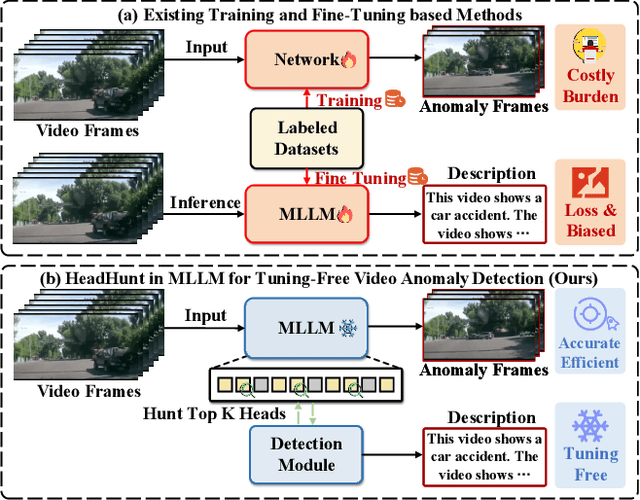
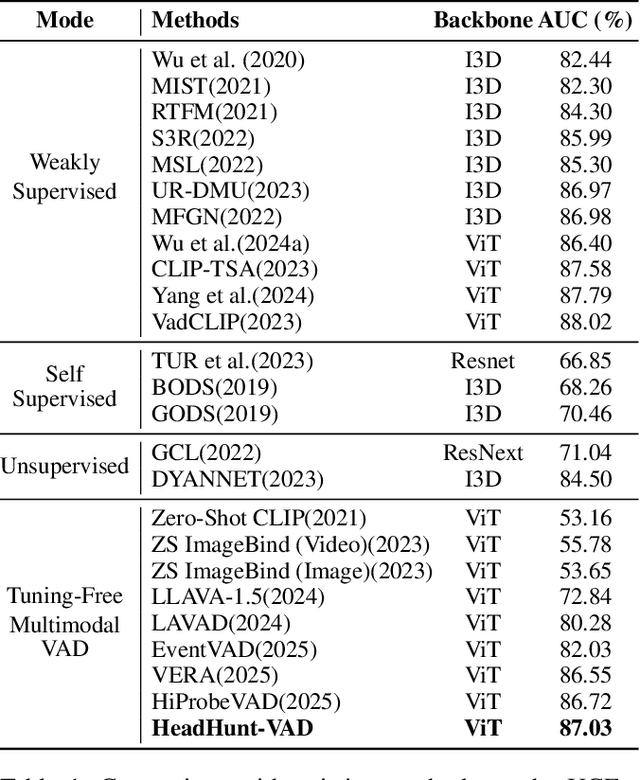
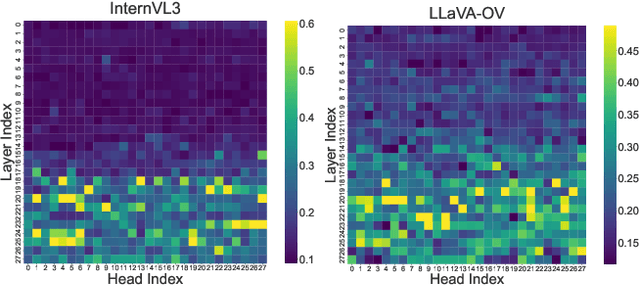
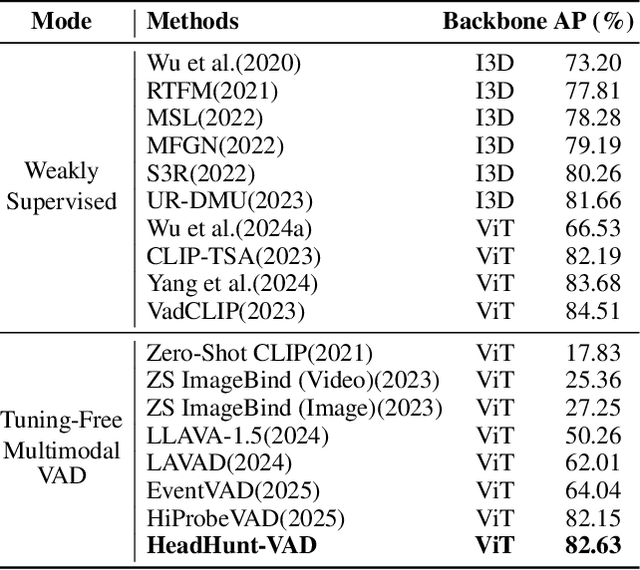
Video Anomaly Detection (VAD) aims to locate events that deviate from normal patterns in videos. Traditional approaches often rely on extensive labeled data and incur high computational costs. Recent tuning-free methods based on Multimodal Large Language Models (MLLMs) offer a promising alternative by leveraging their rich world knowledge. However, these methods typically rely on textual outputs, which introduces information loss, exhibits normalcy bias, and suffers from prompt sensitivity, making them insufficient for capturing subtle anomalous cues. To address these constraints, we propose HeadHunt-VAD, a novel tuning-free VAD paradigm that bypasses textual generation by directly hunting robust anomaly-sensitive internal attention heads within the frozen MLLM. Central to our method is a Robust Head Identification module that systematically evaluates all attention heads using a multi-criteria analysis of saliency and stability, identifying a sparse subset of heads that are consistently discriminative across diverse prompts. Features from these expert heads are then fed into a lightweight anomaly scorer and a temporal locator, enabling efficient and accurate anomaly detection with interpretable outputs. Extensive experiments show that HeadHunt-VAD achieves state-of-the-art performance among tuning-free methods on two major VAD benchmarks while maintaining high efficiency, validating head-level probing in MLLMs as a powerful and practical solution for real-world anomaly detection.
Generative Human-Object Interaction Detection via Differentiable Cognitive Steering of Multi-modal LLMs
Dec 19, 2025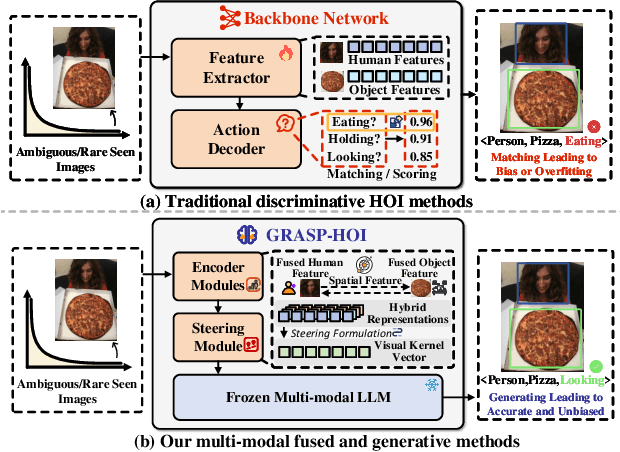
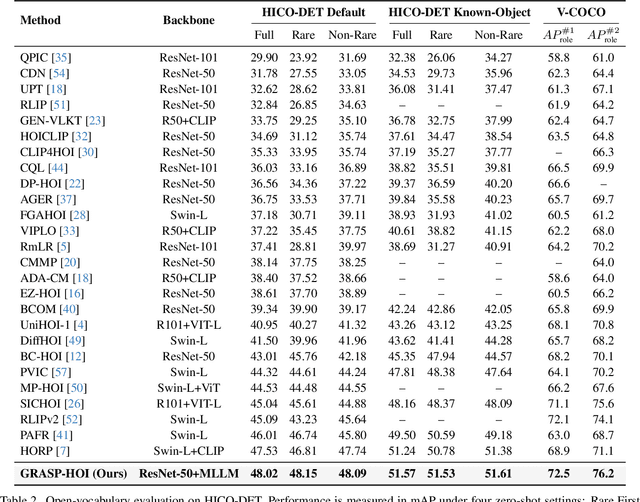
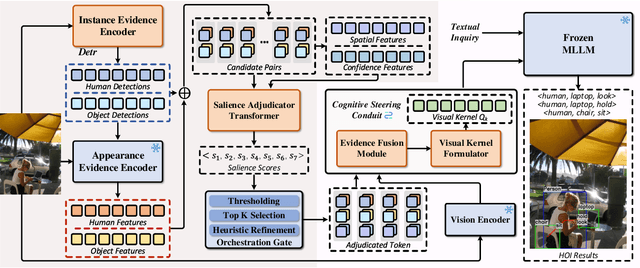
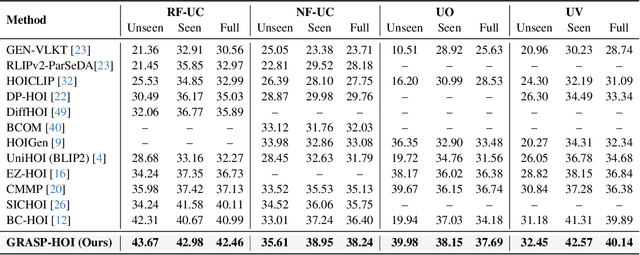
Human-object interaction (HOI) detection aims to localize human-object pairs and the interactions between them. Existing methods operate under a closed-world assumption, treating the task as a classification problem over a small, predefined verb set, which struggles to generalize to the long-tail of unseen or ambiguous interactions in the wild. While recent multi-modal large language models (MLLMs) possess the rich world knowledge required for open-vocabulary understanding, they remain decoupled from existing HOI detectors since fine-tuning them is computationally prohibitive. To address these constraints, we propose \GRASP-HO}, a novel Generative Reasoning And Steerable Perception framework that reformulates HOI detection from the closed-set classification task to the open-vocabulary generation problem. To bridge the vision and cognitive, we first extract hybrid interaction representations, then design a lightweight learnable cognitive steering conduit (CSC) module to inject the fine-grained visual evidence into a frozen MLLM for effective reasoning. To address the supervision mismatch between classification-based HOI datasets and open-vocabulary generative models, we introduce a hybrid guidance strategy that coupling the language modeling loss and auxiliary classification loss, enabling discriminative grounding without sacrificing generative flexibility. Experiments demonstrate state-of-the-art closed-set performance and strong zero-shot generalization, achieving a unified paradigm that seamlessly bridges discriminative perception and generative reasoning for open-world HOI detection.
ManipShield: A Unified Framework for Image Manipulation Detection, Localization and Explanation
Nov 18, 2025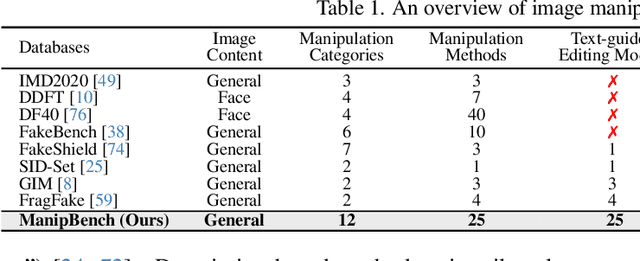
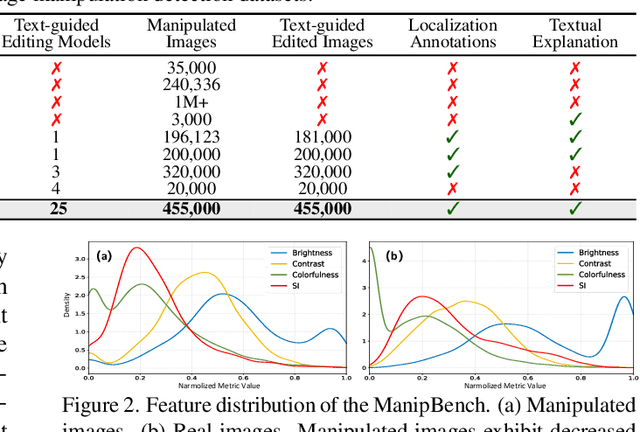
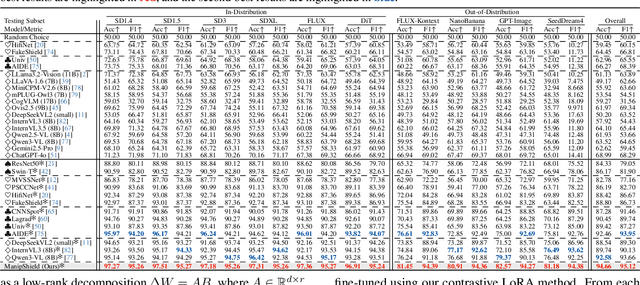
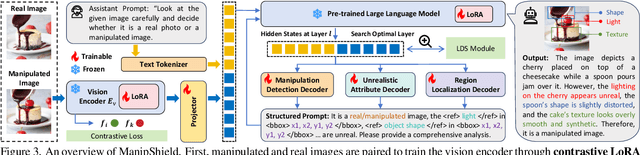
With the rapid advancement of generative models, powerful image editing methods now enable diverse and highly realistic image manipulations that far surpass traditional deepfake techniques, posing new challenges for manipulation detection. Existing image manipulation detection and localization (IMDL) benchmarks suffer from limited content diversity, narrow generative-model coverage, and insufficient interpretability, which hinders the generalization and explanation capabilities of current manipulation detection methods. To address these limitations, we introduce \textbf{ManipBench}, a large-scale benchmark for image manipulation detection and localization focusing on AI-edited images. ManipBench contains over 450K manipulated images produced by 25 state-of-the-art image editing models across 12 manipulation categories, among which 100K images are further annotated with bounding boxes, judgment cues, and textual explanations to support interpretable detection. Building upon ManipBench, we propose \textbf{ManipShield}, an all-in-one model based on a Multimodal Large Language Model (MLLM) that leverages contrastive LoRA fine-tuning and task-specific decoders to achieve unified image manipulation detection, localization, and explanation. Extensive experiments on ManipBench and several public datasets demonstrate that ManipShield achieves state-of-the-art performance and exhibits strong generality to unseen manipulation models. Both ManipBench and ManipShield will be released upon publication.
HiProbe-VAD: Video Anomaly Detection via Hidden States Probing in Tuning-Free Multimodal LLMs
Jul 23, 2025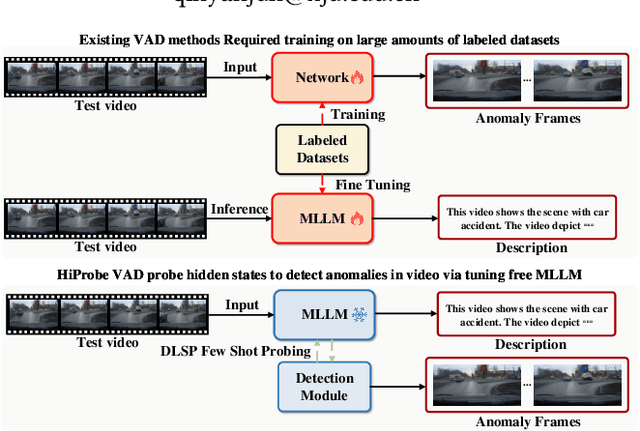
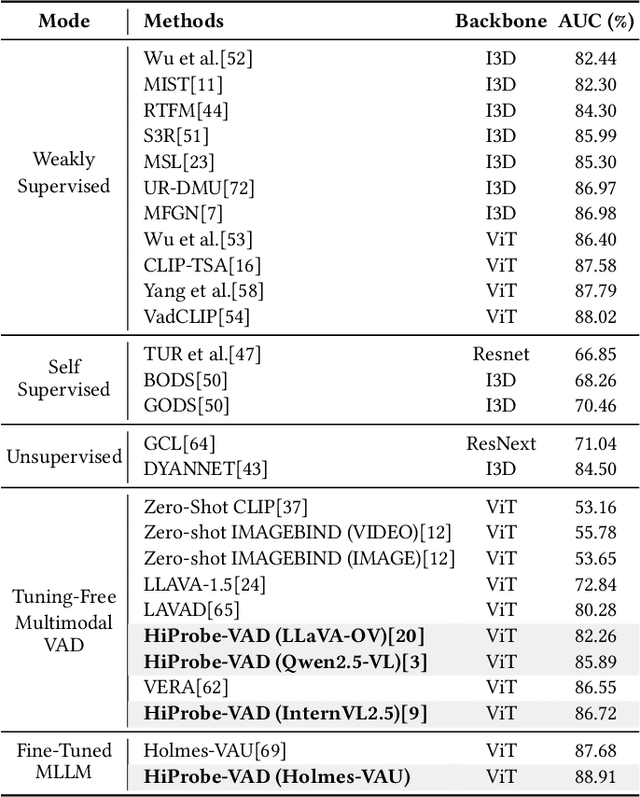
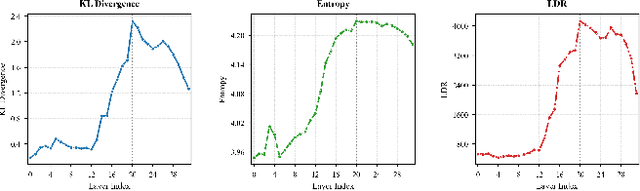
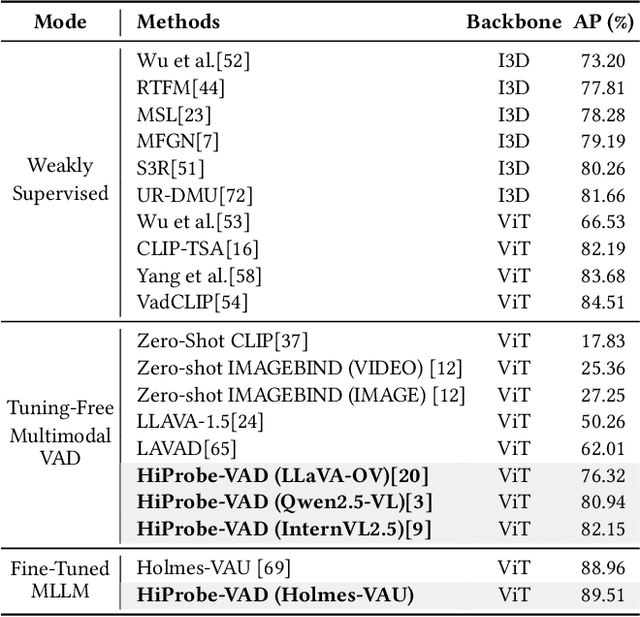
Video Anomaly Detection (VAD) aims to identify and locate deviations from normal patterns in video sequences. Traditional methods often struggle with substantial computational demands and a reliance on extensive labeled datasets, thereby restricting their practical applicability. To address these constraints, we propose HiProbe-VAD, a novel framework that leverages pre-trained Multimodal Large Language Models (MLLMs) for VAD without requiring fine-tuning. In this paper, we discover that the intermediate hidden states of MLLMs contain information-rich representations, exhibiting higher sensitivity and linear separability for anomalies compared to the output layer. To capitalize on this, we propose a Dynamic Layer Saliency Probing (DLSP) mechanism that intelligently identifies and extracts the most informative hidden states from the optimal intermediate layer during the MLLMs reasoning. Then a lightweight anomaly scorer and temporal localization module efficiently detects anomalies using these extracted hidden states and finally generate explanations. Experiments on the UCF-Crime and XD-Violence datasets demonstrate that HiProbe-VAD outperforms existing training-free and most traditional approaches. Furthermore, our framework exhibits remarkable cross-model generalization capabilities in different MLLMs without any tuning, unlocking the potential of pre-trained MLLMs for video anomaly detection and paving the way for more practical and scalable solutions.