 Add to Chrome
 Add to Firefox
 Add to Edge
MathScale: Scaling Instruction Tuning for Mathematical Reasoning
Mar 05, 2024

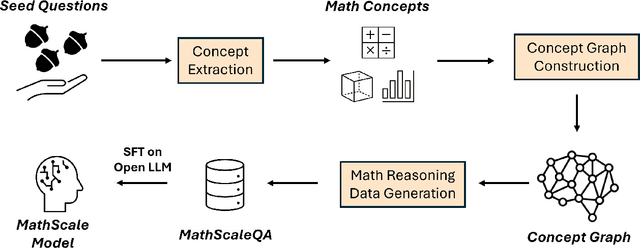
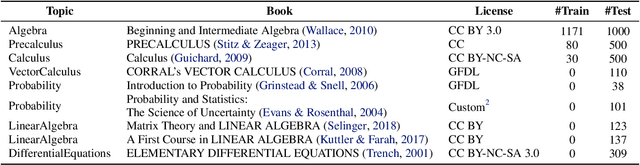

Large language models (LLMs) have demonstrated remarkable capabilities in problem-solving. However, their proficiency in solving mathematical problems remains inadequate. We propose MathScale, a simple and scalable method to create high-quality mathematical reasoning data using frontier LLMs (e.g., {\tt GPT-3.5}). Inspired by the cognitive mechanism in human mathematical learning, it first extracts topics and knowledge points from seed math questions and then build a concept graph, which is subsequently used to generate new math questions. MathScale exhibits effective scalability along the size axis of the math dataset that we generate. As a result, we create a mathematical reasoning dataset (MathScaleQA) containing two million math question-answer pairs. To evaluate mathematical reasoning abilities of LLMs comprehensively, we construct {\sc MwpBench}, a benchmark of Math Word Problems, which is a collection of ten datasets (including GSM8K and MATH) covering K-12, college, and competition level math problems. We apply MathScaleQA to fine-tune open-source LLMs (e.g., LLaMA-2 and Mistral), resulting in significantly improved capabilities in mathematical reasoning. Evaluated on {\sc MwpBench}, MathScale-7B achieves state-of-the-art performance across all datasets, surpassing its best peers of equivalent size by 42.9\% in micro average accuracy and 43.7\% in macro average accuracy, respectively.

Towards Optimal Learning of Language Models
Mar 03, 2024This work studies the general principles of improving the learning of language models (LMs), which aims at reducing the necessary training steps for achieving superior performance. Specifically, we present a theory for the optimal learning of LMs. We first propose an objective that optimizes LM learning by maximizing the data compression ratio in an "LM-training-as-lossless-compression" view. Then, we derive a theorem, named Learning Law, to reveal the properties of the dynamics in the optimal learning process under our objective. The theorem is then validated by experiments on a linear classification and a real-world language modeling task. Finally, we empirically verify that the optimal learning of LMs essentially stems from the improvement of the coefficients in the scaling law of LMs, indicating great promise and significance for designing practical learning acceleration methods. Our code can be found at https://aka.ms/LearningLaw.
ResLoRA: Identity Residual Mapping in Low-Rank Adaption
Feb 28, 2024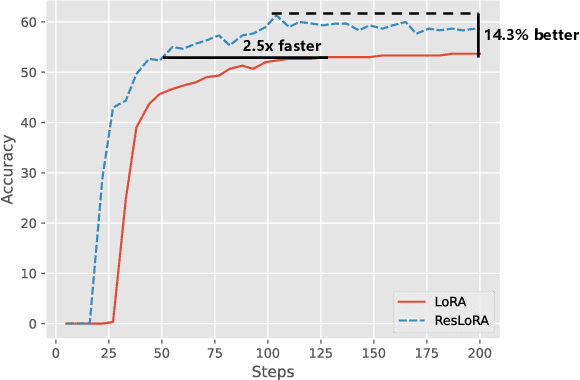
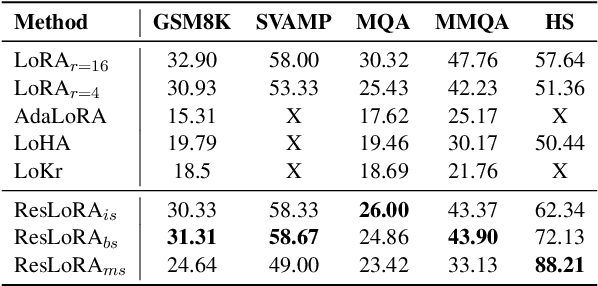
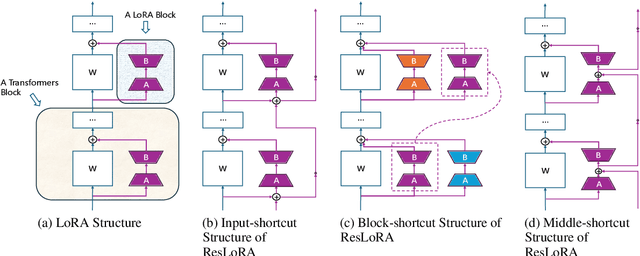
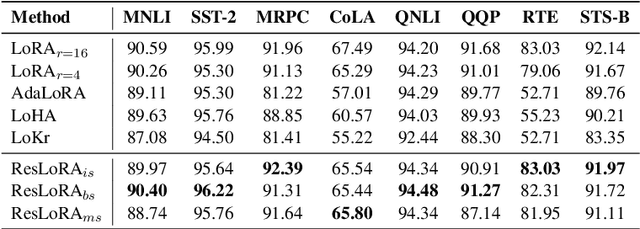
As one of the most popular parameter-efficient fine-tuning (PEFT) methods, low-rank adaptation (LoRA) is commonly applied to fine-tune large language models (LLMs). However, updating the weights of LoRA blocks effectively and expeditiously is challenging due to the long calculation path in the original model. To address this, we propose ResLoRA, an improved framework of LoRA. By adding residual paths during training and using merging approaches to eliminate these extra paths during inference, our method can achieve better results in fewer training steps without any extra trainable parameters or inference cost compared to LoRA. The experiments on NLG, NLU, and text-to-image tasks demonstrate the effectiveness of our method. To the best of our knowledge, ResLoRA is the first work that combines the residual path with LoRA. The code of our method is available at https://github.com/microsoft/LMOps/tree/main/reslora .
The Era of 1-bit LLMs: All Large Language Models are in 1.58 Bits
Feb 27, 2024Recent research, such as BitNet, is paving the way for a new era of 1-bit Large Language Models (LLMs). In this work, we introduce a 1-bit LLM variant, namely BitNet b1.58, in which every single parameter (or weight) of the LLM is ternary {-1, 0, 1}. It matches the full-precision (i.e., FP16 or BF16) Transformer LLM with the same model size and training tokens in terms of both perplexity and end-task performance, while being significantly more cost-effective in terms of latency, memory, throughput, and energy consumption. More profoundly, the 1.58-bit LLM defines a new scaling law and recipe for training new generations of LLMs that are both high-performance and cost-effective. Furthermore, it enables a new computation paradigm and opens the door for designing specific hardware optimized for 1-bit LLMs.
Language-Specific Neurons: The Key to Multilingual Capabilities in Large Language Models
Feb 26, 2024
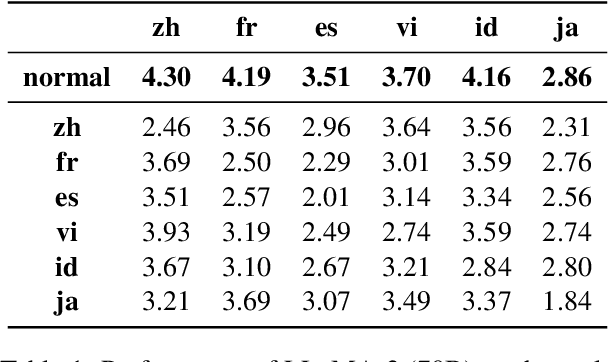

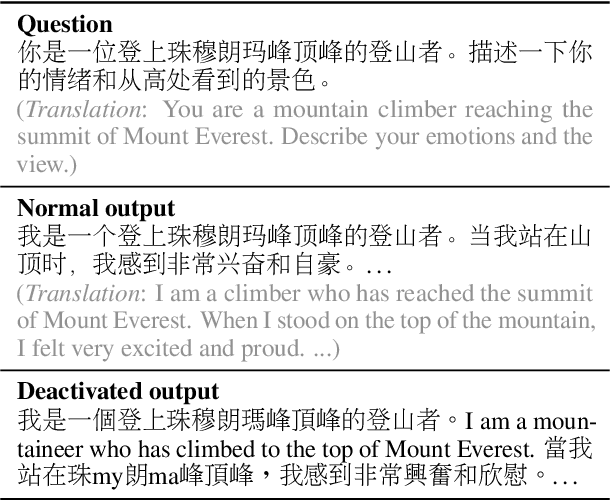
Large language models (LLMs) demonstrate remarkable multilingual capabilities without being pre-trained on specially curated multilingual parallel corpora. It remains a challenging problem to explain the underlying mechanisms by which LLMs process multilingual texts. In this paper, we delve into the composition of Transformer architectures in LLMs to pinpoint language-specific regions. Specially, we propose a novel detection method, language activation probability entropy (LAPE), to identify language-specific neurons within LLMs. Based on LAPE, we conduct comprehensive experiments on two representative LLMs, namely LLaMA-2 and BLOOM. Our findings indicate that LLMs' proficiency in processing a particular language is predominantly due to a small subset of neurons, primarily situated in the models' top and bottom layers. Furthermore, we showcase the feasibility to "steer" the output language of LLMs by selectively activating or deactivating language-specific neurons. Our research provides important evidence to the understanding and exploration of the multilingual capabilities of LLMs.
HD-Eval: Aligning Large Language Model Evaluators Through Hierarchical Criteria Decomposition
Feb 24, 2024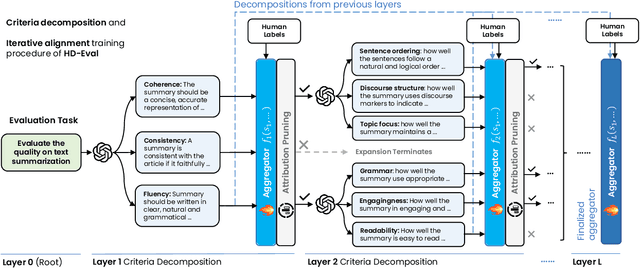
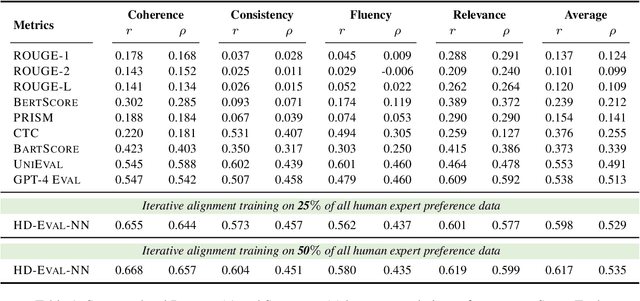
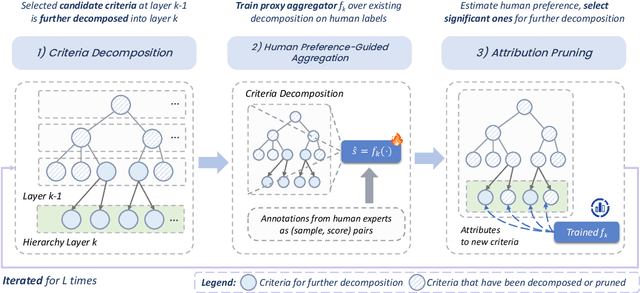
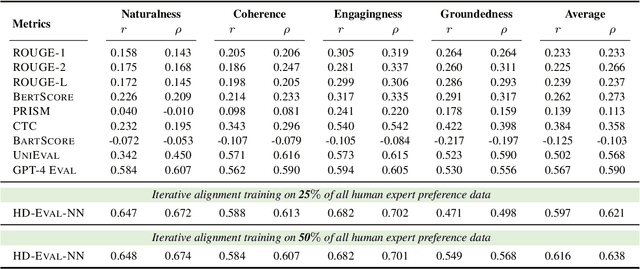
Large language models (LLMs) have emerged as a promising alternative to expensive human evaluations. However, the alignment and coverage of LLM-based evaluations are often limited by the scope and potential bias of the evaluation prompts and criteria. To address this challenge, we propose HD-Eval, a novel framework that iteratively aligns LLM-based evaluators with human preference via Hierarchical Criteria Decomposition. HD-Eval inherits the essence from the evaluation mindset of human experts and enhances the alignment of LLM-based evaluators by decomposing a given evaluation task into finer-grained criteria, aggregating them according to estimated human preferences, pruning insignificant criteria with attribution, and further decomposing significant criteria. By integrating these steps within an iterative alignment training process, we obtain a hierarchical decomposition of criteria that comprehensively captures aspects of natural language at multiple levels of granularity. Implemented as a white box, the human preference-guided aggregator is efficient to train and more explainable than relying solely on prompting, and its independence from model parameters makes it applicable to closed-source LLMs. Extensive experiments on three evaluation domains demonstrate the superiority of HD-Eval in further aligning state-of-the-art evaluators and providing deeper insights into the explanation of evaluation results and the task itself.
Synthetic Data (Almost) from Scratch: Generalized Instruction Tuning for Language Models
Feb 20, 2024We introduce Generalized Instruction Tuning (called GLAN), a general and scalable method for instruction tuning of Large Language Models (LLMs). Unlike prior work that relies on seed examples or existing datasets to construct instruction tuning data, GLAN exclusively utilizes a pre-curated taxonomy of human knowledge and capabilities as input and generates large-scale synthetic instruction data across all disciplines. Specifically, inspired by the systematic structure in human education system, we build the taxonomy by decomposing human knowledge and capabilities to various fields, sub-fields and ultimately, distinct disciplines semi-automatically, facilitated by LLMs. Subsequently, we generate a comprehensive list of subjects for every discipline and proceed to design a syllabus tailored to each subject, again utilizing LLMs. With the fine-grained key concepts detailed in every class session of the syllabus, we are able to generate diverse instructions with a broad coverage across the entire spectrum of human knowledge and skills. Extensive experiments on large language models (e.g., Mistral) demonstrate that GLAN excels in multiple dimensions from mathematical reasoning, coding, academic exams, logical reasoning to general instruction following without using task-specific training data of these tasks. In addition, GLAN allows for easy customization and new fields or skills can be added by simply incorporating a new node into our taxonomy.
Text Diffusion with Reinforced Conditioning
Feb 19, 2024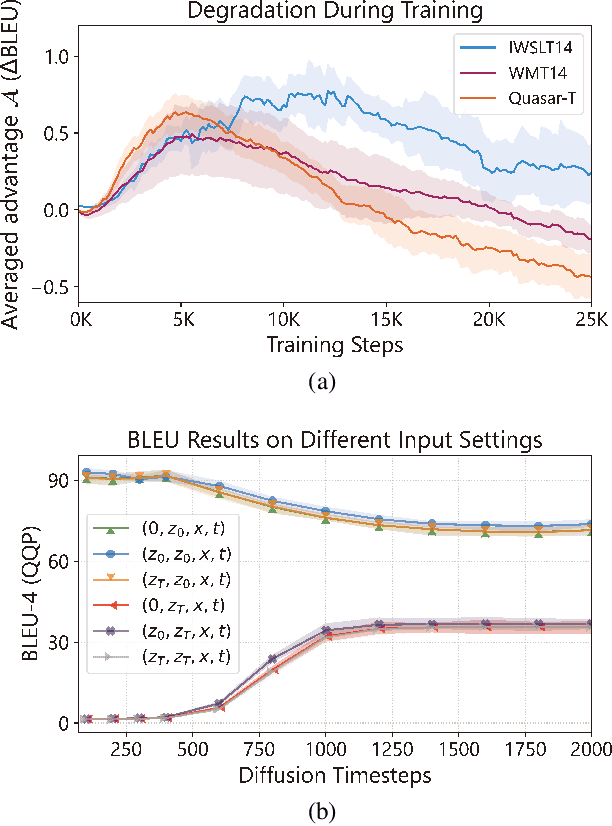
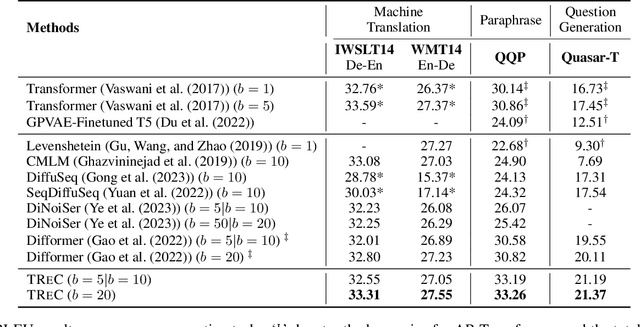
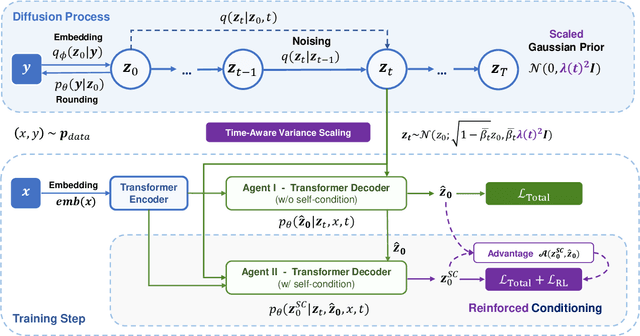
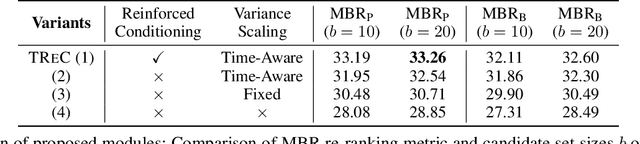
Diffusion models have demonstrated exceptional capability in generating high-quality images, videos, and audio. Due to their adaptiveness in iterative refinement, they provide a strong potential for achieving better non-autoregressive sequence generation. However, existing text diffusion models still fall short in their performance due to a challenge in handling the discreteness of language. This paper thoroughly analyzes text diffusion models and uncovers two significant limitations: degradation of self-conditioning during training and misalignment between training and sampling. Motivated by our findings, we propose a novel Text Diffusion model called TREC, which mitigates the degradation with Reinforced Conditioning and the misalignment by Time-Aware Variance Scaling. Our extensive experiments demonstrate the competitiveness of TREC against autoregressive, non-autoregressive, and diffusion baselines. Moreover, qualitative analysis shows its advanced ability to fully utilize the diffusion process in refining samples.
Generative Representational Instruction Tuning
Feb 15, 2024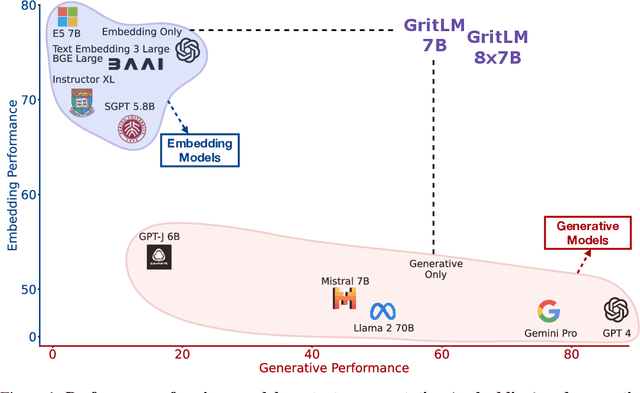
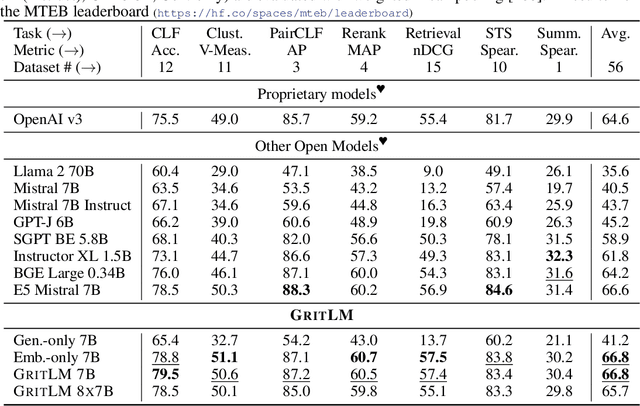
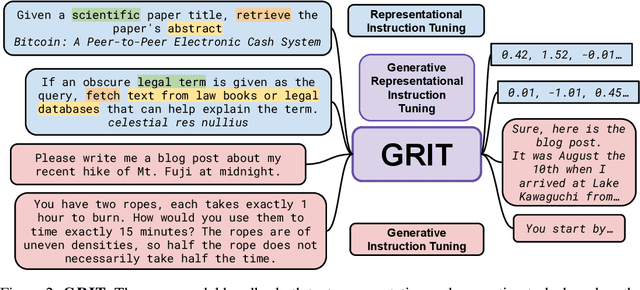
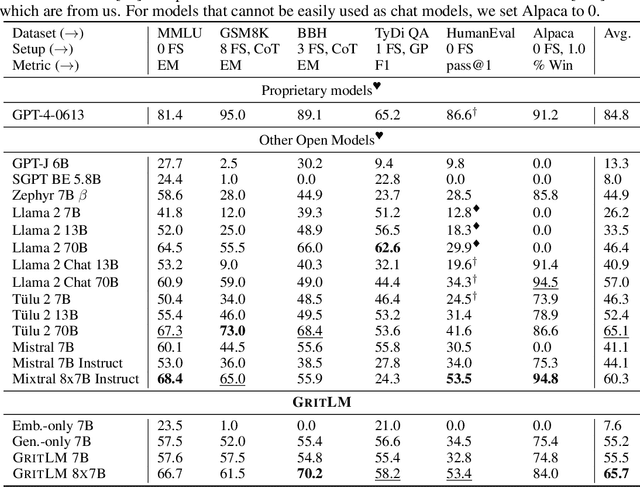
All text-based language problems can be reduced to either generation or embedding. Current models only perform well at one or the other. We introduce generative representational instruction tuning (GRIT) whereby a large language model is trained to handle both generative and embedding tasks by distinguishing between them through instructions. Compared to other open models, our resulting GritLM 7B sets a new state of the art on the Massive Text Embedding Benchmark (MTEB) and outperforms all models up to its size on a range of generative tasks. By scaling up further, GritLM 8x7B outperforms all open generative language models that we tried while still being among the best embedding models. Notably, we find that GRIT matches training on only generative or embedding data, thus we can unify both at no performance loss. Among other benefits, the unification via GRIT speeds up Retrieval-Augmented Generation (RAG) by > 60% for long documents, by no longer requiring separate retrieval and generation models. Models, code, etc. are freely available at https://github.com/ContextualAI/gritlm.
Multilingual E5 Text Embeddings: A Technical Report
Feb 08, 2024This technical report presents the training methodology and evaluation results of the open-source multilingual E5 text embedding models, released in mid-2023. Three embedding models of different sizes (small / base / large) are provided, offering a balance between the inference efficiency and embedding quality. The training procedure adheres to the English E5 model recipe, involving contrastive pre-training on 1 billion multilingual text pairs, followed by fine-tuning on a combination of labeled datasets. Additionally, we introduce a new instruction-tuned embedding model, whose performance is on par with state-of-the-art, English-only models of similar sizes. Information regarding the model release can be found at https://github.com/microsoft/unilm/tree/master/e5 .