 Add to Chrome
 Add to Firefox
 Add to Edge
Towards Real World HDRTV Reconstruction: A Data Synthesis-based Approach
Nov 06, 2022
Existing deep learning based HDRTV reconstruction methods assume one kind of tone mapping operators (TMOs) as the degradation procedure to synthesize SDRTV-HDRTV pairs for supervised training. In this paper, we argue that, although traditional TMOs exploit efficient dynamic range compression priors, they have several drawbacks on modeling the realistic degradation: information over-preservation, color bias and possible artifacts, making the trained reconstruction networks hard to generalize well to real-world cases. To solve this problem, we propose a learning-based data synthesis approach to learn the properties of real-world SDRTVs by integrating several tone mapping priors into both network structures and loss functions. In specific, we design a conditioned two-stream network with prior tone mapping results as a guidance to synthesize SDRTVs by both global and local transformations. To train the data synthesis network, we form a novel self-supervised content loss to constraint different aspects of the synthesized SDRTVs at regions with different brightness distributions and an adversarial loss to emphasize the details to be more realistic. To validate the effectiveness of our approach, we synthesize SDRTV-HDRTV pairs with our method and use them to train several HDRTV reconstruction networks. Then we collect two inference datasets containing both labeled and unlabeled real-world SDRTVs, respectively. Experimental results demonstrate that, the networks trained with our synthesized data generalize significantly better to these two real-world datasets than existing solutions.

Reversed Image Signal Processing and RAW Reconstruction. AIM 2022 Challenge Report
Oct 20, 2022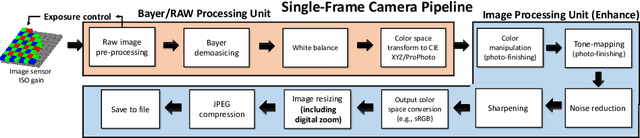
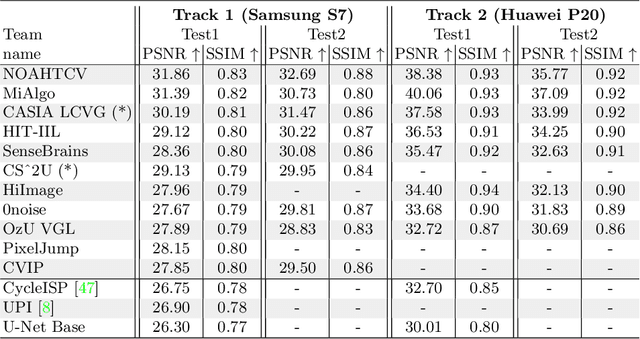
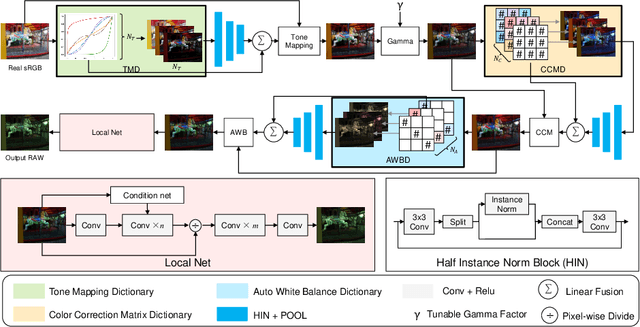
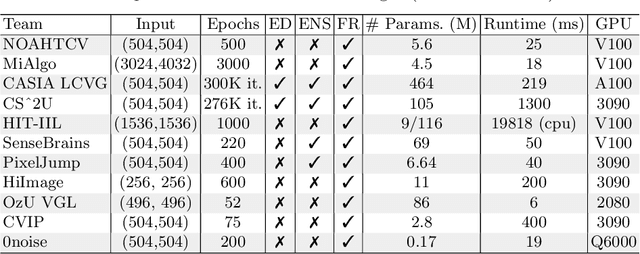
Cameras capture sensor RAW images and transform them into pleasant RGB images, suitable for the human eyes, using their integrated Image Signal Processor (ISP). Numerous low-level vision tasks operate in the RAW domain (e.g. image denoising, white balance) due to its linear relationship with the scene irradiance, wide-range of information at 12bits, and sensor designs. Despite this, RAW image datasets are scarce and more expensive to collect than the already large and public RGB datasets. This paper introduces the AIM 2022 Challenge on Reversed Image Signal Processing and RAW Reconstruction. We aim to recover raw sensor images from the corresponding RGBs without metadata and, by doing this, "reverse" the ISP transformation. The proposed methods and benchmark establish the state-of-the-art for this low-level vision inverse problem, and generating realistic raw sensor readings can potentially benefit other tasks such as denoising and super-resolution.
SJ-HD^2R: Selective Joint High Dynamic Range and Denoising Imaging for Dynamic Scenes
Jun 20, 2022
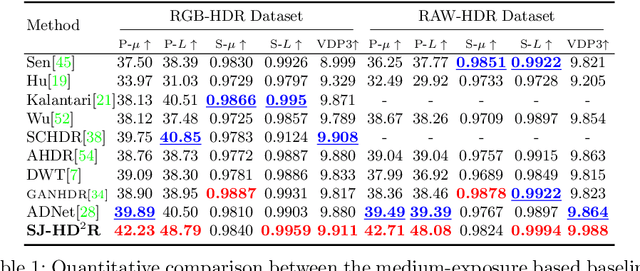
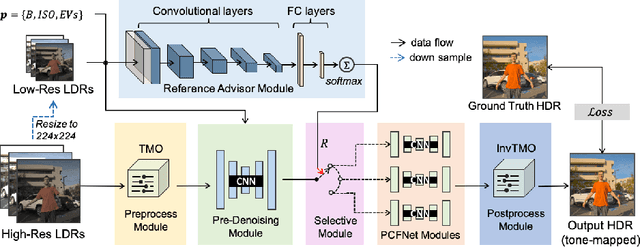

Ghosting artifacts, motion blur, and low fidelity in highlight are the main challenges in High Dynamic Range (HDR) imaging from multiple Low Dynamic Range (LDR) images. These issues come from using the medium-exposed image as the reference frame in previous methods. To deal with them, we propose to use the under-exposed image as the reference to avoid these issues. However, the heavy noise in dark regions of the under-exposed image becomes a new problem. Therefore, we propose a joint HDR and denoising pipeline, containing two sub-networks: (i) a pre-denoising network (PreDNNet) to adaptively denoise input LDRs by exploiting exposure priors; (ii) a pyramid cascading fusion network (PCFNet), introducing an attention mechanism and cascading structure in a multi-scale manner. To further leverage these two paradigms, we propose a selective and joint HDR and denoising (SJ-HD$^2$R) imaging framework, utilizing scenario-specific priors to conduct the path selection with an accuracy of more than 93.3$\%$. We create the first joint HDR and denoising benchmark dataset, which contains a variety of challenging HDR and denoising scenes and supports the switching of the reference image. Extensive experiment results show that our method achieves superior performance to previous methods.
Real-time Image Enhancer via Learnable Spatial-aware 3D Lookup Tables
Aug 19, 2021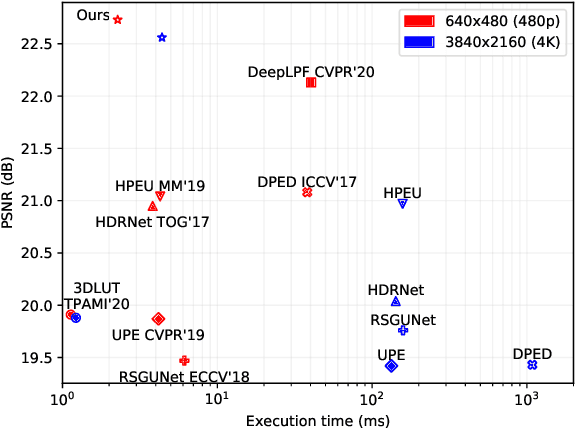
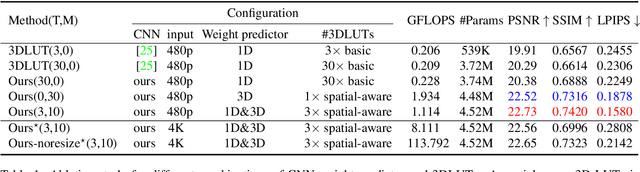
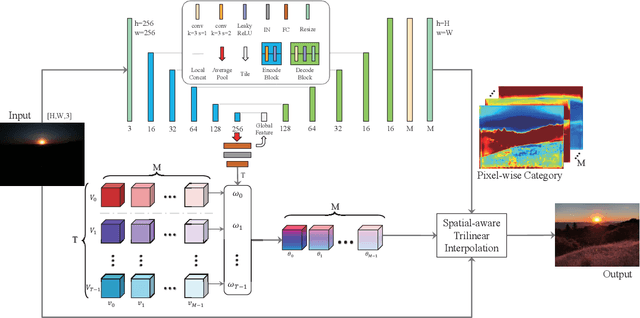
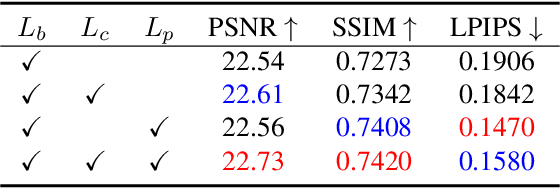
Recently, deep learning-based image enhancement algorithms achieved state-of-the-art (SOTA) performance on several publicly available datasets. However, most existing methods fail to meet practical requirements either for visual perception or for computation efficiency, especially for high-resolution images. In this paper, we propose a novel real-time image enhancer via learnable spatial-aware 3-dimentional lookup tables(3D LUTs), which well considers global scenario and local spatial information. Specifically, we introduce a light weight two-head weight predictor that has two outputs. One is a 1D weight vector used for image-level scenario adaptation, the other is a 3D weight map aimed for pixel-wise category fusion. We learn the spatial-aware 3D LUTs and fuse them according to the aforementioned weights in an end-to-end manner. The fused LUT is then used to transform the source image into the target tone in an efficient way. Extensive results show that our model outperforms SOTA image enhancement methods on public datasets both subjectively and objectively, and that our model only takes about 4ms to process a 4K resolution image on one NVIDIA V100 GPU.
Fast Camera Image Denoising on Mobile GPUs with Deep Learning, Mobile AI 2021 Challenge: Report
May 17, 2021

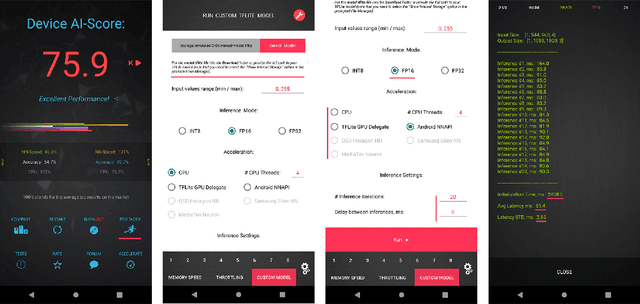
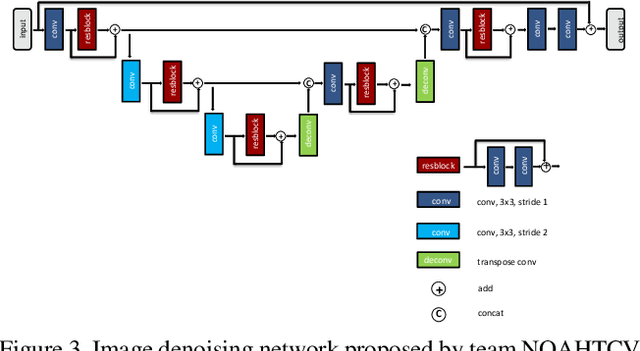
Image denoising is one of the most critical problems in mobile photo processing. While many solutions have been proposed for this task, they are usually working with synthetic data and are too computationally expensive to run on mobile devices. To address this problem, we introduce the first Mobile AI challenge, where the target is to develop an end-to-end deep learning-based image denoising solution that can demonstrate high efficiency on smartphone GPUs. For this, the participants were provided with a novel large-scale dataset consisting of noisy-clean image pairs captured in the wild. The runtime of all models was evaluated on the Samsung Exynos 2100 chipset with a powerful Mali GPU capable of accelerating floating-point and quantized neural networks. The proposed solutions are fully compatible with any mobile GPU and are capable of processing 480p resolution images under 40-80 ms while achieving high fidelity results. A detailed description of all models developed in the challenge is provided in this paper.
Learned Smartphone ISP on Mobile NPUs with Deep Learning, Mobile AI 2021 Challenge: Report
May 17, 2021
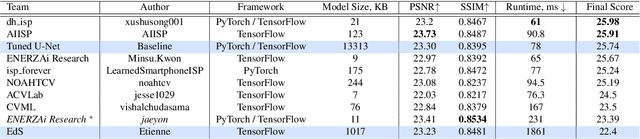
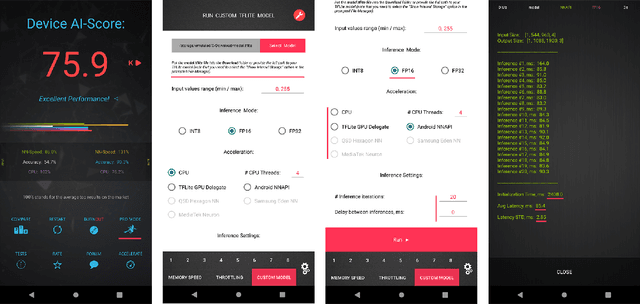
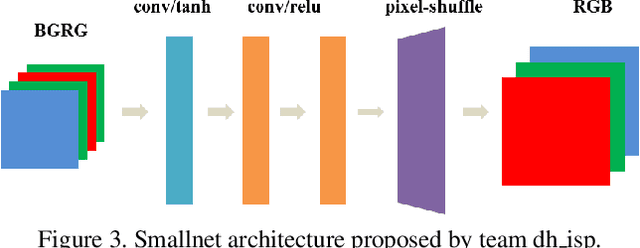
As the quality of mobile cameras starts to play a crucial role in modern smartphones, more and more attention is now being paid to ISP algorithms used to improve various perceptual aspects of mobile photos. In this Mobile AI challenge, the target was to develop an end-to-end deep learning-based image signal processing (ISP) pipeline that can replace classical hand-crafted ISPs and achieve nearly real-time performance on smartphone NPUs. For this, the participants were provided with a novel learned ISP dataset consisting of RAW-RGB image pairs captured with the Sony IMX586 Quad Bayer mobile sensor and a professional 102-megapixel medium format camera. The runtime of all models was evaluated on the MediaTek Dimensity 1000+ platform with a dedicated AI processing unit capable of accelerating both floating-point and quantized neural networks. The proposed solutions are fully compatible with the above NPU and are capable of processing Full HD photos under 60-100 milliseconds while achieving high fidelity results. A detailed description of all models developed in this challenge is provided in this paper.
NTIRE 2021 Challenge on Quality Enhancement of Compressed Video: Methods and Results
May 02, 2021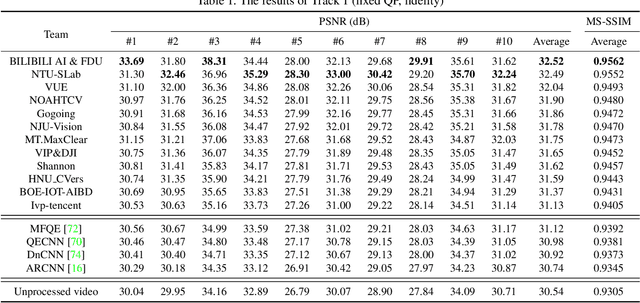
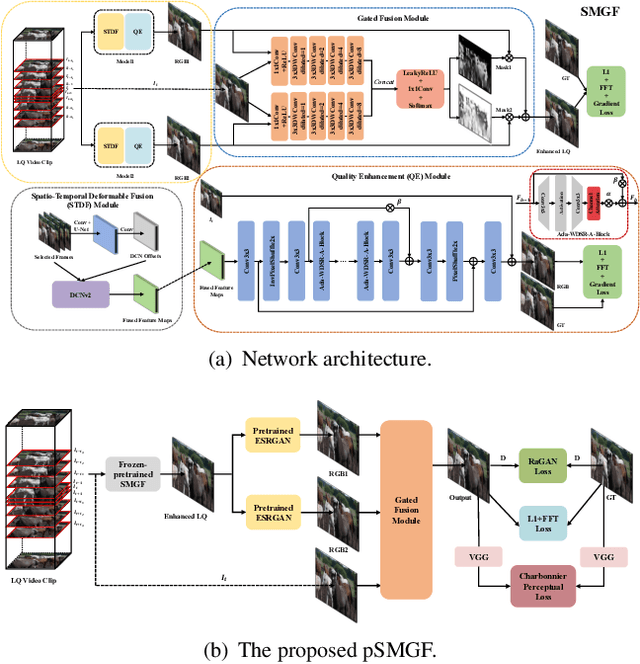
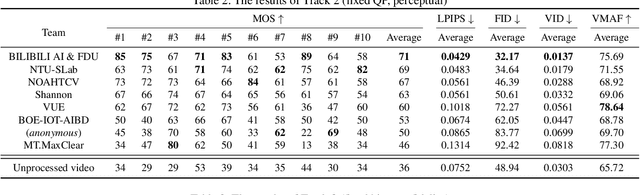
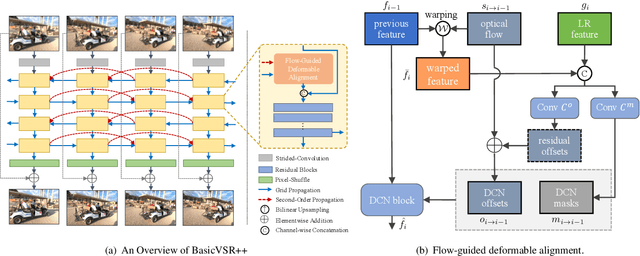
This paper reviews the first NTIRE challenge on quality enhancement of compressed video, with a focus on the proposed methods and results. In this challenge, the new Large-scale Diverse Video (LDV) dataset is employed. The challenge has three tracks. Tracks 1 and 2 aim at enhancing the videos compressed by HEVC at a fixed QP, while Track 3 is designed for enhancing the videos compressed by x265 at a fixed bit-rate. Besides, the quality enhancement of Tracks 1 and 3 targets at improving the fidelity (PSNR), and Track 2 targets at enhancing the perceptual quality. The three tracks totally attract 482 registrations. In the test phase, 12 teams, 8 teams and 11 teams submitted the final results of Tracks 1, 2 and 3, respectively. The proposed methods and solutions gauge the state-of-the-art of video quality enhancement. The homepage of the challenge: https://github.com/RenYang-home/NTIRE21_VEnh
Efficient Multi-Stage Video Denoising with Recurrent Spatio-Temporal Fusion
Mar 09, 2021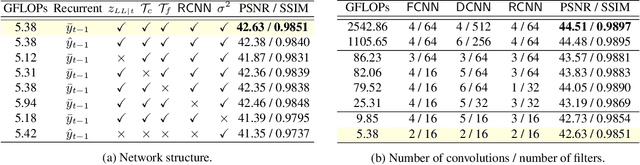
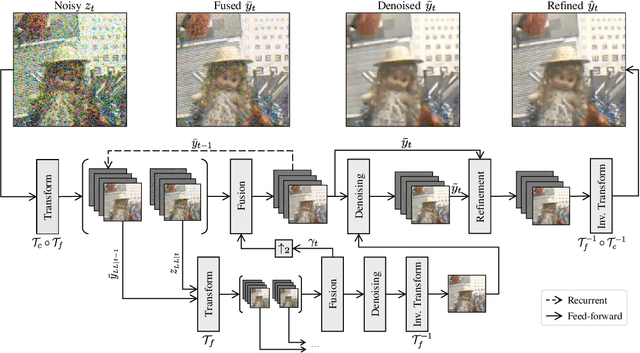
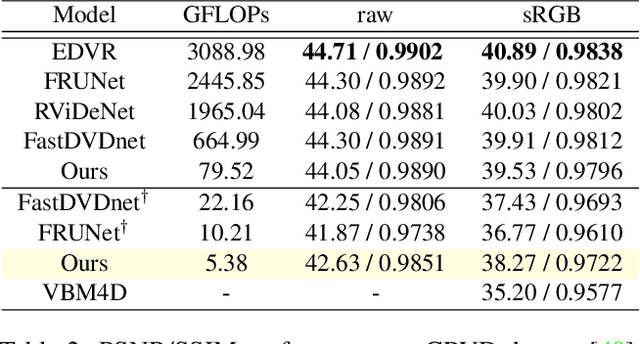
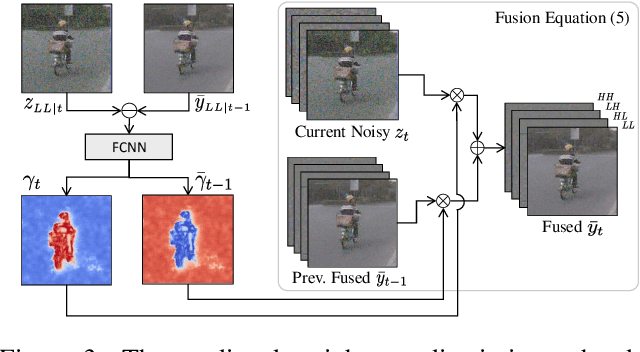
In recent years, methods based on deep learning have achieved unparalleled performance at the cost of large computational complexity. In this work, we propose an Efficient Multi-stage Video Denoising algorithm, called EMVD, to drastically reduce the complexity while maintaining or even improving the performance. First, a fusion stage reduces the noise through a recursive combination of all past frames in the video. Then, a denoising stage removes the noise in the fused frame. Finally, a refinement stage restores the missing high frequency in the denoised frame. All stages operate on a transform-domain representation obtained by learnable and invertible linear operators which simultaneously increase accuracy and decrease complexity of the model. A single loss on the final output is sufficient for successful convergence, hence making EMVD easy to train. Experiments on real raw data demonstrate that EMVD outperforms the state of the art when complexity is constrained, and even remains competitive against methods whose complexities are several orders of magnitude higher. The low complexity and memory requirements of EMVD enable real-time video denoising on low-powered commercial SoC.
NODE: Extreme Low Light Raw Image Denoising using a Noise Decomposition Network
Sep 11, 2019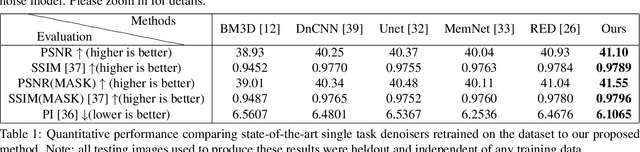
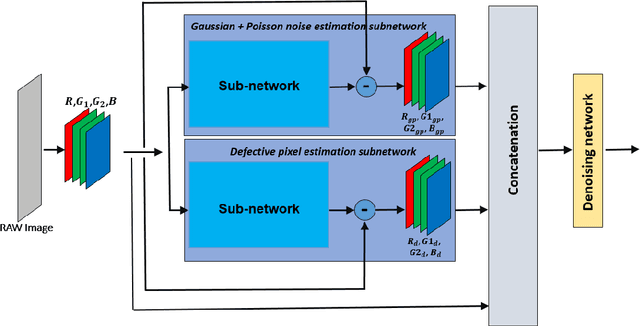
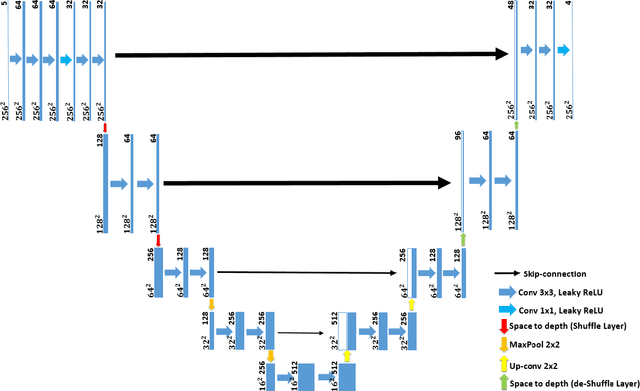

Denoising extreme low light images is a challenging task due to the high noise level. When the illumination is low, digital cameras increase the ISO (electronic gain) to amplify the brightness of captured data. However, this in turn amplifies the noise, arising from read, shot, and defective pixel sources. In the raw domain, read and shot noise are effectively modelled using Gaussian and Poisson distributions respectively, whereas defective pixels can be modeled with impulsive noise. In extreme low light imaging, noise removal becomes a critical challenge to produce a high quality, detailed image with low noise. In this paper, we propose a multi-task deep neural network called Noise Decomposition (NODE) that explicitly and separately estimates defective pixel noise, in conjunction with Gaussian and Poisson noise, to denoise an extreme low light image. Our network is purposely designed to work with raw data, for which the noise is more easily modeled before going through non-linear transformations in the image signal processing (ISP) pipeline. Quantitative and qualitative evaluation show the proposed method to be more effective at denoising real raw images than state-of-the-art techniques.