 Add to Chrome
 Add to Firefox
 Add to Edge
DirectFisheye-GS: Enabling Native Fisheye Input in Gaussian Splatting with Cross-View Joint Optimization
Apr 01, 2026
3D Gaussian Splatting (3DGS) has enabled efficient 3D scene reconstruction from everyday images with real-time, high-fidelity rendering, greatly advancing VR/AR applications. Fisheye cameras, with their wider field of view (FOV), promise high-quality reconstructions from fewer inputs and have recently attracted much attention. However, since 3DGS relies on rasterization, most subsequent works involving fisheye camera inputs first undistort images before training, which introduces two problems: 1) Black borders at image edges cause information loss and negate the fisheye's large FOV advantage; 2) Undistortion's stretch-and-interpolate resampling spreads each pixel's value over a larger area, diluting detail density -- causes 3DGS overfitting these low-frequency zones, producing blur and floating artifacts. In this work, we integrate fisheye camera model into the original 3DGS framework, enabling native fisheye image input for training without preprocessing. Despite correct modeling, we observed that the reconstructed scenes still exhibit floaters at image edges: Distortion increases toward the periphery, and 3DGS's original per-iteration random-selecting-view optimization ignores the cross-view correlations of a Gaussian, leading to extreme shapes (e.g., oversized or elongated) that degrade reconstruction quality. To address this, we introduce a feature-overlap-driven cross-view joint optimization strategy that establishes consistent geometric and photometric constraints across views-a technique equally applicable to existing pinhole-camera-based pipelines. Our DirectFisheye-GS matches or surpasses state-of-the-art performance on public datasets.

An LLM-Enabled Frequency-Aware Flow Diffusion Model for Natural-Language-Guided Power System Scenario Generation
Feb 23, 2026Diverse and controllable scenario generation (e.g., wind, solar, load, etc.) is critical for robust power system planning and operation. As AI-based scenario generation methods are becoming the mainstream, existing methods (e.g., Conditional Generative Adversarial Nets) mainly rely on a fixed-length numerical conditioning vector to control the generation results, facing challenges in user conveniency and generation flexibility. In this paper, a natural-language-guided scenario generation framework, named LLM-enabled Frequency-aware Flow Diffusion (LFFD), is proposed to enable users to generate desired scenarios using plain human language. First, a pretrained LLM module is introduced to convert generation requests described by unstructured natural languages into ordered semantic space. Second, instead of using standard diffusion models, a flow diffusion model employing a rectified flow matching objective is introduced to achieve efficient and high-quality scenario generation, taking the LLM output as the model input. During the model training process, a frequency-aware multi-objective optimization algorithm is introduced to mitigate the frequency-bias issue. Meanwhile, a dual-agent framework is designed to create text-scenario training sample pairs as well as to standardize semantic evaluation. Experiments based on large-scale photovoltaic and load datasets demonstrate the effectiveness of the proposed method.
AutoFly: Vision-Language-Action Model for UAV Autonomous Navigation in the Wild
Feb 10, 2026Vision-language navigation (VLN) requires intelligent agents to navigate environments by interpreting linguistic instructions alongside visual observations, serving as a cornerstone task in Embodied AI. Current VLN research for unmanned aerial vehicles (UAVs) relies on detailed, pre-specified instructions to guide the UAV along predetermined routes. However, real-world outdoor exploration typically occurs in unknown environments where detailed navigation instructions are unavailable. Instead, only coarse-grained positional or directional guidance can be provided, requiring UAVs to autonomously navigate through continuous planning and obstacle avoidance. To bridge this gap, we propose AutoFly, an end-to-end Vision-Language-Action (VLA) model for autonomous UAV navigation. AutoFly incorporates a pseudo-depth encoder that derives depth-aware features from RGB inputs to enhance spatial reasoning, coupled with a progressive two-stage training strategy that effectively aligns visual, depth, and linguistic representations with action policies. Moreover, existing VLN datasets have fundamental limitations for real-world autonomous navigation, stemming from their heavy reliance on explicit instruction-following over autonomous decision-making and insufficient real-world data. To address these issues, we construct a novel autonomous navigation dataset that shifts the paradigm from instruction-following to autonomous behavior modeling through: (1) trajectory collection emphasizing continuous obstacle avoidance, autonomous planning, and recognition workflows; (2) comprehensive real-world data integration. Experimental results demonstrate that AutoFly achieves a 3.9% higher success rate compared to state-of-the-art VLA baselines, with consistent performance across simulated and real environments.
ALPBench: A Benchmark for Attribution-level Long-term Personal Behavior Understanding
Feb 03, 2026Recent advances in large language models have highlighted their potential for personalized recommendation, where accurately capturing user preferences remains a key challenge. Leveraging their strong reasoning and generalization capabilities, LLMs offer new opportunities for modeling long-term user behavior. To systematically evaluate this, we introduce ALPBench, a Benchmark for Attribution-level Long-term Personal Behavior Understanding. Unlike item-focused benchmarks, ALPBench predicts user-interested attribute combinations, enabling ground-truth evaluation even for newly introduced items. It models preferences from long-term historical behaviors rather than users' explicitly expressed requests, better reflecting enduring interests. User histories are represented as natural language sequences, allowing interpretable, reasoning-based personalization. ALPBench enables fine-grained evaluation of personalization by focusing on the prediction of attribute combinations task that remains highly challenging for current LLMs due to the need to capture complex interactions among multiple attributes and reason over long-term user behavior sequences.
Efficient Generative AI Boosts Probabilistic Forecasting of Sudden Stratospheric Warmings
Oct 30, 2025Sudden Stratospheric Warmings (SSWs) are key sources of subseasonal predictability and major drivers of extreme winter weather. Yet, their accurate and efficient forecast remains a persistent challenge for numerical weather prediction (NWP) systems due to limitations in physical representation, initialization, and the immense computational demands of ensemble forecasts. While data-driven forecasting is rapidly evolving, its application to the complex, three-dimensional dynamics of SSWs, particularly for probabilistic forecast, remains underexplored. Here, we bridge this gap by developing a Flow Matching-based generative AI model (FM-Cast) for efficient and skillful probabilistic forecasting of the spatiotemporal evolution of stratospheric circulation. Evaluated across 18 major SSW events (1998-2024), FM-Cast skillfully forecasts the onset, intensity, and morphology of 10 events up to 20 days in advance, achieving ensemble accuracies above 50%. Its performance is comparable to or exceeds leading NWP systems while requiring only two minutes for a 50-member, 30-day forecast on a consumer GPU. Furthermore, leveraging FM-Cast as a scientific tool, we demonstrate through idealized experiments that SSW predictability is fundamentally linked to its underlying physical drivers, distinguishing between events forced from the troposphere and those driven by internal stratospheric dynamics. Our work thus establishes a computationally efficient paradigm for probabilistic forecasting stratospheric anomalies and showcases generative AI's potential to deepen the physical understanding of atmosphere-climate dynamics.
Multi-Turn Jailbreaks Are Simpler Than They Seem
Aug 11, 2025While defenses against single-turn jailbreak attacks on Large Language Models (LLMs) have improved significantly, multi-turn jailbreaks remain a persistent vulnerability, often achieving success rates exceeding 70% against models optimized for single-turn protection. This work presents an empirical analysis of automated multi-turn jailbreak attacks across state-of-the-art models including GPT-4, Claude, and Gemini variants, using the StrongREJECT benchmark. Our findings challenge the perceived sophistication of multi-turn attacks: when accounting for the attacker's ability to learn from how models refuse harmful requests, multi-turn jailbreaking approaches are approximately equivalent to simply resampling single-turn attacks multiple times. Moreover, attack success is correlated among similar models, making it easier to jailbreak newly released ones. Additionally, for reasoning models, we find surprisingly that higher reasoning effort often leads to higher attack success rates. Our results have important implications for AI safety evaluation and the design of jailbreak-resistant systems. We release the source code at https://github.com/diogo-cruz/multi_turn_simpler
Mamba-Adaptor: State Space Model Adaptor for Visual Recognition
May 19, 2025Recent State Space Models (SSM), especially Mamba, have demonstrated impressive performance in visual modeling and possess superior model efficiency. However, the application of Mamba to visual tasks suffers inferior performance due to three main constraints existing in the sequential model: 1) Casual computing is incapable of accessing global context; 2) Long-range forgetting when computing the current hidden states; 3) Weak spatial structural modeling due to the transformed sequential input. To address these issues, we investigate a simple yet powerful vision task Adaptor for Mamba models, which consists of two functional modules: Adaptor-T and Adaptor-S. When solving the hidden states for SSM, we apply a lightweight prediction module Adaptor-T to select a set of learnable locations as memory augmentations to ease long-range forgetting issues. Moreover, we leverage Adapator-S, composed of multi-scale dilated convolutional kernels, to enhance the spatial modeling and introduce the image inductive bias into the feature output. Both modules can enlarge the context modeling in casual computing, as the output is enhanced by the inaccessible features. We explore three usages of Mamba-Adaptor: A general visual backbone for various vision tasks; A booster module to raise the performance of pretrained backbones; A highly efficient fine-tuning module that adapts the base model for transfer learning tasks. Extensive experiments verify the effectiveness of Mamba-Adaptor in three settings. Notably, our Mamba-Adaptor achieves state-of the-art performance on the ImageNet and COCO benchmarks.
VRM: Knowledge Distillation via Virtual Relation Matching
Feb 28, 2025Knowledge distillation (KD) aims to transfer the knowledge of a more capable yet cumbersome teacher model to a lightweight student model. In recent years, relation-based KD methods have fallen behind, as their instance-matching counterparts dominate in performance. In this paper, we revive relational KD by identifying and tackling several key issues in relation-based methods, including their susceptibility to overfitting and spurious responses. Specifically, we transfer novelly constructed affinity graphs that compactly encapsulate a wealth of beneficial inter-sample, inter-class, and inter-view correlations by exploiting virtual views and relations as a new kind of knowledge. As a result, the student has access to richer guidance signals and stronger regularisation throughout the distillation process. To further mitigate the adverse impact of spurious responses, we prune the affinity graphs by dynamically detaching redundant and unreliable edges. Extensive experiments on CIFAR-100 and ImageNet datasets demonstrate the superior performance of the proposed virtual relation matching (VRM) method over a range of models, architectures, and set-ups. For instance, VRM for the first time hits 74.0% accuracy for ResNet50-to-MobileNetV2 distillation on ImageNet, and improves DeiT-T by 14.44% on CIFAR-100 with a ResNet56 teacher. Thorough analyses are also conducted to gauge the soundness, properties, and complexity of our designs. Code and models will be released.
QuadMamba: Learning Quadtree-based Selective Scan for Visual State Space Model
Oct 10, 2024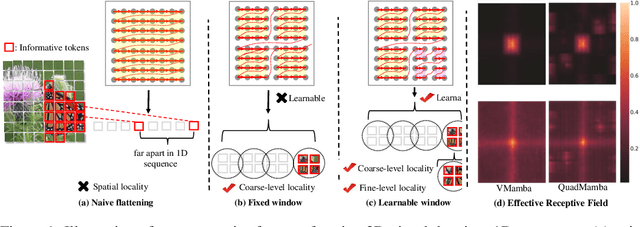
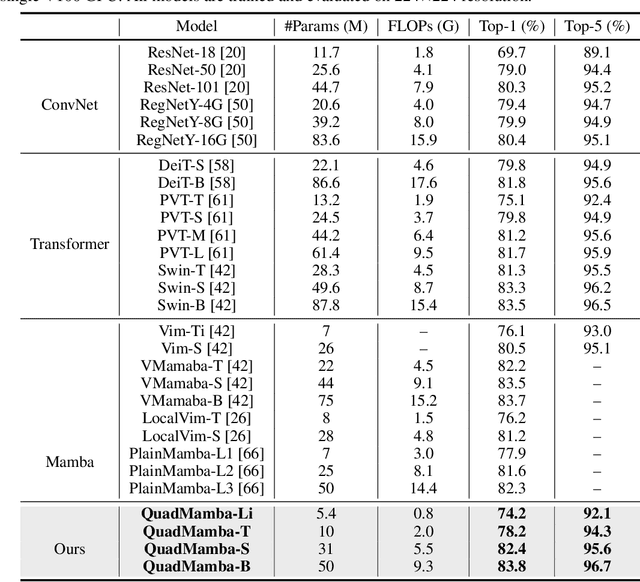
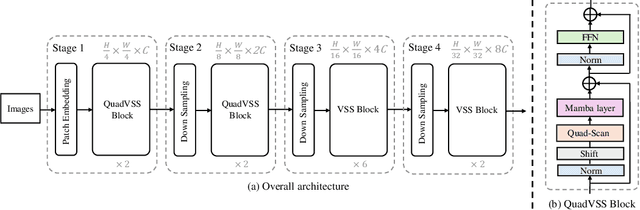
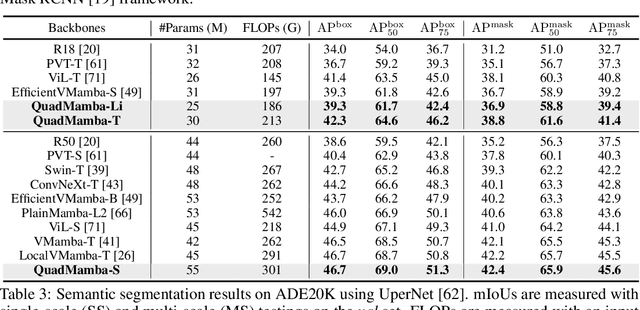
Recent advancements in State Space Models, notably Mamba, have demonstrated superior performance over the dominant Transformer models, particularly in reducing the computational complexity from quadratic to linear. Yet, difficulties in adapting Mamba from language to vision tasks arise due to the distinct characteristics of visual data, such as the spatial locality and adjacency within images and large variations in information granularity across visual tokens. Existing vision Mamba approaches either flatten tokens into sequences in a raster scan fashion, which breaks the local adjacency of images, or manually partition tokens into windows, which limits their long-range modeling and generalization capabilities. To address these limitations, we present a new vision Mamba model, coined QuadMamba, that effectively captures local dependencies of varying granularities via quadtree-based image partition and scan. Concretely, our lightweight quadtree-based scan module learns to preserve the 2D locality of spatial regions within learned window quadrants. The module estimates the locality score of each token from their features, before adaptively partitioning tokens into window quadrants. An omnidirectional window shifting scheme is also introduced to capture more intact and informative features across different local regions. To make the discretized quadtree partition end-to-end trainable, we further devise a sequence masking strategy based on Gumbel-Softmax and its straight-through gradient estimator. Extensive experiments demonstrate that QuadMamba achieves state-of-the-art performance in various vision tasks, including image classification, object detection, instance segmentation, and semantic segmentation. The code is in https://github.com/VISION-SJTU/QuadMamba.
PredFormer: Transformers Are Effective Spatial-Temporal Predictive Learners
Oct 07, 2024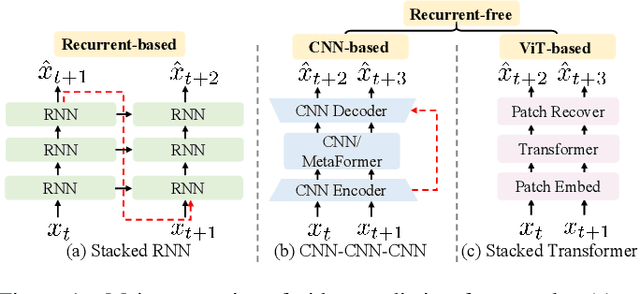
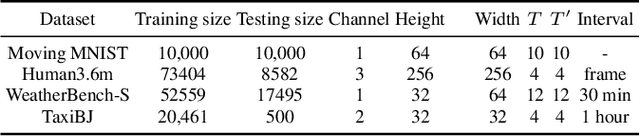
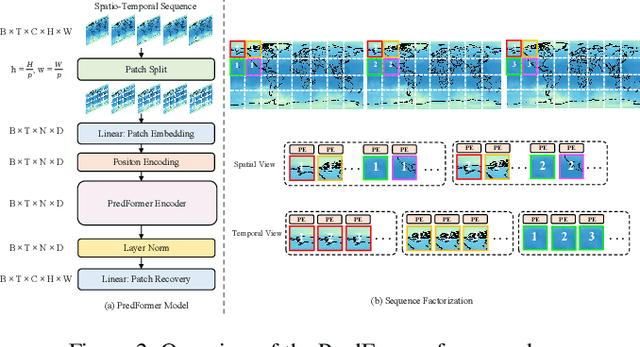

Spatiotemporal predictive learning methods generally fall into two categories: recurrent-based approaches, which face challenges in parallelization and performance, and recurrent-free methods, which employ convolutional neural networks (CNNs) as encoder-decoder architectures. These methods benefit from strong inductive biases but often at the expense of scalability and generalization. This paper proposes PredFormer, a pure transformer-based framework for spatiotemporal predictive learning. Motivated by the Vision Transformers (ViT) design, PredFormer leverages carefully designed Gated Transformer blocks, following a comprehensive analysis of 3D attention mechanisms, including full-, factorized-, and interleaved- spatial-temporal attention. With its recurrent-free, transformer-based design, PredFormer is both simple and efficient, significantly outperforming previous methods by large margins. Extensive experiments on synthetic and real-world datasets demonstrate that PredFormer achieves state-of-the-art performance. On Moving MNIST, PredFormer achieves a 51.3% reduction in MSE relative to SimVP. For TaxiBJ, the model decreases MSE by 33.1% and boosts FPS from 533 to 2364. Additionally, on WeatherBench, it reduces MSE by 11.1% while enhancing FPS from 196 to 404. These performance gains in both accuracy and efficiency demonstrate PredFormer's potential for real-world applications. The source code will be released at https://github.com/yyyujintang/PredFormer.