 Add to Chrome
 Add to Firefox
 Add to Edge
Deep Compression Autoencoder for Efficient High-Resolution Diffusion Models
Oct 14, 2024

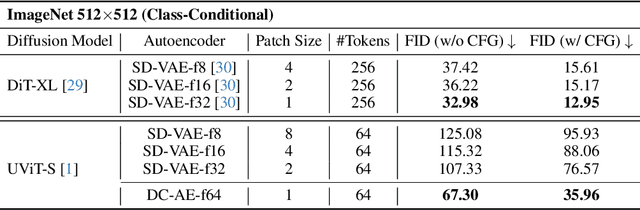
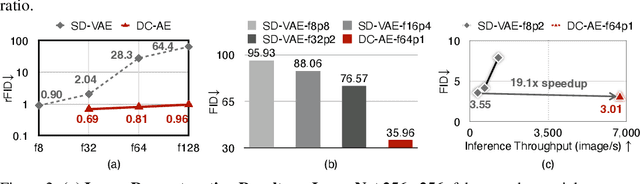
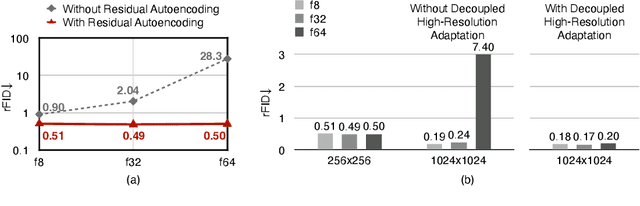
We present Deep Compression Autoencoder (DC-AE), a new family of autoencoder models for accelerating high-resolution diffusion models. Existing autoencoder models have demonstrated impressive results at a moderate spatial compression ratio (e.g., 8x), but fail to maintain satisfactory reconstruction accuracy for high spatial compression ratios (e.g., 64x). We address this challenge by introducing two key techniques: (1) Residual Autoencoding, where we design our models to learn residuals based on the space-to-channel transformed features to alleviate the optimization difficulty of high spatial-compression autoencoders; (2) Decoupled High-Resolution Adaptation, an efficient decoupled three-phases training strategy for mitigating the generalization penalty of high spatial-compression autoencoders. With these designs, we improve the autoencoder's spatial compression ratio up to 128 while maintaining the reconstruction quality. Applying our DC-AE to latent diffusion models, we achieve significant speedup without accuracy drop. For example, on ImageNet 512x512, our DC-AE provides 19.1x inference speedup and 17.9x training speedup on H100 GPU for UViT-H while achieving a better FID, compared with the widely used SD-VAE-f8 autoencoder. Our code is available at https://github.com/mit-han-lab/efficientvit.

HART: Efficient Visual Generation with Hybrid Autoregressive Transformer
Oct 14, 2024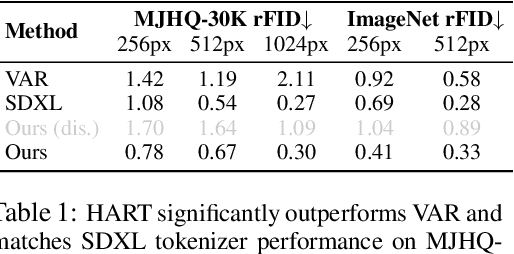


We introduce Hybrid Autoregressive Transformer (HART), an autoregressive (AR) visual generation model capable of directly generating 1024x1024 images, rivaling diffusion models in image generation quality. Existing AR models face limitations due to the poor image reconstruction quality of their discrete tokenizers and the prohibitive training costs associated with generating 1024px images. To address these challenges, we present the hybrid tokenizer, which decomposes the continuous latents from the autoencoder into two components: discrete tokens representing the big picture and continuous tokens representing the residual components that cannot be represented by the discrete tokens. The discrete component is modeled by a scalable-resolution discrete AR model, while the continuous component is learned with a lightweight residual diffusion module with only 37M parameters. Compared with the discrete-only VAR tokenizer, our hybrid approach improves reconstruction FID from 2.11 to 0.30 on MJHQ-30K, leading to a 31% generation FID improvement from 7.85 to 5.38. HART also outperforms state-of-the-art diffusion models in both FID and CLIP score, with 4.5-7.7x higher throughput and 6.9-13.4x lower MACs. Our code is open sourced at https://github.com/mit-han-lab/hart.
VILA-U: a Unified Foundation Model Integrating Visual Understanding and Generation
Sep 06, 2024


VILA-U is a Unified foundation model that integrates Video, Image, Language understanding and generation. Traditional visual language models (VLMs) use separate modules for understanding and generating visual content, which can lead to misalignment and increased complexity. In contrast, VILA-U employs a single autoregressive next-token prediction framework for both tasks, eliminating the need for additional components like diffusion models. This approach not only simplifies the model but also achieves near state-of-the-art performance in visual language understanding and generation. The success of VILA-U is attributed to two main factors: the unified vision tower that aligns discrete visual tokens with textual inputs during pretraining, which enhances visual perception, and autoregressive image generation can achieve similar quality as diffusion models with high-quality dataset. This allows VILA-U to perform comparably to more complex models using a fully token-based autoregressive framework.
Segment, Lift and Fit: Automatic 3D Shape Labeling from 2D Prompts
Jul 16, 2024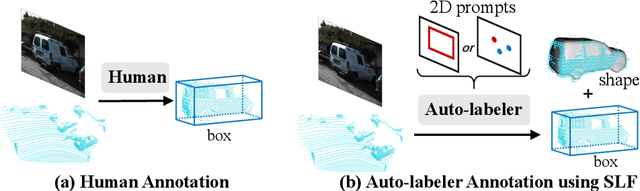

This paper proposes an algorithm for automatically labeling 3D objects from 2D point or box prompts, especially focusing on applications in autonomous driving. Unlike previous arts, our auto-labeler predicts 3D shapes instead of bounding boxes and does not require training on a specific dataset. We propose a Segment, Lift, and Fit (SLF) paradigm to achieve this goal. Firstly, we segment high-quality instance masks from the prompts using the Segment Anything Model (SAM) and transform the remaining problem into predicting 3D shapes from given 2D masks. Due to the ill-posed nature of this problem, it presents a significant challenge as multiple 3D shapes can project into an identical mask. To tackle this issue, we then lift 2D masks to 3D forms and employ gradient descent to adjust their poses and shapes until the projections fit the masks and the surfaces conform to surrounding LiDAR points. Notably, since we do not train on a specific dataset, the SLF auto-labeler does not overfit to biased annotation patterns in the training set as other methods do. Thus, the generalization ability across different datasets improves. Experimental results on the KITTI dataset demonstrate that the SLF auto-labeler produces high-quality bounding box annotations, achieving an AP@0.5 IoU of nearly 90\%. Detectors trained with the generated pseudo-labels perform nearly as well as those trained with actual ground-truth annotations. Furthermore, the SLF auto-labeler shows promising results in detailed shape predictions, providing a potential alternative for the occupancy annotation of dynamic objects.
Lumina-T2X: Transforming Text into Any Modality, Resolution, and Duration via Flow-based Large Diffusion Transformers
May 09, 2024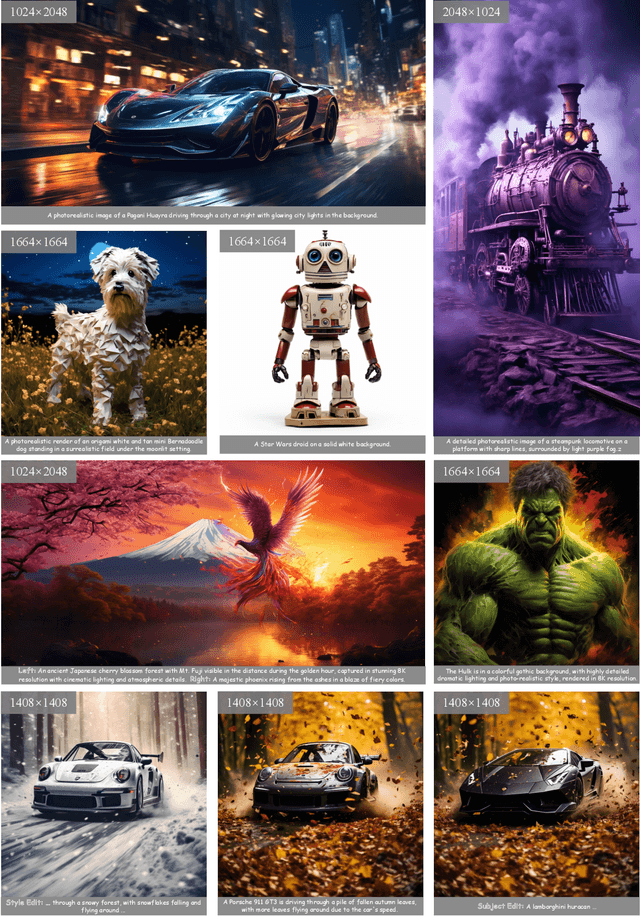
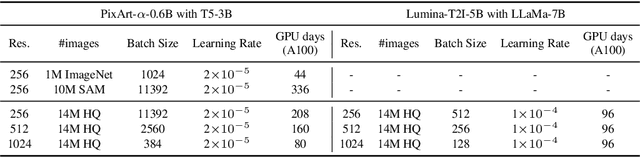
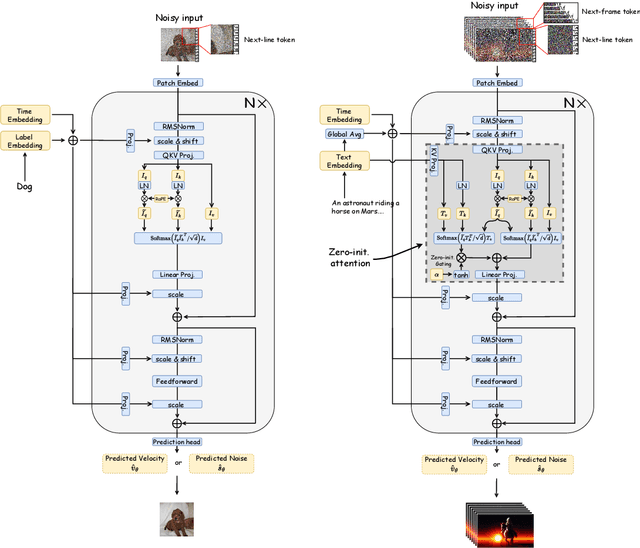

Sora unveils the potential of scaling Diffusion Transformer for generating photorealistic images and videos at arbitrary resolutions, aspect ratios, and durations, yet it still lacks sufficient implementation details. In this technical report, we introduce the Lumina-T2X family - a series of Flow-based Large Diffusion Transformers (Flag-DiT) equipped with zero-initialized attention, as a unified framework designed to transform noise into images, videos, multi-view 3D objects, and audio clips conditioned on text instructions. By tokenizing the latent spatial-temporal space and incorporating learnable placeholders such as [nextline] and [nextframe] tokens, Lumina-T2X seamlessly unifies the representations of different modalities across various spatial-temporal resolutions. This unified approach enables training within a single framework for different modalities and allows for flexible generation of multimodal data at any resolution, aspect ratio, and length during inference. Advanced techniques like RoPE, RMSNorm, and flow matching enhance the stability, flexibility, and scalability of Flag-DiT, enabling models of Lumina-T2X to scale up to 7 billion parameters and extend the context window to 128K tokens. This is particularly beneficial for creating ultra-high-definition images with our Lumina-T2I model and long 720p videos with our Lumina-T2V model. Remarkably, Lumina-T2I, powered by a 5-billion-parameter Flag-DiT, requires only 35% of the training computational costs of a 600-million-parameter naive DiT. Our further comprehensive analysis underscores Lumina-T2X's preliminary capability in resolution extrapolation, high-resolution editing, generating consistent 3D views, and synthesizing videos with seamless transitions. We expect that the open-sourcing of Lumina-T2X will further foster creativity, transparency, and diversity in the generative AI community.
DriveCoT: Integrating Chain-of-Thought Reasoning with End-to-End Driving
Mar 25, 2024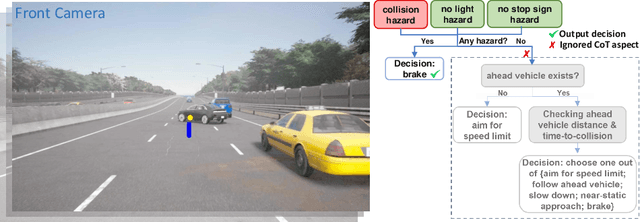
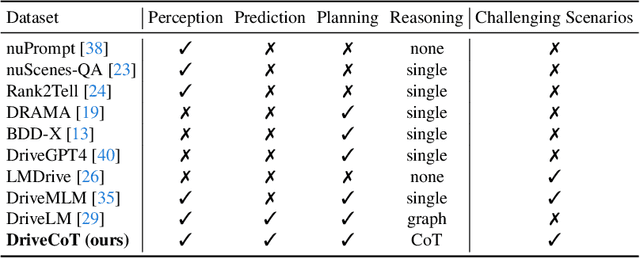
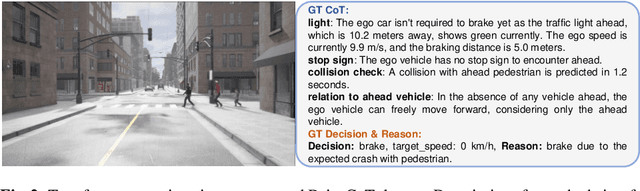
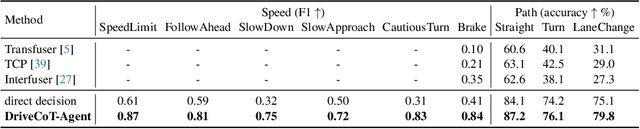
End-to-end driving has made significant progress in recent years, demonstrating benefits such as system simplicity and competitive driving performance under both open-loop and closed-loop settings. Nevertheless, the lack of interpretability and controllability in its driving decisions hinders real-world deployment for end-to-end driving systems. In this paper, we collect a comprehensive end-to-end driving dataset named DriveCoT, leveraging the CARLA simulator. It contains sensor data, control decisions, and chain-of-thought labels to indicate the reasoning process. We utilize the challenging driving scenarios from the CARLA leaderboard 2.0, which involve high-speed driving and lane-changing, and propose a rule-based expert policy to control the vehicle and generate ground truth labels for its reasoning process across different driving aspects and the final decisions. This dataset can serve as an open-loop end-to-end driving benchmark, enabling the evaluation of accuracy in various chain-of-thought aspects and the final decision. In addition, we propose a baseline model called DriveCoT-Agent, trained on our dataset, to generate chain-of-thought predictions and final decisions. The trained model exhibits strong performance in both open-loop and closed-loop evaluations, demonstrating the effectiveness of our proposed dataset.
Editing Massive Concepts in Text-to-Image Diffusion Models
Mar 20, 2024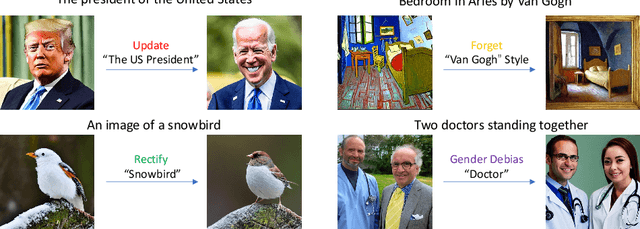

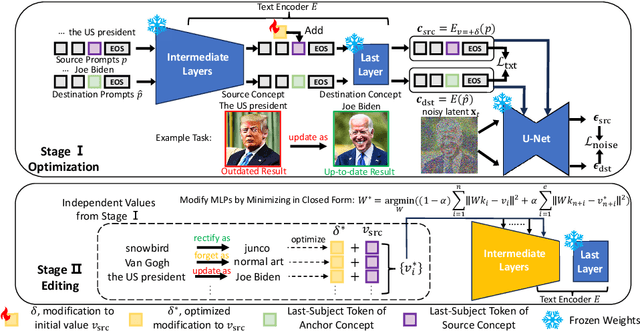
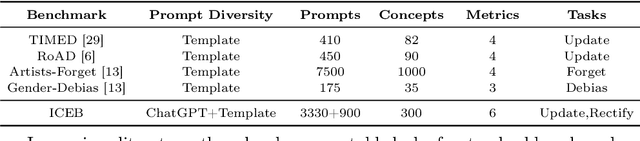
Text-to-image diffusion models suffer from the risk of generating outdated, copyrighted, incorrect, and biased content. While previous methods have mitigated the issues on a small scale, it is essential to handle them simultaneously in larger-scale real-world scenarios. We propose a two-stage method, Editing Massive Concepts In Diffusion Models (EMCID). The first stage performs memory optimization for each individual concept with dual self-distillation from text alignment loss and diffusion noise prediction loss. The second stage conducts massive concept editing with multi-layer, closed form model editing. We further propose a comprehensive benchmark, named ImageNet Concept Editing Benchmark (ICEB), for evaluating massive concept editing for T2I models with two subtasks, free-form prompts, massive concept categories, and extensive evaluation metrics. Extensive experiments conducted on our proposed benchmark and previous benchmarks demonstrate the superior scalability of EMCID for editing up to 1,000 concepts, providing a practical approach for fast adjustment and re-deployment of T2I diffusion models in real-world applications.
TextBlockV2: Towards Precise-Detection-Free Scene Text Spotting with Pre-trained Language Model
Mar 15, 2024Existing scene text spotters are designed to locate and transcribe texts from images. However, it is challenging for a spotter to achieve precise detection and recognition of scene texts simultaneously. Inspired by the glimpse-focus spotting pipeline of human beings and impressive performances of Pre-trained Language Models (PLMs) on visual tasks, we ask: 1) "Can machines spot texts without precise detection just like human beings?", and if yes, 2) "Is text block another alternative for scene text spotting other than word or character?" To this end, our proposed scene text spotter leverages advanced PLMs to enhance performance without fine-grained detection. Specifically, we first use a simple detector for block-level text detection to obtain rough positional information. Then, we finetune a PLM using a large-scale OCR dataset to achieve accurate recognition. Benefiting from the comprehensive language knowledge gained during the pre-training phase, the PLM-based recognition module effectively handles complex scenarios, including multi-line, reversed, occluded, and incomplete-detection texts. Taking advantage of the fine-tuned language model on scene recognition benchmarks and the paradigm of text block detection, extensive experiments demonstrate the superior performance of our scene text spotter across multiple public benchmarks. Additionally, we attempt to spot texts directly from an entire scene image to demonstrate the potential of PLMs, even Large Language Models (LLMs).
PixArt-Σ: Weak-to-Strong Training of Diffusion Transformer for 4K Text-to-Image Generation
Mar 07, 2024


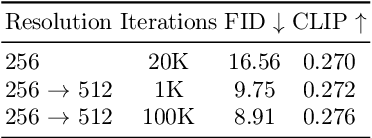
In this paper, we introduce PixArt-\Sigma, a Diffusion Transformer model~(DiT) capable of directly generating images at 4K resolution. PixArt-\Sigma represents a significant advancement over its predecessor, PixArt-\alpha, offering images of markedly higher fidelity and improved alignment with text prompts. A key feature of PixArt-\Sigma is its training efficiency. Leveraging the foundational pre-training of PixArt-\alpha, it evolves from the `weaker' baseline to a `stronger' model via incorporating higher quality data, a process we term "weak-to-strong training". The advancements in PixArt-\Sigma are twofold: (1) High-Quality Training Data: PixArt-\Sigma incorporates superior-quality image data, paired with more precise and detailed image captions. (2) Efficient Token Compression: we propose a novel attention module within the DiT framework that compresses both keys and values, significantly improving efficiency and facilitating ultra-high-resolution image generation. Thanks to these improvements, PixArt-\Sigma achieves superior image quality and user prompt adherence capabilities with significantly smaller model size (0.6B parameters) than existing text-to-image diffusion models, such as SDXL (2.6B parameters) and SD Cascade (5.1B parameters). Moreover, PixArt-\Sigma's capability to generate 4K images supports the creation of high-resolution posters and wallpapers, efficiently bolstering the production of high-quality visual content in industries such as film and gaming.
Accelerating Diffusion Sampling with Optimized Time Steps
Feb 27, 2024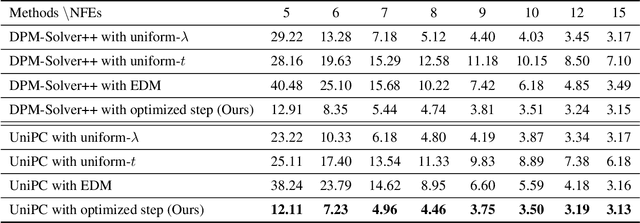
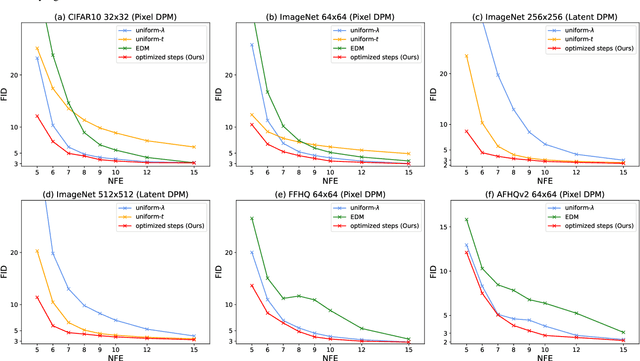
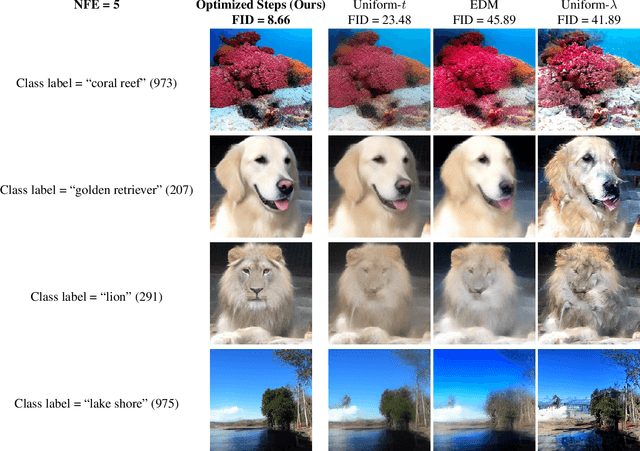

Diffusion probabilistic models (DPMs) have shown remarkable performance in high-resolution image synthesis, but their sampling efficiency is still to be desired due to the typically large number of sampling steps. Recent advancements in high-order numerical ODE solvers for DPMs have enabled the generation of high-quality images with much fewer sampling steps. While this is a significant development, most sampling methods still employ uniform time steps, which is not optimal when using a small number of steps. To address this issue, we propose a general framework for designing an optimization problem that seeks more appropriate time steps for a specific numerical ODE solver for DPMs. This optimization problem aims to minimize the distance between the ground-truth solution to the ODE and an approximate solution corresponding to the numerical solver. It can be efficiently solved using the constrained trust region method, taking less than $15$ seconds. Our extensive experiments on both unconditional and conditional sampling using pixel- and latent-space DPMs demonstrate that, when combined with the state-of-the-art sampling method UniPC, our optimized time steps significantly improve image generation performance in terms of FID scores for datasets such as CIFAR-10 and ImageNet, compared to using uniform time steps.