 Add to Chrome
 Add to Firefox
 Add to Edge
CausaLab: A Scalable Environment for Interactive Causal Discovery Toward AI Scientists
May 28, 2026
We introduce CausaLab, a scalable environment for evaluating interactive causal discovery by LLM agents. Unlike prior evaluations, CausaLab evaluates both whether an agent can solve a problem using causal evidence and whether its answer is grounded in a faithful recovered causal mechanism. Each episode places an agent in a synthetic laboratory: it receives prior measurement records, intervenes on a manipulator crystal, and predicts the resonance frequency of a held-out reactor crystal governed by the same mechanism. The hidden data-generating process is a randomly sampled structural causal model (SCM), so success requires recovering both a causal graph and structural equations rather than recalling prior knowledge. Experiments show a persistent gap between prediction and mechanism recovery: in the purely observational 6-node setting, GPT-5.2-high reaches 92% task accuracy but only 0.471 all-edge $F_1$. Mixed observation-intervention strategies improve structural fidelity, while pure intervention remains difficult even for strong agents. We identify premature stopping as a major weakness and show that consistency verification mitigates it. CausaLab therefore separates predictive success from causal understanding and exposes current LLM agents' limits as experimental causal reasoners.

Towards a Universal Causal Reasoner
May 24, 2026Despite the importance of causal reasoning, training LLMs to reason causally remains underexplored. Existing data efforts mostly focus on benchmarking LLMs on specific aspects of causality, making them less suitable for training generalizable causal reasoners. To address this, we propose UniCo, a data generation framework that both (1) addresses 18 causal query types across Pearl's Causal Ladder and (2) translates natively symbolic examples into code and natural language forms to simulate real-world use cases where causal terms are not explicitly specified. To ensure data quality, UniCo grounds answers with exact causal inference and filters cases with reasoning shortcuts. Upon supervised finetuning with 66.6K UniCo-generated instances, Qwen3-4B, Qwen3-8B and Olmo-3-7B-Instruct achieve an average of 22.9% improvements across all 18 in-distribution query types, and 8.1% over state-of-the-art causal data generation frameworks on 7 established causal benchmarks outside the training distribution. More importantly, in real-world medical understanding, legal decision, and tabular reasoning, UniCo-trained models consistently display more faithful reasoning traces, outperforming the base models by an average of 20.2% in faithfulness metrics. These suggest that causality-centered training not only strengthens causal reasoning, but also equips LLMs with a causal mindset in general reasoning tasks.
Code as Agent Harness
May 18, 2026Recent large language models (LLMs) have demonstrated strong capabilities in understanding and generating code, from competitive programming to repository-level software engineering. In emerging agentic systems, code is no longer only a target output. It increasingly serves as an operational substrate for agent reasoning, acting, environment modeling, and execution-based verification. We frame this shift through the lens of agent harnesses and introduce code as agent harness: a unified view that centers code as the basis for agent infrastructure. To systematically study this perspective, we organize the survey around three connected layers. First, we study the harness interface, where code connects agents to reasoning, action, and environment modeling. Second, we examine harness mechanisms: planning, memory, and tool use for long-horizon execution, together with feedback-driven control and optimization that make harness reliable and adaptive. Third, we discuss scaling the harness from single-agent systems to multi-agent settings, where shared code artifacts support multi-agent coordination, review, and verification. Across these layers, we summarize representative methods and practical applications of code as agent harness, spanning coding assistants, GUI/OS automation, embodied agents, scientific discovery, personalization and recommendation, DevOps, and enterprise workflows. We further outline open challenges for harness engineering, including evaluation beyond final task success, verification under incomplete feedback, regression-free harness improvement, consistent shared state across multiple agents, human oversight for safety-critical actions, and extensions to multimodal environments. By centering code as the harness of agentic AI, this survey provides a unified roadmap toward executable, verifiable, and stateful AI agent systems.
Useful Memories Become Faulty When Continuously Updated by LLMs
May 13, 2026Learning from past experience benefits from two complementary forms of memory: episodic traces -- raw trajectories of what happened -- and consolidated abstractions distilled across many episodes into reusable, schema-like lessons. Recent agentic-memory systems pursue the consolidated form: an LLM rewrites past trajectories into a textual memory bank that it continuously updates with new interactions, promising self-improving agents without parameter updates. Yet we find that such consolidated memories produced by today's LLMs are often faulty even when derived from useful experiences. As consolidation proceeds, memory utility first rises, then degrades, and can fall below the no-memory baseline. More surprisingly, even when consolidating from ground-truth solutions, GPT-5.4 fails on 54% of a set of ARC-AGI problems it had previously solved without memory. We trace the regression to the consolidation step rather than the underlying experience: the same trajectories yield qualitatively different memories under different update schedules, and an episodic-only control that simply retains those trajectories remains competitive with the consolidators we test. In a controlled ARC-AGI Stream environment that exposes Retain, Delete, and Consolidate actions, agents preserve raw episodes by default and double the accuracy of their forced-consolidation counterparts; disabling consolidation entirely (episodic management only) matches this auto regime. Practically, robust agent memory should treat raw episodes as first-class evidence and gate consolidation explicitly rather than firing it after every interaction. Looking forward, reliable agentic memory will require LLMs that can consolidate without overwriting the evidence they depend on.
Let the Abyss Stare Back Adaptive Falsification for Autonomous Scientific Discovery
Mar 30, 2026Autonomous scientific discovery is entering a more dangerous regime: once the evaluator is frozen, a sufficiently strong search process can learn to win the exam without learning the mechanism the task was meant to reveal. This is the idea behind our title. To let the abyss stare back is to make evaluation actively push against the candidate through adaptive falsification, rather than passively certify it through static validation. We introduce DASES, a falsification-driven framework in which an Innovator, an Abyss Falsifier, and a Mechanistic Causal Extractor co-evolve executable scientific artifacts and scientifically admissible counterexample environments under a fixed scientific contract. In a controlled loss-discovery problem with a single editable locus, DASES rejects artifacts that static validation would have accepted, identifies the first candidate that survives the admissible falsification frontier, and discovers FNG-CE, a loss that transfers beyond the synthetic discovery environment and consistently outperforms CE and CE+L2 under controlled comparisons across standard benchmarks, including ImageNet.
Agentic Automation of BT-RADS Scoring: End-to-End Multi-Agent System for Standardized Brain Tumor Follow-up Assessment
Mar 23, 2026The Brain Tumor Reporting and Data System (BT-RADS) standardizes post-treatment MRI response assessment in patients with diffuse gliomas but requires complex integration of imaging trends, medication effects, and radiation timing. This study evaluates an end-to-end multi-agent large language model (LLM) and convolutional neural network (CNN) system for automated BT-RADS classification. A multi-agent LLM system combined with automated CNN-based tumor segmentation was retrospectively evaluated on 509 consecutive post-treatment glioma MRI examinations from a single high-volume center. An extractor agent identified clinical variables (steroid status, bevacizumab status, radiation date) from unstructured clinical notes, while a scorer agent applied BT-RADS decision logic integrating extracted variables with volumetric measurements. Expert reference standard classifications were established by an independent board-certified neuroradiologist. Of 509 examinations, 492 met inclusion criteria. The system achieved 374/492 (76.0%; 95% CI, 72.1%-79.6%) accuracy versus 283/492 (57.5%; 95% CI, 53.1%-61.8%) for initial clinical assessments (+18.5 percentage points; P<.001). Context-dependent categories showed high sensitivity (BT-1b 100%, BT-1a 92.7%, BT-3a 87.5%), while threshold-dependent categories showed moderate sensitivity (BT-3c 74.8%, BT-2 69.2%, BT-4 69.3%, BT-3b 57.1%). For BT-4, positive predictive value was 92.9%. The multi-agent LLM system achieved higher BT-RADS classification agreement with expert reference standard compared to initial clinical scoring, with high accuracy for context-dependent scores and high positive predictive value for BT-4 detection.
Good SFT Optimizes for SFT, Better SFT Prepares for Reinforcement Learning
Feb 01, 2026Post-training of reasoning LLMs is a holistic process that typically consists of an offline SFT stage followed by an online reinforcement learning (RL) stage. However, SFT is often optimized in isolation to maximize SFT performance alone. We show that, after identical RL training, models initialized from stronger SFT checkpoints can significantly underperform those initialized from weaker ones. We attribute this to a mismatch typical in current SFT-RL pipelines: the distribution that generates the offline SFT data can differ substantially from the policy optimized during online RL, which learns from its own rollouts. We propose PEAR (Policy Evaluation-inspired Algorithm for Offline Learning Loss Re-weighting), an SFT-stage method that corrects this mismatch and better prepares the model for RL. PEAR uses importance sampling to reweight the SFT loss, with three variants operating at the token, block, and sequence levels. It can be used to augment standard SFT objectives and incurs little additional training overhead once probabilities for the offline data are collected. We conduct controlled experiments on verifiable reasoning games and mathematical reasoning tasks on Qwen 2.5 and 3 and DeepSeek-distilled models. PEAR consistently improves post-RL performance over canonical SFT, with pass at 8 gains up to a 14.6 percent on AIME2025. Our results suggest that PEAR is an effective step toward more holistic LLM post-training by designing and evaluating SFT with downstream RL in mind rather than in isolation.
Adaptation of Agentic AI
Dec 22, 2025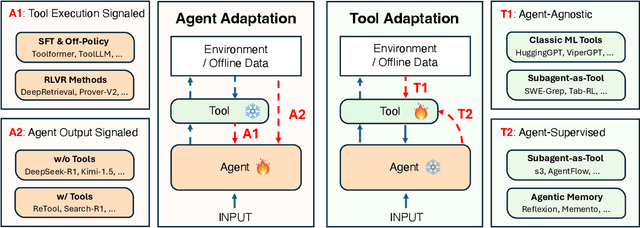
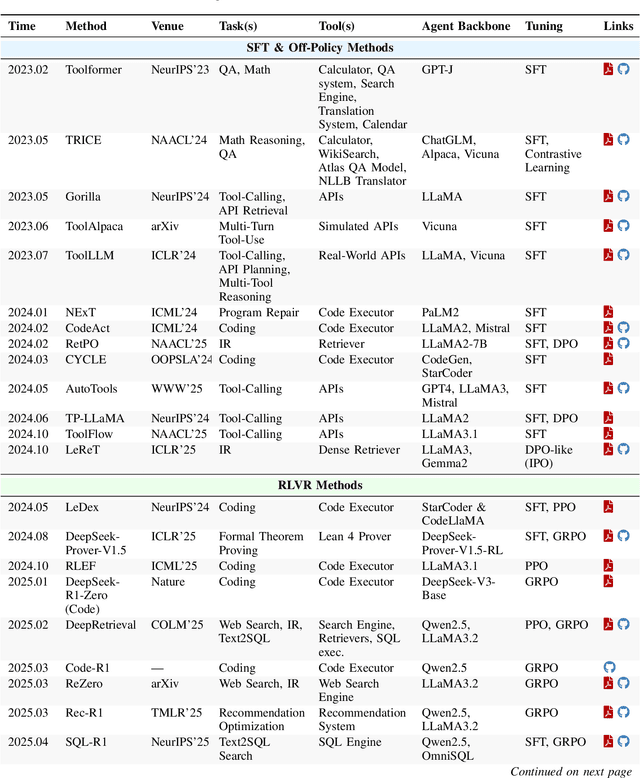
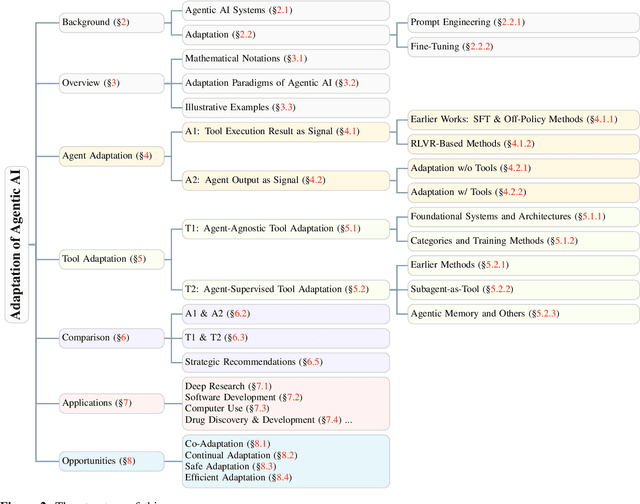
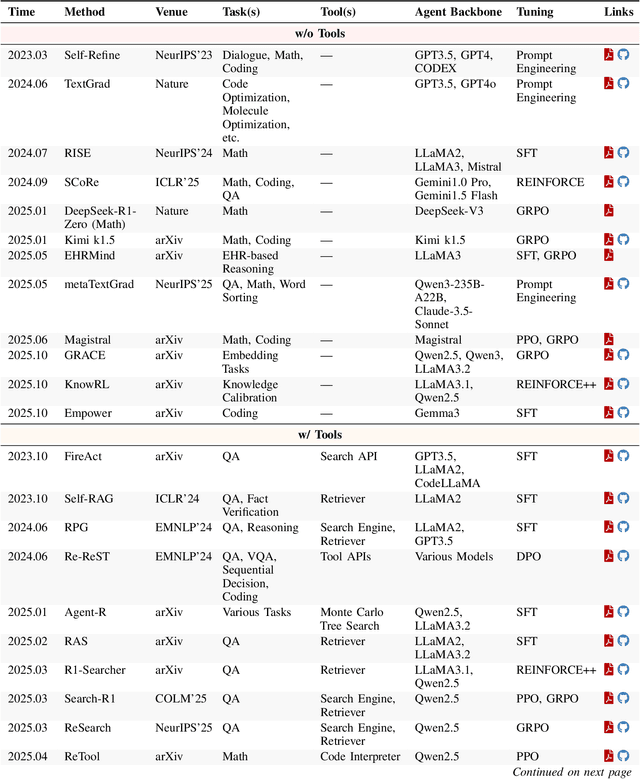
Cutting-edge agentic AI systems are built on foundation models that can be adapted to plan, reason, and interact with external tools to perform increasingly complex and specialized tasks. As these systems grow in capability and scope, adaptation becomes a central mechanism for improving performance, reliability, and generalization. In this paper, we unify the rapidly expanding research landscape into a systematic framework that spans both agent adaptations and tool adaptations. We further decompose these into tool-execution-signaled and agent-output-signaled forms of agent adaptation, as well as agent-agnostic and agent-supervised forms of tool adaptation. We demonstrate that this framework helps clarify the design space of adaptation strategies in agentic AI, makes their trade-offs explicit, and provides practical guidance for selecting or switching among strategies during system design. We then review the representative approaches in each category, analyze their strengths and limitations, and highlight key open challenges and future opportunities. Overall, this paper aims to offer a conceptual foundation and practical roadmap for researchers and practitioners seeking to build more capable, efficient, and reliable agentic AI systems.
Building A Proof-Oriented Programmer That Is 64% Better Than GPT-4o Under Data Scarsity
Feb 17, 2025Existing LMs struggle with proof-oriented programming due to data scarcity, which manifest in two key ways: (1) a lack of sufficient corpora for proof-oriented programming languages such as F*, and (2) the absence of large-scale, project-level proof-oriented implementations that can teach the model the intricate reasoning process when performing proof-oriented programming. We present the first on synthetic data augmentation for project level proof oriented programming for both generation and repair. Our method addresses data scarcity by synthesizing basic proof-oriented programming problems for proficiency in that language; incorporating diverse coding data for reasoning capability elicitation and creating new proofs and repair data within existing repositories. This approach enables language models to both synthesize and repair proofs for function- and repository-level code. We show that our fine-tuned 14B parameter model, PoPilot, can exceed the performance of the models that outperforms GPT-4o in project-level proof-oriented programming by 64% relative margin, and can improve GPT-4o's performance by 54% by repairing its outputs over GPT-4o's self-repair.
The Best Instruction-Tuning Data are Those That Fit
Feb 07, 2025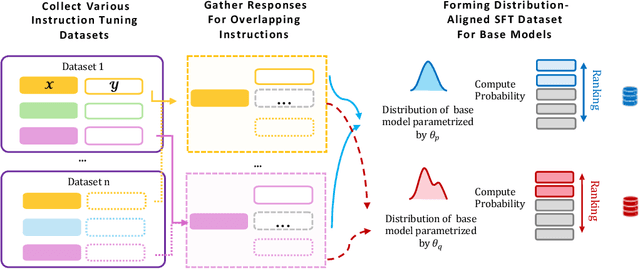
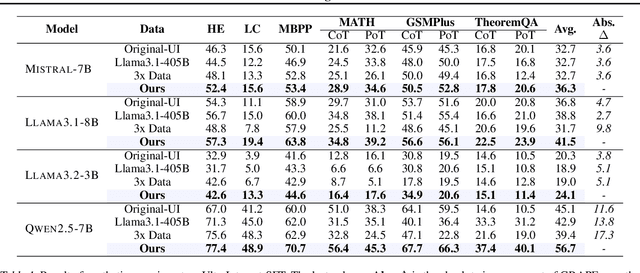
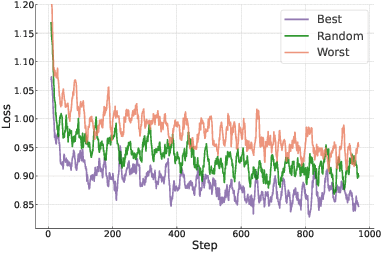
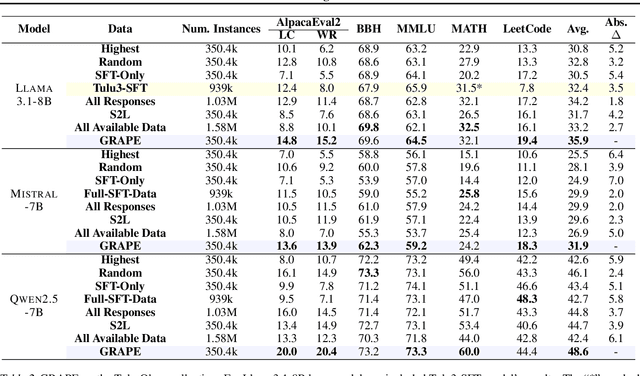
High-quality supervised fine-tuning (SFT) data are crucial for eliciting strong capabilities from pretrained large language models (LLMs). Typically, instructions are paired with multiple responses sampled from other LLMs, which are often out of the distribution of the target model to be fine-tuned. This, at scale, can lead to diminishing returns and even hurt the models' performance and robustness. We propose **GRAPE**, a novel SFT framework that accounts for the unique characteristics of the target model. For each instruction, it gathers responses from various LLMs and selects the one with the highest probability measured by the target model, indicating that it aligns most closely with the target model's pretrained distribution; it then proceeds with standard SFT training. We first evaluate GRAPE with a controlled experiment, where we sample various solutions for each question in UltraInteract from multiple models and fine-tune commonly used LMs like LLaMA3.1-8B, Mistral-7B, and Qwen2.5-7B on GRAPE-selected data. GRAPE significantly outperforms strong baselines, including distilling from the strongest model with an absolute gain of up to 13.8%, averaged across benchmarks, and training on 3x more data with a maximum performance improvement of 17.3%. GRAPE's strong performance generalizes to realistic settings. We experiment with the post-training data used for Tulu3 and Olmo-2. GRAPE outperforms strong baselines trained on 4.5 times more data by 6.1% and a state-of-the-art data selection approach by 3% on average performance. Remarkably, using 1/3 of the data and half the number of epochs, GRAPE enables LLaMA3.1-8B to surpass the performance of Tulu3-SFT by 3.5%.