 Add to Chrome
 Add to Firefox
 Add to Edge
Agentic Automation of BT-RADS Scoring: End-to-End Multi-Agent System for Standardized Brain Tumor Follow-up Assessment
Mar 23, 2026
The Brain Tumor Reporting and Data System (BT-RADS) standardizes post-treatment MRI response assessment in patients with diffuse gliomas but requires complex integration of imaging trends, medication effects, and radiation timing. This study evaluates an end-to-end multi-agent large language model (LLM) and convolutional neural network (CNN) system for automated BT-RADS classification. A multi-agent LLM system combined with automated CNN-based tumor segmentation was retrospectively evaluated on 509 consecutive post-treatment glioma MRI examinations from a single high-volume center. An extractor agent identified clinical variables (steroid status, bevacizumab status, radiation date) from unstructured clinical notes, while a scorer agent applied BT-RADS decision logic integrating extracted variables with volumetric measurements. Expert reference standard classifications were established by an independent board-certified neuroradiologist. Of 509 examinations, 492 met inclusion criteria. The system achieved 374/492 (76.0%; 95% CI, 72.1%-79.6%) accuracy versus 283/492 (57.5%; 95% CI, 53.1%-61.8%) for initial clinical assessments (+18.5 percentage points; P<.001). Context-dependent categories showed high sensitivity (BT-1b 100%, BT-1a 92.7%, BT-3a 87.5%), while threshold-dependent categories showed moderate sensitivity (BT-3c 74.8%, BT-2 69.2%, BT-4 69.3%, BT-3b 57.1%). For BT-4, positive predictive value was 92.9%. The multi-agent LLM system achieved higher BT-RADS classification agreement with expert reference standard compared to initial clinical scoring, with high accuracy for context-dependent scores and high positive predictive value for BT-4 detection.

Language Models and Retrieval Augmented Generation for Automated Structured Data Extraction from Diagnostic Reports
Sep 18, 2024
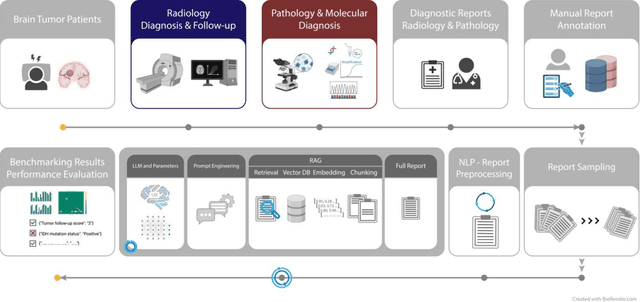
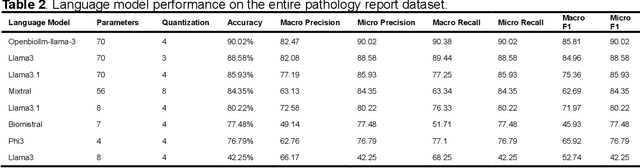
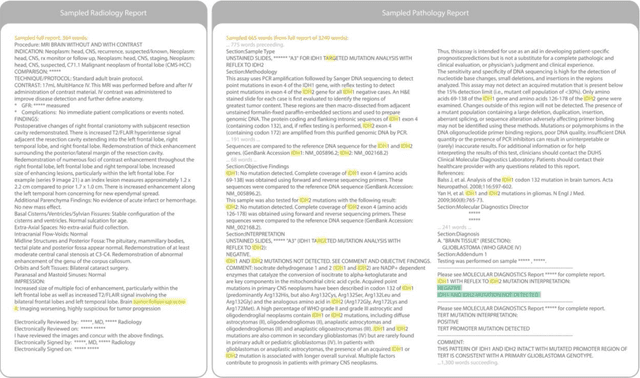
Purpose: To develop and evaluate an automated system for extracting structured clinical information from unstructured radiology and pathology reports using open-weights large language models (LMs) and retrieval augmented generation (RAG), and to assess the effects of model configuration variables on extraction performance. Methods and Materials: The study utilized two datasets: 7,294 radiology reports annotated for Brain Tumor Reporting and Data System (BT-RADS) scores and 2,154 pathology reports annotated for isocitrate dehydrogenase (IDH) mutation status. An automated pipeline was developed to benchmark the performance of various LMs and RAG configurations. The impact of model size, quantization, prompting strategies, output formatting, and inference parameters was systematically evaluated. Results: The best performing models achieved over 98% accuracy in extracting BT-RADS scores from radiology reports and over 90% for IDH mutation status extraction from pathology reports. The top model being medical fine-tuned llama3. Larger, newer, and domain fine-tuned models consistently outperformed older and smaller models. Model quantization had minimal impact on performance. Few-shot prompting significantly improved accuracy. RAG improved performance for complex pathology reports but not for shorter radiology reports. Conclusions: Open LMs demonstrate significant potential for automated extraction of structured clinical data from unstructured clinical reports with local privacy-preserving application. Careful model selection, prompt engineering, and semi-automated optimization using annotated data are critical for optimal performance. These approaches could be reliable enough for practical use in research workflows, highlighting the potential for human-machine collaboration in healthcare data extraction.