 Add to Chrome
 Add to Firefox
 Add to Edge
Integrated Sensing and Communication with Massive MIMO: A Unified Tensor Approach for Channel and Target Parameter Estimation
Jan 03, 2024
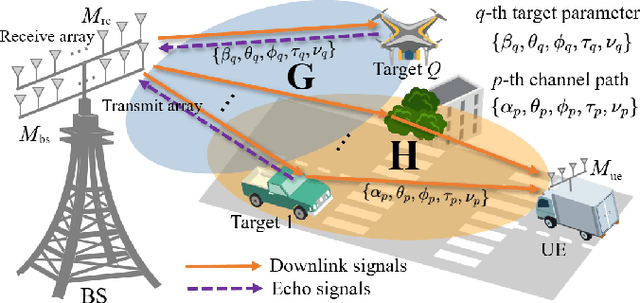
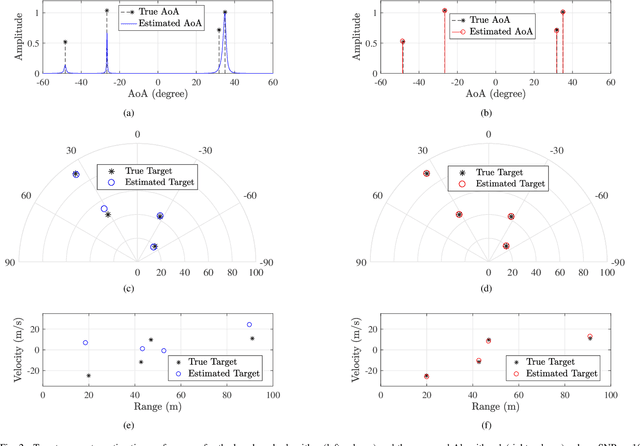
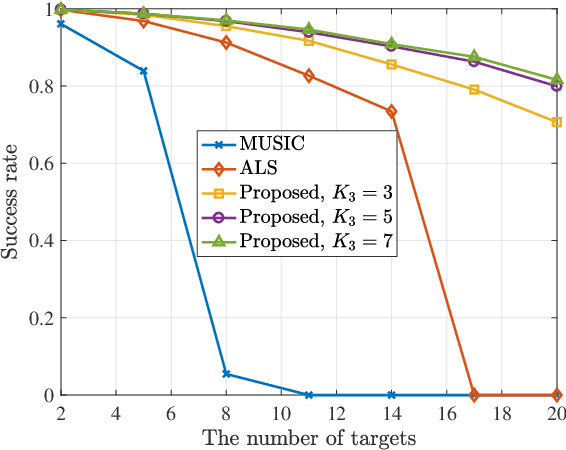
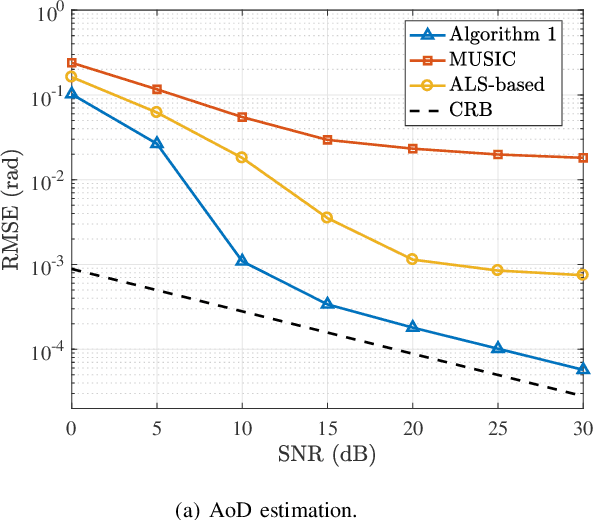
Benefitting from the vast spatial degrees of freedom, the amalgamation of integrated sensing and communication (ISAC) and massive multiple-input multiple-output (MIMO) is expected to simultaneously improve spectral and energy efficiencies as well as the sensing capability. However, a large number of antennas deployed in massive MIMO-ISAC raises critical challenges in acquiring both accurate channel state information and target parameter information. To overcome these two challenges with a unified framework, we first analyze their underlying system models and then propose a novel tensor-based approach that addresses both the channel estimation and target sensing problems. Specifically, by parameterizing the high-dimensional communication channel exploiting a small number of physical parameters, we associate the channel state information with the sensing parameters of targets in terms of angular, delay, and Doppler dimensions. Then, we propose a shared training pattern adopting the same time-frequency resources such that both the channel estimation and target parameter estimation can be formulated as a canonical polyadic decomposition problem with a similar mathematical expression. On this basis, we first investigate the uniqueness condition of the tensor factorization and the maximum number of resolvable targets by utilizing the specific Vandermonde

Optimal BER Minimum Precoder Design for OTFS-Based ISAC Systems
Dec 19, 2023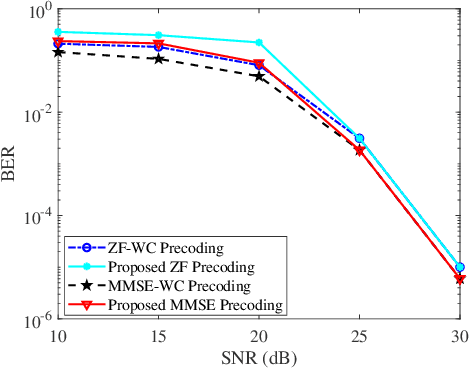

This paper investigates the bit error rate (BER) minimum pre-coder design for an orthogonal time frequency space (OTFS)-based integrated sensing and communications (ISAC) system, which is considered as a promising technique for enabling future wireless networks. In particular, the BER minimum problem takes into account the maximized available transmission power and the required sensing performance. We devise the precoder from the perspective of delay-Doppler (DD) domain by exploiting the equivalent DD channel. To address the non-convex design problem, we resort to minimizing the lower bound of the derived average BER. Afterwards, we propose a computationally iterative method to solve the dual problem at low cost. Simulation results verify the effectiveness of our proposed precoder and reveal the interplay between sensing and communication for dual-functional precoder design.
Secure Cell-Free Integrated Sensing and Communication in the Presence of Information and Sensing Eavesdroppers
Dec 07, 2023This paper studies a secure cell-free integrated sensing and communication (ISAC) system, in which multiple ISAC transmitters collaboratively send confidential information to multiple communication users (CUs) and concurrently conduct target detection. Different from prior works investigating communication security against potential information eavesdropping, we consider the security of both communication and sensing in the presence of both information and sensing eavesdroppers that aim to intercept confidential communication information and extract target information, respectively. Towards this end, we optimize the joint information and sensing transmit beamforming at these ISAC transmitters for secure cell-free ISAC. Our objective is to maximize the detection probability over a designated sensing area while ensuring the minimum signal-to-interference-plus-noise-ratio (SINR) requirements at CUs. Our formulation also takes into account the maximum tolerable signal-to-noise ratio (SNR) at information eavesdroppers for ensuring the confidentiality of information transmission, and the maximum detection probability constraints at sensing eavesdroppers for preserving sensing privacy. The formulated secure joint transmit beamforming problem is highly non-convex due to the intricate interplay between the detection probabilities, beamforming vectors, and SINR constraints. Fortunately, through strategic manipulation and via applying the semidefinite relaxation (SDR) technique, we successfully obtain the globally optimal solution to the design problem by rigorously verifying the tightness of SDR. Furthermore, we present two alternative joint beamforming designs based on the sensing SNR maximization over the specific sensing area and the coordinated beamforming, respectively. Numerical results reveal the benefits of our proposed design over these alternative benchmarks.
Joint Distributed Precoding and Beamforming for RIS-aided Cell-Free Massive MIMO Systems
Nov 22, 2023
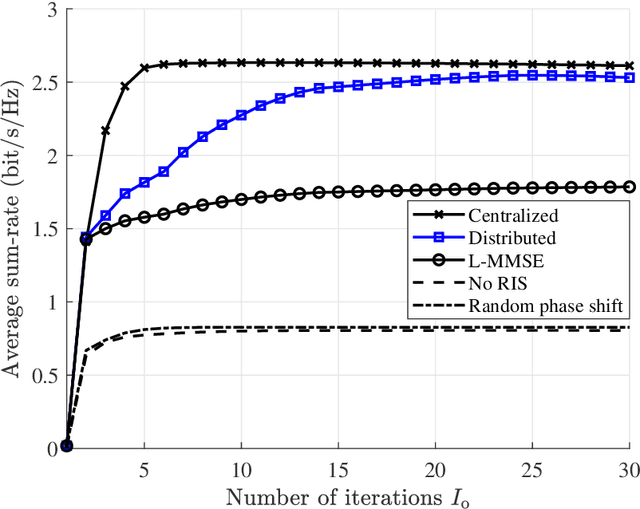
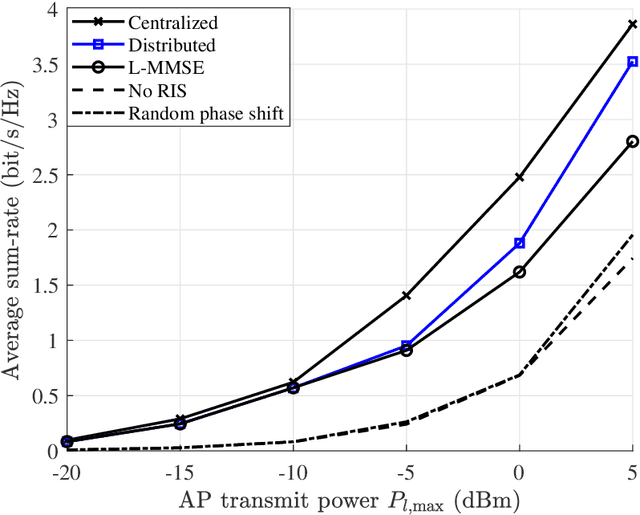

The amalgamation of cell-free networks and reconfigurable intelligent surface (RIS) has become a prospective technique for future sixth-generation wireless communication systems. In this paper, we focus on the precoding and beamforming design for a downlink RIS-aided cell-free network. The design is formulated as a non-convex optimization problem by jointly optimizing the combining vector, active precoding, and passive RIS beamforming for minimizing the weighted sum of users' mean square error. A novel joint distributed precoding and beamforming framework is proposed to decentralize the alternating optimization method for acquiring a suboptimal solution to the design problem. Finally, numerical results validate the effectiveness of the proposed distributed precoding and beamforming framework, showing its low-complexity and improved scalability compared with the centralized method.
Stacked Intelligent Metasurface-Aided MIMO Transceiver Design
Nov 16, 2023Next-generation wireless networks are expected to utilize the limited radio frequency (RF) resources more efficiently with the aid of intelligent transceivers. To this end, we propose a promising transceiver architecture relying on stacked intelligent metasurfaces (SIM). An SIM is constructed by stacking an array of programmable metasurface layers, where each layer consists of a massive number of low-cost passive meta-atoms that individually manipulate the electromagnetic (EM) waves. By appropriately configuring the passive meta-atoms, an SIM is capable of accomplishing advanced computation and signal processing tasks, such as multiple-input multiple-output (MIMO) precoding/combining, multi-user interference mitigation, and radar sensing, as the EM wave propagates through the multiple layers of the metasurface, which effectively reduces both the RF-related energy consumption and processing delay. Inspired by this, we provide an overview of the SIM-aided MIMO transceiver design, which encompasses its hardware architecture and its potential benefits over state-of-the-art solutions. Furthermore, we discuss promising application scenarios and identify the open research challenges associated with the design of advanced SIM architectures for next-generation wireless networks. Finally, numerical results are provided for quantifying the benefits of wave-based signal processing in wireless systems.
Compressive Sensing-Based Grant-Free Massive Access for 6G Massive Communication
Nov 12, 2023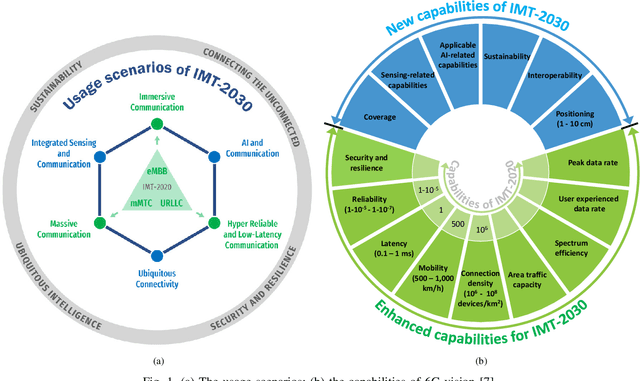
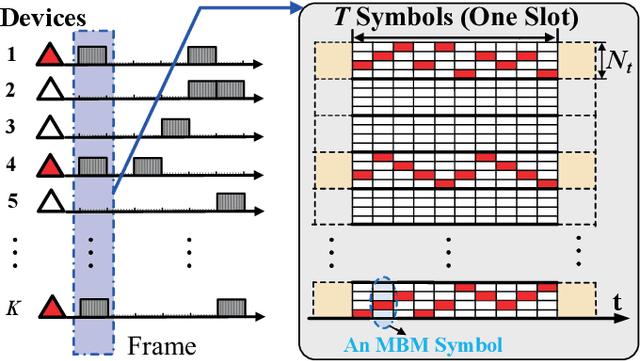
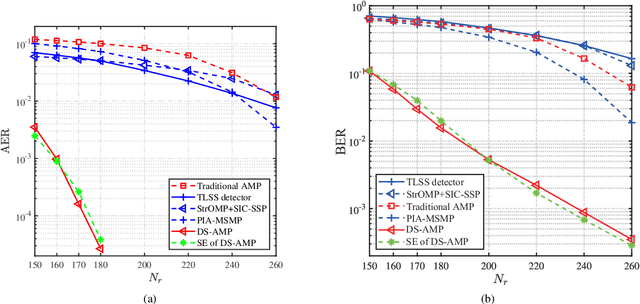
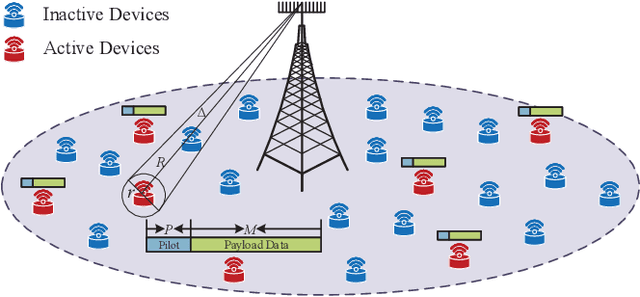
The advent of the sixth-generation (6G) of wireless communications has given rise to the necessity to connect vast quantities of heterogeneous wireless devices, which requires advanced system capabilities far beyond existing network architectures. In particular, such massive communication has been recognized as a prime driver that can empower the 6G vision of future ubiquitous connectivity, supporting Internet of Human-Machine-Things for which massive access is critical. This paper surveys the most recent advances toward massive access in both academic and industry communities, focusing primarily on the promising compressive sensing-based grant-free massive access paradigm. We first specify the limitations of existing random access schemes and reveal that the practical implementation of massive communication relies on a dramatically different random access paradigm from the current ones mainly designed for human-centric communications. Then, a compressive sensing-based grant-free massive access roadmap is presented, where the evolutions from single-antenna to large-scale antenna array-based base stations, from single-station to cooperative massive multiple-input multiple-output systems, and from unsourced to sourced random access scenarios are detailed. Finally, we discuss the key challenges and open issues to shed light on the potential future research directions of grant-free massive access.
Sensing-Assisted Sparse Channel Recovery for Massive Antenna Systems
Nov 10, 2023This correspondence presents a novel sensing-assisted sparse channel recovery approach for massive antenna wireless communication systems. We focus on a fundamental configuration with one massive-antenna base station (BS) and one single-antenna communication user (CU). The wireless channel exhibits sparsity and consists of multiple paths associated with scatterers detectable via radar sensing. Under this setup, the BS first sends downlink pilots to the CU and concurrently receives the echo pilot signals for sensing the surrounding scatterers. Subsequently, the CU sends feedback information on its received pilot signal to the BS. Accordingly, the BS determines the sparse basis based on the sensed scatterers and proceeds to recover the wireless channel, exploiting the feedback information based on advanced compressive sensing (CS) algorithms. Numerical results show that the proposed sensing-assisted approach significantly increases the overall achievable rate than the conventional design relying on a discrete Fourier transform (DFT)-based sparse basis without sensing, thanks to the reduced training overhead and enhanced recovery accuracy with limited feedback.
Fully-Passive versus Semi-Passive IRS-Enabled Sensing: SNR and CRB Comparison
Nov 10, 2023
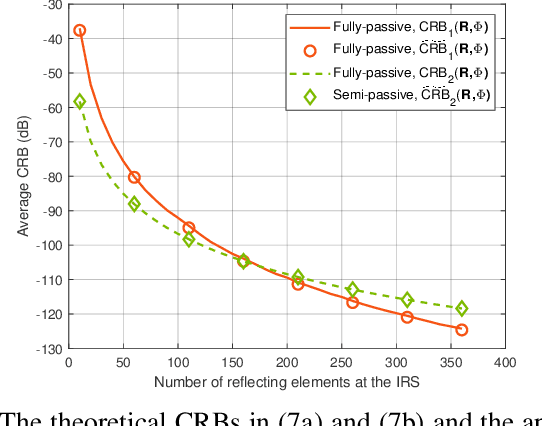


This paper investigates the sensing performance of two intelligent reflecting surface (IRS)-enabled non-line-of-sight (NLoS) sensing systems with fully-passive and semi-passive IRSs, respectively. In particular, we consider a fundamental setup with one base station (BS), one uniform linear array (ULA) IRS, and one point target in the NLoS region of the BS. Accordingly, we analyze the sensing signal-to-noise ratio (SNR) performance for a target detection scenario and the estimation Cram\'er-Rao bound (CRB) performance for a target's direction-of-arrival (DoA) estimation scenario, in cases where the transmit beamforming at the BS and the reflective beamforming at the IRS are jointly optimized. First, for the target detection scenario, we characterize the maximum sensing SNR when the BS-IRS channels are line-of-sight (LoS) and Rayleigh fading, respectively. It is revealed that when the number of reflecting elements $N$ equipped at the IRS becomes sufficiently large, the maximum sensing SNR increases proportionally to $N^2$ for the semi-passive-IRS sensing system, but proportionally to $N^4$ for the fully-passive-IRS counterpart. Then, for the target's DoA estimation scenario, we analyze the minimum CRB performance when the BS-IRS channel follows Rayleigh fading. Specifically, when $N$ grows, the minimum CRB decreases inversely proportionally to $N^4$ and $N^6$ for the semi-passive and fully-passive-IRS sensing systems, respectively. Finally, numerical results are presented to corroborate our analysis across various transmit and reflective beamforming design schemes under general channel setups. It is shown that the fully-passive-IRS sensing system outperforms the semi-passive counterpart when $N$ exceeds a certain threshold. This advantage is attributed to the additional reflective beamforming gain in the IRS-BS path, which efficiently compensates for the path loss for a large $N$.
DPSS-based Codebook Design for Near-Field XL-MIMO Channel Estimation
Oct 27, 2023Future sixth-generation (6G) systems are expected to leverage extremely large-scale multiple-input multiple-output (XL-MIMO) technology, which significantly expands the range of the near-field region. While accurate channel estimation is essential for beamforming and data detection, the unique characteristics of near-field channels pose additional challenges to the effective acquisition of channel state information. In this paper, we propose a novel codebook design, which allows efficient near-field channel estimation with significantly reduced codebook size. Specifically, we consider the eigen-problem based on the near-field electromagnetic wave transmission model. Moreover, we derive the general form of the eigenvectors associated with the near-field channel matrix, revealing their noteworthy connection to the discrete prolate spheroidal sequence (DPSS). Based on the proposed near-field codebook design, we further introduce a two-step channel estimation scheme. Simulation results demonstrate that the proposed codebook design not only achieves superior sparsification performance of near-field channels with a lower leakage effect, but also significantly improves the accuracy in compressive sensing channel estimation.
Integrated Sensing and Channel Estimation by Exploiting Dual Timescales for Delay-Doppler Alignment Modulation
Oct 17, 2023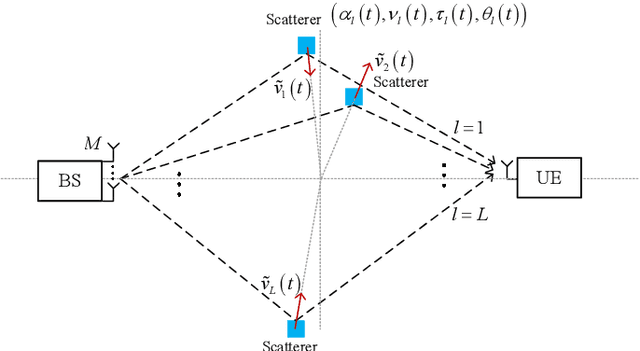
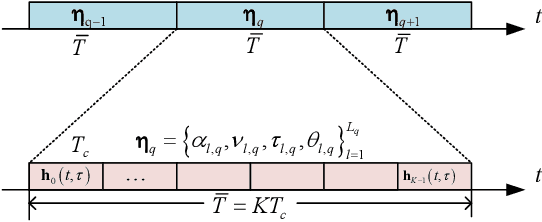
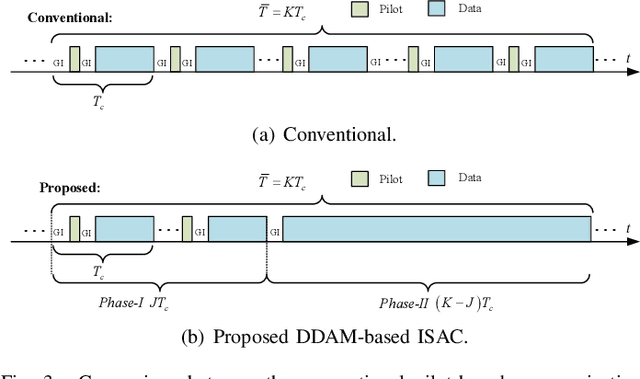
For integrated sensing and communication (ISAC) systems, the channel information essential for communication and sensing tasks fluctuates across different timescales. Specifically, wireless sensing primarily focuses on acquiring path state information (PSI) (e.g., delay, angle, and Doppler) of individual multi-path components to sense the environment, which usually evolves much more slowly than the composite channel state information (CSI) required for communications. Typically, the CSI is approximately unchanged during the channel coherence time, which characterizes the statistical properties of wireless communication channels. However, this concept is less appropriate for describing that for wireless sensing. To this end, in this paper, we introduce a new timescale to study the variation of the PSI from a channel geometric perspective, termed path invariant time, during which the PSI largely remains constant. Our analysis indicates that the path invariant time considerably exceeds the channel coherence time. Thus, capitalizing on these dual timescales of the wireless channel, in this paper, we propose a novel ISAC framework exploiting the recently proposed delay-Doppler alignment modulation (DDAM) technique. Different from most existing studies on DDAM that assume the availability of perfect PSI, in this work, we propose a novel algorithm, termed as adaptive simultaneously orthogonal matching pursuit with support refinement (ASOMP-SR), for joint environment sensing and PSI estimation. We also analyze the performance of DDAM with imperfectly sensed PSI.Simulation results unveil that the proposed DDAM-based ISAC can achieve superior spectral efficiency and a reduced peak-to-average power ratio (PAPR) compared to standard orthogonal frequency division multiplexing (OFDM).