 Add to Chrome
 Add to Firefox
 Add to Edge
Motion-Oriented Compositional Neural Radiance Fields for Monocular Dynamic Human Modeling
Jul 16, 2024
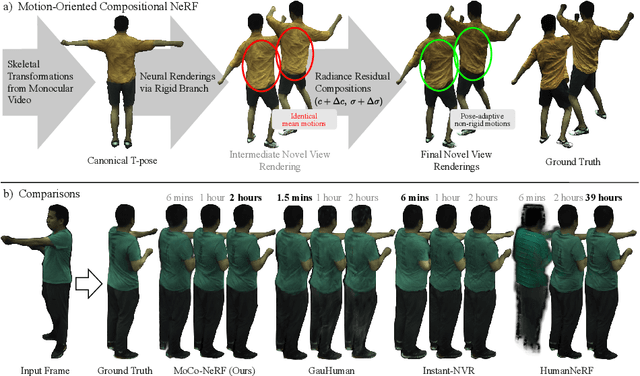
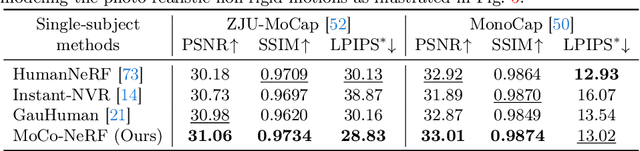


This paper introduces Motion-oriented Compositional Neural Radiance Fields (MoCo-NeRF), a framework designed to perform free-viewpoint rendering of monocular human videos via novel non-rigid motion modeling approach. In the context of dynamic clothed humans, complex cloth dynamics generate non-rigid motions that are intrinsically distinct from skeletal articulations and critically important for the rendering quality. The conventional approach models non-rigid motions as spatial (3D) deviations in addition to skeletal transformations. However, it is either time-consuming or challenging to achieve optimal quality due to its high learning complexity without a direct supervision. To target this problem, we propose a novel approach of modeling non-rigid motions as radiance residual fields to benefit from more direct color supervision in the rendering and utilize the rigid radiance fields as a prior to reduce the complexity of the learning process. Our approach utilizes a single multiresolution hash encoding (MHE) to concurrently learn the canonical T-pose representation from rigid skeletal motions and the radiance residual field for non-rigid motions. Additionally, to further improve both training efficiency and usability, we extend MoCo-NeRF to support simultaneous training of multiple subjects within a single framework, thanks to our effective design for modeling non-rigid motions. This scalability is achieved through the integration of a global MHE and learnable identity codes in addition to multiple local MHEs. We present extensive results on ZJU-MoCap and MonoCap, clearly demonstrating state-of-the-art performance in both single- and multi-subject settings. The code and model will be made publicly available at the project page: https://stevejaehyeok.github.io/publications/moco-nerf.

Learning Online Scale Transformation for Talking Head Video Generation
Jul 13, 2024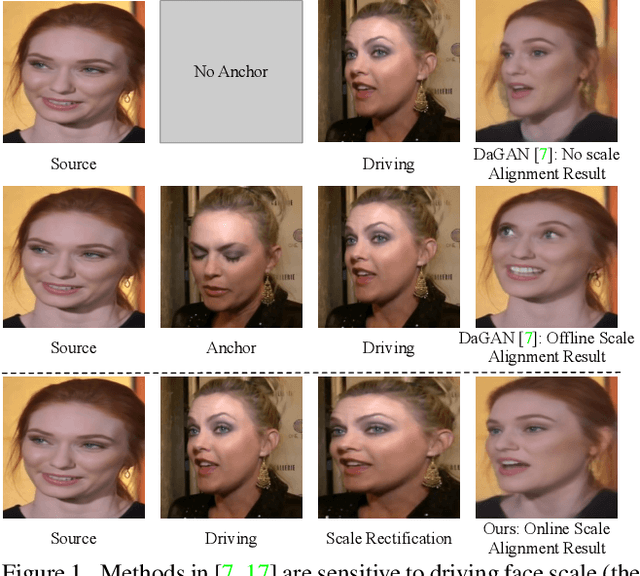
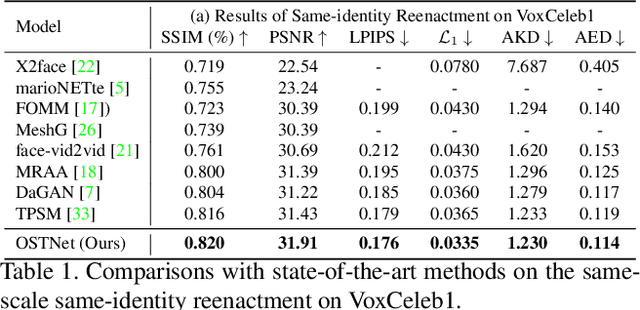
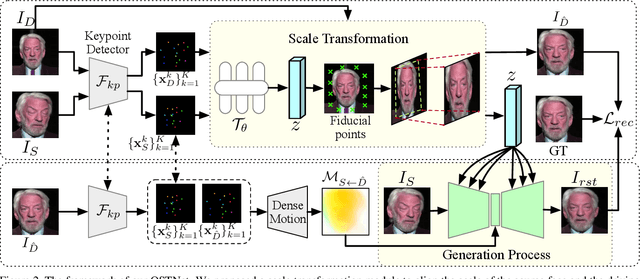
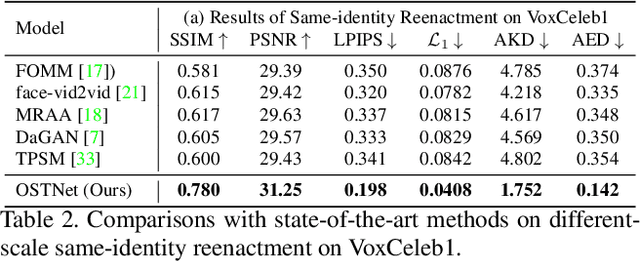
One-shot talking head video generation uses a source image and driving video to create a synthetic video where the source person's facial movements imitate those of the driving video. However, differences in scale between the source and driving images remain a challenge for face reenactment. Existing methods attempt to locate a frame in the driving video that aligns best with the source image, but imprecise alignment can result in suboptimal outcomes. To this end, we introduce a scale transformation module that can automatically adjust the scale of the driving image to fit that of the source image, by using the information of scale difference maintained in the detected keypoints of the source image and the driving frame. Furthermore, to keep perceiving the scale information of faces during the generation process, we incorporate the scale information learned from the scale transformation module into each layer of the generation process to produce a final result with an accurate scale. Our method can perform accurate motion transfer between the two images without any anchor frame, achieved through the contributions of the proposed online scale transformation facial reenactment network. Extensive experiments have demonstrated that our proposed method adjusts the scale of the driving face automatically according to the source face, and generates high-quality faces with an accurate scale in the cross-identity facial reenactment.
Sample-efficient Imitative Multi-token Decision Transformer for Generalizable Real World Driving
Jun 18, 2024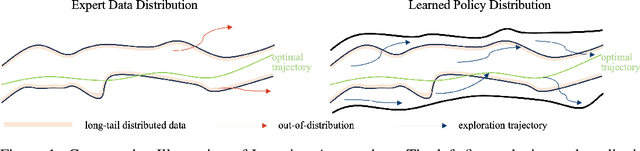

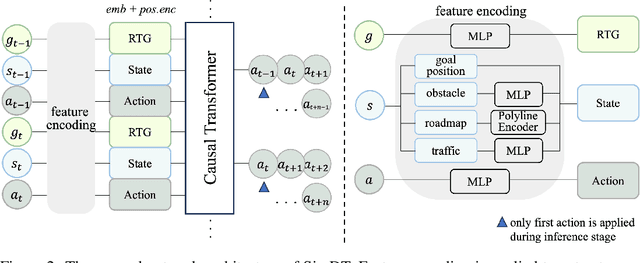

Reinforcement learning via sequence modeling has shown remarkable promise in autonomous systems, harnessing the power of offline datasets to make informed decisions in simulated environments. However, the full potential of such methods in complex dynamic environments remain to be discovered. In autonomous driving domain, learning-based agents face significant challenges when transferring knowledge from simulated to real-world settings and the performance is also significantly impacted by data distribution shift. To address these issue, we propose Sample-efficient Imitative Multi-token Decision Transformer (SimDT). SimDT introduces multi-token prediction, imitative online learning and prioritized experience replay to Decision Transformer. The performance is evaluated through empirical experiments and results exceed popular imitation and reinforcement learning algorithms on Waymax benchmark.
Holistic-Motion2D: Scalable Whole-body Human Motion Generation in 2D Space
Jun 17, 2024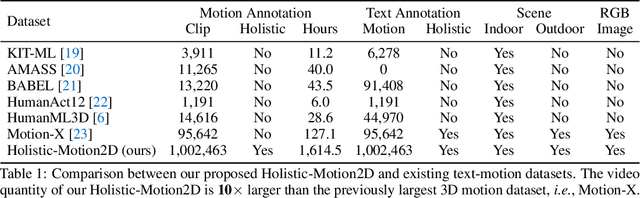
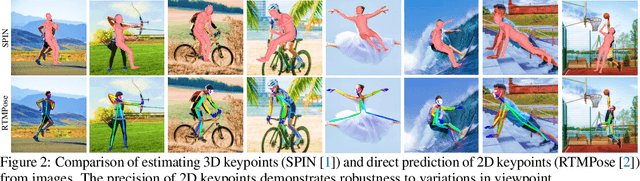
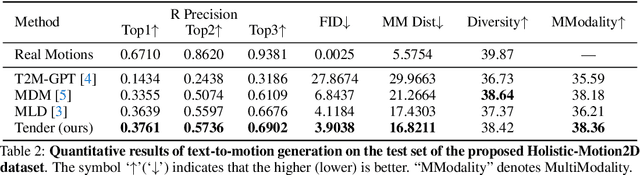
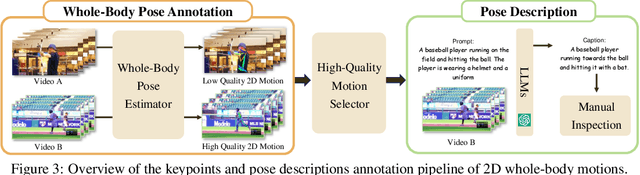
In this paper, we introduce a novel path to $\textit{general}$ human motion generation by focusing on 2D space. Traditional methods have primarily generated human motions in 3D, which, while detailed and realistic, are often limited by the scope of available 3D motion data in terms of both the size and the diversity. To address these limitations, we exploit extensive availability of 2D motion data. We present $\textbf{Holistic-Motion2D}$, the first comprehensive and large-scale benchmark for 2D whole-body motion generation, which includes over 1M in-the-wild motion sequences, each paired with high-quality whole-body/partial pose annotations and textual descriptions. Notably, Holistic-Motion2D is ten times larger than the previously largest 3D motion dataset. We also introduce a baseline method, featuring innovative $\textit{whole-body part-aware attention}$ and $\textit{confidence-aware modeling}$ techniques, tailored for 2D $\underline{\text T}$ext-driv$\underline{\text{EN}}$ whole-bo$\underline{\text D}$y motion gen$\underline{\text{ER}}$ation, namely $\textbf{Tender}$. Extensive experiments demonstrate the effectiveness of $\textbf{Holistic-Motion2D}$ and $\textbf{Tender}$ in generating expressive, diverse, and realistic human motions. We also highlight the utility of 2D motion for various downstream applications and its potential for lifting to 3D motion. The page link is: https://holistic-motion2d.github.io.
RoomTex: Texturing Compositional Indoor Scenes via Iterative Inpainting
Jun 04, 2024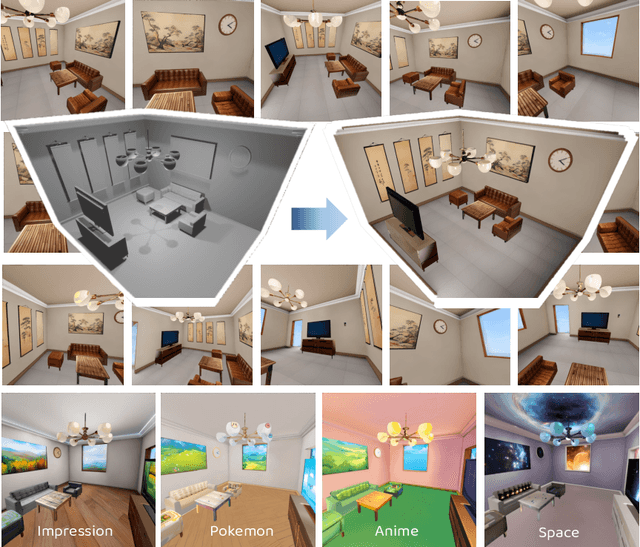
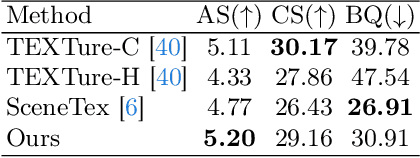
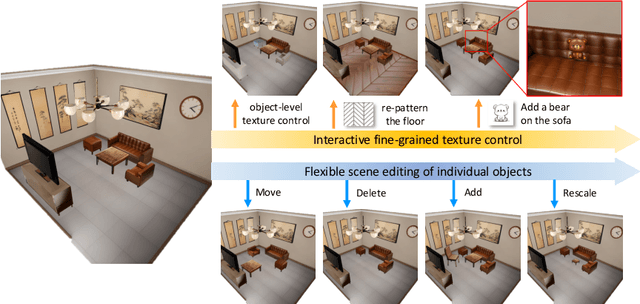
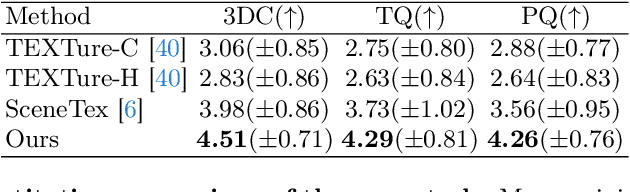
The advancement of diffusion models has pushed the boundary of text-to-3D object generation. While it is straightforward to composite objects into a scene with reasonable geometry, it is nontrivial to texture such a scene perfectly due to style inconsistency and occlusions between objects. To tackle these problems, we propose a coarse-to-fine 3D scene texturing framework, referred to as RoomTex, to generate high-fidelity and style-consistent textures for untextured compositional scene meshes. In the coarse stage, RoomTex first unwraps the scene mesh to a panoramic depth map and leverages ControlNet to generate a room panorama, which is regarded as the coarse reference to ensure the global texture consistency. In the fine stage, based on the panoramic image and perspective depth maps, RoomTex will refine and texture every single object in the room iteratively along a series of selected camera views, until this object is completely painted. Moreover, we propose to maintain superior alignment between RGB and depth spaces via subtle edge detection methods. Extensive experiments show our method is capable of generating high-quality and diverse room textures, and more importantly, supporting interactive fine-grained texture control and flexible scene editing thanks to our inpainting-based framework and compositional mesh input. Our project page is available at https://qwang666.github.io/RoomTex/.
Collaborative Novel Object Discovery and Box-Guided Cross-Modal Alignment for Open-Vocabulary 3D Object Detection
Jun 02, 2024Open-vocabulary 3D Object Detection (OV-3DDet) addresses the detection of objects from an arbitrary list of novel categories in 3D scenes, which remains a very challenging problem. In this work, we propose CoDAv2, a unified framework designed to innovatively tackle both the localization and classification of novel 3D objects, under the condition of limited base categories. For localization, the proposed 3D Novel Object Discovery (3D-NOD) strategy utilizes 3D geometries and 2D open-vocabulary semantic priors to discover pseudo labels for novel objects during training. 3D-NOD is further extended with an Enrichment strategy that significantly enriches the novel object distribution in the training scenes, and then enhances the model's ability to localize more novel objects. The 3D-NOD with Enrichment is termed 3D-NODE. For classification, the Discovery-driven Cross-modal Alignment (DCMA) module aligns features from 3D point clouds and 2D/textual modalities, employing both class-agnostic and class-specific alignments that are iteratively refined to handle the expanding vocabulary of objects. Besides, 2D box guidance boosts the classification accuracy against complex background noises, which is coined as Box-DCMA. Extensive evaluation demonstrates the superiority of CoDAv2. CoDAv2 outperforms the best-performing method by a large margin (AP_Novel of 9.17 vs. 3.61 on SUN-RGBD and 9.12 vs. 3.74 on ScanNetv2). Source code and pre-trained models are available at the GitHub project page.
PyGS: Large-scale Scene Representation with Pyramidal 3D Gaussian Splatting
May 29, 2024Neural Radiance Fields (NeRFs) have demonstrated remarkable proficiency in synthesizing photorealistic images of large-scale scenes. However, they are often plagued by a loss of fine details and long rendering durations. 3D Gaussian Splatting has recently been introduced as a potent alternative, achieving both high-fidelity visual results and accelerated rendering performance. Nonetheless, scaling 3D Gaussian Splatting is fraught with challenges. Specifically, large-scale scenes grapples with the integration of objects across multiple scales and disparate viewpoints, which often leads to compromised efficacy as the Gaussians need to balance between detail levels. Furthermore, the generation of initialization points via COLMAP from large-scale dataset is both computationally demanding and prone to incomplete reconstructions. To address these challenges, we present Pyramidal 3D Gaussian Splatting (PyGS) with NeRF Initialization. Our approach represent the scene with a hierarchical assembly of Gaussians arranged in a pyramidal fashion. The top level of the pyramid is composed of a few large Gaussians, while each subsequent layer accommodates a denser collection of smaller Gaussians. We effectively initialize these pyramidal Gaussians through sampling a rapidly trained grid-based NeRF at various frequencies. We group these pyramidal Gaussians into clusters and use a compact weighting network to dynamically determine the influence of each pyramid level of each cluster considering camera viewpoint during rendering. Our method achieves a significant performance leap across multiple large-scale datasets and attains a rendering time that is over 400 times faster than current state-of-the-art approaches.
X-VILA: Cross-Modality Alignment for Large Language Model
May 29, 2024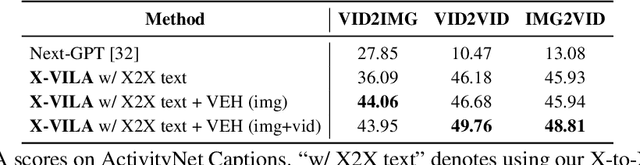
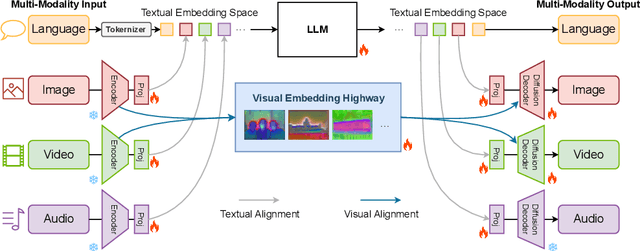

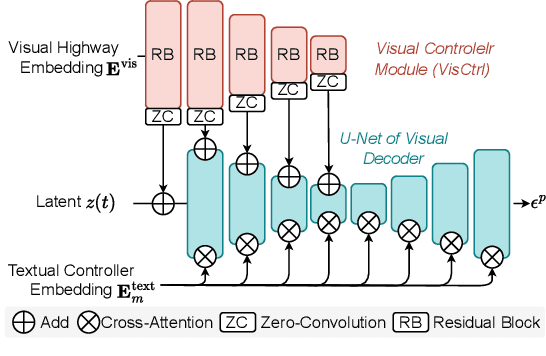
We introduce X-VILA, an omni-modality model designed to extend the capabilities of large language models (LLMs) by incorporating image, video, and audio modalities. By aligning modality-specific encoders with LLM inputs and diffusion decoders with LLM outputs, X-VILA achieves cross-modality understanding, reasoning, and generation. To facilitate this cross-modality alignment, we curate an effective interleaved any-to-any modality instruction-following dataset. Furthermore, we identify a significant problem with the current cross-modality alignment method, which results in visual information loss. To address the issue, we propose a visual alignment mechanism with a visual embedding highway module. We then introduce a resource-efficient recipe for training X-VILA, that exhibits proficiency in any-to-any modality conversation, surpassing previous approaches by large margins. X-VILA also showcases emergent properties across modalities even in the absence of similar training data. The project will be made open-source.
Efficient Multitask Dense Predictor via Binarization
May 23, 2024Multi-task learning for dense prediction has emerged as a pivotal area in computer vision, enabling simultaneous processing of diverse yet interrelated pixel-wise prediction tasks. However, the substantial computational demands of state-of-the-art (SoTA) models often limit their widespread deployment. This paper addresses this challenge by introducing network binarization to compress resource-intensive multi-task dense predictors. Specifically, our goal is to significantly accelerate multi-task dense prediction models via Binary Neural Networks (BNNs) while maintaining and even improving model performance at the same time. To reach this goal, we propose a Binary Multi-task Dense Predictor, Bi-MTDP, and several variants of Bi-MTDP, in which a multi-task dense predictor is constructed via specified binarized modules. Our systematical analysis of this predictor reveals that performance drop from binarization is primarily caused by severe information degradation. To address this issue, we introduce a deep information bottleneck layer that enforces representations for downstream tasks satisfying Gaussian distribution in forward propagation. Moreover, we introduce a knowledge distillation mechanism to correct the direction of information flow in backward propagation. Intriguingly, one variant of Bi-MTDP outperforms full-precision (FP) multi-task dense prediction SoTAs, ARTC (CNN-based) and InvPT (ViT-Based). This result indicates that Bi-MTDP is not merely a naive trade-off between performance and efficiency, but is rather a benefit of the redundant information flow thanks to the multi-task architecture. Code is available at https://github.com/42Shawn/BiMTDP.
Enhance Planning with Physics-informed Safety Controllor for End-to-end Autonomous Driving
May 01, 2024Recent years have seen a growing research interest in applications of Deep Neural Networks (DNN) on autonomous vehicle technology. The trend started with perception and prediction a few years ago and it is gradually being applied to motion planning tasks. Despite the performance of networks improve over time, DNN planners inherit the natural drawbacks of Deep Learning. Learning-based planners have limitations in achieving perfect accuracy on the training dataset and network performance can be affected by out-of-distribution problem. In this paper, we propose FusionAssurance, a novel trajectory-based end-to-end driving fusion framework which combines physics-informed control for safety assurance. By incorporating Potential Field into Model Predictive Control, FusionAssurance is capable of navigating through scenarios that are not included in the training dataset and scenarios where neural network fail to generalize. The effectiveness of the approach is demonstrated by extensive experiments under various scenarios on the CARLA benchmark.