 Add to Chrome
 Add to Firefox
 Add to Edge
VTAE: Variational Transformer Autoencoder with Manifolds Learning
Apr 03, 2023
Deep generative models have demonstrated successful applications in learning non-linear data distributions through a number of latent variables and these models use a nonlinear function (generator) to map latent samples into the data space. On the other hand, the nonlinearity of the generator implies that the latent space shows an unsatisfactory projection of the data space, which results in poor representation learning. This weak projection, however, can be addressed by a Riemannian metric, and we show that geodesics computation and accurate interpolations between data samples on the Riemannian manifold can substantially improve the performance of deep generative models. In this paper, a Variational spatial-Transformer AutoEncoder (VTAE) is proposed to minimize geodesics on a Riemannian manifold and improve representation learning. In particular, we carefully design the variational autoencoder with an encoded spatial-Transformer to explicitly expand the latent variable model to data on a Riemannian manifold, and obtain global context modelling. Moreover, to have smooth and plausible interpolations while traversing between two different objects' latent representations, we propose a geodesic interpolation network different from the existing models that use linear interpolation with inferior performance. Experiments on benchmarks show that our proposed model can improve predictive accuracy and versatility over a range of computer vision tasks, including image interpolations, and reconstructions.

Vision Transformer with Quadrangle Attention
Mar 27, 2023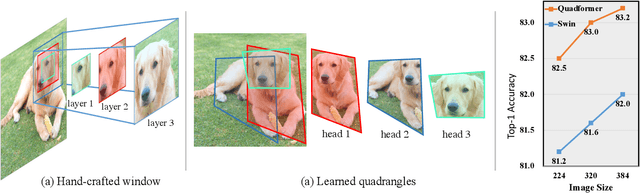

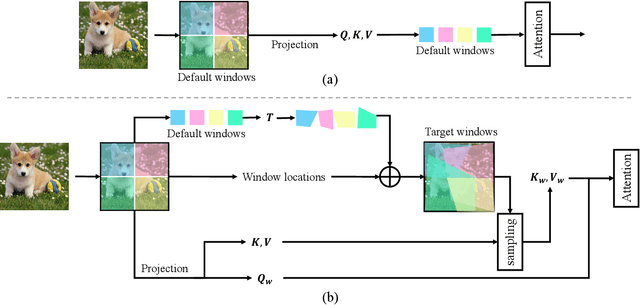
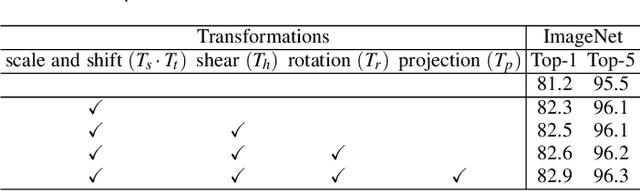
Window-based attention has become a popular choice in vision transformers due to its superior performance, lower computational complexity, and less memory footprint. However, the design of hand-crafted windows, which is data-agnostic, constrains the flexibility of transformers to adapt to objects of varying sizes, shapes, and orientations. To address this issue, we propose a novel quadrangle attention (QA) method that extends the window-based attention to a general quadrangle formulation. Our method employs an end-to-end learnable quadrangle regression module that predicts a transformation matrix to transform default windows into target quadrangles for token sampling and attention calculation, enabling the network to model various targets with different shapes and orientations and capture rich context information. We integrate QA into plain and hierarchical vision transformers to create a new architecture named QFormer, which offers minor code modifications and negligible extra computational cost. Extensive experiments on public benchmarks demonstrate that QFormer outperforms existing representative vision transformers on various vision tasks, including classification, object detection, semantic segmentation, and pose estimation. The code will be made publicly available at \href{https://github.com/ViTAE-Transformer/QFormer}{QFormer}.
Towards Making the Most of ChatGPT for Machine Translation
Mar 24, 2023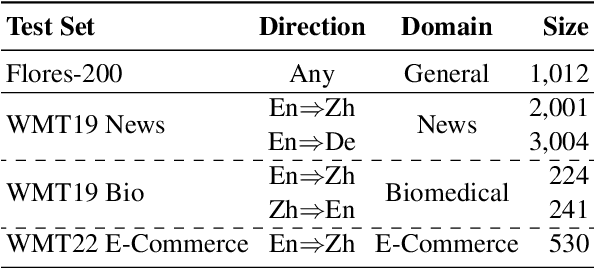
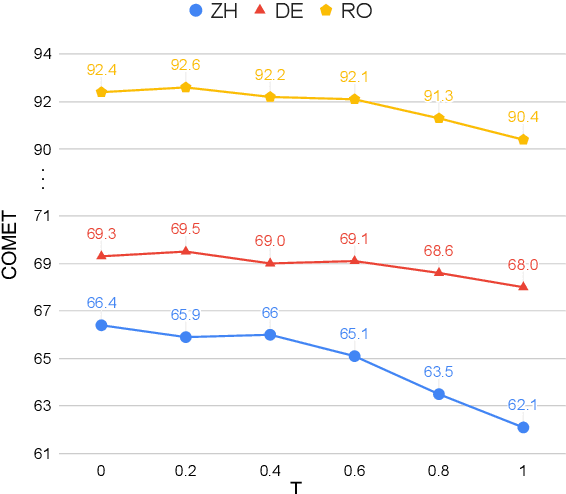
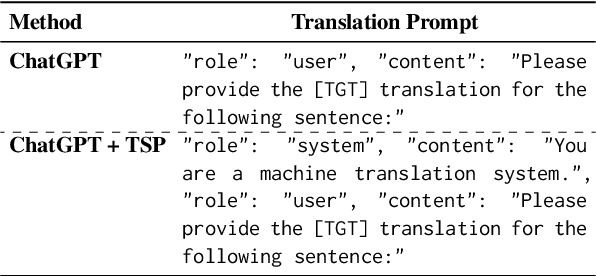
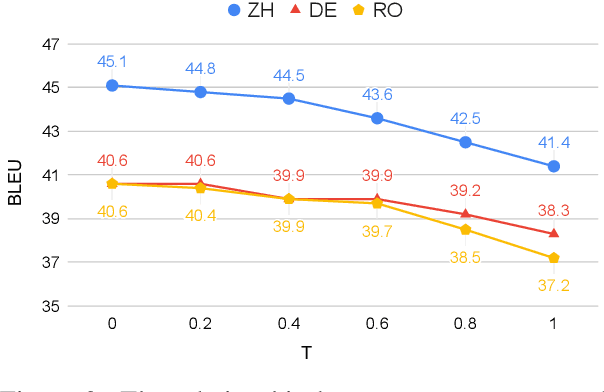
ChatGPT shows remarkable capabilities for machine translation (MT). Several prior studies have shown that it achieves comparable results to commercial systems for high-resource languages, but lags behind in complex tasks, e.g, low-resource and distant-language-pairs translation. However, they usually adopt simple prompts which can not fully elicit the capability of ChatGPT. In this report, we aim to further mine ChatGPT's translation ability by revisiting several aspects: temperature, task information, and domain information, and correspondingly propose two (simple but effective) prompts: Task-Specific Prompts (TSP) and Domain-Specific Prompts (DSP). We show that: 1) The performance of ChatGPT depends largely on temperature, and a lower temperature usually can achieve better performance; 2) Emphasizing the task information further improves ChatGPT's performance, particularly in complex MT tasks; 3) Introducing domain information can elicit ChatGPT's generalization ability and improve its performance in the specific domain; 4) ChatGPT tends to generate hallucinations for non-English-centric MT tasks, which can be partially addressed by our proposed prompts but still need to be highlighted for the MT/NLP community. We also explore the effects of advanced in-context learning strategies and find a (negative but interesting) observation: the powerful chain-of-thought prompt leads to word-by-word translation behavior, thus bringing significant translation degradation.
Error Analysis Prompting Enables Human-Like Translation Evaluation in Large Language Models: A Case Study on ChatGPT
Mar 24, 2023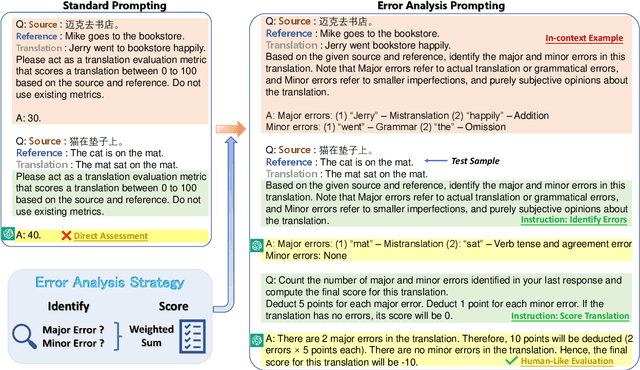
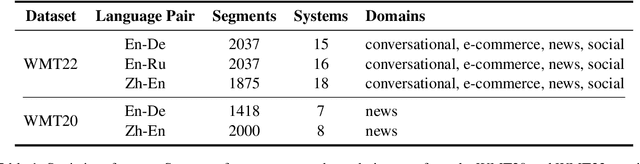
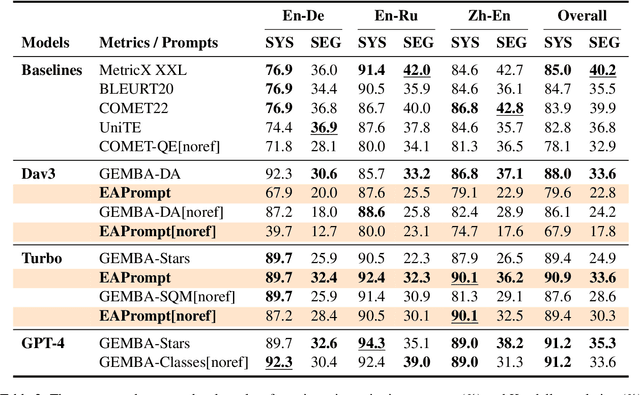
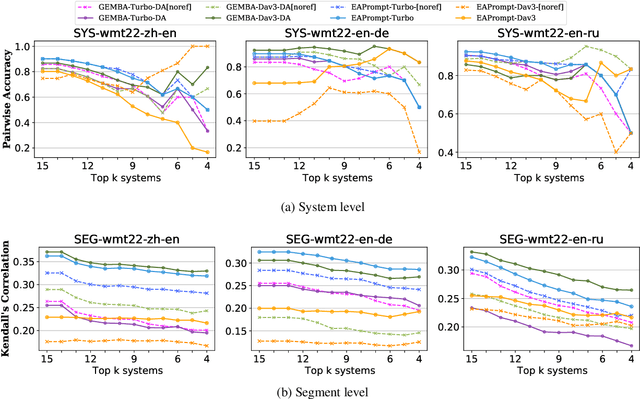
Generative large language models (LLMs), e.g., ChatGPT, have demonstrated remarkable proficiency across several NLP tasks such as machine translation, question answering, text summarization, and natural language understanding. Recent research has shown that utilizing ChatGPT for assessing the quality of machine translation (MT) achieves state-of-the-art performance at the system level but performs poorly at the segment level. To further improve the performance of LLMs on MT quality assessment, we conducted an investigation into several prompting methods. Our results indicate that by combining Chain-of-Thoughts and Error Analysis, a new prompting method called \textbf{\texttt{Error Analysis Prompting}}, LLMs like ChatGPT can \textit{generate human-like MT evaluations at both the system and segment level}. Additionally, we discovered some limitations of ChatGPT as an MT evaluator, such as unstable scoring and biases when provided with multiple translations in a single query. Our findings aim to provide a preliminary experience for appropriately evaluating translation quality on ChatGPT while offering a variety of tricks in designing prompts for in-context learning. We anticipate that this report will shed new light on advancing the field of translation evaluation with LLMs by enhancing both the accuracy and reliability of metrics. The project can be found in \url{https://github.com/Coldmist-Lu/ErrorAnalysis_Prompt}.
Make Landscape Flatter in Differentially Private Federated Learning
Mar 20, 2023

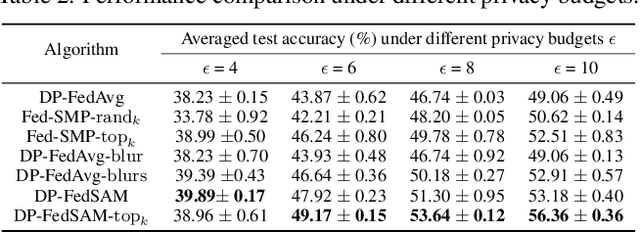
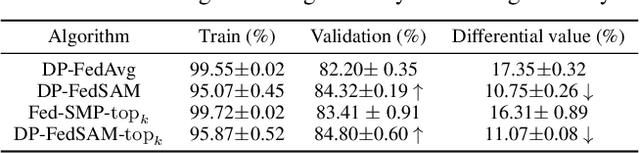
To defend the inference attacks and mitigate the sensitive information leakages in Federated Learning (FL), client-level Differentially Private FL (DPFL) is the de-facto standard for privacy protection by clipping local updates and adding random noise. However, existing DPFL methods tend to make a sharper loss landscape and have poorer weight perturbation robustness, resulting in severe performance degradation. To alleviate these issues, we propose a novel DPFL algorithm named DP-FedSAM, which leverages gradient perturbation to mitigate the negative impact of DP. Specifically, DP-FedSAM integrates Sharpness Aware Minimization (SAM) optimizer to generate local flatness models with better stability and weight perturbation robustness, which results in the small norm of local updates and robustness to DP noise, thereby improving the performance. From the theoretical perspective, we analyze in detail how DP-FedSAM mitigates the performance degradation induced by DP. Meanwhile, we give rigorous privacy guarantees with R\'enyi DP and present the sensitivity analysis of local updates. At last, we empirically confirm that our algorithm achieves state-of-the-art (SOTA) performance compared with existing SOTA baselines in DPFL.
Architecture, Dataset and Model-Scale Agnostic Data-free Meta-Learning
Mar 20, 2023The goal of data-free meta-learning is to learn useful prior knowledge from a collection of pre-trained models without accessing their training data. However, existing works only solve the problem in parameter space, which (i) ignore the fruitful data knowledge contained in the pre-trained models; (ii) can not scale to large-scale pre-trained models; (iii) can only meta-learn pre-trained models with the same network architecture. To address those issues, we propose a unified framework, dubbed PURER, which contains: (1) ePisode cUrriculum inveRsion (ECI) during data-free meta training; and (2) invErsion calibRation following inner loop (ICFIL) during meta testing. During meta training, we propose ECI to perform pseudo episode training for learning to adapt fast to new unseen tasks. Specifically, we progressively synthesize a sequence of pseudo episodes by distilling the training data from each pre-trained model. The ECI adaptively increases the difficulty level of pseudo episodes according to the real-time feedback of the meta model. We formulate the optimization process of meta training with ECI as an adversarial form in an end-to-end manner. During meta testing, we further propose a simple plug-and-play supplement-ICFIL-only used during meta testing to narrow the gap between meta training and meta testing task distribution. Extensive experiments in various real-world scenarios show the superior performance of ours.
Deep Learning for Camera Calibration and Beyond: A Survey
Mar 19, 2023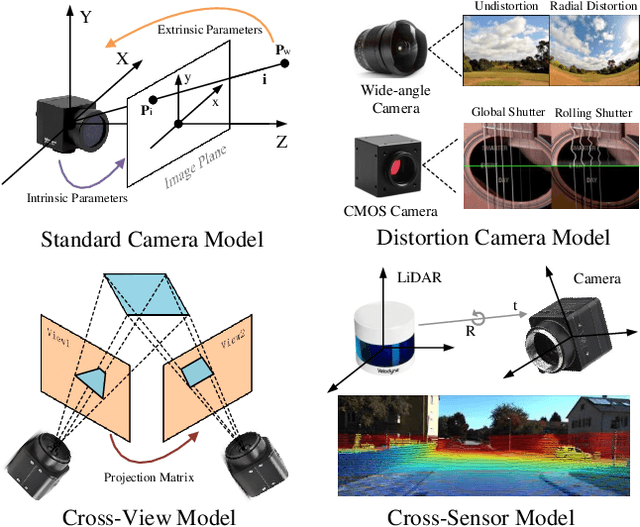
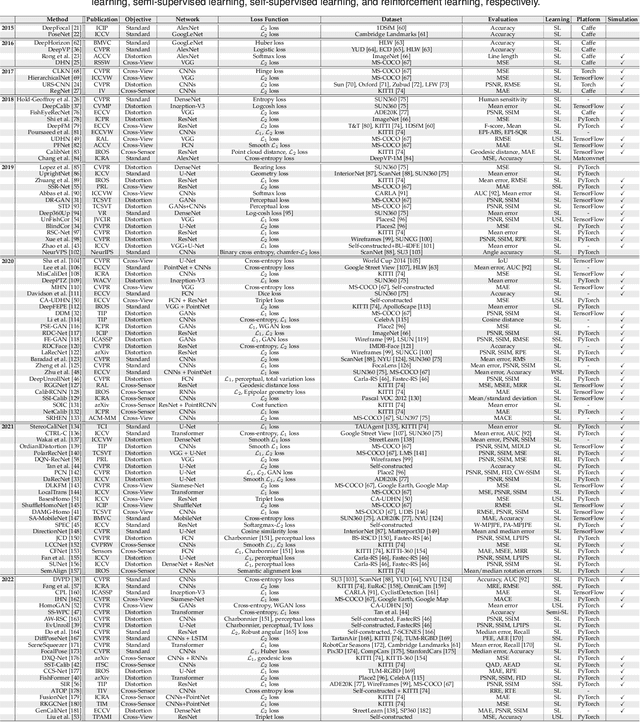
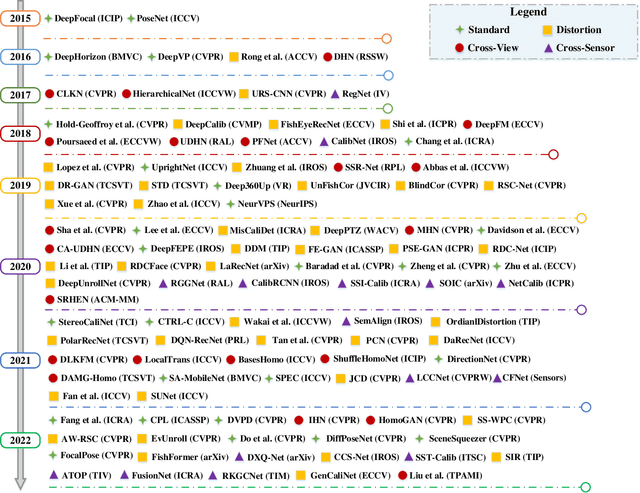
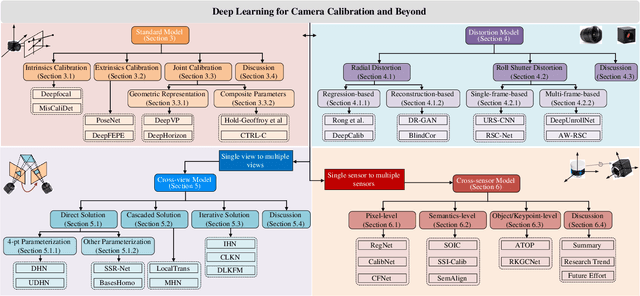
Camera calibration involves estimating camera parameters to infer geometric features from captured sequences, which is crucial for computer vision and robotics. However, conventional calibration is laborious and requires dedicated collection. Recent efforts show that learning-based solutions have the potential to be used in place of the repeatability works of manual calibrations. Among these solutions, various learning strategies, networks, geometric priors, and datasets have been investigated. In this paper, we provide a comprehensive survey of learning-based camera calibration techniques, by analyzing their strengths and limitations. Our main calibration categories include the standard pinhole camera model, distortion camera model, cross-view model, and cross-sensor model, following the research trend and extended applications. As there is no benchmark in this community, we collect a holistic calibration dataset that can serve as a public platform to evaluate the generalization of existing methods. It comprises both synthetic and real-world data, with images and videos captured by different cameras in diverse scenes. Toward the end of this paper, we discuss the challenges and provide further research directions. To our knowledge, this is the first survey for the learning-based camera calibration (spanned 8 years). The summarized methods, datasets, and benchmarks are available and will be regularly updated at https://github.com/KangLiao929/Awesome-Deep-Camera-Calibration.
DDS2M: Self-Supervised Denoising Diffusion Spatio-Spectral Model for Hyperspectral Image Restoration
Mar 19, 2023Diffusion models have recently received a surge of interest due to their impressive performance for image restoration, especially in terms of noise robustness. However, existing diffusion-based methods are trained on a large amount of training data and perform very well in-distribution, but can be quite susceptible to distribution shift. This is especially inappropriate for data-starved hyperspectral image (HSI) restoration. To tackle this problem, this work puts forth a self-supervised diffusion model for HSI restoration, namely Denoising Diffusion Spatio-Spectral Model (\texttt{DDS2M}), which works by inferring the parameters of the proposed Variational Spatio-Spectral Module (VS2M) during the reverse diffusion process, solely using the degraded HSI without any extra training data. In VS2M, a variational inference-based loss function is customized to enable the untrained spatial and spectral networks to learn the posterior distribution, which serves as the transitions of the sampling chain to help reverse the diffusion process. Benefiting from its self-supervised nature and the diffusion process, \texttt{DDS2M} enjoys stronger generalization ability to various HSIs compared to existing diffusion-based methods and superior robustness to noise compared to existing HSI restoration methods. Extensive experiments on HSI denoising, noisy HSI completion and super-resolution on a variety of HSIs demonstrate \texttt{DDS2M}'s superiority over the existing task-specific state-of-the-arts.
TriDet: Temporal Action Detection with Relative Boundary Modeling
Mar 16, 2023In this paper, we present a one-stage framework TriDet for temporal action detection. Existing methods often suffer from imprecise boundary predictions due to the ambiguous action boundaries in videos. To alleviate this problem, we propose a novel Trident-head to model the action boundary via an estimated relative probability distribution around the boundary. In the feature pyramid of TriDet, we propose an efficient Scalable-Granularity Perception (SGP) layer to mitigate the rank loss problem of self-attention that takes place in the video features and aggregate information across different temporal granularities. Benefiting from the Trident-head and the SGP-based feature pyramid, TriDet achieves state-of-the-art performance on three challenging benchmarks: THUMOS14, HACS and EPIC-KITCHEN 100, with lower computational costs, compared to previous methods. For example, TriDet hits an average mAP of $69.3\%$ on THUMOS14, outperforming the previous best by $2.5\%$, but with only $74.6\%$ of its latency. The code is released to https://github.com/sssste/TriDet.
Sensitivity-Aware Visual Parameter-Efficient Tuning
Mar 15, 2023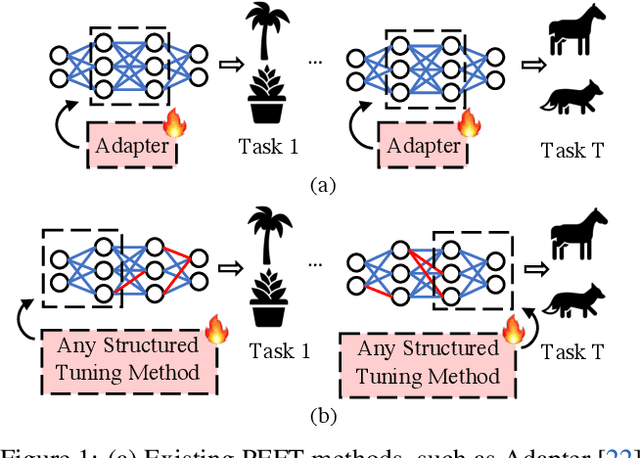
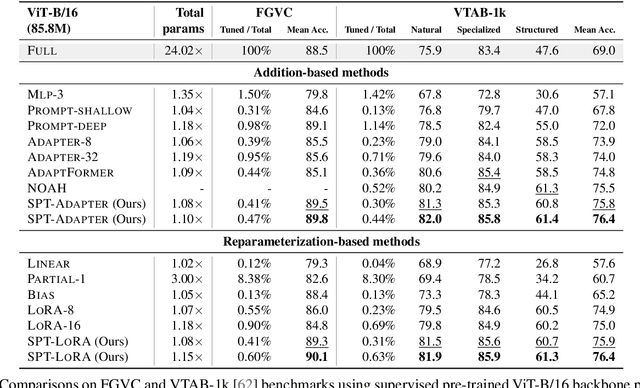

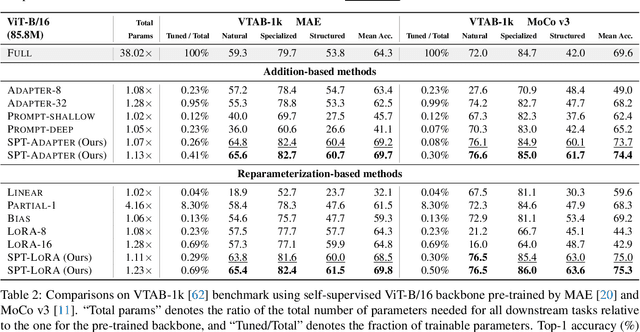
Visual Parameter-Efficient Tuning (VPET) has become a powerful alternative for full fine-tuning so as to adapt pre-trained vision models to downstream tasks, which only tunes a small number of parameters while freezing the vast majority ones to ease storage burden and optimization difficulty. However, existing VPET methods introduce trainable parameters to the same positions across different tasks depending solely on human heuristics and neglect the domain gaps. To this end, we study where to introduce and how to allocate trainable parameters by proposing a novel Sensitivity-aware visual Parameter-efficient Tuning (SPT) scheme, which adaptively allocates trainable parameters to task-specific important positions given a desired tunable parameter budget. Specifically, our SPT first quickly identifies the sensitive parameters that require tuning for a given task in a data-dependent way. Next, our SPT further boosts the representational capability for the weight matrices whose number of sensitive parameters exceeds a pre-defined threshold by utilizing any of the existing structured tuning methods, e.g., LoRA or Adapter, to replace directly tuning the selected sensitive parameters (unstructured tuning) under the budget. Extensive experiments on a wide range of downstream recognition tasks show that our SPT is complementary to the existing VPET methods and largely boosts their performance, e.g., SPT improves Adapter with supervised pre-trained ViT-B/16 backbone by 4.2% and 1.4% mean Top-1 accuracy, reaching SOTA performance on FGVC and VTAB-1k benchmarks, respectively. Source code is at https://github.com/ziplab/SPT