 Add to Chrome
 Add to Firefox
 Add to Edge
Multi-Domain Learning with Global Expert Mapping
Apr 20, 2026
Human perception generalizes well across different domains, but most vision models struggle beyond their training data. This gap motivates multi-dataset learning, where a single model is trained on diverse datasets to improve robustness under domain shifts. However, unified training remains challenging due to inconsistencies in data distributions and label semantics. Mixture-of-Experts (MoE) models provide a scalable solution by routing inputs to specialized subnetworks (experts). Yet, existing MoEs often fail to specialize effectively, as their load-balancing mechanisms enforce uniform input distribution across experts. This fairness conflicts with domain-aware routing, causing experts to learn redundant representations, and reducing performance especially on rare or out-of-distribution domains. We propose GEM (Global Expert Mapping), a planner-compiler framework that replaces the learned router with a global scheduler. Our planner, based on linear programming relaxation, computes a fractional assignment of datasets to experts, while the compiler applies hierarchical rounding to convert this soft plan into a deterministic, capacity-aware mapping. Unlike prior MoEs, GEM avoids balancing loss, resolves the conflict between fairness and specialization, and produces interpretable routing. Experiments show that GEM-DINO achieves state-of-the-art performance on the UODB benchmark, with notable gains on underrepresented datasets and solves task interference in few-shot adaptation scenarios.

Task Switching Without Forgetting via Proximal Decoupling
Apr 20, 2026In continual learning, the primary challenge is to learn new information without forgetting old knowledge. A common solution addresses this trade-off through regularization, penalizing changes to parameters critical for previous tasks. In most cases, this regularization term is directly added to the training loss and optimized with standard gradient descent, which blends learning and retention signals into a single update and does not explicitly separate essential parameters from redundant ones. As task sequences grow, this coupling can over-constrain the model, limiting forward transfer and leading to inefficient use of capacity. We propose a different approach that separates task learning from stability enforcement via operator splitting. The learning step focuses on minimizing the current task loss, while a proximal stability step applies a sparse regularizer to prune unnecessary parameters and preserve task-relevant ones. This turns the stability-plasticity into a negotiated update between two complementary operators, rather than a conflicting gradient. We provide theoretical justification for the splitting method on the continual-learning objective, and demonstrate that our proposed solver achieves state-of-the-art results on standard benchmarks, improving both stability and adaptability without the need for replay buffers, Bayesian sampling, or meta-learning components.
HMR-Net: Hierarchical Modular Routing for Cross-Domain Object Detection in Aerial Images
Apr 20, 2026Despite advances in object detection, aerial imagery remains a challenging domain, as models often fail to generalize across variations in spatial resolution, scene composition, and semantic label coverage. Differences in geographic context, sensor characteristics, and object distributions across datasets limit the capacity of conventional models to learn consistent and transferable representations. Shared methods trained on such data tend to impose a unified representation across fundamentally different domains, resulting in poor performance on region-specific content and less flexibility when dealing with novel object categories. To address this, we propose a novel modular learning framework that enables structured specialization in aerial detection. Our method introduces a hierarchical routing mechanism with two levels of modularity: a global expert assignment layer that uses latent geographic embeddings to route datasets to specialized processing modules, and a local scene decomposition mechanism that allocates image subregions to region-specific sub-modules. This allows our method to specialize across datasets and within complex scenes. Additionally, the framework contains a conditional expert module that uses external semantic information (e.g., category names or textual descriptions) to enable detection of novel object categories during inference, without the need for retraining or fine-tuning. By moving beyond monolithic representations, our method offers an adaptive framework for remote sensing object detection. Comprehensive evaluations on four datasets highlight improvements in multi-dataset generalization, regional specialization, and open-category detection.
IntRec: Intent-based Retrieval with Contrastive Refinement
Feb 19, 2026Retrieving user-specified objects from complex scenes remains a challenging task, especially when queries are ambiguous or involve multiple similar objects. Existing open-vocabulary detectors operate in a one-shot manner, lacking the ability to refine predictions based on user feedback. To address this, we propose IntRec, an interactive object retrieval framework that refines predictions based on user feedback. At its core is an Intent State (IS) that maintains dual memory sets for positive anchors (confirmed cues) and negative constraints (rejected hypotheses). A contrastive alignment function ranks candidate objects by maximizing similarity to positive cues while penalizing rejected ones, enabling fine-grained disambiguation in cluttered scenes. Our interactive framework provides substantial improvements in retrieval accuracy without additional supervision. On LVIS, IntRec achieves 35.4 AP, outperforming OVMR, CoDet, and CAKE by +2.3, +3.7, and +0.5, respectively. On the challenging LVIS-Ambiguous benchmark, it improves performance by +7.9 AP over its one-shot baseline after a single corrective feedback, with less than 30 ms of added latency per interaction.
Finding Structure in Continual Learning
Feb 04, 2026Learning from a stream of tasks usually pits plasticity against stability: acquiring new knowledge often causes catastrophic forgetting of past information. Most methods address this by summing competing loss terms, creating gradient conflicts that are managed with complex and often inefficient strategies such as external memory replay or parameter regularization. We propose a reformulation of the continual learning objective using Douglas-Rachford Splitting (DRS). This reframes the learning process not as a direct trade-off, but as a negotiation between two decoupled objectives: one promoting plasticity for new tasks and the other enforcing stability of old knowledge. By iteratively finding a consensus through their proximal operators, DRS provides a more principled and stable learning dynamic. Our approach achieves an efficient balance between stability and plasticity without the need for auxiliary modules or complex add-ons, providing a simpler yet more powerful paradigm for continual learning systems.
From Missing Pieces to Masterpieces: Image Completion with Context-Adaptive Diffusion
Apr 19, 2025Image completion is a challenging task, particularly when ensuring that generated content seamlessly integrates with existing parts of an image. While recent diffusion models have shown promise, they often struggle with maintaining coherence between known and unknown (missing) regions. This issue arises from the lack of explicit spatial and semantic alignment during the diffusion process, resulting in content that does not smoothly integrate with the original image. Additionally, diffusion models typically rely on global learned distributions rather than localized features, leading to inconsistencies between the generated and existing image parts. In this work, we propose ConFill, a novel framework that introduces a Context-Adaptive Discrepancy (CAD) model to ensure that intermediate distributions of known and unknown regions are closely aligned throughout the diffusion process. By incorporating CAD, our model progressively reduces discrepancies between generated and original images at each diffusion step, leading to contextually aligned completion. Moreover, ConFill uses a new Dynamic Sampling mechanism that adaptively increases the sampling rate in regions with high reconstruction complexity. This approach enables precise adjustments, enhancing detail and integration in restored areas. Extensive experiments demonstrate that ConFill outperforms current methods, setting a new benchmark in image completion.
Fractional Correspondence Framework in Detection Transformer
Mar 06, 2025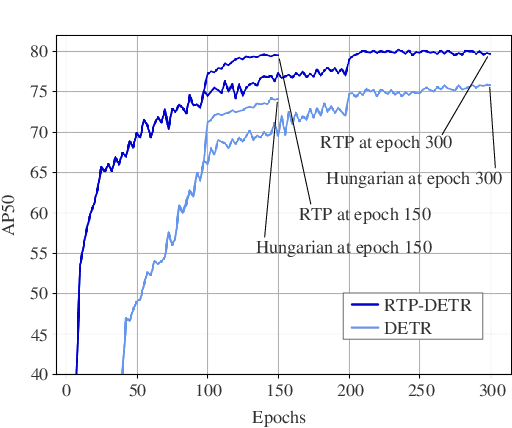
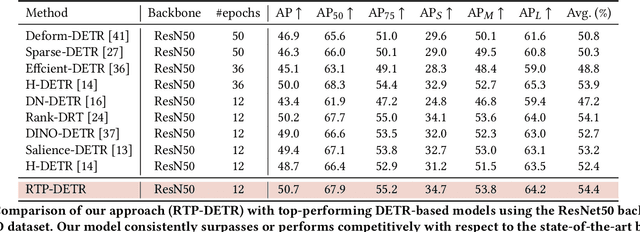
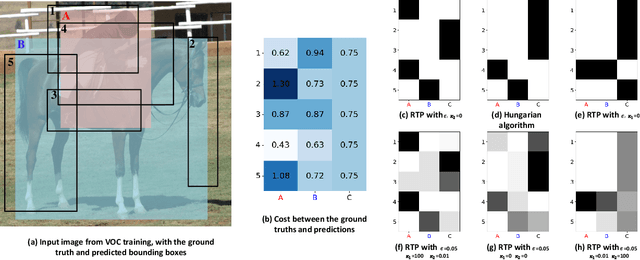
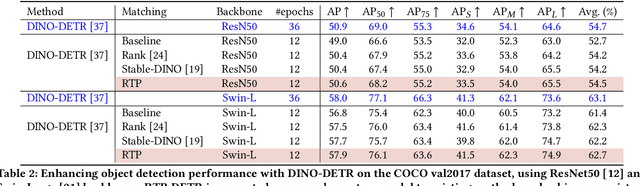
The Detection Transformer (DETR), by incorporating the Hungarian algorithm, has significantly simplified the matching process in object detection tasks. This algorithm facilitates optimal one-to-one matching of predicted bounding boxes to ground-truth annotations during training. While effective, this strict matching process does not inherently account for the varying densities and distributions of objects, leading to suboptimal correspondences such as failing to handle multiple detections of the same object or missing small objects. To address this, we propose the Regularized Transport Plan (RTP). RTP introduces a flexible matching strategy that captures the cost of aligning predictions with ground truths to find the most accurate correspondences between these sets. By utilizing the differentiable Sinkhorn algorithm, RTP allows for soft, fractional matching rather than strict one-to-one assignments. This approach enhances the model's capability to manage varying object densities and distributions effectively. Our extensive evaluations on the MS-COCO and VOC benchmarks demonstrate the effectiveness of our approach. RTP-DETR, surpassing the performance of the Deform-DETR and the recently introduced DINO-DETR, achieving absolute gains in mAP of +3.8% and +1.7%, respectively.
SeTformer is What You Need for Vision and Language
Jan 07, 2024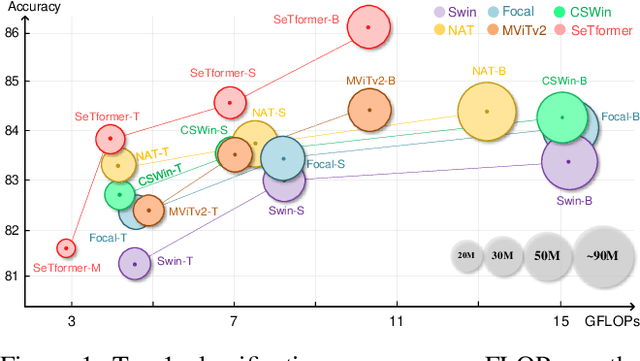
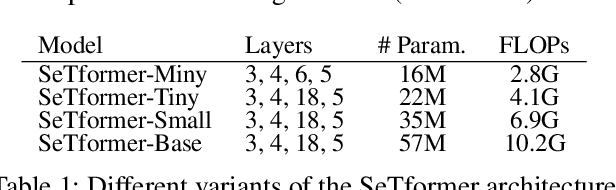
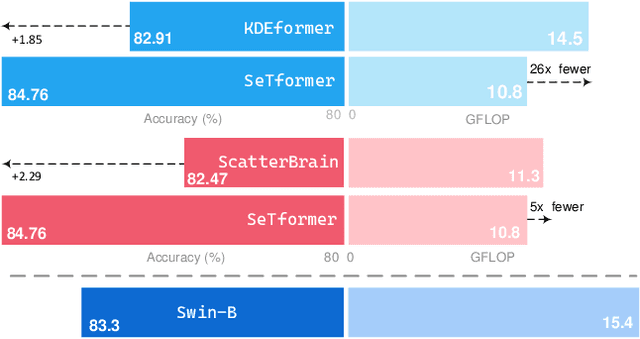
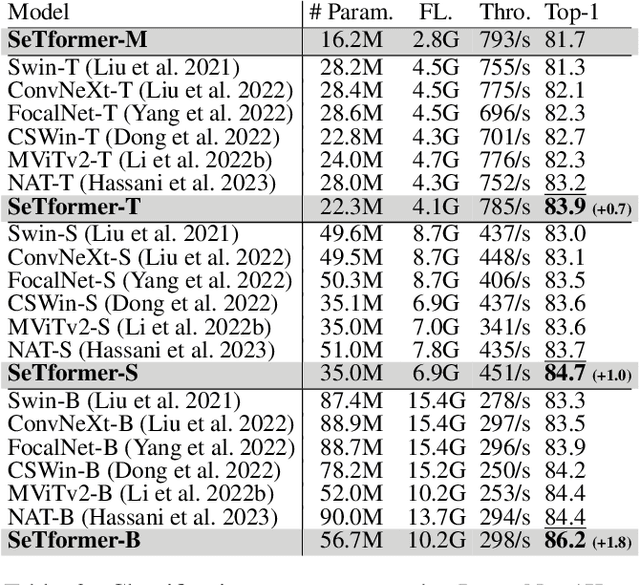
The dot product self-attention (DPSA) is a fundamental component of transformers. However, scaling them to long sequences, like documents or high-resolution images, becomes prohibitively expensive due to quadratic time and memory complexities arising from the softmax operation. Kernel methods are employed to simplify computations by approximating softmax but often lead to performance drops compared to softmax attention. We propose SeTformer, a novel transformer, where DPSA is purely replaced by Self-optimal Transport (SeT) for achieving better performance and computational efficiency. SeT is based on two essential softmax properties: maintaining a non-negative attention matrix and using a nonlinear reweighting mechanism to emphasize important tokens in input sequences. By introducing a kernel cost function for optimal transport, SeTformer effectively satisfies these properties. In particular, with small and basesized models, SeTformer achieves impressive top-1 accuracies of 84.7% and 86.2% on ImageNet-1K. In object detection, SeTformer-base outperforms the FocalNet counterpart by +2.2 mAP, using 38% fewer parameters and 29% fewer FLOPs. In semantic segmentation, our base-size model surpasses NAT by +3.5 mIoU with 33% fewer parameters. SeTformer also achieves state-of-the-art results in language modeling on the GLUE benchmark. These findings highlight SeTformer's applicability in vision and language tasks.
Distance Weighted Trans Network for Image Completion
Oct 25, 2023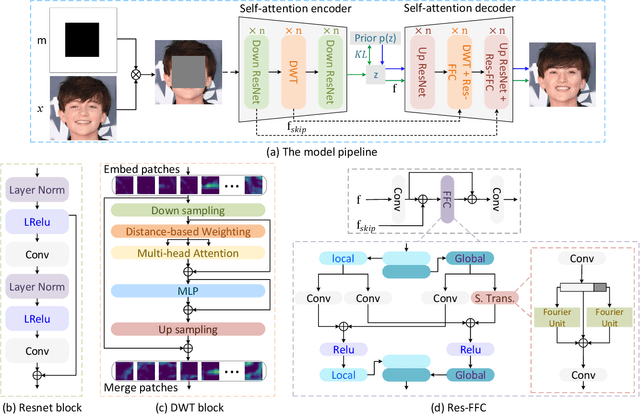

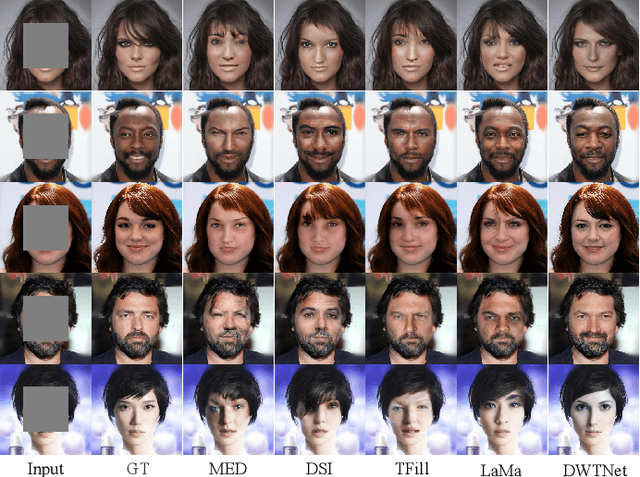
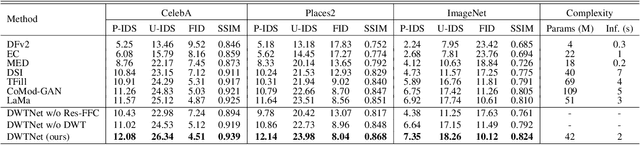
The challenge of image generation has been effectively modeled as a problem of structure priors or transformation. However, existing models have unsatisfactory performance in understanding the global input image structures because of particular inherent features (for example, local inductive prior). Recent studies have shown that self-attention is an efficient modeling technique for image completion problems. In this paper, we propose a new architecture that relies on Distance-based Weighted Transformer (DWT) to better understand the relationships between an image's components. In our model, we leverage the strengths of both Convolutional Neural Networks (CNNs) and DWT blocks to enhance the image completion process. Specifically, CNNs are used to augment the local texture information of coarse priors and DWT blocks are used to recover certain coarse textures and coherent visual structures. Unlike current approaches that generally use CNNs to create feature maps, we use the DWT to encode global dependencies and compute distance-based weighted feature maps, which substantially minimizes the problem of visual ambiguities. Meanwhile, to better produce repeated textures, we introduce Residual Fast Fourier Convolution (Res-FFC) blocks to combine the encoder's skip features with the coarse features provided by our generator. Furthermore, a simple yet effective technique is proposed to normalize the non-zero values of convolutions, and fine-tune the network layers for regularization of the gradient norms to provide an efficient training stabiliser. Extensive quantitative and qualitative experiments on three challenging datasets demonstrate the superiority of our proposed model compared to existing approaches.
Entropy Transformer Networks: A Learning Approach via Tangent Bundle Data Manifold
Jul 24, 2023This paper focuses on an accurate and fast interpolation approach for image transformation employed in the design of CNN architectures. Standard Spatial Transformer Networks (STNs) use bilinear or linear interpolation as their interpolation, with unrealistic assumptions about the underlying data distributions, which leads to poor performance under scale variations. Moreover, STNs do not preserve the norm of gradients in propagation due to their dependency on sparse neighboring pixels. To address this problem, a novel Entropy STN (ESTN) is proposed that interpolates on the data manifold distributions. In particular, random samples are generated for each pixel in association with the tangent space of the data manifold and construct a linear approximation of their intensity values with an entropy regularizer to compute the transformer parameters. A simple yet effective technique is also proposed to normalize the non-zero values of the convolution operation, to fine-tune the layers for gradients' norm-regularization during training. Experiments on challenging benchmarks show that the proposed ESTN can improve predictive accuracy over a range of computer vision tasks, including image reconstruction, and classification, while reducing the computational cost.