 Add to Chrome
 Add to Firefox
 Add to Edge
Prisma-World: Camera-Controllable Multi-Agent Video World Model
Jun 08, 2026
Video world models have made rapid progress in generating controllable visual experiences, but most of them still simulate the world from a single observer. Extending such models to multiple agents raises a central challenge: if each agent's future state is generated independently, overlapping views may instantiate different versions of the same scene, leading to inconsistent objects, layouts, and appearances across agents. Conventional camera conditioning controls individual trajectories, but it does not explicitly couple the generation of views that should agree under shared scene geometry. We introduce Prisma-World, a camera-controllable multi-agent world model that formulates multi-agent generation as a joint geometry-aware denoising process for cross-view consistency. Prisma-World processes all agent videos within one full-attention sequence, uses a multi-agent RoPE design to distinguish agent identities while preserving synchronized temporal coordinates, and injects relative camera geometry into attention to bias overlapping viewpoints toward shared scene evidence. To further strengthen multi-view consistency and enhance global spatial perception, we augment our framework with an overlap-decaying curriculum training paradigm alongside minimap-conditioned structural guidance. To facilitate the training and evaluation of multi-agent models, we introduce PrismaDataset, a large-scale UE5 dataset with panoramic acquisition across diverse scenes, composable multi-agent view groups with flexible agent counts and complex camera trajectories, and precise camera/action annotations for consistency training and evaluation. Experiments show that a single Prisma-World model can generate high-fidelity multi-agent videos with flexible agent numbers, camera controllability, improved cross-view consistency, and spatial grounding under minimap guidance.

Knowledge Visualization: A Benchmark and Method for Knowledge-Intensive Text-to-Image Generation
Apr 24, 2026Recent text-to-image (T2I) models have demonstrated impressive capabilities in photorealistic synthesis and instruction following. However, their reliability in knowledge-intensive settings remains largely unexplored. Unlike natural image generation, knowledge visualization requires not only semantic alignment but also strict adherence to domain knowledge, structural constraints, and symbolic conventions, exposing a critical gap between visual plausibility and scientific correctness. To systematically study this problem, we introduce KVBench, a curriculum-grounded benchmark for evaluating knowledge-intensive T2I generation. KVBench covers six senior high-school subjects: Biology, Chemistry, Geography, History, Mathematics, and Physics. The benchmark consists of 1,800 expert-curated prompts derived from over 30 authoritative textbooks. Using this benchmark, we evaluate 14 state-of-the-art open- and closed-source models, revealing substantial deficiencies in logical reasoning, symbolic precision, and multilingual robustness, with open-source models consistently underperforming proprietary systems. To address these limitations, we further propose KE-Check, a two-stage framework that improves scientific fidelity via (1) Knowledge Elaboration for structured prompt enrichment, and (2) Checklist-Guided Refinement for explicit constraint enforcement through violation identification and constraint-guided editing. KE-Check effectively mitigates scientific hallucinations, narrowing the performance gap between open-source and leading closed-source models. Data and codes are publicly available at https://github.com/zhaoran66/KVBench.
StructDiff: A Structure-Preserving and Spatially Controllable Diffusion Model for Single-Image Generation
Apr 14, 2026This paper introduces StructDiff, a generative framework based on a single-scale diffusion model for single-image generation. Single-image generation aims to synthesize diverse samples with similar visual content to the source image by capturing its internal statistics, without relying on external data. However, existing methods often struggle to preserve the structural layout, especially for images with large rigid objects or strict spatial constraints. Moreover, most approaches lack spatial controllability, making it difficult to guide the structure or placement of generated content. To address these challenges, StructDiff introduces an \textit{adaptive receptive field} module to maintain both global and local distributions. Building on this foundation, StructDiff incorporates 3D positional encoding (PE) as a spatial prior, allowing flexible control over positions, scale, and local details of generated objects. To our knowledge, this spatial control capability represents the first exploration of PE-based manipulation in single-image generation. Furthermore, we propose a novel evaluation criterion for single-image generation based on large language models (LLMs). This criterion specifically addresses the limitations of existing objective metrics and the high labor costs associated with user studies. StructDiff also demonstrates broad applicability across downstream tasks, such as text-guided image generation, image editing, outpainting, and paint-to-image synthesis. Extensive experiments demonstrate that StructDiff outperforms existing methods in structural consistency, visual quality, and spatial controllability. The project page is available at https://butter-crab.github.io/StructDiff/.
UniStitch: Unifying Semantic and Geometric Features for Image Stitching
Mar 11, 2026Traditional image stitching methods estimate warps from hand-crafted geometric features, whereas recent learning-based solutions leverage semantic features from neural networks instead. These two lines of research have largely diverged along separate evolution, with virtually no meaningful convergence to date. In this paper, we take a pioneering step to bridge this gap by unifying semantic and geometric features with UniStitch, a unified image stitching framework from multimodal features. To align discrete geometric features (i.e., keypoint) with continuous semantic feature maps, we present a Neural Point Transformer (NPT) module, which transforms unordered, sparse 1D geometric keypoints into ordered, dense 2D semantic maps. Then, to integrate the advantages of both representations, an Adaptive Mixture of Experts (AMoE) module is designed to fuse geometric and semantic representations. It dynamically shifts focus toward more reliable features during the fusion process, allowing the model to handle complex scenes, especially when either modality might be compromised. The fused representation can be adopted into common deep stitching pipelines, delivering significant performance gains over any single feature. Experiments show that UniStitch outperforms existing state-of-the-art methods with a large margin, paving the way for a unified paradigm between traditional and learning-based image stitching.
Geometry-Guided Reinforcement Learning for Multi-view Consistent 3D Scene Editing
Mar 03, 2026Leveraging the priors of 2D diffusion models for 3D editing has emerged as a promising paradigm. However, maintaining multi-view consistency in edited results remains challenging, and the extreme scarcity of 3D-consistent editing paired data renders supervised fine-tuning (SFT), the most effective training strategy for editing tasks, infeasible. In this paper, we observe that, while generating multi-view consistent 3D content is highly challenging, verifying 3D consistency is tractable, naturally positioning reinforcement learning (RL) as a feasible solution. Motivated by this, we propose \textbf{RL3DEdit}, a single-pass framework driven by RL optimization with novel rewards derived from the 3D foundation model, VGGT. Specifically, we leverage VGGT's robust priors learned from massive real-world data, feed the edited images, and utilize the output confidence maps and pose estimation errors as reward signals, effectively anchoring the 2D editing priors onto a 3D-consistent manifold via RL. Extensive experiments demonstrate that RL3DEdit achieves stable multi-view consistency and outperforms state-of-the-art methods in editing quality with high efficiency. To promote the development of 3D editing, we will release the code and model.
From Editor to Dense Geometry Estimator
Sep 04, 2025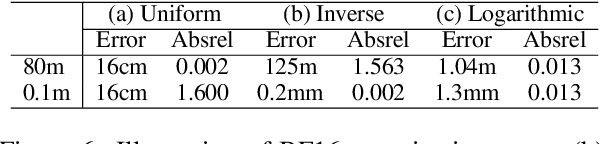
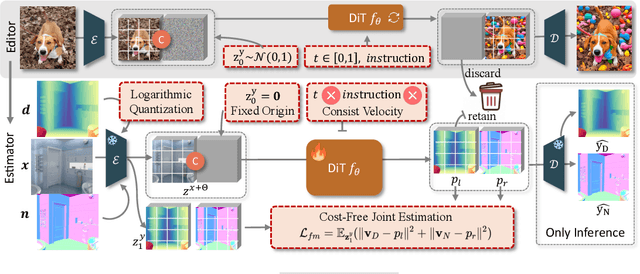
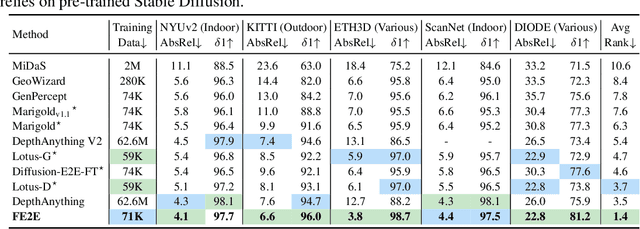
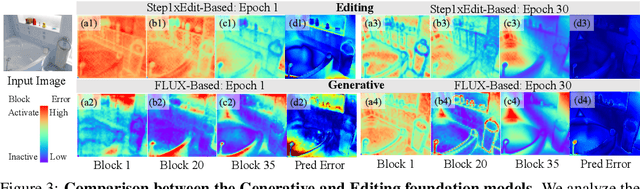
Leveraging visual priors from pre-trained text-to-image (T2I) generative models has shown success in dense prediction. However, dense prediction is inherently an image-to-image task, suggesting that image editing models, rather than T2I generative models, may be a more suitable foundation for fine-tuning. Motivated by this, we conduct a systematic analysis of the fine-tuning behaviors of both editors and generators for dense geometry estimation. Our findings show that editing models possess inherent structural priors, which enable them to converge more stably by ``refining" their innate features, and ultimately achieve higher performance than their generative counterparts. Based on these findings, we introduce \textbf{FE2E}, a framework that pioneeringly adapts an advanced editing model based on Diffusion Transformer (DiT) architecture for dense geometry prediction. Specifically, to tailor the editor for this deterministic task, we reformulate the editor's original flow matching loss into the ``consistent velocity" training objective. And we use logarithmic quantization to resolve the precision conflict between the editor's native BFloat16 format and the high precision demand of our tasks. Additionally, we leverage the DiT's global attention for a cost-free joint estimation of depth and normals in a single forward pass, enabling their supervisory signals to mutually enhance each other. Without scaling up the training data, FE2E achieves impressive performance improvements in zero-shot monocular depth and normal estimation across multiple datasets. Notably, it achieves over 35\% performance gains on the ETH3D dataset and outperforms the DepthAnything series, which is trained on 100$\times$ data. The project page can be accessed \href{https://amap-ml.github.io/FE2E/}{here}.
StabStitch++: Unsupervised Online Video Stitching with Spatiotemporal Bidirectional Warps
May 08, 2025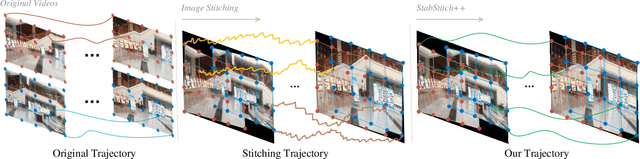
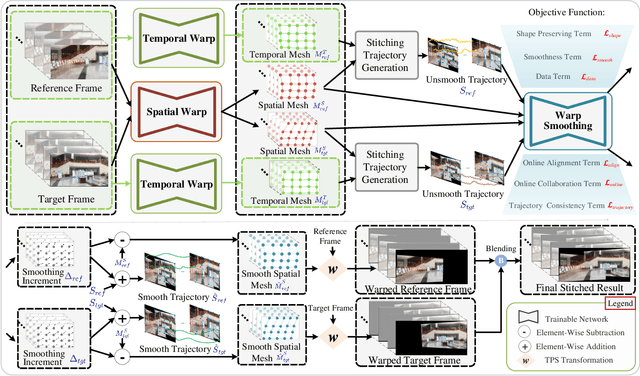
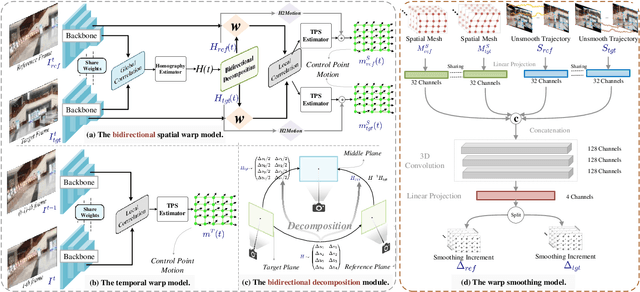
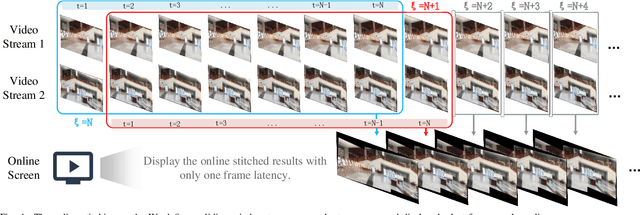
We retarget video stitching to an emerging issue, named warping shake, which unveils the temporal content shakes induced by sequentially unsmooth warps when extending image stitching to video stitching. Even if the input videos are stable, the stitched video can inevitably cause undesired warping shakes and affect the visual experience. To address this issue, we propose StabStitch++, a novel video stitching framework to realize spatial stitching and temporal stabilization with unsupervised learning simultaneously. First, different from existing learning-based image stitching solutions that typically warp one image to align with another, we suppose a virtual midplane between original image planes and project them onto it. Concretely, we design a differentiable bidirectional decomposition module to disentangle the homography transformation and incorporate it into our spatial warp, evenly spreading alignment burdens and projective distortions across two views. Then, inspired by camera paths in video stabilization, we derive the mathematical expression of stitching trajectories in video stitching by elaborately integrating spatial and temporal warps. Finally, a warp smoothing model is presented to produce stable stitched videos with a hybrid loss to simultaneously encourage content alignment, trajectory smoothness, and online collaboration. Compared with StabStitch that sacrifices alignment for stabilization, StabStitch++ makes no compromise and optimizes both of them simultaneously, especially in the online mode. To establish an evaluation benchmark and train the learning framework, we build a video stitching dataset with a rich diversity in camera motions and scenes. Experiments exhibit that StabStitch++ surpasses current solutions in stitching performance, robustness, and efficiency, offering compelling advancements in this field by building a real-time online video stitching system.
You Need a Transition Plane: Bridging Continuous Panoramic 3D Reconstruction with Perspective Gaussian Splatting
Apr 12, 2025Recently, reconstructing scenes from a single panoramic image using advanced 3D Gaussian Splatting (3DGS) techniques has attracted growing interest. Panoramic images offer a 360$\times$ 180 field of view (FoV), capturing the entire scene in a single shot. However, panoramic images introduce severe distortion, making it challenging to render 3D Gaussians into 2D distorted equirectangular space directly. Converting equirectangular images to cubemap projections partially alleviates this problem but introduces new challenges, such as projection distortion and discontinuities across cube-face boundaries. To address these limitations, we present a novel framework, named TPGS, to bridge continuous panoramic 3D scene reconstruction with perspective Gaussian splatting. Firstly, we introduce a Transition Plane between adjacent cube faces to enable smoother transitions in splatting directions and mitigate optimization ambiguity in the boundary region. Moreover, an intra-to-inter face optimization strategy is proposed to enhance local details and restore visual consistency across cube-face boundaries. Specifically, we optimize 3D Gaussians within individual cube faces and then fine-tune them in the stitched panoramic space. Additionally, we introduce a spherical sampling technique to eliminate visible stitching seams. Extensive experiments on indoor and outdoor, egocentric, and roaming benchmark datasets demonstrate that our approach outperforms existing state-of-the-art methods. Code and models will be available at https://github.com/zhijieshen-bjtu/TPGS.
Jasmine: Harnessing Diffusion Prior for Self-supervised Depth Estimation
Mar 20, 2025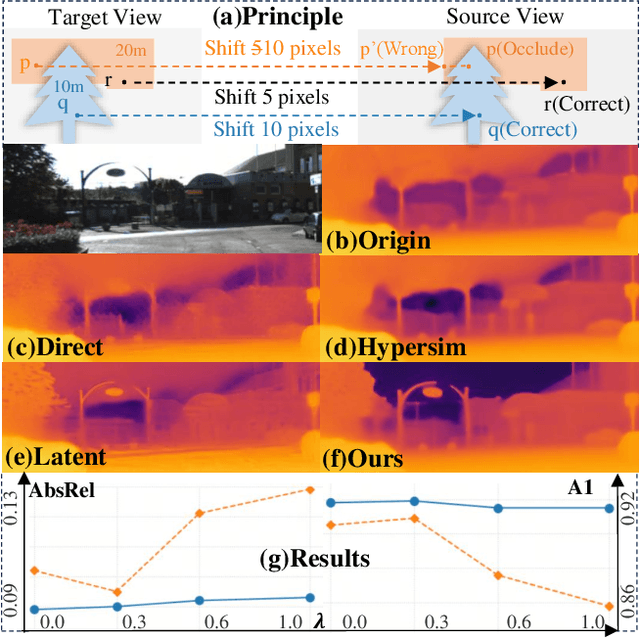
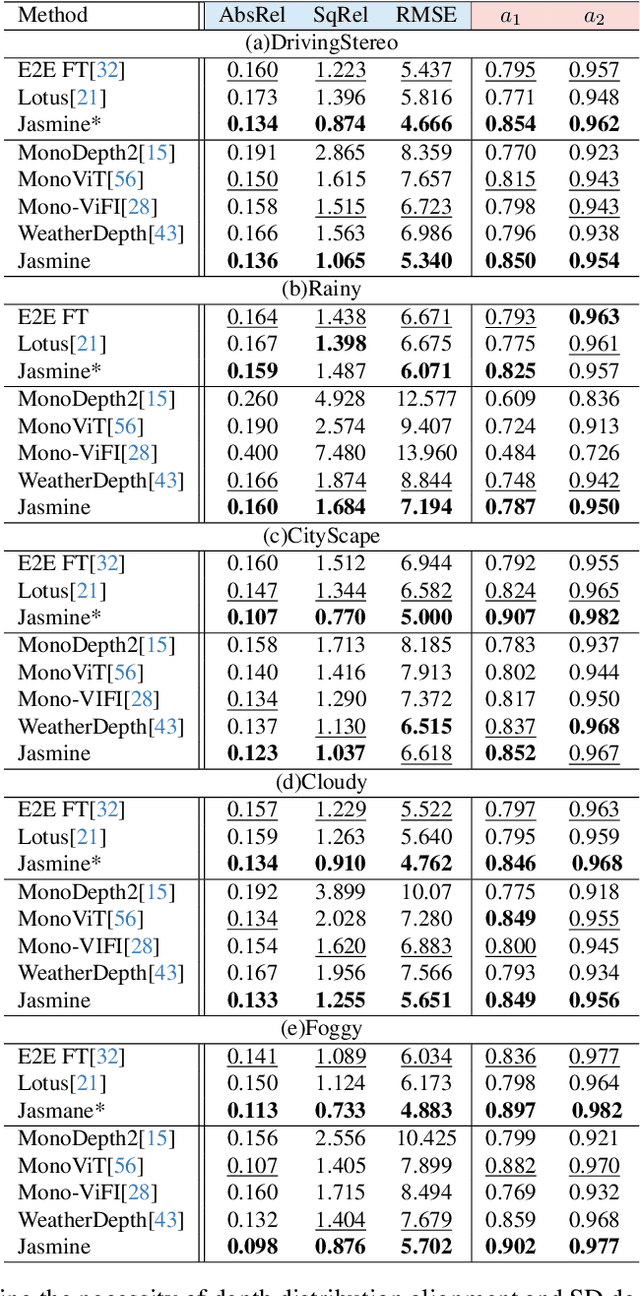
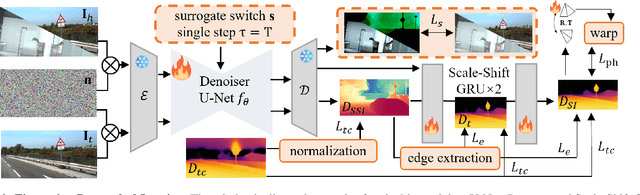
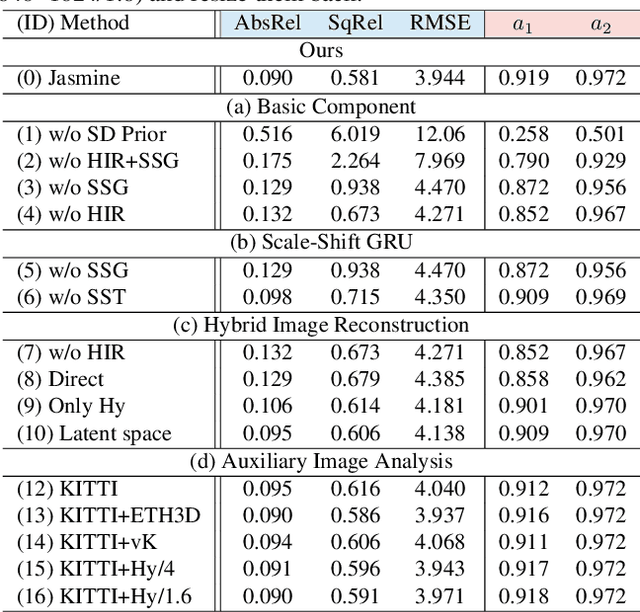
In this paper, we propose Jasmine, the first Stable Diffusion (SD)-based self-supervised framework for monocular depth estimation, which effectively harnesses SD's visual priors to enhance the sharpness and generalization of unsupervised prediction. Previous SD-based methods are all supervised since adapting diffusion models for dense prediction requires high-precision supervision. In contrast, self-supervised reprojection suffers from inherent challenges (e.g., occlusions, texture-less regions, illumination variance), and the predictions exhibit blurs and artifacts that severely compromise SD's latent priors. To resolve this, we construct a novel surrogate task of hybrid image reconstruction. Without any additional supervision, it preserves the detail priors of SD models by reconstructing the images themselves while preventing depth estimation from degradation. Furthermore, to address the inherent misalignment between SD's scale and shift invariant estimation and self-supervised scale-invariant depth estimation, we build the Scale-Shift GRU. It not only bridges this distribution gap but also isolates the fine-grained texture of SD output against the interference of reprojection loss. Extensive experiments demonstrate that Jasmine achieves SoTA performance on the KITTI benchmark and exhibits superior zero-shot generalization across multiple datasets.
Semi-Supervised 360 Layout Estimation with Panoramic Collaborative Perturbations
Mar 03, 2025The performance of existing supervised layout estimation methods heavily relies on the quality of data annotations. However, obtaining large-scale and high-quality datasets remains a laborious and time-consuming challenge. To solve this problem, semi-supervised approaches are introduced to relieve the demand for expensive data annotations by encouraging the consistent results of unlabeled data with different perturbations. However, existing solutions merely employ vanilla perturbations, ignoring the characteristics of panoramic layout estimation. In contrast, we propose a novel semi-supervised method named SemiLayout360, which incorporates the priors of the panoramic layout and distortion through collaborative perturbations. Specifically, we leverage the panoramic layout prior to enhance the model's focus on potential layout boundaries. Meanwhile, we introduce the panoramic distortion prior to strengthen distortion awareness. Furthermore, to prevent intense perturbations from hindering model convergence and ensure the effectiveness of prior-based perturbations, we divide and reorganize them as panoramic collaborative perturbations. Our experimental results on three mainstream benchmarks demonstrate that the proposed method offers significant advantages over existing state-of-the-art (SoTA) solutions.