 Add to Chrome
 Add to Firefox
 Add to Edge
Tri-Domain Multiuser MIMO Precoding Optimization and Channel Estimation with Spatial-EM Reconfigurable Antenna
May 22, 2026
In this paper, we propose a tri-domain reconfigurable multiuser multiple-input multiple-output (MIMO) communication system that integrates the electromagnetic (EM) reconfigurable antenna (EMRA) with the spatially movable antenna (SMA), termed the spatial-EM reconfigurable antenna (SEMRA). The proposed system offers EM, spatial, and digital domain degrees of freedom (DoFs) for joint channel reconfiguration, yet introduces new challenges in channel estimation (CE) and precoding optimization. Specifically, for multiuser orthogonal frequency division multiplexing (OFDM) downlink, the precoding design is formulated as a tri-domain optimization problem over antenna positions, EM-domain radiation-pattern weights, and digital precoders. We first develop a zero-forcing (ZF)-based baseline algorithm to decouple the design of spatial reconfiguration, and then propose a weighted minimum mean square error (WMMSE)-based tri-domain joint optimization algorithm for further improving the spectral efficiency (SE). Furthermore, we propose a low-overhead movement-aided channel estimation scheme in which coordinated antenna repositioning across pilot slots synthesizes a denser virtual array, enabling more accurate angle-of-departure (AoD) estimation and EM-domain channel state information (eCSI) reconstruction under the same per-user pilot overhead as the EMRA baseline. The resulting parametric representation enables eCSI assembly at desired antenna positions without additional pilots. Simulation results show that the proposed CE scheme improves eCSI estimation accuracy and the proposed SEMRA achieves higher SE than the EMRA baseline under the same pilot overhead.

Slow Movable Antenna System Design Based on Cell-Specific Long-Term Angular Power Spectrum
May 12, 2026Movable antenna (MA) has recently emerged as a promising paradigm for enhancing wireless communication performance by exploiting spatial degrees of freedom through flexible antenna repositioning. However, most existing designs rely on short-term user-specific instantaneous/statistical channel state information (CSI), which incurs excessive channel estimation overhead and complexity due to frequent antenna movement. To address this issue, this paper proposes a new design framework for antenna position optimization over a much longer timescale based on the cell-level statistical channel information acquired at the base station (BS). To this end, a cell-specific statistical channel model is developed for MA-aided multiuser communication systems, based on which the antenna position optimization framework for maximizing the ergodic system utility is formulated. Then, the covariance-eigenvalues-balancing antenna positions (CEBAP) design is derived to asymptotically approximate optimal solutions by statistically reducing users' channel correlation. Notably, the CEBAP solution solely depends on the BS-side angular power spectrum (APS) of wireless channels for mobile users across the cell, which significantly alleviates the overhead of channel acquisition and antenna movement, and yet remains effective for improving various system utilities over long timescales, such as weighted sum rate and minimum signal-to-interference-plus-noise ratio. Moreover, a low-complexity log-barrier penalized optimization (LOBPO) method is proposed to numerically solve the CEBAP. Simulation results based on realistic urban layouts and ray-tracing channels demonstrate consistent performance gains of the proposed CEBAP over fixed-position antenna systems across different utility functions, which closely approaches the upper bound achieved by instantaneous CSI-based MA optimization for moderately large antenna regions.
Flexible Cylindrical Array-Aided Secure Wireless Communications
Apr 10, 2026Flexible-geometry arrays based on movable antennas have shown considerable potential for improving wireless communication performance. In this letter, we investigate a multiuser multiple-input single-output (MU-MISO) downlink secure communication system aided by a flexible cylindrical array (FCLA) and artificial noise (AN), where each antenna element rotates along circular tracks while the circular slices move along a vertical axis. To guarantee transmission security, we aim to maximize the achievable sum rate at multiple legitimate information receivers by jointly optimizing transmit beamforming, AN covariance matrix, and antenna placement under secrecy constraints for an eavesdropper. While the resulting problem is intractable to solve, we develop a block coordinate descent (BCD)-based framework that combines the Lagrangian dual transform, tight semidefinite relaxation (SDR), and Nesterov-accelerated projected gradient descent (PGD). Numerical results show that the proposed algorithm converges rapidly and achieves significant sum-rate gains over benchmark schemes by exploiting the geometry flexibility of the array.
Rotatable Antenna-Empowered Wireless Networks: A Tutorial
Mar 26, 2026Non-fixed flexible antenna architectures, such as fluid antenna system (FAS), movable antenna (MA), and pinching antenna, have garnered significant interest in recent years. Among them, rotatable antenna (RA) has emerged as a promising technology for enhancing wireless communication and sensing performance through flexible antenna orientation/boresight rotation. By enabling mechanical or electronic boresight adjustment without altering physical antenna positions, RA introduces additional spatial degrees of freedom (DoFs) beyond conventional beamforming. In this paper, we provide a comprehensive tutorial on the fundamentals, architectures, and applications of RA-empowered wireless networks. Specifically, we begin by reviewing the historical evolution of RA-related technologies and clarifying the distinctive role of RA among flexible antenna architectures. Then, we establish a unified mathematical framework for RA-enabled systems, including general antenna/array rotation models, as well as channel models that cover near- and far-field propagation characteristics, wideband frequency selectivity, and polarization effects. Building upon this foundation, we investigate antenna/array rotation optimization in representative communication and sensing scenarios. Furthermore, we examine RA channel estimation/acquisition strategies encompassing orientation scheduling mechanisms and signal processing methods that exploit multi-view channel observations. Beyond theoretical modeling and algorithmic design, we discuss practical RA configurations and deployment strategies. We also present recent RA prototypes and experimental results that validate the practical performance gains enabled by antenna rotation. Finally, we highlight promising extensions of RA to emerging wireless paradigms and outline open challenges to inspire future research.
3-D Trajectory Optimization for Robust Direction Sensing in Movable Antenna Systems
Mar 11, 2026This paper presents a novel wireless sensing system where a movable antenna (MA) continuously moves and receives sensing signals within a three-dimensional (3-D) region to enhance sensing performance compared with conventional fixed-position antenna (FPA)-based sensing. We show that the performance of direction vector estimation for a target is fundamentally related to the 3-D MA trajectory in terms of the mean square angular error lower-bound (MSAEB), which is adopted as a coordinate-invariant performance metric. In particular, the closed-form expression of the MSAEB is derived as a function of the trajectory covariance matrix. Theoretical analysis shows that two-dimensional (2-D) antenna movement suffers from performance divergence for target direction close to the endfire direction of the 2-D MA plane, whereas 3-D movement can achieve isotropic sensing performance over the entire angular region. To achieve robust sensing performance, we formulate a min-max optimization problem to minimize the maximum (worst-case) MSAEB over a given continuous angular region wherein the target is located. An efficient successive convex approximation (SCA) algorithm is developed to optimize the 3-D MA trajectory and obtain a locally optimal solution. Numerical results demonstrate that the proposed 3-D MA sensing scheme is able to significantly reduce the worst-case mean square angular error (MSAE) compared with conventional arrays with FPAs and MA systems with 2-D movement only, thus achieving more accurate and robust direction estimation over the entire angular region.
Movable Antenna Enhanced MIMO Communications with Spatial Modulation
Jan 19, 2026Movable antenna (MA) has demonstrated great potential in enhancing wireless communication performance. In this paper, we investigate an MA-enabled multiple-input multiple-output (MIMO) communication system with spatial modulation (SM), which improves communication performance by utilizing flexible MA placement while reducing the cost of RF chains. To this end, we propose a joint transceiver design framework aimed at minimizing the bit error rate (BER) based on the maximum minimum distance (MMD) criterion. To address the intractable problem, we develop an efficient iterative algorithm based on alternating optimization (AO) and successive convex approximation (SCA) techniques. Simulation results demonstrate that the proposed algorithm achieves rapid convergence performance and significantly outperforms the existing benchmark schemes.
Movable Antenna for Integrating Near-field Channel Estimation and Localization
Jan 13, 2026Movable antenna (MA) introduces a new degree of freedom for future wireless communication systems by enabling the adaptive adjustment of antenna positions. Its large-range movement renders wireless channels transmission into the near-field region, which brings new performance enhancement for integrated sensing and communication (ISAC). This paper proposes a novel multi-stage design framework for broadband near-field ISAC assisted by MA. The framework first divides the MA movement area into multiple subregions, and employs the Newtonized orthogonal matching pursuit algorithm (NOMP) to achieve high-precision angle estimation in each subregion. Subsequently, a method called near-field localization via subregion ray clustering (LSRC) is proposed for identifying the positions of scatterers. This method finds the coordinates of each scatterer by jointly processing the angle estimates across all subregions. Finally, according to the estimated locations of the scatterers, the near-field channel estimation (CE) is refined for improving communication performance. Simulation results demonstrate that the proposed scheme can significantly enhance MA sensing accuracy and CE, providing an efficient solution for MA-aided near-field ISAC.
6D Movable Antenna Enhanced Cell-free MIMO: Two-timescale Decentralized Beamforming and Antenna Movement Optimization
Jan 08, 2026This paper investigates a six-dimensional movable antenna (6DMA)-aided cell-free multi-user multiple-input multiple-output (MIMO) communication system. In this system, each distributed access point (AP) can flexibly adjust its array orientation and antenna positions to adapt to spatial channel variations and enhance communication performance. However, frequent antenna movements and centralized beamforming based on global instantaneous channel state information (CSI) sharing among APs entail extremely high signal processing delay and system overhead, which is difficult to be practically implemented in high-mobility scenarios with short channel coherence time. To address these practical implementation challenges and improve scalability, a two-timescale decentralized optimization framework is proposed in this paper to jointly design the beamformer, antenna positions, and array orientations. In the short timescale, each AP updates its receive beamformer based on local instantaneous CSI and global statistical CSI. In the long timescale, the central processing unit optimizes the antenna positions and array orientations at all APs based on global statistical CSI to maximize the ergodic sum rate of all users. The resulting optimization problem is non-convex and involves highly coupled variables, thus posing significant challenges for obtaining efficient solutions. To address this problem, a constrained stochastic successive convex approximation algorithm is developed. Numerical results demonstrate that the proposed 6DMA-aided cell-free system with decentralized beamforming significantly outperforms other antenna movement schemes with less flexibility and even achieves a performance comparable to that of the centralized beamforming benchmark.
Fundamental Models and Signal Processing for Movable Antenna-Enhanced Wireless Communications and Sensing
Nov 07, 2025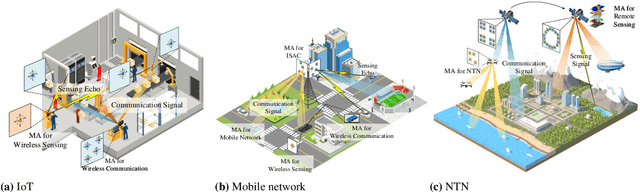
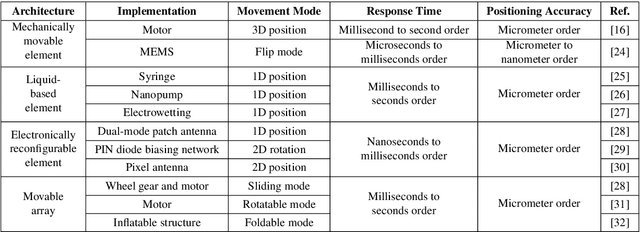
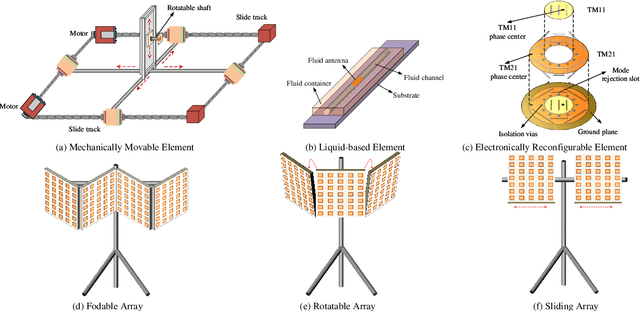
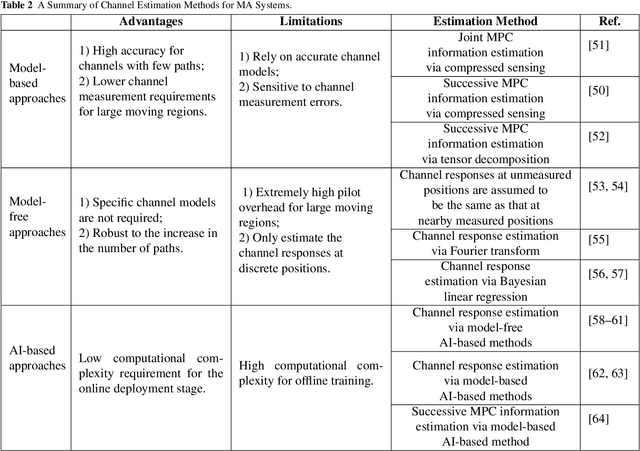
Movable antenna (MA) has been recognized as a promising technology for performance enhancement in wireless communication and sensing systems by exploiting the spatial degrees of freedom (DoFs) in flexible antenna movement. However, the integration of MAs into next-generation wireless networks still faces design challenges due to the paradigm shift from conventional fixed-position antennas (FPAs) to MAs, which motivates this paper to provide a comprehensive overview of the models, scenarios, and signal processing techniques for MA-enhanced wireless networks. First, we introduce several efficient methods to realize flexible antenna movement. Next, channel models based on field response and spatial correlation are presented to characterize the channel variations with respect to MA movement. Then, we discuss the advantages and challenges of applying MAs to typical application scenarios of wireless communications and sensing. Moreover, we show the signal processing techniques for MA-enhanced communication and sensing systems, including channel acquisition and antenna position optimization. Finally, we highlight promising research directions to inspire future investigations.
AI Signal Processing Paradigm for Movable Antenna: From Geometric Optimization to Electromagnetic Reconfigurability
Oct 22, 2025As 6G wireless communication systems evolve toward intelligence and high reconfigurability, the limitations of traditional fixed antenna (TFA) has become increasingly prominent, with geometrically movable antenna (GMA) and electromagnetically reconfigurable antenna (ERA) emerging as key technologies to break through this bottleneck. GMA activates spatial degrees of freedom (DoF) by dynamically adjusting antenna positions, ERA regulates radiation characteristics using tunable metamaterials, thereby introducing DoF in the electromagnetic domain. However, the ``geometric-electromagnetic dual reconfiguration" paradigm formed by their integration poses severe challenges of high-dimensional hybrid optimization to signal processing. To address this issue, we integrate the geometric optimization of GMA and the electromagnetic reconfiguration of ERA for the first time, propose a unified modeling framework for movable and reconfigurable antenna (MARA), investigate the channel modeling and spectral efficiency (SE) optimization for GMA, ERA, and MARA. Besides, we systematically review artificial intelligence (AI)-based solutions, focusing on analyzing the advantages of AI over traditional algorithms in high-dimensional non-convex optimization computations. This paper fills the gap in existing literature regarding the lack of a comprehensive review on the AI-driven signal processing paradigm under geometric-electromagnetic dual reconfiguration and provides theoretical support for the design and optimization of 6G wireless systems with high SE and flexibility.