 Add to Chrome
 Add to Firefox
 Add to Edge
Harmony in Diversity: Multi-domain Contrastive Policy Optimization for Large Reasoning Models
May 25, 2026
Post-training has significantly enhanced the reasoning capability of Large Reasoning Models (LRMs), especially with Reinforcement Learning (RL) like Group Relative Policy Optimization (GRPO). However, GRPO-style RL methods in multi-domain settings often fail to achieve consistent improvements across all domains due to inherent interference in policy optimization. Prior studies on multi-domain RL primarily focus on alleviating cross-domain interference, while often neglecting the pivotal role of knowledge sharing, which we argue is the key to transforming cross-domain interactions from harmful competition into beneficial transfer. To address this limitation, we propose Multi-domain Contrastive Policy Optimization (MCPO), which analyzes the structural relationships among rollouts and promotes cross-domain knowledge sharing and in-domain knowledge consolidation in a contrastive manner. Specifically, for a given prompt, MCPO identifies transferable reasoning trajectories from other domains as positive examples, while treating incorrect rollouts as negative ones. It then encourages consistent representations for positive pairs and pushes negative pairs apart, thereby facilitating knowledge transfer and reducing interference. Moreover, MCPO aligns intra-domain correct rollouts to build a consolidated representation space. In this way, MCPO contrastively learns a harmonious representation space that can accommodate diverse multi-domain knowledge. Empirical results show that MCPO improves the reasoning capabilities of LRMs across multiple domains and even outperforms single-domain training in some cases. Code is available at https://github.com/Maricalce/MCPO.

Rank Aggregation in Crowdsourcing for Listwise Annotations
Oct 10, 2024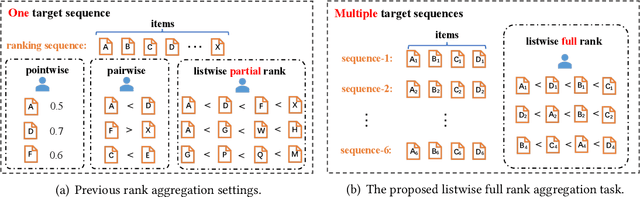

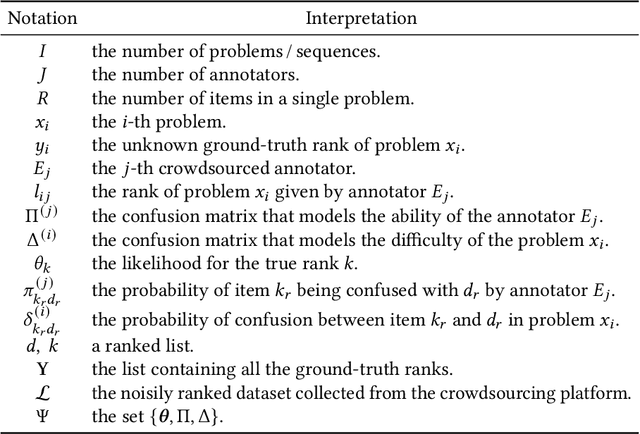
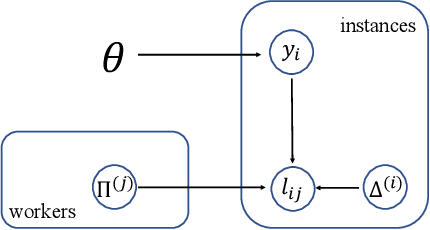
Rank aggregation through crowdsourcing has recently gained significant attention, particularly in the context of listwise ranking annotations. However, existing methods primarily focus on a single problem and partial ranks, while the aggregation of listwise full ranks across numerous problems remains largely unexplored. This scenario finds relevance in various applications, such as model quality assessment and reinforcement learning with human feedback. In light of practical needs, we propose LAC, a Listwise rank Aggregation method in Crowdsourcing, where the global position information is carefully measured and included. In our design, an especially proposed annotation quality indicator is employed to measure the discrepancy between the annotated rank and the true rank. We also take the difficulty of the ranking problem itself into consideration, as it directly impacts the performance of annotators and consequently influences the final results. To our knowledge, LAC is the first work to directly deal with the full rank aggregation problem in listwise crowdsourcing, and simultaneously infer the difficulty of problems, the ability of annotators, and the ground-truth ranks in an unsupervised way. To evaluate our method, we collect a real-world business-oriented dataset for paragraph ranking. Experimental results on both synthetic and real-world benchmark datasets demonstrate the effectiveness of our proposed LAC method.