 Add to Chrome
 Add to Firefox
 Add to Edge
AutoKnow: Self-Driving Knowledge Collection for Products of Thousands of Types
Jun 24, 2020
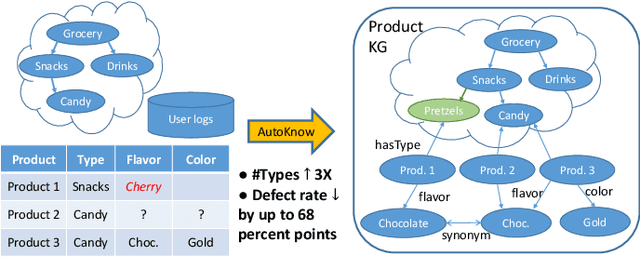
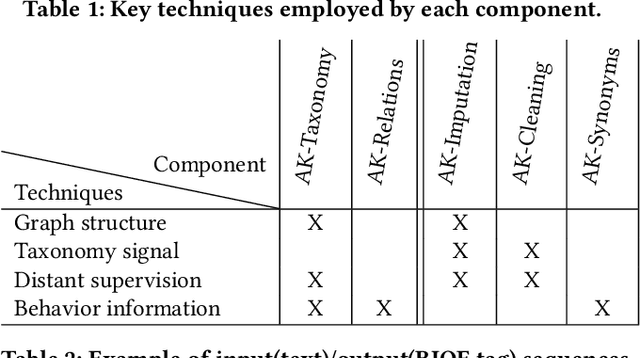
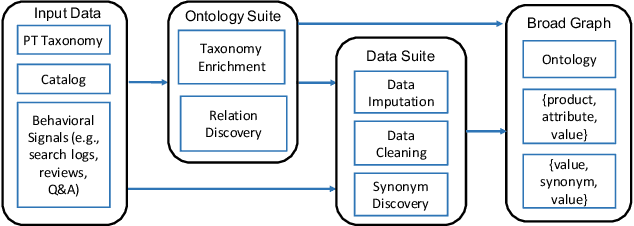
Can one build a knowledge graph (KG) for all products in the world? Knowledge graphs have firmly established themselves as valuable sources of information for search and question answering, and it is natural to wonder if a KG can contain information about products offered at online retail sites. There have been several successful examples of generic KGs, but organizing information about products poses many additional challenges, including sparsity and noise of structured data for products, complexity of the domain with millions of product types and thousands of attributes, heterogeneity across large number of categories, as well as large and constantly growing number of products. We describe AutoKnow, our automatic (self-driving) system that addresses these challenges. The system includes a suite of novel techniques for taxonomy construction, product property identification, knowledge extraction, anomaly detection, and synonym discovery. AutoKnow is (a) automatic, requiring little human intervention, (b) multi-scalable, scalable in multiple dimensions (many domains, many products, and many attributes), and (c) integrative, exploiting rich customer behavior logs. AutoKnow has been operational in collecting product knowledge for over 11K product types.

Octet: Online Catalog Taxonomy Enrichment with Self-Supervision
Jun 18, 2020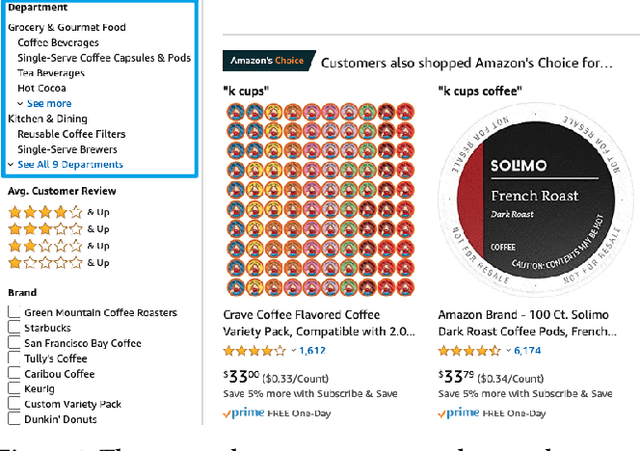
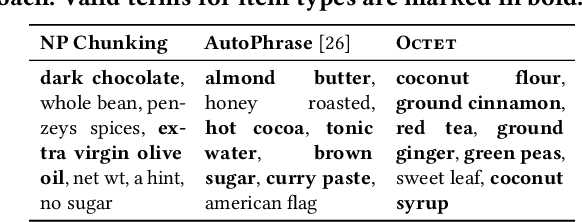
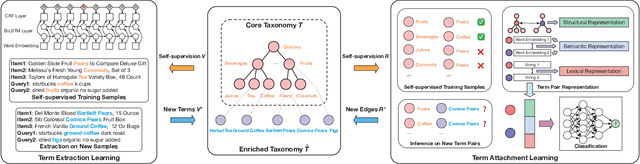
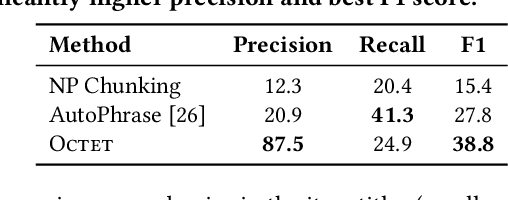
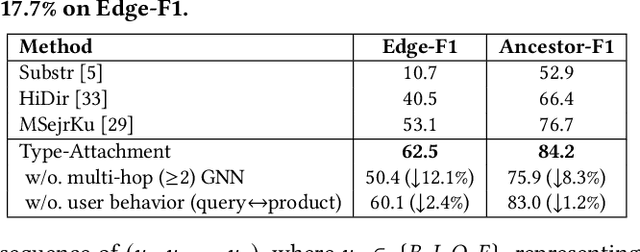
Taxonomies have found wide applications in various domains, especially online for item categorization, browsing, and search. Despite the prevalent use of online catalog taxonomies, most of them in practice are maintained by humans, which is labor-intensive and difficult to scale. While taxonomy construction from scratch is considerably studied in the literature, how to effectively enrich existing incomplete taxonomies remains an open yet important research question. Taxonomy enrichment not only requires the robustness to deal with emerging terms but also the consistency between existing taxonomy structure and new term attachment. In this paper, we present a self-supervised end-to-end framework, Octet, for Online Catalog Taxonomy EnrichmenT. Octet leverages heterogeneous information unique to online catalog taxonomies such as user queries, items, and their relations to the taxonomy nodes while requiring no other supervision than the existing taxonomies. We propose to distantly train a sequence labeling model for term extraction and employ graph neural networks (GNNs) to capture the taxonomy structure as well as the query-item-taxonomy interactions for term attachment. Extensive experiments in different online domains demonstrate the superiority of Octet over state-of-the-art methods via both automatic and human evaluations. Notably, Octet enriches an online catalog taxonomy in production to 2 times larger in the open-world evaluation.
SelfORE: Self-supervised Relational Feature Learning for Open Relation Extraction
Apr 06, 2020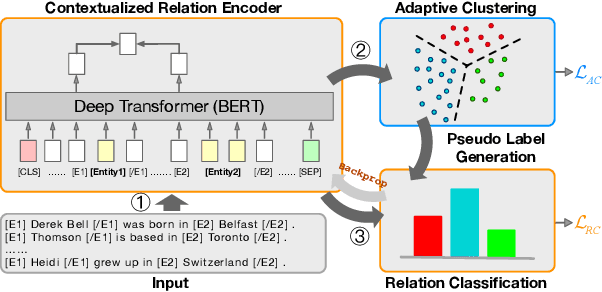
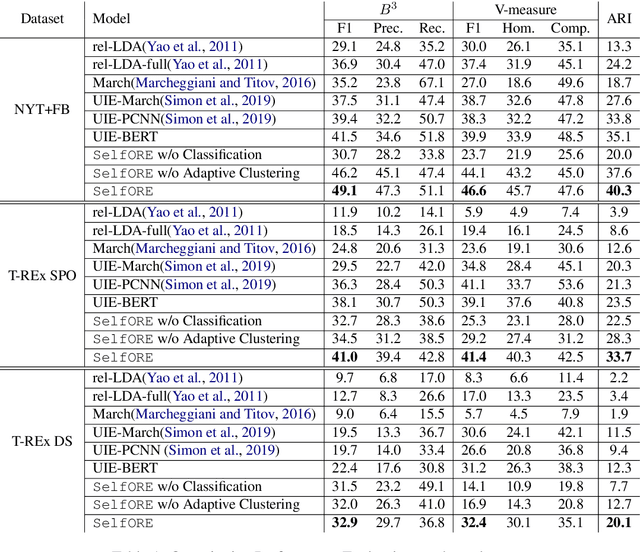

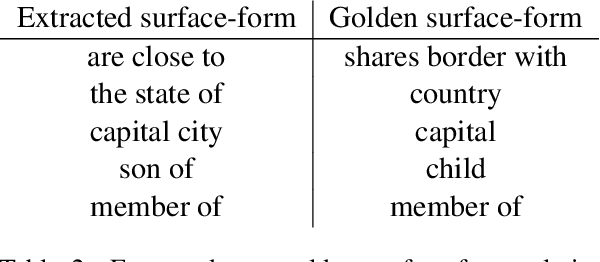
Open relation extraction is the task of extracting open-domain relation facts from natural language sentences. Existing works either utilize heuristics or distant-supervised annotations to train a supervised classifier over pre-defined relations, or adopt unsupervised methods with additional assumptions that have less discriminative power. In this work, we proposed a self-supervised framework named SelfORE, which exploits weak, self-supervised signals by leveraging large pretrained language model for adaptive clustering on contextualized relational features, and bootstraps the self-supervised signals by improving contextualized features in relation classification. Experimental results on three datasets show the effectiveness and robustness of SelfORE on open-domain Relation Extraction when comparing with competitive baselines. Source code is available at https://github.com/THU-BPM/SelfORE.
CG-BERT: Conditional Text Generation with BERT for Generalized Few-shot Intent Detection
Apr 04, 2020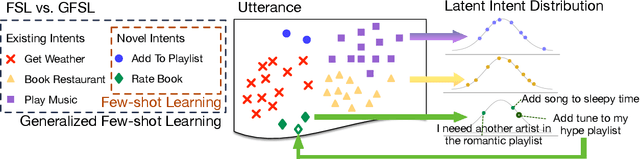
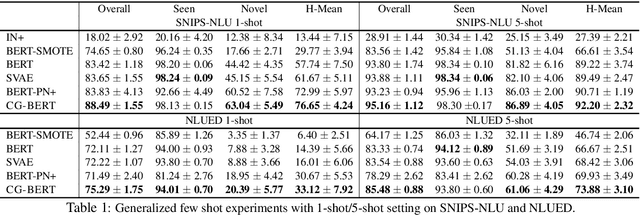
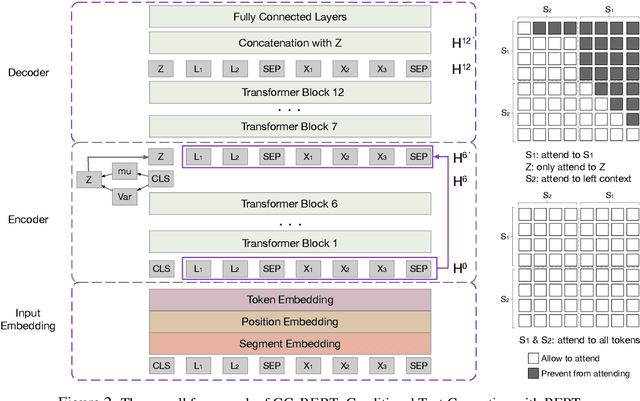
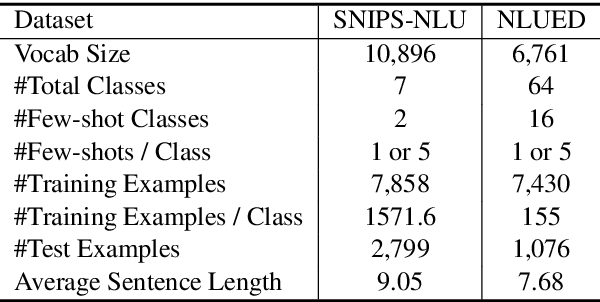
In this paper, we formulate a more realistic and difficult problem setup for the intent detection task in natural language understanding, namely Generalized Few-Shot Intent Detection (GFSID). GFSID aims to discriminate a joint label space consisting of both existing intents which have enough labeled data and novel intents which only have a few examples for each class. To approach this problem, we propose a novel model, Conditional Text Generation with BERT (CG-BERT). CG-BERT effectively leverages a large pre-trained language model to generate text conditioned on the intent label. By modeling the utterance distribution with variational inference, CG-BERT can generate diverse utterances for the novel intents even with only a few utterances available. Experimental results show that CG-BERT achieves state-of-the-art performance on the GFSID task with 1-shot and 5-shot settings on two real-world datasets.
Attribute2vec: Deep Network Embedding Through Multi-Filtering GCN
Apr 03, 2020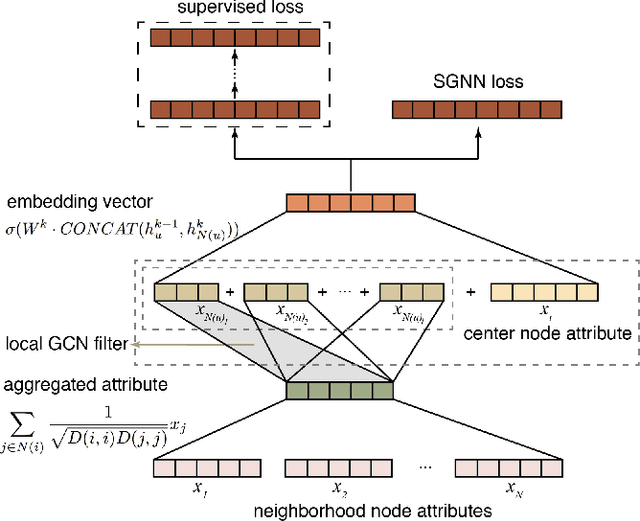
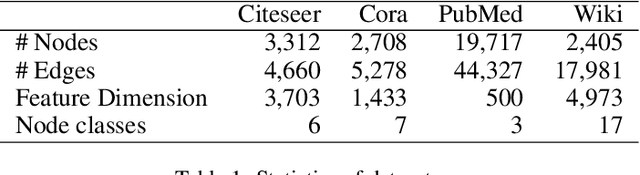
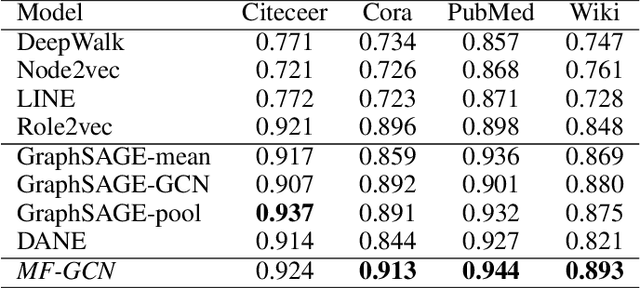
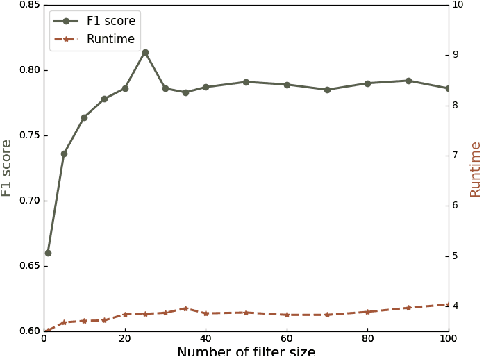
We present a multi-filtering Graph Convolution Neural Network (GCN) framework for network embedding task. It uses multiple local GCN filters to do feature extraction in every propagation layer. We show this approach could capture different important aspects of node features against the existing attribute embedding based method. We also show that with multi-filtering GCN approach, we can achieve significant improvement against baseline methods when training data is limited. We also perform many empirical experiments and demonstrate the benefit of using multiple filters against single filter as well as most current existing network embedding methods for both the link prediction and node classification tasks.
Med2Meta: Learning Representations of Medical Concepts with Meta-Embeddings
Jan 04, 2020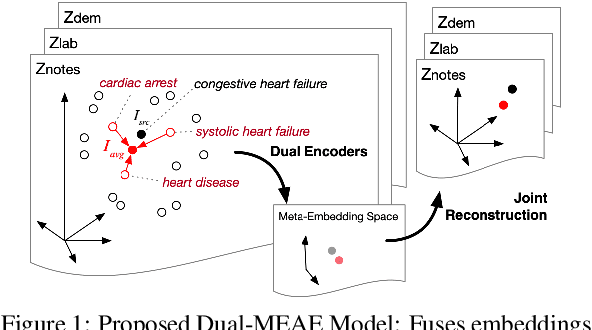
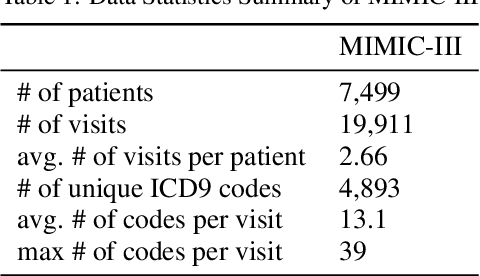
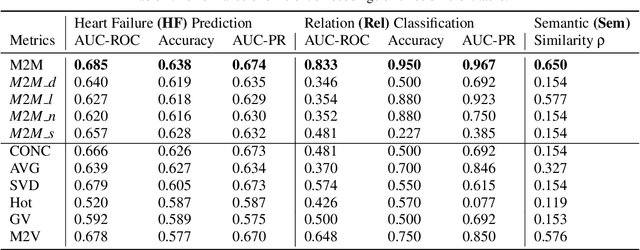

Distributed representations of medical concepts have been used to support downstream clinical tasks recently. Electronic Health Records (EHR) capture different aspects of patients' hospital encounters and serve as a rich source for augmenting clinical decision making by learning robust medical concept embeddings. However, the same medical concept can be recorded in different modalities (e.g., clinical notes, lab results)-with each capturing salient information unique to that modality-and a holistic representation calls for relevant feature ensemble from all information sources. We hypothesize that representations learned from heterogeneous data types would lead to performance enhancement on various clinical informatics and predictive modeling tasks. To this end, our proposed approach makes use of meta-embeddings, embeddings aggregated from learned embeddings. Firstly, modality-specific embeddings for each medical concept is learned with graph autoencoders. The ensemble of all the embeddings is then modeled as a meta-embedding learning problem to incorporate their correlating and complementary information through a joint reconstruction. Empirical results of our model on both quantitative and qualitative clinical evaluations have shown improvements over state-of-the-art embedding models, thus validating our hypothesis.
* 9 pages
Generative Temporal Link Prediction via Self-tokenized Sequence Modeling
Nov 26, 2019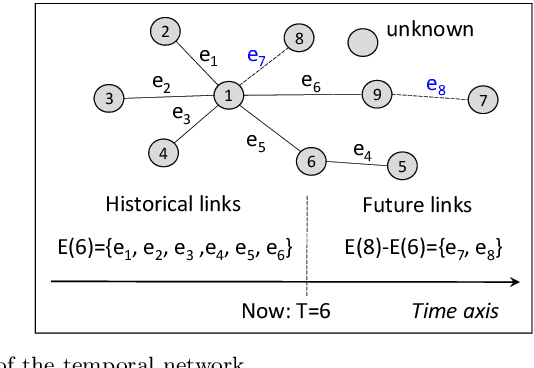
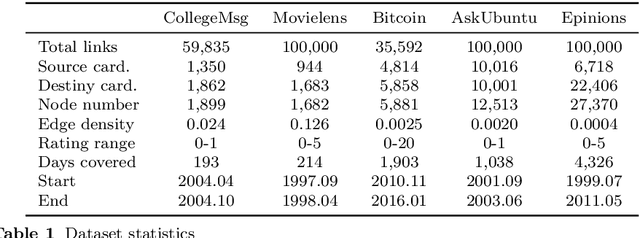
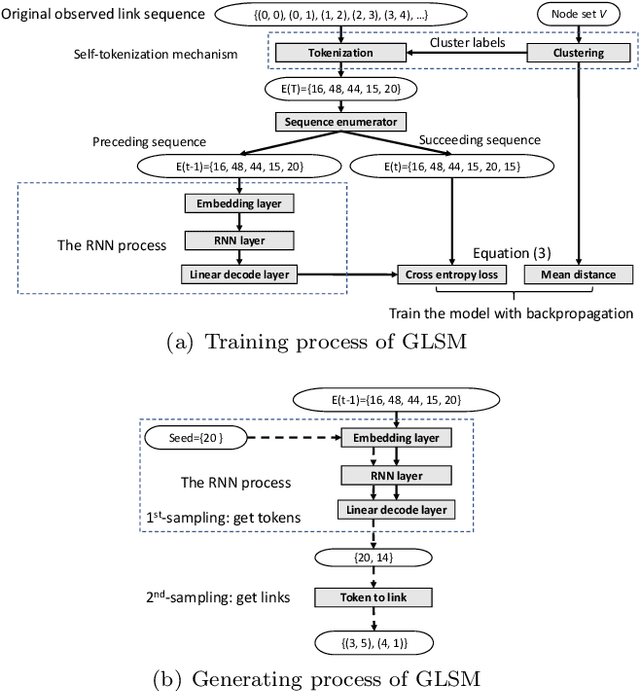
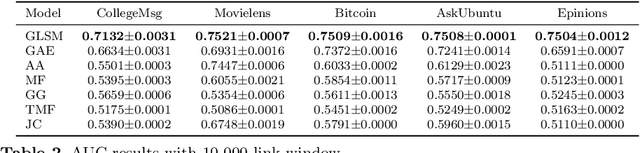
We formalize networks with evolving structures as temporal networks and propose a generative link prediction model, Generative Link Sequence Modeling (GLSM), to predict future links for temporal networks. GLSM captures the temporal link formation patterns from the observed links with a sequence modeling framework and has the ability to generate the emerging links by inferring from the probability distribution on the potential future links. To avoid overfitting caused by treating each link as a unique token, we propose a self-tokenization mechanism to transform each raw link in the network to an abstract aggregation token automatically. The self-tokenization is seamlessly integrated into the sequence modeling framework, which allows the proposed GLSM model to have the generalization capability to discover link formation patterns beyond raw link sequences. We compare GLSM with the existing state-of-art methods on five real-world datasets. The experimental results demonstrate that GLSM obtains future positive links effectively in a generative fashion while achieving the best performance (2-10\% improvements on AUC) among other alternatives.
Hierarchical Semantic Correspondence Learning for Post-Discharge Patient Mortality Prediction
Oct 15, 2019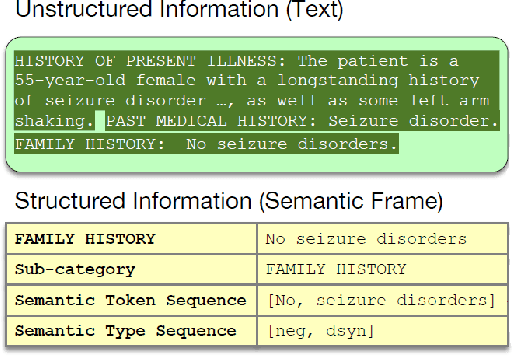
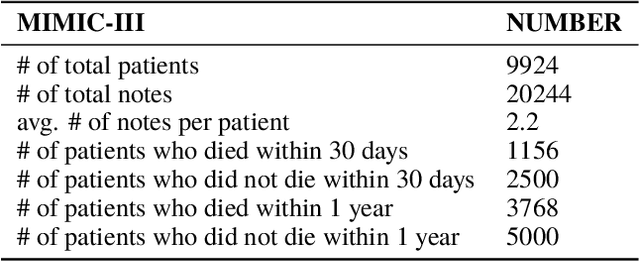
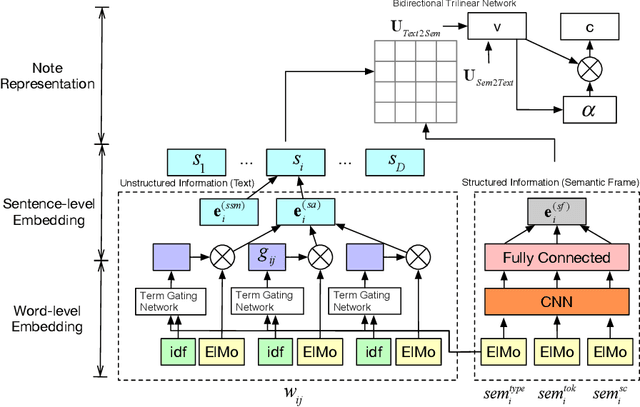
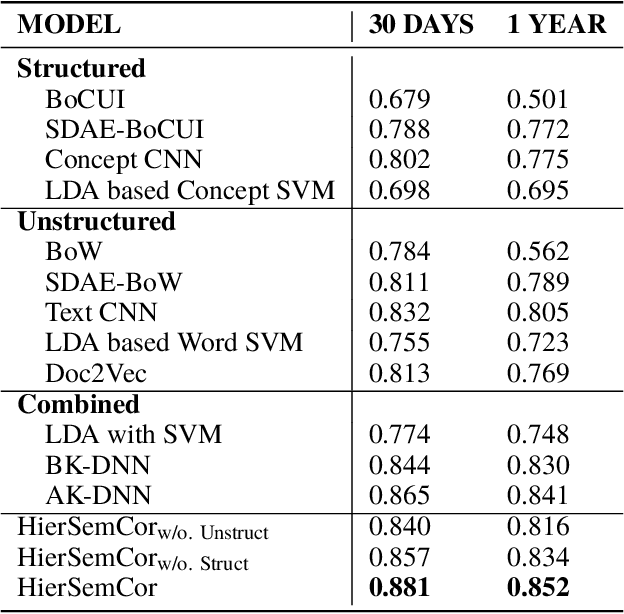
Predicting patient mortality is an important and challenging problem in the healthcare domain, especially for intensive care unit (ICU) patients. Electronic health notes serve as a rich source for learning patient representations, that can facilitate effective risk assessment. However, a large portion of clinical notes are unstructured and also contain domain specific terminologies, from which we need to extract structured information. In this paper, we introduce an embedding framework to learn semantically-plausible distributed representations of clinical notes that exploits the semantic correspondence between the unstructured texts and their corresponding structured knowledge, known as semantic frame, in a hierarchical fashion. Our approach integrates text modeling and semantic correspondence learning into a single model that comprises 1) an unstructured embedding module that makes use of self-similarity matrix representations in order to inject structural regularities of different segments inherent in clinical texts to promote local coherence, 2) a structured embedding module to embed the semantic frames (e.g., UMLS semantic types) with deep ConvNet and 3) a hierarchical semantic correspondence module that embeds by enhancing the interactions between text-semantic frame embedding pairs at multiple levels (i.e., words, sentence, note). Evaluations on multiple embedding benchmarks on post discharge intensive care patient mortality prediction tasks demonstrate its effectiveness compared to approaches that do not exploit the semantic interactions between structured and unstructured information present in clinical notes.
Mixed Pooling Multi-View Attention Autoencoder for Representation Learning in Healthcare
Oct 14, 2019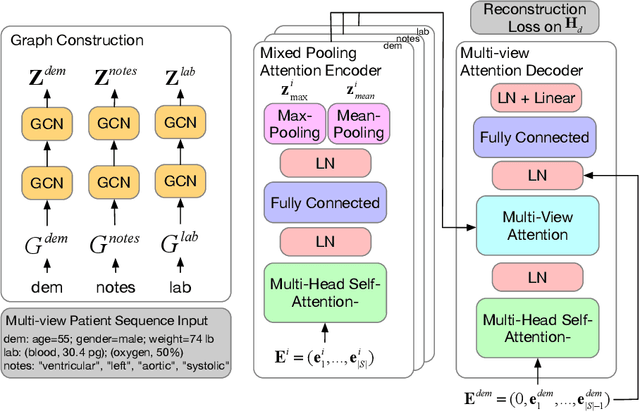
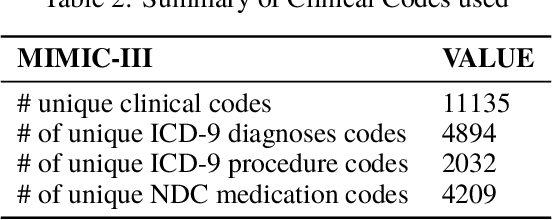
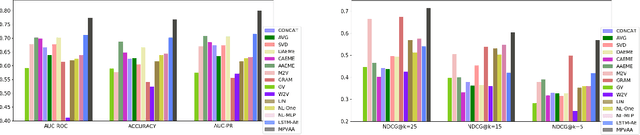
Distributed representations have been used to support downstream tasks in healthcare recently. Healthcare data (e.g., electronic health records) contain multiple modalities of data from heterogeneous sources that can provide complementary information, alongside an added dimension to learning personalized patient representations. To this end, in this paper we propose a novel unsupervised encoder-decoder model, namely Mixed Pooling Multi-View Attention Autoencoder (MPVAA), that generates patient representations encapsulating a holistic view of their medical profile. Specifically, by first learning personalized graph embeddings pertaining to each patient's heterogeneous healthcare data, it then integrates the non-linear relationships among them into a unified representation through multi-view attention mechanism. Additionally, a mixed pooling strategy is incorporated in the encoding step to learn diverse information specific to each data modality. Experiments conducted for multiple tasks demonstrate the effectiveness of the proposed model over the state-of-the-art representation learning methods in healthcare.
Generative Question Refinement with Deep Reinforcement Learning in Retrieval-based QA System
Aug 27, 2019
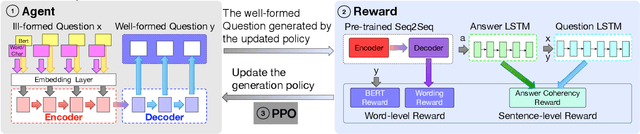

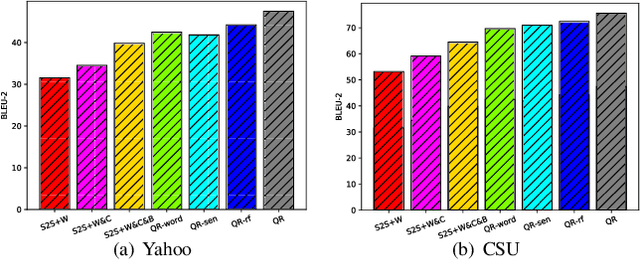
In real-world question-answering (QA) systems, ill-formed questions, such as wrong words, ill word order, and noisy expressions, are common and may prevent the QA systems from understanding and answering them accurately. In order to eliminate the effect of ill-formed questions, we approach the question refinement task and propose a unified model, QREFINE, to refine the ill-formed questions to well-formed question. The basic idea is to learn a Seq2Seq model to generate a new question from the original one. To improve the quality and retrieval performance of the generated questions, we make two major improvements: 1) To better encode the semantics of ill-formed questions, we enrich the representation of questions with character embedding and the recent proposed contextual word embedding such as BERT, besides the traditional context-free word embeddings; 2) To make it capable to generate desired questions, we train the model with deep reinforcement learning techniques that considers an appropriate wording of the generation as an immediate reward and the correlation between generated question and answer as time-delayed long-term rewards. Experimental results on real-world datasets show that the proposed QREFINE method can generate refined questions with more readability but fewer mistakes than the original questions provided by users. Moreover, the refined questions also significantly improve the accuracy of answer retrieval.