 Add to Chrome
 Add to Firefox
 Add to Edge
Single-temporal Supervised Remote Change Detection for Domain Generalization
Apr 19, 2024
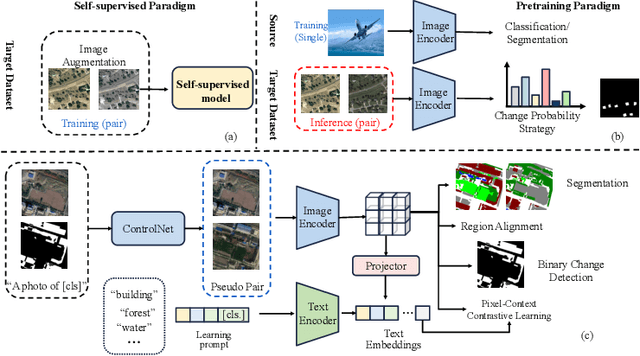
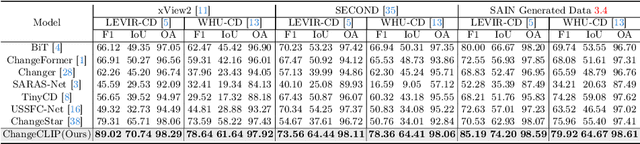
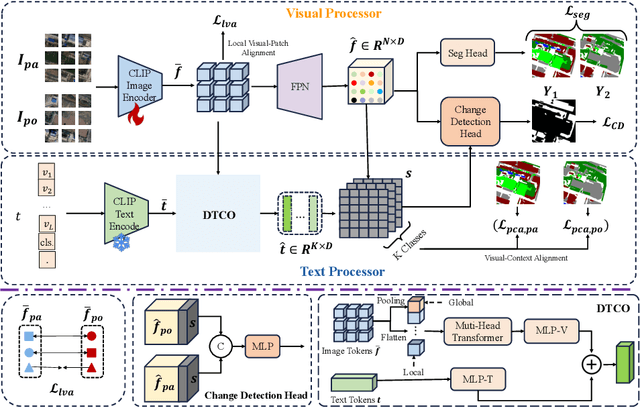
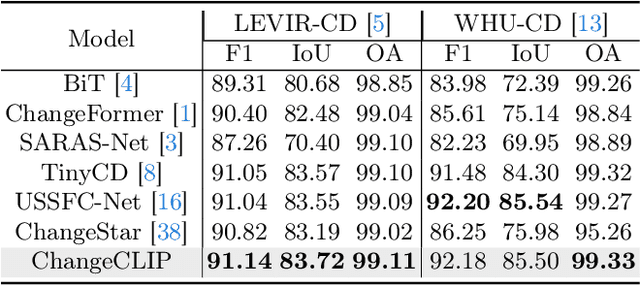
Change detection is widely applied in remote sensing image analysis. Existing methods require training models separately for each dataset, which leads to poor domain generalization. Moreover, these methods rely heavily on large amounts of high-quality pair-labelled data for training, which is expensive and impractical. In this paper, we propose a multimodal contrastive learning (ChangeCLIP) based on visual-language pre-training for change detection domain generalization. Additionally, we propose a dynamic context optimization for prompt learning. Meanwhile, to address the data dependency issue of existing methods, we introduce a single-temporal and controllable AI-generated training strategy (SAIN). This allows us to train the model using a large number of single-temporal images without image pairs in the real world, achieving excellent generalization. Extensive experiments on series of real change detection datasets validate the superiority and strong generalization of ChangeCLIP, outperforming state-of-the-art change detection methods. Code will be available.

Leveraging Fine-Grained Information and Noise Decoupling for Remote Sensing Change Detection
Apr 17, 2024Change detection aims to identify remote sense object changes by analyzing data between bitemporal image pairs. Due to the large temporal and spatial span of data collection in change detection image pairs, there are often a significant amount of task-specific and task-agnostic noise. Previous effort has focused excessively on denoising, with this goes a great deal of loss of fine-grained information. In this paper, we revisit the importance of fine-grained features in change detection and propose a series of operations for fine-grained information compensation and noise decoupling (FINO). First, the context is utilized to compensate for the fine-grained information in the feature space. Next, a shape-aware and a brightness-aware module are designed to improve the capacity for representation learning. The shape-aware module guides the backbone for more precise shape estimation, guiding the backbone network in extracting object shape features. The brightness-aware module learns a overall brightness estimation to improve the model's robustness to task-agnostic noise. Finally, a task-specific noise decoupling structure is designed as a way to improve the model's ability to separate noise interference from feature similarity. With these training schemes, our proposed method achieves new state-of-the-art (SOTA) results in multiple change detection benchmarks. The code will be made available.
Learning Feature Inversion for Multi-class Anomaly Detection under General-purpose COCO-AD Benchmark
Apr 16, 2024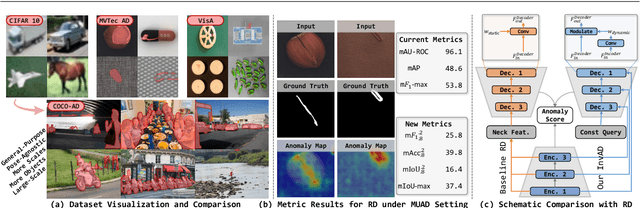

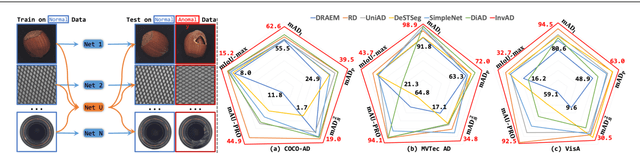

Anomaly detection (AD) is often focused on detecting anomaly areas for industrial quality inspection and medical lesion examination. However, due to the specific scenario targets, the data scale for AD is relatively small, and evaluation metrics are still deficient compared to classic vision tasks, such as object detection and semantic segmentation. To fill these gaps, this work first constructs a large-scale and general-purpose COCO-AD dataset by extending COCO to the AD field. This enables fair evaluation and sustainable development for different methods on this challenging benchmark. Moreover, current metrics such as AU-ROC have nearly reached saturation on simple datasets, which prevents a comprehensive evaluation of different methods. Inspired by the metrics in the segmentation field, we further propose several more practical threshold-dependent AD-specific metrics, ie, m$F_1$$^{.2}_{.8}$, mAcc$^{.2}_{.8}$, mIoU$^{.2}_{.8}$, and mIoU-max. Motivated by GAN inversion's high-quality reconstruction capability, we propose a simple but more powerful InvAD framework to achieve high-quality feature reconstruction. Our method improves the effectiveness of reconstruction-based methods on popular MVTec AD, VisA, and our newly proposed COCO-AD datasets under a multi-class unsupervised setting, where only a single detection model is trained to detect anomalies from different classes. Extensive ablation experiments have demonstrated the effectiveness of each component of our InvAD. Full codes and models are available at https://github.com/zhangzjn/ader.
MambaAD: Exploring State Space Models for Multi-class Unsupervised Anomaly Detection
Apr 14, 2024

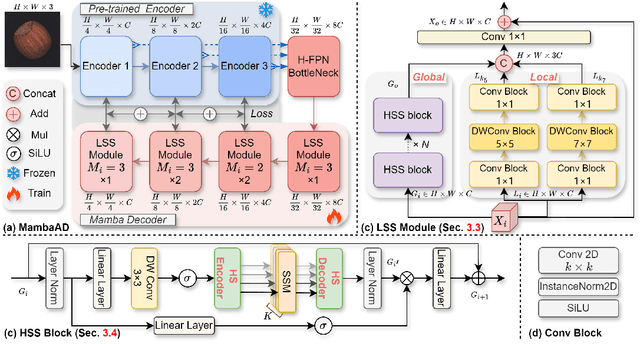
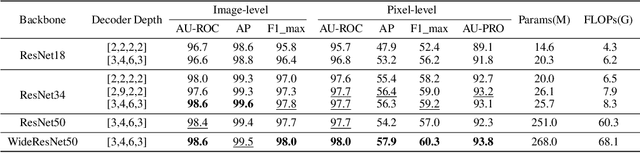
Recent advancements in anomaly detection have seen the efficacy of CNN- and transformer-based approaches. However, CNNs struggle with long-range dependencies, while transformers are burdened by quadratic computational complexity. Mamba-based models, with their superior long-range modeling and linear efficiency, have garnered substantial attention. This study pioneers the application of Mamba to multi-class unsupervised anomaly detection, presenting MambaAD, which consists of a pre-trained encoder and a Mamba decoder featuring (Locality-Enhanced State Space) LSS modules at multi-scales. The proposed LSS module, integrating parallel cascaded (Hybrid State Space) HSS blocks and multi-kernel convolutions operations, effectively captures both long-range and local information. The HSS block, utilizing (Hybrid Scanning) HS encoders, encodes feature maps into five scanning methods and eight directions, thereby strengthening global connections through the (State Space Model) SSM. The use of Hilbert scanning and eight directions significantly improves feature sequence modeling. Comprehensive experiments on six diverse anomaly detection datasets and seven metrics demonstrate state-of-the-art performance, substantiating the method's effectiveness.
Deepfake Generation and Detection: A Benchmark and Survey
Apr 09, 2024


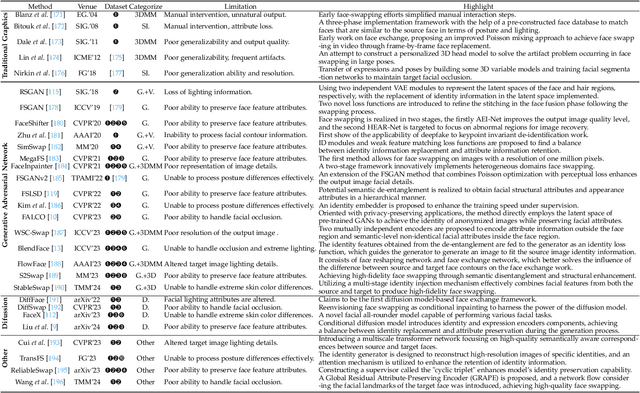
In addition to the advancements in deepfake generation, corresponding detection technologies need to continuously evolve to regulate the potential misuse of deepfakes, such as for privacy invasion and phishing attacks. This survey comprehensively reviews the latest developments in deepfake generation and detection, summarizing and analyzing the current state of the art in this rapidly evolving field. We first unify task definitions, comprehensively introduce datasets and metrics, and discuss the development of generation and detection technology frameworks. Then, we discuss the development of several related sub-fields and focus on researching four mainstream deepfake fields: popular face swap, face reenactment, talking face generation, and facial attribute editing, as well as foreign detection. Subsequently, we comprehensively benchmark representative methods on popular datasets for each field, fully evaluating the latest and influential works published in top conferences/journals. Finally, we analyze the challenges and future research directions of the discussed fields. We closely follow the latest developments in https://github.com/flyingby/Awesome-Deepfake-Generation-and-Detection.
DiffFAE: Advancing High-fidelity One-shot Facial Appearance Editing with Space-sensitive Customization and Semantic Preservation
Mar 26, 2024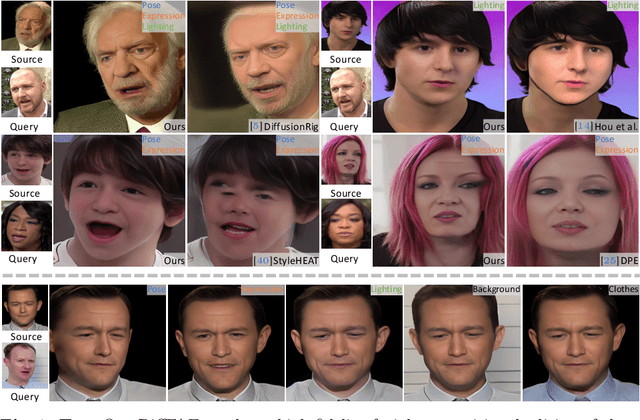
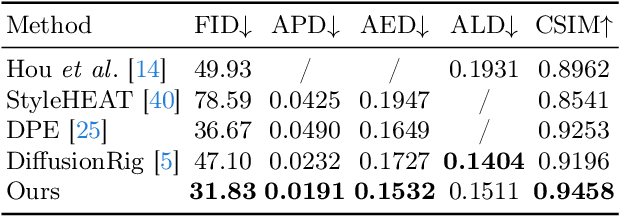
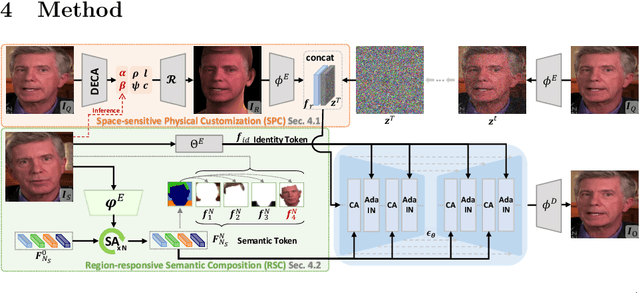
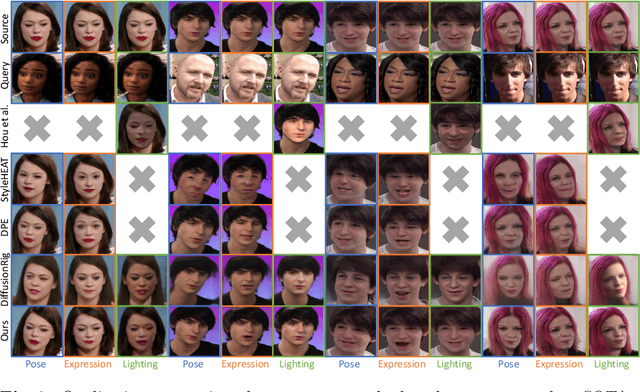
Facial Appearance Editing (FAE) aims to modify physical attributes, such as pose, expression and lighting, of human facial images while preserving attributes like identity and background, showing great importance in photograph. In spite of the great progress in this area, current researches generally meet three challenges: low generation fidelity, poor attribute preservation, and inefficient inference. To overcome above challenges, this paper presents DiffFAE, a one-stage and highly-efficient diffusion-based framework tailored for high-fidelity FAE. For high-fidelity query attributes transfer, we adopt Space-sensitive Physical Customization (SPC), which ensures the fidelity and generalization ability by utilizing rendering texture derived from 3D Morphable Model (3DMM). In order to preserve source attributes, we introduce the Region-responsive Semantic Composition (RSC). This module is guided to learn decoupled source-regarding features, thereby better preserving the identity and alleviating artifacts from non-facial attributes such as hair, clothes, and background. We further introduce a consistency regularization for our pipeline to enhance editing controllability by leveraging prior knowledge in the attention matrices of diffusion model. Extensive experiments demonstrate the superiority of DiffFAE over existing methods, achieving state-of-the-art performance in facial appearance editing.
SoftPatch: Unsupervised Anomaly Detection with Noisy Data
Mar 21, 2024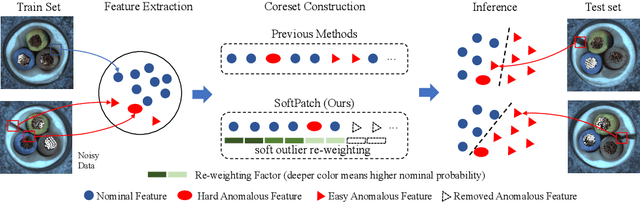
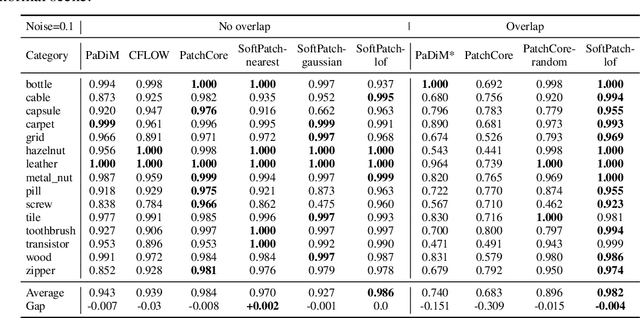
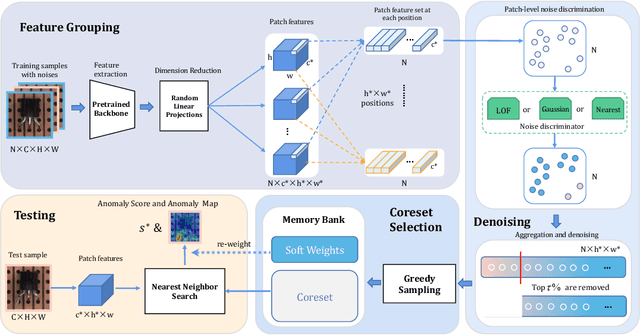

Although mainstream unsupervised anomaly detection (AD) algorithms perform well in academic datasets, their performance is limited in practical application due to the ideal experimental setting of clean training data. Training with noisy data is an inevitable problem in real-world anomaly detection but is seldom discussed. This paper considers label-level noise in image sensory anomaly detection for the first time. To solve this problem, we proposed a memory-based unsupervised AD method, SoftPatch, which efficiently denoises the data at the patch level. Noise discriminators are utilized to generate outlier scores for patch-level noise elimination before coreset construction. The scores are then stored in the memory bank to soften the anomaly detection boundary. Compared with existing methods, SoftPatch maintains a strong modeling ability of normal data and alleviates the overconfidence problem in coreset. Comprehensive experiments in various noise scenes demonstrate that SoftPatch outperforms the state-of-the-art AD methods on the MVTecAD and BTAD benchmarks and is comparable to those methods under the setting without noise.
* 36th Conference on Neural Information Processing Systems
Toward Multi-class Anomaly Detection: Exploring Class-aware Unified Model against Inter-class Interference
Mar 21, 2024In the context of high usability in single-class anomaly detection models, recent academic research has become concerned about the more complex multi-class anomaly detection. Although several papers have designed unified models for this task, they often overlook the utility of class labels, a potent tool for mitigating inter-class interference. To address this issue, we introduce a Multi-class Implicit Neural representation Transformer for unified Anomaly Detection (MINT-AD), which leverages the fine-grained category information in the training stage. By learning the multi-class distributions, the model generates class-aware query embeddings for the transformer decoder, mitigating inter-class interference within the reconstruction model. Utilizing such an implicit neural representation network, MINT-AD can project category and position information into a feature embedding space, further supervised by classification and prior probability loss functions. Experimental results on multiple datasets demonstrate that MINT-AD outperforms existing unified training models.
T-Pixel2Mesh: Combining Global and Local Transformer for 3D Mesh Generation from a Single Image
Mar 20, 2024


Pixel2Mesh (P2M) is a classical approach for reconstructing 3D shapes from a single color image through coarse-to-fine mesh deformation. Although P2M is capable of generating plausible global shapes, its Graph Convolution Network (GCN) often produces overly smooth results, causing the loss of fine-grained geometry details. Moreover, P2M generates non-credible features for occluded regions and struggles with the domain gap from synthetic data to real-world images, which is a common challenge for single-view 3D reconstruction methods. To address these challenges, we propose a novel Transformer-boosted architecture, named T-Pixel2Mesh, inspired by the coarse-to-fine approach of P2M. Specifically, we use a global Transformer to control the holistic shape and a local Transformer to progressively refine the local geometry details with graph-based point upsampling. To enhance real-world reconstruction, we present the simple yet effective Linear Scale Search (LSS), which serves as prompt tuning during the input preprocessing. Our experiments on ShapeNet demonstrate state-of-the-art performance, while results on real-world data show the generalization capability.
TexDreamer: Towards Zero-Shot High-Fidelity 3D Human Texture Generation
Mar 19, 2024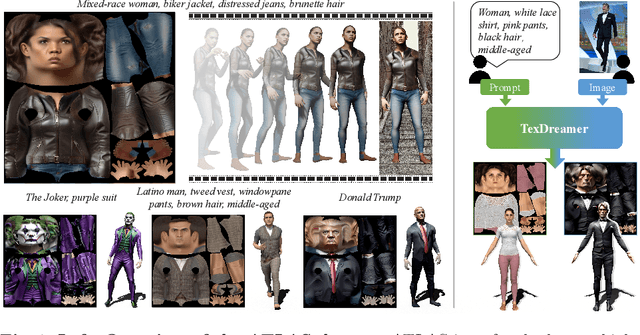
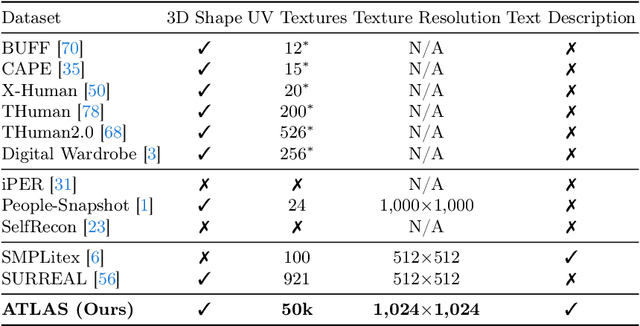
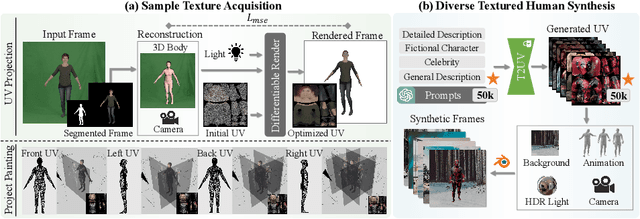
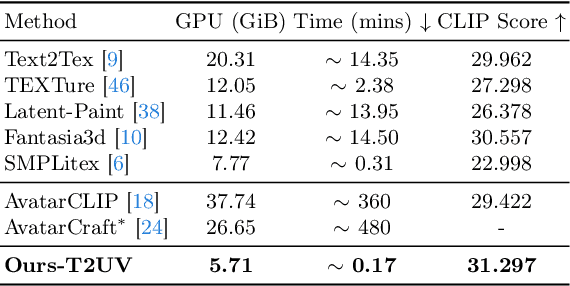
Texturing 3D humans with semantic UV maps remains a challenge due to the difficulty of acquiring reasonably unfolded UV. Despite recent text-to-3D advancements in supervising multi-view renderings using large text-to-image (T2I) models, issues persist with generation speed, text consistency, and texture quality, resulting in data scarcity among existing datasets. We present TexDreamer, the first zero-shot multimodal high-fidelity 3D human texture generation model. Utilizing an efficient texture adaptation finetuning strategy, we adapt large T2I model to a semantic UV structure while preserving its original generalization capability. Leveraging a novel feature translator module, the trained model is capable of generating high-fidelity 3D human textures from either text or image within seconds. Furthermore, we introduce ArTicuLated humAn textureS (ATLAS), the largest high-resolution (1024 X 1024) 3D human texture dataset which contains 50k high-fidelity textures with text descriptions.