 Add to Chrome
 Add to Firefox
 Add to Edge
Generative AI for Cel-Animation: A Survey
Jan 08, 2025
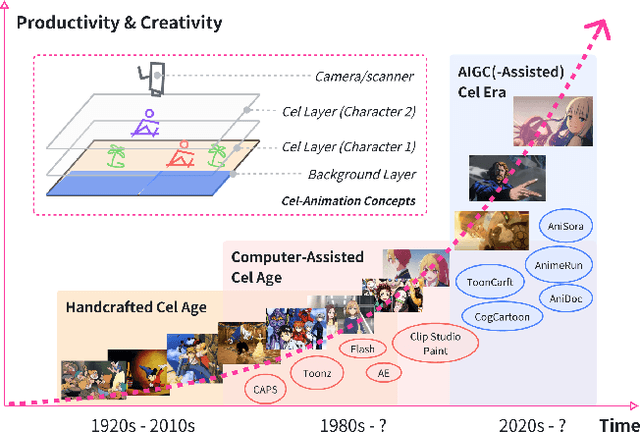
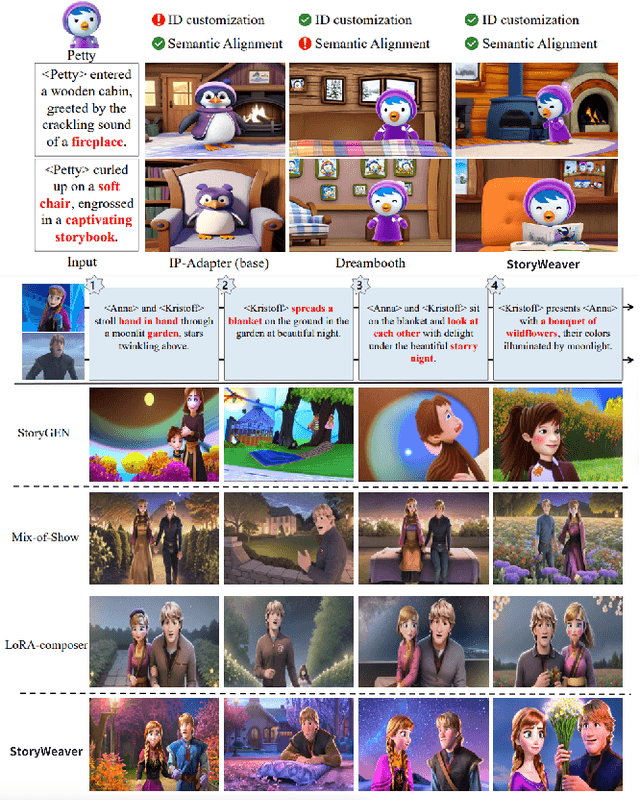
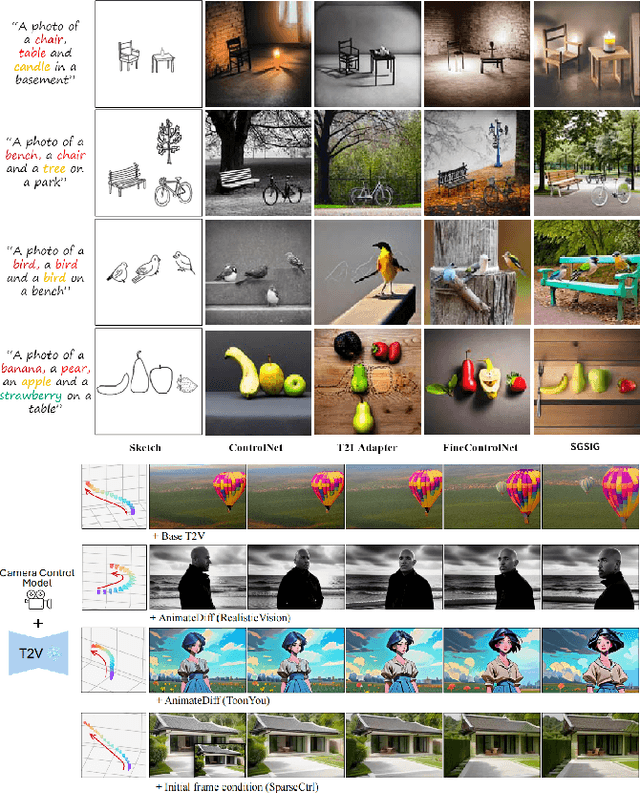
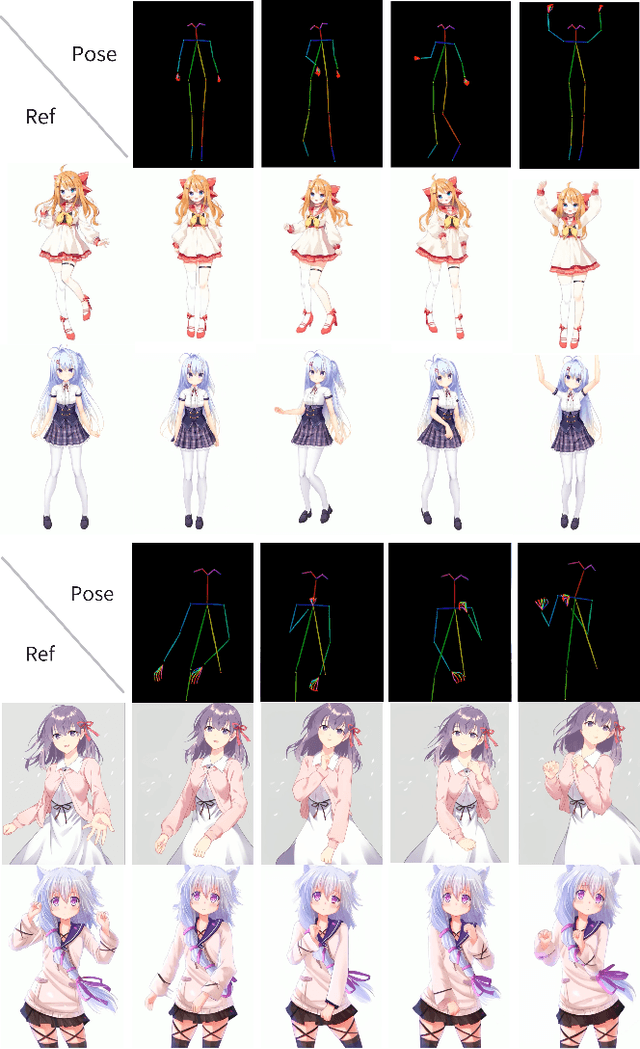
Traditional Celluloid (Cel) Animation production pipeline encompasses multiple essential steps, including storyboarding, layout design, keyframe animation, inbetweening, and colorization, which demand substantial manual effort, technical expertise, and significant time investment. These challenges have historically impeded the efficiency and scalability of Cel-Animation production. The rise of generative artificial intelligence (GenAI), encompassing large language models, multimodal models, and diffusion models, offers innovative solutions by automating tasks such as inbetween frame generation, colorization, and storyboard creation. This survey explores how GenAI integration is revolutionizing traditional animation workflows by lowering technical barriers, broadening accessibility for a wider range of creators through tools like AniDoc, ToonCrafter, and AniSora, and enabling artists to focus more on creative expression and artistic innovation. Despite its potential, issues such as maintaining visual consistency, ensuring stylistic coherence, and addressing ethical considerations continue to pose challenges. Furthermore, this paper discusses future directions and explores potential advancements in AI-assisted animation. For further exploration and resources, please visit our GitHub repository: https://github.com/yunlong10/Awesome-AI4Animation

LightGNN: Simple Graph Neural Network for Recommendation
Jan 07, 2025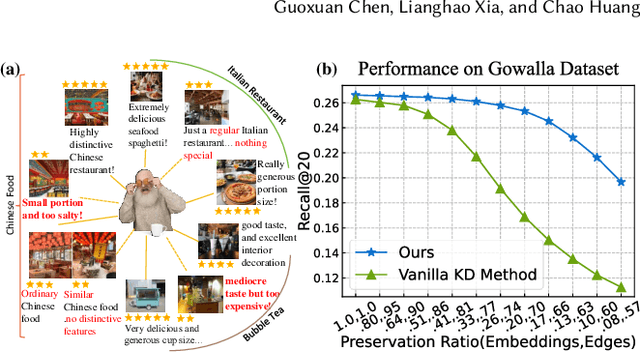
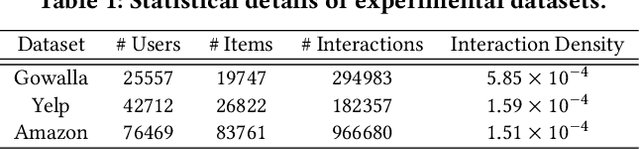
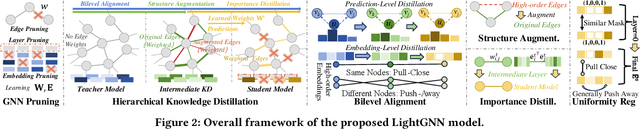
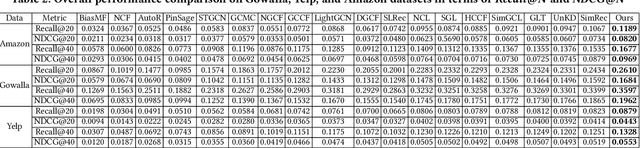
Graph neural networks (GNNs) have demonstrated superior performance in collaborative recommendation through their ability to conduct high-order representation smoothing, effectively capturing structural information within users' interaction patterns. However, existing GNN paradigms face significant challenges in scalability and robustness when handling large-scale, noisy, and real-world datasets. To address these challenges, we present LightGNN, a lightweight and distillation-based GNN pruning framework designed to substantially reduce model complexity while preserving essential collaboration modeling capabilities. Our LightGNN framework introduces a computationally efficient pruning module that adaptively identifies and removes redundant edges and embedding entries for model compression. The framework is guided by a resource-friendly hierarchical knowledge distillation objective, whose intermediate layer augments the observed graph to maintain performance, particularly in high-rate compression scenarios. Extensive experiments on public datasets demonstrate LightGNN's effectiveness, significantly improving both computational efficiency and recommendation accuracy. Notably, LightGNN achieves an 80% reduction in edge count and 90% reduction in embedding entries while maintaining performance comparable to more complex state-of-the-art baselines. The implementation of our LightGNN framework is available at the github repository: https://github.com/HKUDS/LightGNN.
DiffGraph: Heterogeneous Graph Diffusion Model
Jan 04, 2025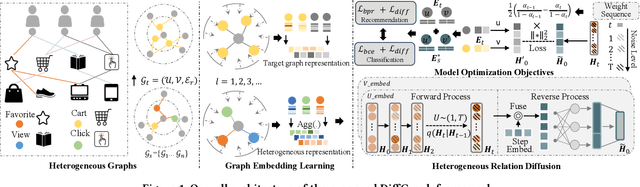
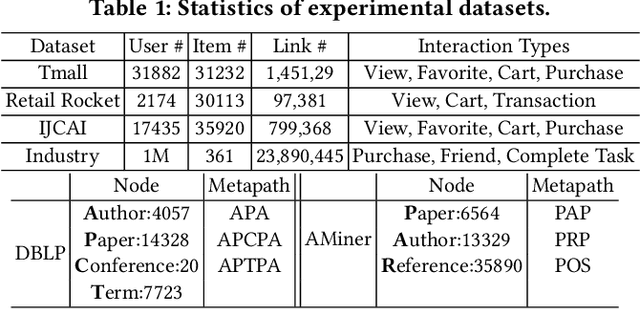
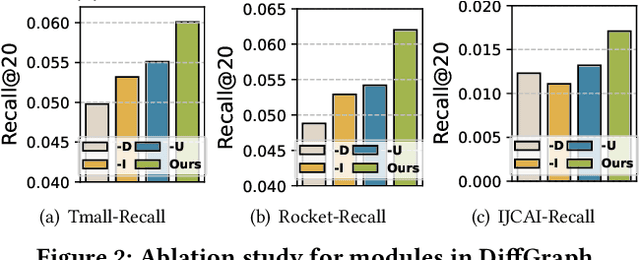

Recent advances in Graph Neural Networks (GNNs) have revolutionized graph-structured data modeling, yet traditional GNNs struggle with complex heterogeneous structures prevalent in real-world scenarios. Despite progress in handling heterogeneous interactions, two fundamental challenges persist: noisy data significantly compromising embedding quality and learning performance, and existing methods' inability to capture intricate semantic transitions among heterogeneous relations, which impacts downstream predictions. To address these fundamental issues, we present the Heterogeneous Graph Diffusion Model (DiffGraph), a pioneering framework that introduces an innovative cross-view denoising strategy. This advanced approach transforms auxiliary heterogeneous data into target semantic spaces, enabling precise distillation of task-relevant information. At its core, DiffGraph features a sophisticated latent heterogeneous graph diffusion mechanism, implementing a novel forward and backward diffusion process for superior noise management. This methodology achieves simultaneous heterogeneous graph denoising and cross-type transition, while significantly simplifying graph generation through its latent-space diffusion capabilities. Through rigorous experimental validation on both public and industrial datasets, we demonstrate that DiffGraph consistently surpasses existing methods in link prediction and node classification tasks, establishing new benchmarks for robustness and efficiency in heterogeneous graph processing. The model implementation is publicly available at: https://github.com/HKUDS/DiffGraph.
RecLM: Recommendation Instruction Tuning
Dec 26, 2024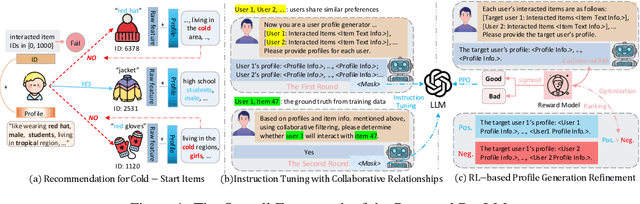
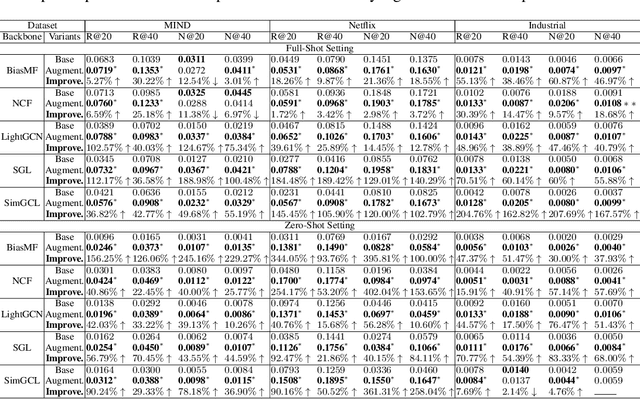

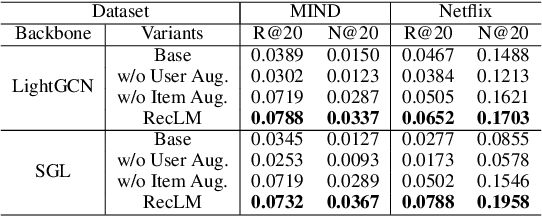
Modern recommender systems aim to deeply understand users' complex preferences through their past interactions. While deep collaborative filtering approaches using Graph Neural Networks (GNNs) excel at capturing user-item relationships, their effectiveness is limited when handling sparse data or zero-shot scenarios, primarily due to constraints in ID-based embedding functions. To address these challenges, we propose a model-agnostic recommendation instruction-tuning paradigm that seamlessly integrates large language models with collaborative filtering. Our proposed Recommendation Language Model (RecLM) enhances the capture of user preference diversity through a carefully designed reinforcement learning reward function that facilitates self-augmentation of language models. Comprehensive evaluations demonstrate significant advantages of our approach across various settings, and its plug-and-play compatibility with state-of-the-art recommender systems results in notable performance enhancements.
GraphAgent: Agentic Graph Language Assistant
Dec 22, 2024Real-world data is represented in both structured (e.g., graph connections) and unstructured (e.g., textual, visual information) formats, encompassing complex relationships that include explicit links (such as social connections and user behaviors) and implicit interdependencies among semantic entities, often illustrated through knowledge graphs. In this work, we propose GraphAgent, an automated agent pipeline that addresses both explicit graph dependencies and implicit graph-enhanced semantic inter-dependencies, aligning with practical data scenarios for predictive tasks (e.g., node classification) and generative tasks (e.g., text generation). GraphAgent comprises three key components: (i) a Graph Generator Agent that builds knowledge graphs to reflect complex semantic dependencies; (ii) a Task Planning Agent that interprets diverse user queries and formulates corresponding tasks through agentic self-planning; and (iii) a Task Execution Agent that efficiently executes planned tasks while automating tool matching and invocation in response to user queries. These agents collaborate seamlessly, integrating language models with graph language models to uncover intricate relational information and data semantic dependencies. Through extensive experiments on various graph-related predictive and text generative tasks on diverse datasets, we demonstrate the effectiveness of our GraphAgent across various settings. We have made our proposed GraphAgent open-source at: https://github.com/HKUDS/GraphAgent.
MixRec: Heterogeneous Graph Collaborative Filtering
Dec 22, 2024


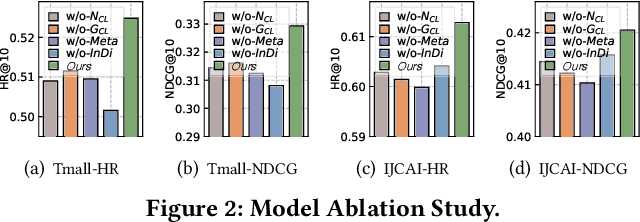
For modern recommender systems, the use of low-dimensional latent representations to embed users and items based on their observed interactions has become commonplace. However, many existing recommendation models are primarily designed for coarse-grained and homogeneous interactions, which limits their effectiveness in two critical dimensions. Firstly, these models fail to leverage the relational dependencies that exist across different types of user behaviors, such as page views, collects, comments, and purchases. Secondly, they struggle to capture the fine-grained latent factors that drive user interaction patterns. To address these limitations, we present a heterogeneous graph collaborative filtering model MixRec that excels at disentangling users' multi-behavior interaction patterns and uncovering the latent intent factors behind each behavior. Our model achieves this by incorporating intent disentanglement and multi-behavior modeling, facilitated by a parameterized heterogeneous hypergraph architecture. Furthermore, we introduce a novel contrastive learning paradigm that adaptively explores the advantages of self-supervised data augmentation, thereby enhancing the model's resilience against data sparsity and expressiveness with relation heterogeneity. To validate the efficacy of MixRec, we conducted extensive experiments on three public datasets. The results clearly demonstrate its superior performance, significantly outperforming various state-of-the-art baselines. Our model is open-sourced and available at: https://github.com/HKUDS/MixRec.
The Impact of Cut Layer Selection in Split Federated Learning
Dec 20, 2024
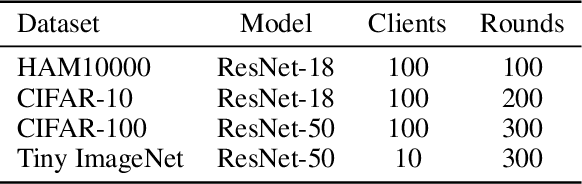
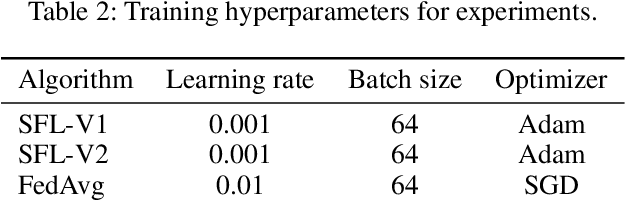
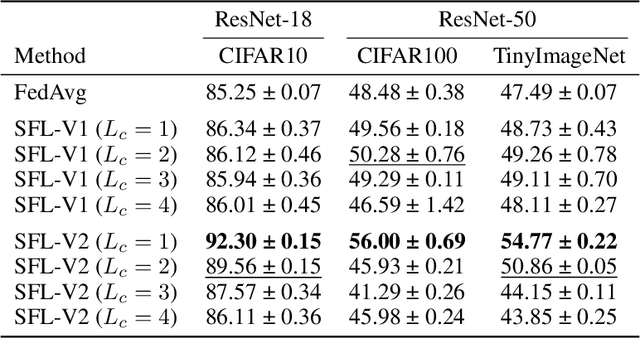
Split Federated Learning (SFL) is a distributed machine learning paradigm that combines federated learning and split learning. In SFL, a neural network is partitioned at a cut layer, with the initial layers deployed on clients and remaining layers on a training server. There are two main variants of SFL: SFL-V1 where the training server maintains separate server-side models for each client, and SFL-V2 where the training server maintains a single shared model for all clients. While existing studies have focused on algorithm development for SFL, a comprehensive quantitative analysis of how the cut layer selection affects model performance remains unexplored. This paper addresses this gap by providing numerical and theoretical analysis of SFL performance and convergence relative to cut layer selection. We find that SFL-V1 is relatively invariant to the choice of cut layer, which is consistent with our theoretical results. Numerical experiments on four datasets and two neural networks show that the cut layer selection significantly affects the performance of SFL-V2. Moreover, SFL-V2 with an appropriate cut layer selection outperforms FedAvg on heterogeneous data.
Aria-UI: Visual Grounding for GUI Instructions
Dec 20, 2024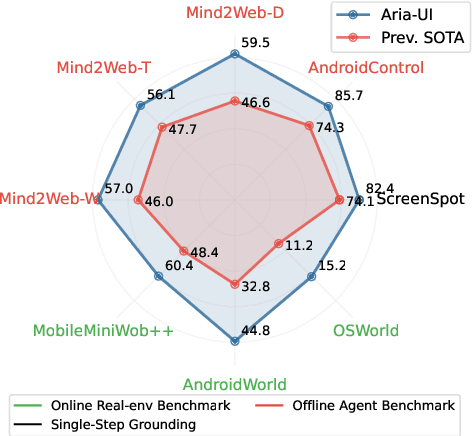

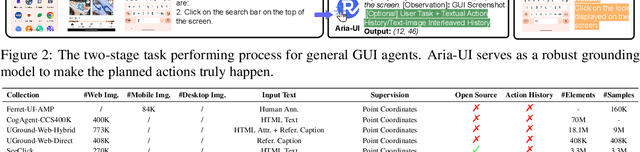
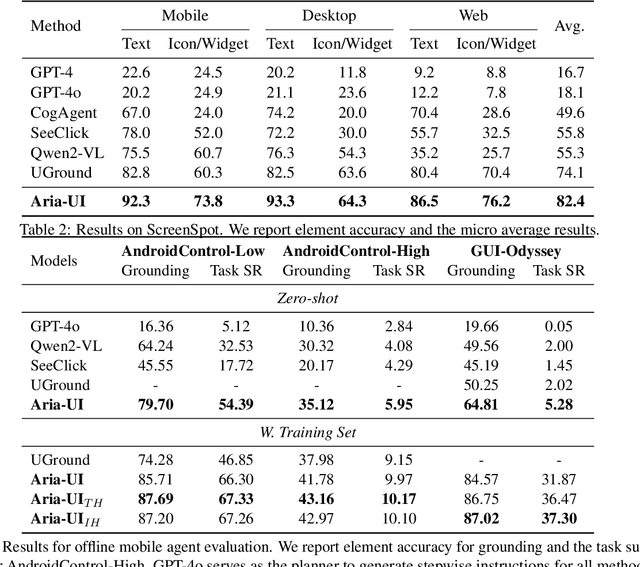
Digital agents for automating tasks across different platforms by directly manipulating the GUIs are increasingly important. For these agents, grounding from language instructions to target elements remains a significant challenge due to reliance on HTML or AXTree inputs. In this paper, we introduce Aria-UI, a large multimodal model specifically designed for GUI grounding. Aria-UI adopts a pure-vision approach, eschewing reliance on auxiliary inputs. To adapt to heterogeneous planning instructions, we propose a scalable data pipeline that synthesizes diverse and high-quality instruction samples for grounding. To handle dynamic contexts in task performing, Aria-UI incorporates textual and text-image interleaved action histories, enabling robust context-aware reasoning for grounding. Aria-UI sets new state-of-the-art results across offline and online agent benchmarks, outperforming both vision-only and AXTree-reliant baselines. We release all training data and model checkpoints to foster further research at https://ariaui.github.io.
SepLLM: Accelerate Large Language Models by Compressing One Segment into One Separator
Dec 16, 2024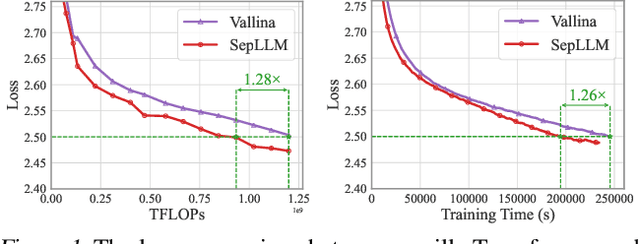

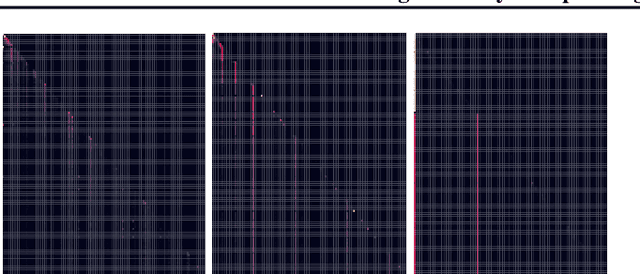

Large Language Models (LLMs) have exhibited exceptional performance across a spectrum of natural language processing tasks. However, their substantial sizes pose considerable challenges, particularly in computational demands and inference speed, due to their quadratic complexity. In this work, we have identified a key pattern: certain seemingly meaningless special tokens (i.e., separators) contribute disproportionately to attention scores compared to semantically meaningful tokens. This observation suggests that information of the segments between these separator tokens can be effectively condensed into the separator tokens themselves without significant information loss. Guided by this insight, we introduce SepLLM, a plug-and-play framework that accelerates inference by compressing these segments and eliminating redundant tokens. Additionally, we implement efficient kernels for training acceleration. Experimental results across training-free, training-from-scratch, and post-training settings demonstrate SepLLM's effectiveness. Notably, using the Llama-3-8B backbone, SepLLM achieves over 50% reduction in KV cache on the GSM8K-CoT benchmark while maintaining comparable performance. Furthermore, in streaming settings, SepLLM effectively processes sequences of up to 4 million tokens or more while maintaining consistent language modeling capabilities.
Inverse Delayed Reinforcement Learning
Dec 04, 2024


Inverse Reinforcement Learning (IRL) has demonstrated effectiveness in a variety of imitation tasks. In this paper, we introduce an IRL framework designed to extract rewarding features from expert trajectories affected by delayed disturbances. Instead of relying on direct observations, our approach employs an efficient off-policy adversarial training framework to derive expert features and recover optimal policies from augmented delayed observations. Empirical evaluations in the MuJoCo environment under diverse delay settings validate the effectiveness of our method. Furthermore, we provide a theoretical analysis showing that recovering expert policies from augmented delayed observations outperforms using direct delayed observations.