 Add to Chrome
 Add to Firefox
 Add to Edge
DramaDirector: Geometry-Guided Short Drama Generation
Jun 23, 2026
Short dramas, with their rapid shot rhythms, dialogue-driven focus shifts, and demanding cinematographic grounding, pose challenges that prompt-level or text-only video generation pipelines struggle to meet. We study plot-to-short-drama generation, where a global plot and local context are transformed into visually grounded multi-shot videos. We propose DramaDirector, a geometry-grounded framework that lets the planner borrow cinematographic geometry from a gallery of real short-drama shots indexed by depth and pose. DramaDirector decouples each shot into static visual and dynamic narrative conditions, trains the planner with schema-constrained SFT and GRPO under a learned text-visual alignment reward, and retrieves depth-pose references to guide first-frame generation and image-to-video synthesis. We also introduce DramaBoard, a benchmark built from 35 live-action dramas, 2.8K episodes, and 81K shots, with structured storyboards and multi-dimensional evaluation protocols. Experiments show that DramaDirector improves over representative multi-agent and video generation baselines on faithfulness, consistency, and controllability. Our code is released at: https://github.com/iLearn-Lab/DramaDirector

OmniTraffic: A Controllable Generation Pipeline and Benchmark for Spatio-Temporal Traffic Reasoning
Jun 14, 2026Traffic scene understanding requires models to reason beyond object recognition, including lane topology, multi-view geometry, temporal evolution, and signal-phase semantics. However, existing traffic-oriented multimodal benchmarks largely emphasize passive visual recognition or isolated video understanding, offering limited support for evaluating structure-aware traffic reasoning under controlled conditions. We introduce OmniTraffic, a controllable generation pipeline and benchmark for spatio-temporal traffic reasoning. Built around 12 real-world intersections reconstructed into editable 3D traffic environments and complemented by surveillance footage from two countries, OmniTraffic supports both controlled and natural-condition evaluation. It defines a three-level task hierarchy spanning scene perception, multi-view and temporal reasoning, and decision support. Using structured traffic metadata, OmniTraffic generates synchronized multi-view VQA samples covering vehicle states, lane functions, view--BEV correspondence, temporal dynamics, and signal-phase analysis, resulting in 8M VQA samples and a 3K human-verified test set. Evaluation of eleven frontier MLLMs reveals a large human--model gap, with the most pronounced failures in topology-grounded and spatio-temporal reasoning tasks. Fine-tuning a lightweight MLLM on simulated OmniTraffic data further improves performance on real-world traffic scenes, demonstrating the value of simulation-generated supervision for traffic-specific multimodal reasoning. Beyond a fixed dataset, OmniTraffic provides an extensible pipeline with configurable intersections, camera views, traffic demands, signal phases, visual conditions, and rare events.
Unlocking Location Intelligence: A Survey from Deep Learning to The LLM Era
May 13, 2025Location Intelligence (LI), the science of transforming location-centric geospatial data into actionable knowledge, has become a cornerstone of modern spatial decision-making. The rapid evolution of Geospatial Representation Learning is fundamentally reshaping LI development through two successive technological revolutions: the deep learning breakthrough and the emerging large language model (LLM) paradigm. While deep neural networks (DNNs) have demonstrated remarkable success in automated feature extraction from structured geospatial data (e.g., satellite imagery, GPS trajectories), the recent integration of LLMs introduces transformative capabilities for cross-modal geospatial reasoning and unstructured geo-textual data processing. This survey presents a comprehensive review of geospatial representation learning across both technological eras, organizing them into a structured taxonomy based on the complete pipeline comprising: (1) data perspective, (2) methodological perspective and (3) application perspective. We also highlight current advancements, discuss existing limitations, and propose potential future research directions in the LLM era. This work offers a thorough exploration of the field and providing a roadmap for further innovation in LI. The summary of the up-to-date paper list can be found in https://github.com/CityMind-Lab/Awesome-Location-Intelligence and will undergo continuous updates.
GraphAgent: Agentic Graph Language Assistant
Dec 22, 2024Real-world data is represented in both structured (e.g., graph connections) and unstructured (e.g., textual, visual information) formats, encompassing complex relationships that include explicit links (such as social connections and user behaviors) and implicit interdependencies among semantic entities, often illustrated through knowledge graphs. In this work, we propose GraphAgent, an automated agent pipeline that addresses both explicit graph dependencies and implicit graph-enhanced semantic inter-dependencies, aligning with practical data scenarios for predictive tasks (e.g., node classification) and generative tasks (e.g., text generation). GraphAgent comprises three key components: (i) a Graph Generator Agent that builds knowledge graphs to reflect complex semantic dependencies; (ii) a Task Planning Agent that interprets diverse user queries and formulates corresponding tasks through agentic self-planning; and (iii) a Task Execution Agent that efficiently executes planned tasks while automating tool matching and invocation in response to user queries. These agents collaborate seamlessly, integrating language models with graph language models to uncover intricate relational information and data semantic dependencies. Through extensive experiments on various graph-related predictive and text generative tasks on diverse datasets, we demonstrate the effectiveness of our GraphAgent across various settings. We have made our proposed GraphAgent open-source at: https://github.com/HKUDS/GraphAgent.
Learning Geospatial Region Embedding with Heterogeneous Graph
May 23, 2024Learning effective geospatial embeddings is crucial for a series of geospatial applications such as city analytics and earth monitoring. However, learning comprehensive region representations presents two significant challenges: first, the deficiency of effective intra-region feature representation; and second, the difficulty of learning from intricate inter-region dependencies. In this paper, we present GeoHG, an effective heterogeneous graph structure for learning comprehensive region embeddings for various downstream tasks. Specifically, we tailor satellite image representation learning through geo-entity segmentation and point-of-interest (POI) integration for expressive intra-regional features. Furthermore, GeoHG unifies informative spatial interdependencies and socio-environmental attributes into a powerful heterogeneous graph to encourage explicit modeling of higher-order inter-regional relationships. The intra-regional features and inter-regional correlations are seamlessly integrated by a model-agnostic graph learning framework for diverse downstream tasks. Extensive experiments demonstrate the effectiveness of GeoHG in geo-prediction tasks compared to existing methods, even under extreme data scarcity (with just 5% of training data). With interpretable region representations, GeoHG exhibits strong generalization capabilities across regions. We will release code and data upon paper notification.
Deep Learning for Cross-Domain Data Fusion in Urban Computing: Taxonomy, Advances, and Outlook
Feb 29, 2024

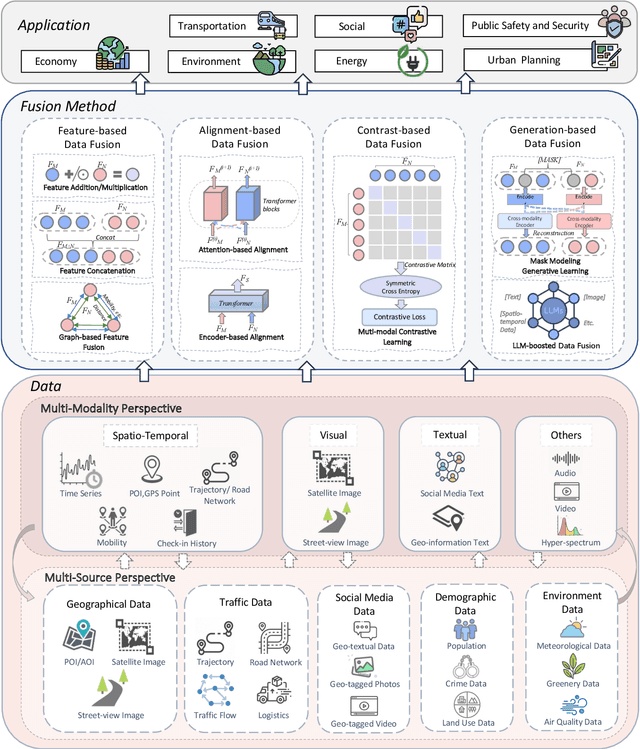
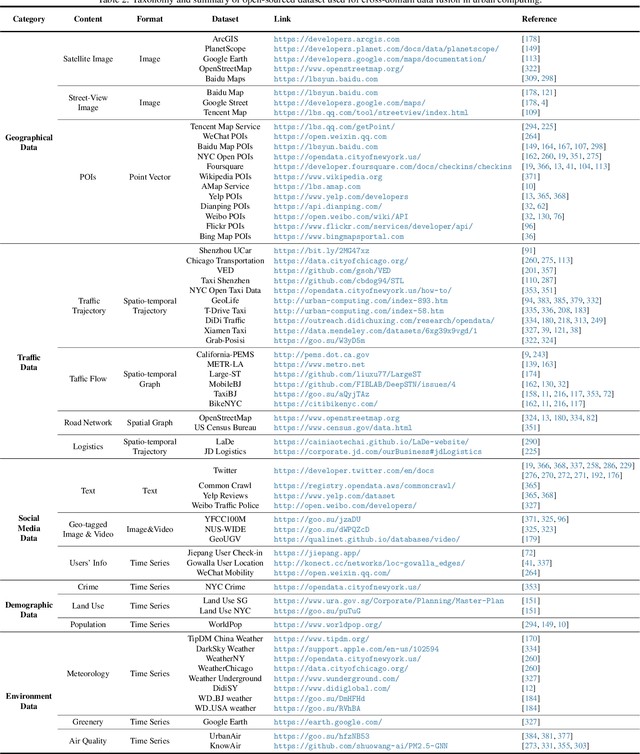
As cities continue to burgeon, Urban Computing emerges as a pivotal discipline for sustainable development by harnessing the power of cross-domain data fusion from diverse sources (e.g., geographical, traffic, social media, and environmental data) and modalities (e.g., spatio-temporal, visual, and textual modalities). Recently, we are witnessing a rising trend that utilizes various deep-learning methods to facilitate cross-domain data fusion in smart cities. To this end, we propose the first survey that systematically reviews the latest advancements in deep learning-based data fusion methods tailored for urban computing. Specifically, we first delve into data perspective to comprehend the role of each modality and data source. Secondly, we classify the methodology into four primary categories: feature-based, alignment-based, contrast-based, and generation-based fusion methods. Thirdly, we further categorize multi-modal urban applications into seven types: urban planning, transportation, economy, public safety, society, environment, and energy. Compared with previous surveys, we focus more on the synergy of deep learning methods with urban computing applications. Furthermore, we shed light on the interplay between Large Language Models (LLMs) and urban computing, postulating future research directions that could revolutionize the field. We firmly believe that the taxonomy, progress, and prospects delineated in our survey stand poised to significantly enrich the research community. The summary of the comprehensive and up-to-date paper list can be found at https://github.com/yoshall/Awesome-Multimodal-Urban-Computing.