 Add to Chrome
 Add to Firefox
 Add to Edge
MANIGUARD: A Benchmark and Data Suite for Specification-Grounded Safety Evaluation and Improvement of Robotic Manipulation
Aug 18, 2026
Foundation-model policies for robotic manipulation are advancing rapidly on task success, but rigorous evaluation of whether they succeed safely is still lacking. We introduce ManiGuard, a specification-grounded framework for evaluating and improving the safety of foundation-model manipulation, comprising the ManiGuard-Bench task suite and a paired safety-annotated trajectory-generation pipeline. ManiGuard-Bench organizes six contact-rich household task families into 200 locked base tasks along a skill $\times$ constraint taxonomy, with safety specified independently of task success. Each task is evaluated under one in-distribution and four single-axis out-of-distribution perturbations that hold the safety specification fixed, giving 1,000 locked scenarios. Every rollout is runtime-checked by LTL$_f$-grounded automaton monitors over physics-grounded predicates rather than learned classifiers or LLM judges, in simulation and on a physical Franka platform. The pipeline pairs an automated motion-planning generator with human teleoperation, annotated by the same per-step monitor, and directly supports safety-aware fine-tuning; we release 8,000 safety-annotated demonstrations, 40 per base task. Benchmarking zero-shot and fine-tuned VLAs across more than 23,000 rollouts, we find: (i) safety must be evaluated independently of task success, as 6-21% of successful rollouts violate the specification; (ii) fine-tuning on our suite raises safe task completion from near zero to 7.5-29.8% and engaged-and-safe behavior from 16-40% to 51-72%; but (iii) a gap remains that scaling demonstrations does not close, with 21-42% of engaged rollouts still violating, two of six families below 2% safe success for every policy, and these failures persisting under distribution shift and on hardware.

Inverse Delayed Reinforcement Learning
Dec 04, 2024


Inverse Reinforcement Learning (IRL) has demonstrated effectiveness in a variety of imitation tasks. In this paper, we introduce an IRL framework designed to extract rewarding features from expert trajectories affected by delayed disturbances. Instead of relying on direct observations, our approach employs an efficient off-policy adversarial training framework to derive expert features and recover optimal policies from augmented delayed observations. Empirical evaluations in the MuJoCo environment under diverse delay settings validate the effectiveness of our method. Furthermore, we provide a theoretical analysis showing that recovering expert policies from augmented delayed observations outperforms using direct delayed observations.
Model-Based Reward Shaping for Adversarial Inverse Reinforcement Learning in Stochastic Environments
Oct 04, 2024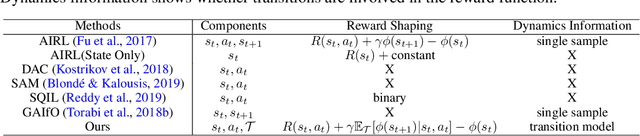
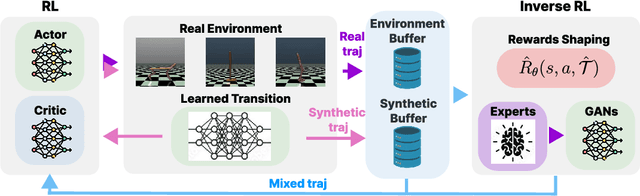

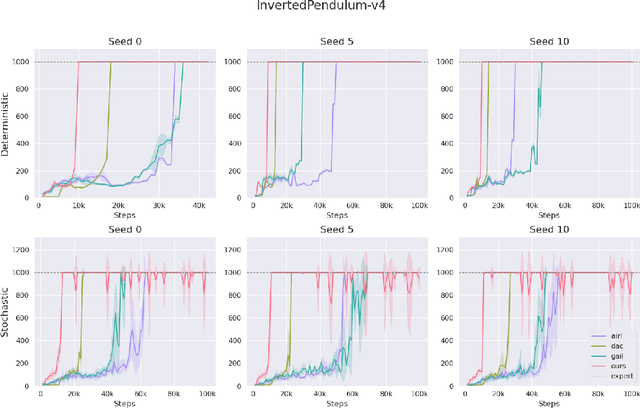
In this paper, we aim to tackle the limitation of the Adversarial Inverse Reinforcement Learning (AIRL) method in stochastic environments where theoretical results cannot hold and performance is degraded. To address this issue, we propose a novel method which infuses the dynamics information into the reward shaping with the theoretical guarantee for the induced optimal policy in the stochastic environments. Incorporating our novel model-enhanced rewards, we present a novel Model-Enhanced AIRL framework, which integrates transition model estimation directly into reward shaping. Furthermore, we provide a comprehensive theoretical analysis of the reward error bound and performance difference bound for our method. The experimental results in MuJoCo benchmarks show that our method can achieve superior performance in stochastic environments and competitive performance in deterministic environments, with significant improvement in sample efficiency, compared to existing baselines.