 Add to Chrome
 Add to Firefox
 Add to Edge
BRAVA-GNN: Betweenness Ranking Approximation Via Degree MAss Inspired Graph Neural Network
Feb 10, 2026
Computing node importance in networks is a long-standing fundamental problem that has driven extensive study of various centrality measures. A particularly well-known centrality measure is betweenness centrality, which becomes computationally prohibitive on large-scale networks. Graph Neural Network (GNN) models have thus been proposed to predict node rankings according to their relative betweenness centrality. However, state-of-the-art methods fail to generalize to high-diameter graphs such as road networks. We propose BRAVA-GNN, a lightweight GNN architecture that leverages the empirically observed correlation linking betweenness centrality to degree-based quantities, in particular multi-hop degree mass. This correlation motivates the use of degree masses as size-invariant node features and synthetic training graphs that closely match the degree distributions of real networks. Furthermore, while previous work relies on scale-free synthetic graphs, we leverage the hyperbolic random graph model, which reproduces power-law exponents outside the scale-free regime, better capturing the structure of real-world graphs like road networks. This design enables BRAVA-GNN to generalize across diverse graph families while using 54x fewer parameters than the most lightweight existing GNN baseline. Extensive experiments on 19 real-world networks, spanning social, web, email, and road graphs, show that BRAVA-GNN achieves up to 214% improvement in Kendall-Tau correlation and up to 70x speedup in inference time over state-of-the-art GNN-based approaches, particularly on challenging road networks.

The Impact of Cut Layer Selection in Split Federated Learning
Dec 20, 2024
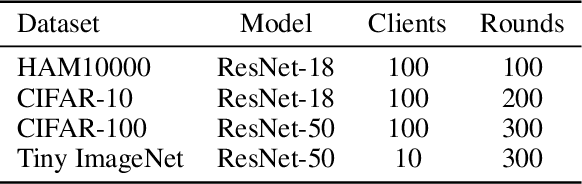
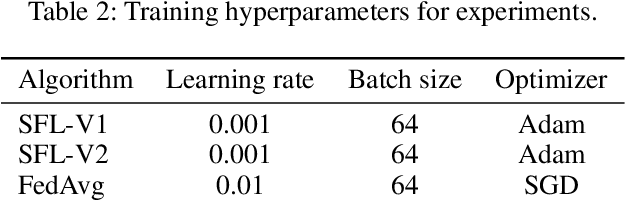
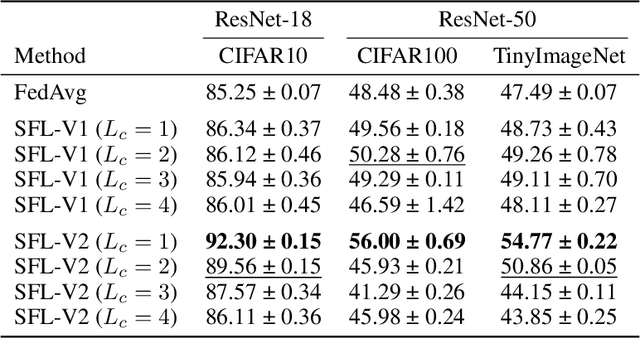
Split Federated Learning (SFL) is a distributed machine learning paradigm that combines federated learning and split learning. In SFL, a neural network is partitioned at a cut layer, with the initial layers deployed on clients and remaining layers on a training server. There are two main variants of SFL: SFL-V1 where the training server maintains separate server-side models for each client, and SFL-V2 where the training server maintains a single shared model for all clients. While existing studies have focused on algorithm development for SFL, a comprehensive quantitative analysis of how the cut layer selection affects model performance remains unexplored. This paper addresses this gap by providing numerical and theoretical analysis of SFL performance and convergence relative to cut layer selection. We find that SFL-V1 is relatively invariant to the choice of cut layer, which is consistent with our theoretical results. Numerical experiments on four datasets and two neural networks show that the cut layer selection significantly affects the performance of SFL-V2. Moreover, SFL-V2 with an appropriate cut layer selection outperforms FedAvg on heterogeneous data.