 Add to Chrome
 Add to Firefox
 Add to Edge
GEMeX: A Large-Scale, Groundable, and Explainable Medical VQA Benchmark for Chest X-ray Diagnosis
Nov 25, 2024


Medical Visual Question Answering (VQA) is an essential technology that integrates computer vision and natural language processing to automatically respond to clinical inquiries about medical images. However, current medical VQA datasets exhibit two significant limitations: (1) they often lack visual and textual explanations for answers, which impedes their ability to satisfy the comprehension needs of patients and junior doctors; (2) they typically offer a narrow range of question formats, inadequately reflecting the diverse requirements encountered in clinical scenarios. These limitations pose significant challenges to the development of a reliable and user-friendly Med-VQA system. To address these challenges, we introduce a large-scale, Groundable, and Explainable Medical VQA benchmark for chest X-ray diagnosis (GEMeX), featuring several innovative components: (1) A multi-modal explainability mechanism that offers detailed visual and textual explanations for each question-answer pair, thereby enhancing answer comprehensibility; (2) Four distinct question types, open-ended, closed-ended, single-choice, and multiple-choice, that better reflect diverse clinical needs. We evaluated 10 representative large vision language models on GEMeX and found that they underperformed, highlighting the dataset's complexity. However, after fine-tuning a baseline model using the training set, we observed a significant performance improvement, demonstrating the dataset's effectiveness. The project is available at www.med-vqa.com/GEMeX.

Cautious Optimizers: Improving Training with One Line of Code
Nov 25, 2024
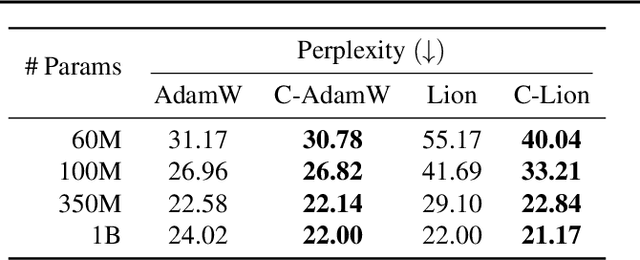


AdamW has been the default optimizer for transformer pretraining. For many years, our community searches for faster and more stable optimizers with only constraint positive outcomes. In this work, we propose a \textbf{single-line modification in Pytorch} to any momentum-based optimizer, which we rename Cautious Optimizer, e.g. C-AdamW and C-Lion. Our theoretical result shows that this modification preserves Adam's Hamiltonian function and it does not break the convergence guarantee under the Lyapunov analysis. In addition, a whole new family of optimizers is revealed by our theoretical insight. Among them, we pick the simplest one for empirical experiments, showing speed-up on Llama and MAE pretraining up to $1.47\times$. Code is available at https://github.com/kyleliang919/C-Optim
FastTrackTr:Towards Fast Multi-Object Tracking with Transformers
Nov 24, 2024


Transformer-based multi-object tracking (MOT) methods have captured the attention of many researchers in recent years. However, these models often suffer from slow inference speeds due to their structure or other issues. To address this problem, we revisited the Joint Detection and Tracking (JDT) method by looking back at past approaches. By integrating the original JDT approach with some advanced theories, this paper employs an efficient method of information transfer between frames on the DETR, constructing a fast and novel JDT-type MOT framework: FastTrackTr. Thanks to the superiority of this information transfer method, our approach not only reduces the number of queries required during tracking but also avoids the excessive introduction of network structures, ensuring model simplicity. Experimental results indicate that our method has the potential to achieve real-time tracking and exhibits competitive tracking accuracy across multiple datasets.
Face De-identification: State-of-the-art Methods and Comparative Studies
Nov 15, 2024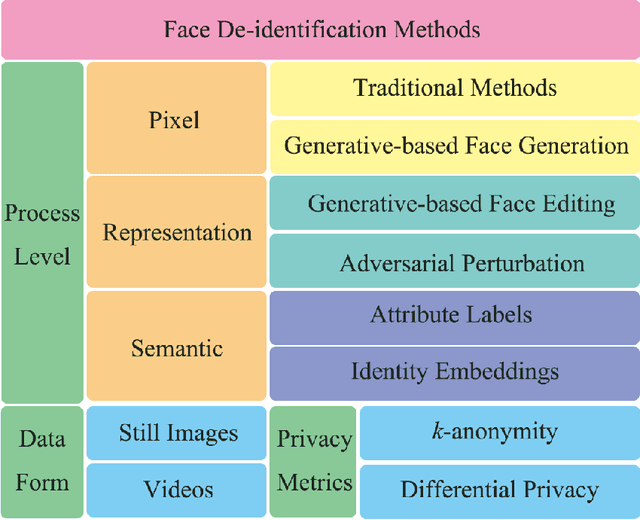

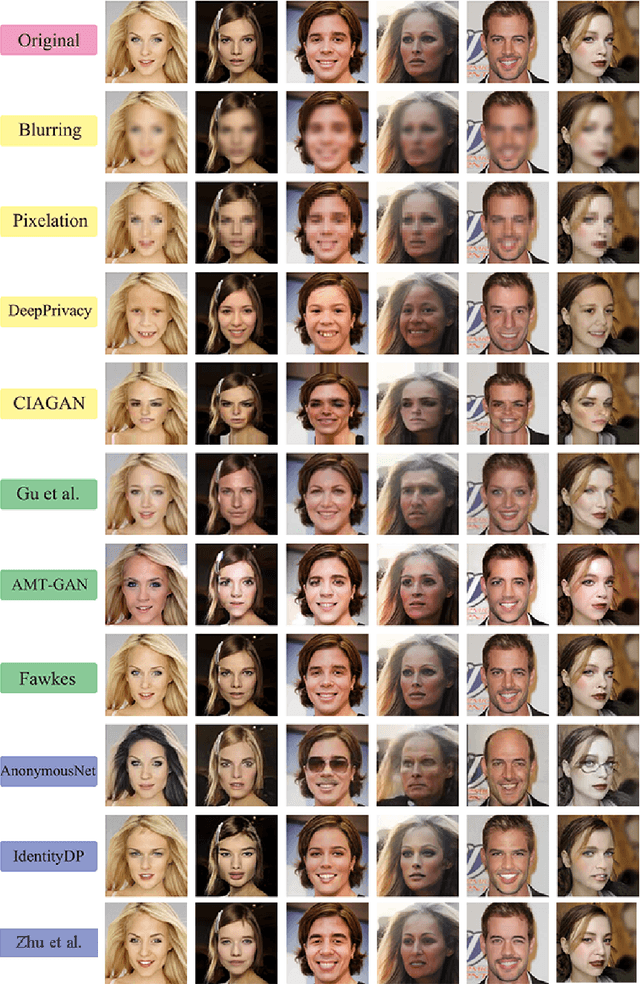

The widespread use of image acquisition technologies, along with advances in facial recognition, has raised serious privacy concerns. Face de-identification usually refers to the process of concealing or replacing personal identifiers, which is regarded as an effective means to protect the privacy of facial images. A significant number of methods for face de-identification have been proposed in recent years. In this survey, we provide a comprehensive review of state-of-the-art face de-identification methods, categorized into three levels: pixel-level, representation-level, and semantic-level techniques. We systematically evaluate these methods based on two key criteria, the effectiveness of privacy protection and preservation of image utility, highlighting their advantages and limitations. Our analysis includes qualitative and quantitative comparisons of the main algorithms, demonstrating that deep learning-based approaches, particularly those using Generative Adversarial Networks (GANs) and diffusion models, have achieved significant advancements in balancing privacy and utility. Experimental results reveal that while recent methods demonstrate strong privacy protection, trade-offs remain in visual fidelity and computational complexity. This survey not only summarizes the current landscape but also identifies key challenges and future research directions in face de-identification.
Learning Memory Mechanisms for Decision Making through Demonstrations
Nov 13, 2024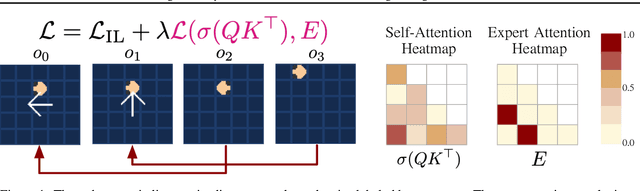

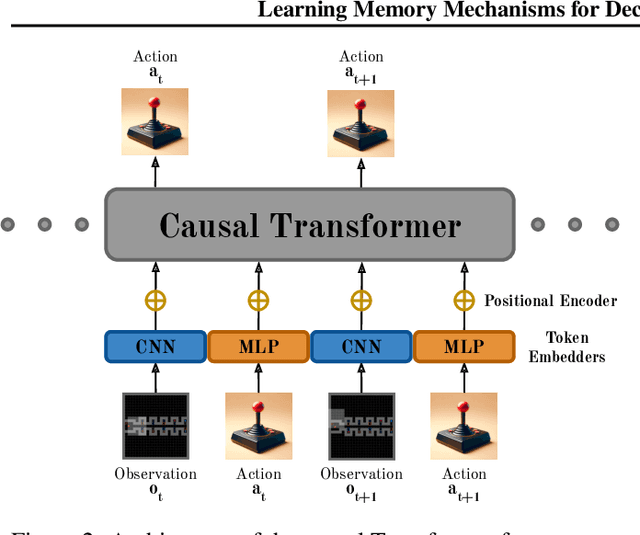

In Partially Observable Markov Decision Processes, integrating an agent's history into memory poses a significant challenge for decision-making. Traditional imitation learning, relying on observation-action pairs for expert demonstrations, fails to capture the expert's memory mechanisms used in decision-making. To capture memory processes as demonstrations, we introduce the concept of memory dependency pairs $(p, q)$ indicating that events at time $p$ are recalled for decision-making at time $q$. We introduce AttentionTuner to leverage memory dependency pairs in Transformers and find significant improvements across several tasks compared to standard Transformers when evaluated on Memory Gym and the Long-term Memory Benchmark. Code is available at https://github.com/WilliamYue37/AttentionTuner.
Alleviating Hyperparameter-Tuning Burden in SVM Classifiers for Pulmonary Nodules Diagnosis with Multi-Task Bayesian Optimization
Nov 09, 2024In the field of non-invasive medical imaging, radiomic features are utilized to measure tumor characteristics. However, these features can be affected by the techniques used to discretize the images, ultimately impacting the accuracy of diagnosis. To investigate the influence of various image discretization methods on diagnosis, it is common practice to evaluate multiple discretization strategies individually. This approach often leads to redundant and time-consuming tasks such as training predictive models and fine-tuning hyperparameters separately. This study examines the feasibility of employing multi-task Bayesian optimization to accelerate the hyperparameters search for classifying benign and malignant pulmonary nodules using RBF SVM. Our findings suggest that multi-task Bayesian optimization significantly accelerates the search for hyperparameters in comparison to a single-task approach. To the best of our knowledge, this is the first investigation to utilize multi-task Bayesian optimization in a critical medical context.
DICE: Discrete Inversion Enabling Controllable Editing for Multinomial Diffusion and Masked Generative Models
Oct 10, 2024Discrete diffusion models have achieved success in tasks like image generation and masked language modeling but face limitations in controlled content editing. We introduce DICE (Discrete Inversion for Controllable Editing), the first approach to enable precise inversion for discrete diffusion models, including multinomial diffusion and masked generative models. By recording noise sequences and masking patterns during the reverse diffusion process, DICE enables accurate reconstruction and flexible editing of discrete data without the need for predefined masks or attention manipulation. We demonstrate the effectiveness of DICE across both image and text domains, evaluating it on models such as VQ-Diffusion, Paella, and RoBERTa. Our results show that DICE preserves high data fidelity while enhancing editing capabilities, offering new opportunities for fine-grained content manipulation in discrete spaces. For project webpage, see https://hexiaoxiao-cs.github.io/DICE/.
IGroupSS-Mamba: Interval Group Spatial-Spectral Mamba for Hyperspectral Image Classification
Oct 07, 2024
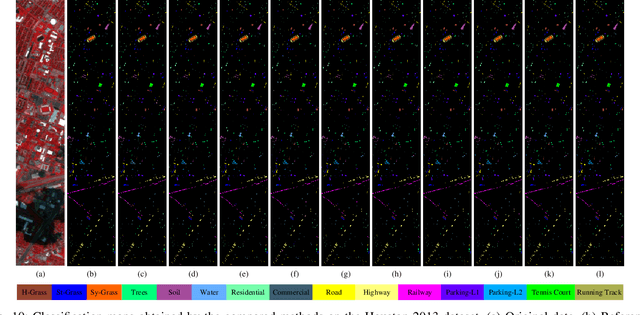


Hyperspectral image (HSI) classification has garnered substantial attention in remote sensing fields. Recent Mamba architectures built upon the Selective State Space Models (S6) have demonstrated enormous potential in long-range sequence modeling. However, the high dimensionality of hyperspectral data and information redundancy pose challenges to the application of Mamba in HSI classification, suffering from suboptimal performance and computational efficiency. In light of this, this paper investigates a lightweight Interval Group Spatial-Spectral Mamba framework (IGroupSS-Mamba) for HSI classification, which allows for multi-directional and multi-scale global spatial-spectral information extraction in a grouping and hierarchical manner. Technically, an Interval Group S6 Mechanism (IGSM) is developed as the core component, which partitions high-dimensional features into multiple non-overlapping groups at intervals, and then integrates a unidirectional S6 for each group with a specific scanning direction to achieve non-redundant sequence modeling. Compared to conventional applying multi-directional scanning to all bands, this grouping strategy leverages the complementary strengths of different scanning directions while decreasing computational costs. To adequately capture the spatial-spectral contextual information, an Interval Group Spatial-Spectral Block (IGSSB) is introduced, in which two IGSM-based spatial and spectral operators are cascaded to characterize the global spatial-spectral relationship along the spatial and spectral dimensions, respectively. IGroupSS-Mamba is constructed as a hierarchical structure stacked by multiple IGSSB blocks, integrating a pixel aggregation-based downsampling strategy for multiscale spatial-spectral semantic learning from shallow to deep stages. Extensive experiments demonstrate that IGroupSS-Mamba outperforms the state-of-the-art methods.
Fine-Grained Gradient Restriction: A Simple Approach for Mitigating Catastrophic Forgetting
Oct 01, 2024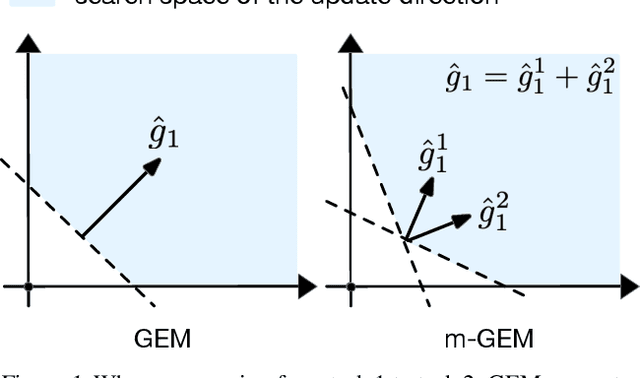
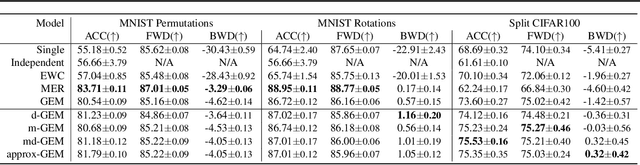
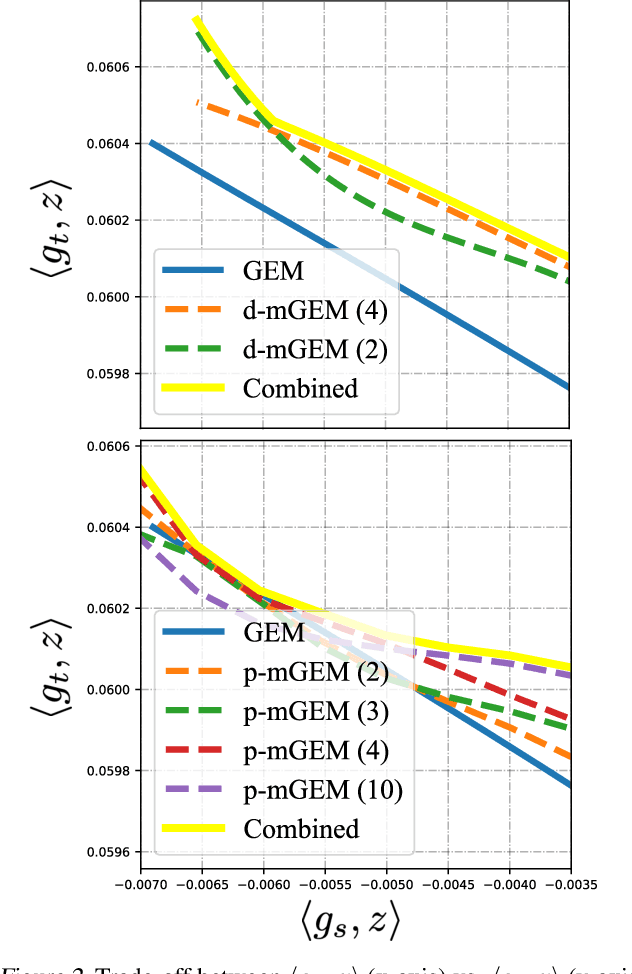
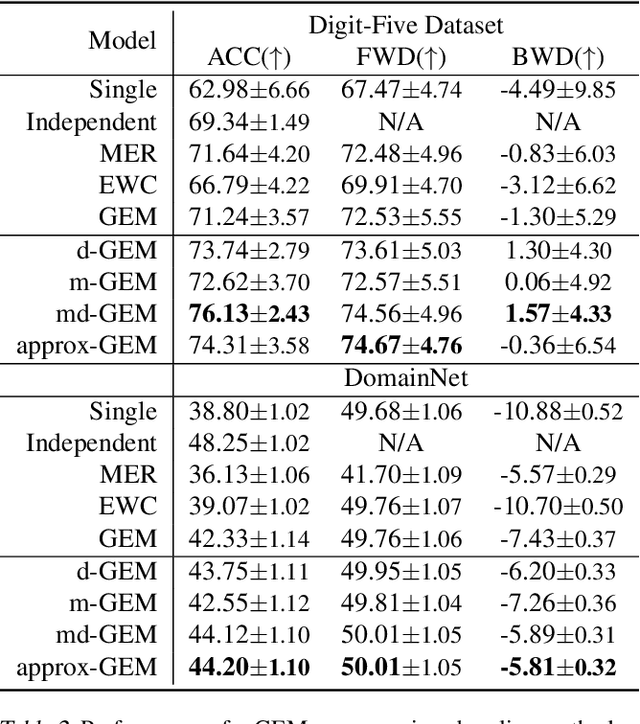
A fundamental challenge in continual learning is to balance the trade-off between learning new tasks and remembering the previously acquired knowledge. Gradient Episodic Memory (GEM) achieves this balance by utilizing a subset of past training samples to restrict the update direction of the model parameters. In this work, we start by analyzing an often overlooked hyper-parameter in GEM, the memory strength, which boosts the empirical performance by further constraining the update direction. We show that memory strength is effective mainly because it improves GEM's generalization ability and therefore leads to a more favorable trade-off. By this finding, we propose two approaches that more flexibly constrain the update direction. Our methods are able to achieve uniformly better Pareto Frontiers of remembering old and learning new knowledge than using memory strength. We further propose a computationally efficient method to approximately solve the optimization problem with more constraints.
Diversity-grounded Channel Prototypical Learning for Out-of-Distribution Intent Detection
Sep 17, 2024In the realm of task-oriented dialogue systems, a robust intent detection mechanism must effectively handle malformed utterances encountered in real-world scenarios. This study presents a novel fine-tuning framework for large language models (LLMs) aimed at enhancing in-distribution (ID) intent classification and out-of-distribution (OOD) intent detection, which utilizes semantic matching with prototypes derived from ID class names. By harnessing the highly distinguishable representations of LLMs, we construct semantic prototypes for each ID class using a diversity-grounded prompt tuning approach. We rigorously test our framework in a challenging OOD context, where ID and OOD classes are semantically close yet distinct, referred to as \emph{near} OOD detection. For a thorough assessment, we benchmark our method against the prevalent fine-tuning approaches. The experimental findings reveal that our method demonstrates superior performance in both few-shot ID intent classification and near-OOD intent detection tasks.